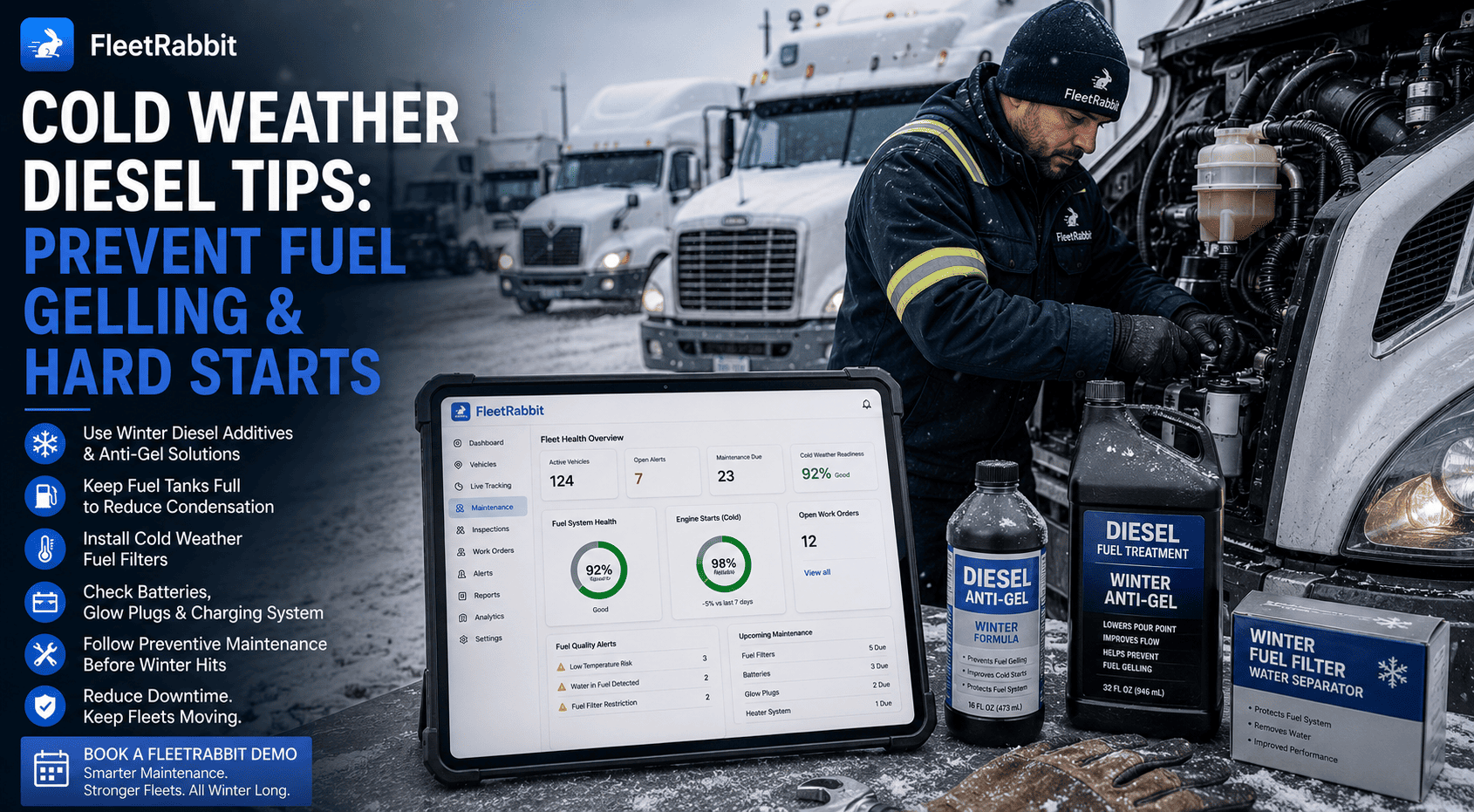
Diesel fuel additives represent one of the most debated maintenance investments for commercial fleet managers. While some products deliver measurable benefits for injector cleanliness, cetane improvement, and fuel stabilization, others provide minimal value despite marketing claims. Fleet Rabbit monitors fuel consumption patterns, engine diagnostics, and maintenance outcomes in real time to help fleets evaluate additive effectiveness through data—not anecdotes. Predictive analytics enable maintenance teams to identify which treatments actually improve fuel economy, reduce wear, or extend component life versus those that simply add cost without ROI. Start free trial or book a demo to deploy fuel intelligence monitoring across your diesel fleet today.
15–25%
Typical fuel spend recovery potential through systematic additive evaluation and targeted interventions
$1,000–$3,600
Annual additive cost per truck when used without performance verification
5–7%
Average fuel economy improvement from validated injector cleaning additives
8–12 hrs
Quarterly administrative time saved through automated fuel performance reporting
Diesel Additive Decisions Impact Fleet Costs. Fleet Rabbit Helps You Choose Based on Data, Not Claims.
Fleet Rabbit connects to existing telematics and fuel card systems to capture consumption data, engine diagnostics, and maintenance outcomes in a centralized dashboard—enabling evidence-based additive selection without hardware replacement or operational disruption.
The Hidden Cost of Unverified Additive Use in Commercial Fleets
Before investing in fuel treatments, it is important to understand where additive spending typically delivers value versus waste in commercial truck operations. Manual tracking and anecdotal decision making leave significant performance patterns unaddressed—patterns that structured analytics can help identify and optimize.
Additive Spending Without Performance Verification
Fleets often adopt additives based on vendor claims or peer recommendations without measuring actual impact on fuel economy, emissions, or component wear. Costs accumulate while benefits remain unverified.
Injector Cleaners That Don't Address Root Causes
Some injector cleaners remove surface deposits but cannot repair worn nozzles or damaged solenoids. Using cleaning additives on mechanically failed injectors wastes money and delays necessary repairs.
Cetane Boosters With Minimal Real-World Impact
While cetane improvement can enhance cold starting and combustion smoothness, many commercial diesel engines already operate near optimal cetane levels. Additional boosts may provide negligible performance gains relative to cost.
Fuel Stabilizers for High-Turnover Fleets
Stabilizers prevent fuel degradation during long-term storage, but high-utilization fleets with rapid fuel turnover rarely benefit. Using stabilizers unnecessarily adds cost without measurable protection.
Which Diesel Fuel Additives Actually Work for Commercial Fleets
Fleet Rabbit's AI analyzes fuel consumption data, engine diagnostics, and maintenance outcomes to identify which additive categories deliver measurable ROI. Understanding these distinctions enables targeted investments that improve performance and control costs.
01
Injector Cleaners: Effective for Deposit Removal
Quality injector cleaners can restore spray patterns in deposit-fouled injectors. Fleet Rabbit correlates fuel trim data and MPG trends to verify cleaning effectiveness before recommending continued use.
02
Cetane Boosters: Situational Value for Cold Climates
Cetane improvement enhances cold starting and combustion smoothness in low-temperature operations. Fleet Rabbit tracks start-time metrics and idle quality to quantify benefits for specific routes and seasons.
03
Fuel Stabilizers: Essential for Stored Equipment
Stabilizers prevent oxidation and microbial growth in fuel during extended storage. Fleet Rabbit flags low-utilization assets requiring stabilization versus high-turnover vehicles where additives provide minimal value.
04
Lubricity Enhancers: Critical for ULSD Compatibility
Ultra-low sulfur diesel has reduced natural lubricity, increasing wear on fuel pumps and injectors. Fleet Rabbit monitors fuel system diagnostics to identify vehicles benefiting from lubricity additives.
05
Water Separators and Demulsifiers
Water contamination causes injector corrosion and microbial growth. Fleet Rabbit correlates fuel filter change frequency with moisture detection to validate demulsifier effectiveness.
06
Anti-Gel Additives for Winter Operations
Cold flow improvers prevent wax crystallization in low temperatures. Fleet Rabbit tracks cold-start performance and fuel filter restrictions to optimize anti-gel usage by region and season.
How Fleet Rabbit Supports Data-Driven Additive Decisions
Fleet Rabbit integrates with existing telematics, fuel cards, and diagnostic systems to provide structured fuel performance analytics without requiring hardware replacement. Data is captured at source and presented in actionable formats for operations teams. See a live demo focused on additive evaluation, fuel efficiency tracking, and maintenance optimization.
07
Real-Time Fuel Performance Monitoring
Tracks MPG, fuel trim, and engine diagnostics by vehicle and additive regimen. Detects anomalies that indicate treatment effectiveness or emerging issues requiring intervention.
08
Additive ROI Scoring and Benchmarking
AI models analyze historical data to score additive effectiveness by vehicle type, route, and operating conditions. Recommendations include confidence levels and expected cost savings per treatment.
09
Maintenance Outcome Correlation
Links additive usage to injector replacement intervals, fuel filter life, and emissions test results. Enables evidence-based decisions about which treatments extend component life.
10
Automated Reporting and Compliance Documentation
Generates additive usage reports, performance summaries, and cost-benefit analyses formatted for management review and regulatory submissions.
Regulatory Framework Support for Fuel Treatment Documentation
Fleet Rabbit supports compliance documentation for fuel-related regulatory requirements commonly faced by commercial trucking operations.
EPA Emissions Compliance
Fuel additive usage and emissions test results structured to support regulatory submissions and inspection readiness with timestamped documentation.
Warranty Claim Support
Complete additive usage history and maintenance records formatted for manufacturer warranty claims, reducing denial risk for fuel system repairs.
FMCSA Recordkeeping
Digital DVIR and preventive maintenance logs linked to fuel treatment data, supporting audit requests with tamper-evident documentation.
ESG and Sustainability Reporting
Fuel consumption and emissions data structured to support Scope 1 calculations and sustainability disclosures with additive impact analysis.
Start Evaluating Additives. Identify What Actually Works for Your Fleet.
Fleet Rabbit's fixed-scope onboarding means no open timelines, no hardware installation, and no months of customization before you gain visibility. Deploy at $5/vehicle/month and begin monitoring within 72 hours.
Deployment Approach for Additive Performance Monitoring
Fleet Rabbit follows a structured onboarding process designed for dispersed fleet operations—delivering initial visibility within the first week and full feature activation within two weeks. No hardware installation required.
01
Asset and Data Audit
Map vehicles, fuel sources, and additive usage patterns
02
System Integration
Connect fuel cards and diagnostic APIs
03
Baseline Configuration
Set performance thresholds and alert parameters
04
Team Training
Onboard maintenance managers and procurement
05
Go-Live and Review
Activate monitoring and schedule check-in
Typical Timeline and Expected Outcomes
Every Fleet Rabbit engagement follows a defined onboarding sequence with measurable milestones. Results vary by fleet size, operating conditions, and intervention follow-through. Request the full onboarding scope document tailored to your fleet profile.
Days 1–3
Integration and Baseline
Connect fuel card accounts and diagnostic systems via API
Import historical fuel and maintenance data for baseline analysis
Configure performance thresholds and additive tracking parameters
Days 4–10
Pilot Monitoring
Activate fuel performance tracking on highest-mileage vehicle segments
Review initial additive usage patterns and efficiency trends with operations team
Identify quick-win opportunities such as overused or ineffective treatments
Days 11–14
Full Activation
Expand monitoring to full fleet with all configured parameters
Enable automated additive ROI reporting and compliance documentation
Schedule 30-day review to assess intervention effectiveness
REALISTIC EXPECTATIONS: MEASURABLE IMPROVEMENTS WITH CONSISTENT INTERVENTION
Fleets that systematically evaluate additive effectiveness—such as verifying injector cleaner impact on fuel economy or quantifying cetane booster benefits in cold climates—typically see cost optimization within the first 60–90 days. Results depend on operational follow-through and baseline conditions.
5–10%
Additive cost reduction
8–12%
Fuel economy improvement
15–20%
Maintenance cost avoidance
Use Cases from Diesel Fleet Additive Deployments
These examples reflect common scenarios where Fleet Rabbit has supported additive evaluation efforts. Outcomes depend on fleet size, operating conditions, and intervention consistency. Request additional details for the use case most relevant to your operations.
A regional carrier used multiple injector cleaners without measuring effectiveness. Fleet Rabbit's fuel trim analysis identified which products actually improved spray patterns and MPG. Administrative time for additive procurement was also reduced through automated performance reporting.
6–8%
Fuel economy improvement
10 hrs
Reporting time saved
Book a Demo
A northern operator sought to reduce cold-start issues and improve combustion smoothness. Fleet Rabbit's start-time and idle quality analysis highlighted which routes and seasons benefited from cetane boosters, enabling targeted usage that reduced additive costs by 30 percent while maintaining performance.
30%
Additive cost reduction
12%
Cold-start improvement
Book a Demo
An operator managing both high-utilization and stored equipment used stabilizers fleet-wide. Fleet Rabbit correlated fuel turnover rates with degradation indicators, enabling targeted stabilizer use only for low-utilization assets. This reduced additive spending by 40 percent while maintaining fuel quality for stored vehicles.
40%
Additive cost reduction
95%+
Fuel quality maintained
Book a Demo
What Fleet Teams Say About Fleet Rabbit
Fleet Rabbit helped us identify which fuel additives actually delivered value for our operation. The automated performance reports also cut our quarterly procurement review time significantly. It is a practical tool for evidence-based maintenance decisions.
Fleet Maintenance Manager
Regional Trucking Company
Frequently Asked Questions
Does Fleet Rabbit require new hardware to evaluate fuel additives?
No. Fleet Rabbit connects to existing fuel card providers, diagnostic systems, and telematics via API. Where gaps are identified during onboarding, targeted additions may be recommended—but full hardware replacement is not required.
Book a demo.
Which engine platforms does Fleet Rabbit support for additive evaluation?
Natively integrates with Cummins, Detroit Diesel, Paccar, Volvo, and other major commercial engine platforms via OEM diagnostic protocols. Integration scope is confirmed during the initial asset audit.
Book a demo.
How does Fleet Rabbit measure additive effectiveness?
AI models analyze fuel consumption trends, engine diagnostics, and maintenance outcomes before and after additive use. Recommendations include confidence levels and expected ROI for each treatment category.
Book a demo.
What reports can Fleet Rabbit generate for additive management?
Automated additive usage summaries, performance impact analyses, cost-benefit reports, and compliance documentation. All reports are exportable in standard formats for management review and audit readiness.
Book a demo.
How long does it take to see additive performance insights after onboarding?
Baseline fuel data is available within 3–5 days of integration. Performance trends and additive impact analysis begin populating as vehicles operate. Meaningful trend analysis typically requires 2–4 weeks of data.
Book a demo.
Can Fleet Rabbit scale with fleet growth?
Yes—from 10 to 10,000+ vehicles. Add vehicles, locations, and users without re-implementation. Pricing is $5/vehicle/month with no volume minimums.
Book a demo.
Evaluate Additives. Optimize Spending. Improve Performance in Two Weeks.
Fleet Rabbit provides commercial trucking teams with real-time fuel performance analytics, additive ROI scoring, automated reporting, and compliance documentation—integrated with existing telematics in 5–7 working days, at $5/vehicle/month, with no new hardware required.
Fuel performance tracking via OEM diagnostic APIs
Additive ROI scoring with confidence levels
Automated performance reports and compliance documentation
Offline-capable mobile apps for remote operations
May 22, 2026By John Polus
All Blogs