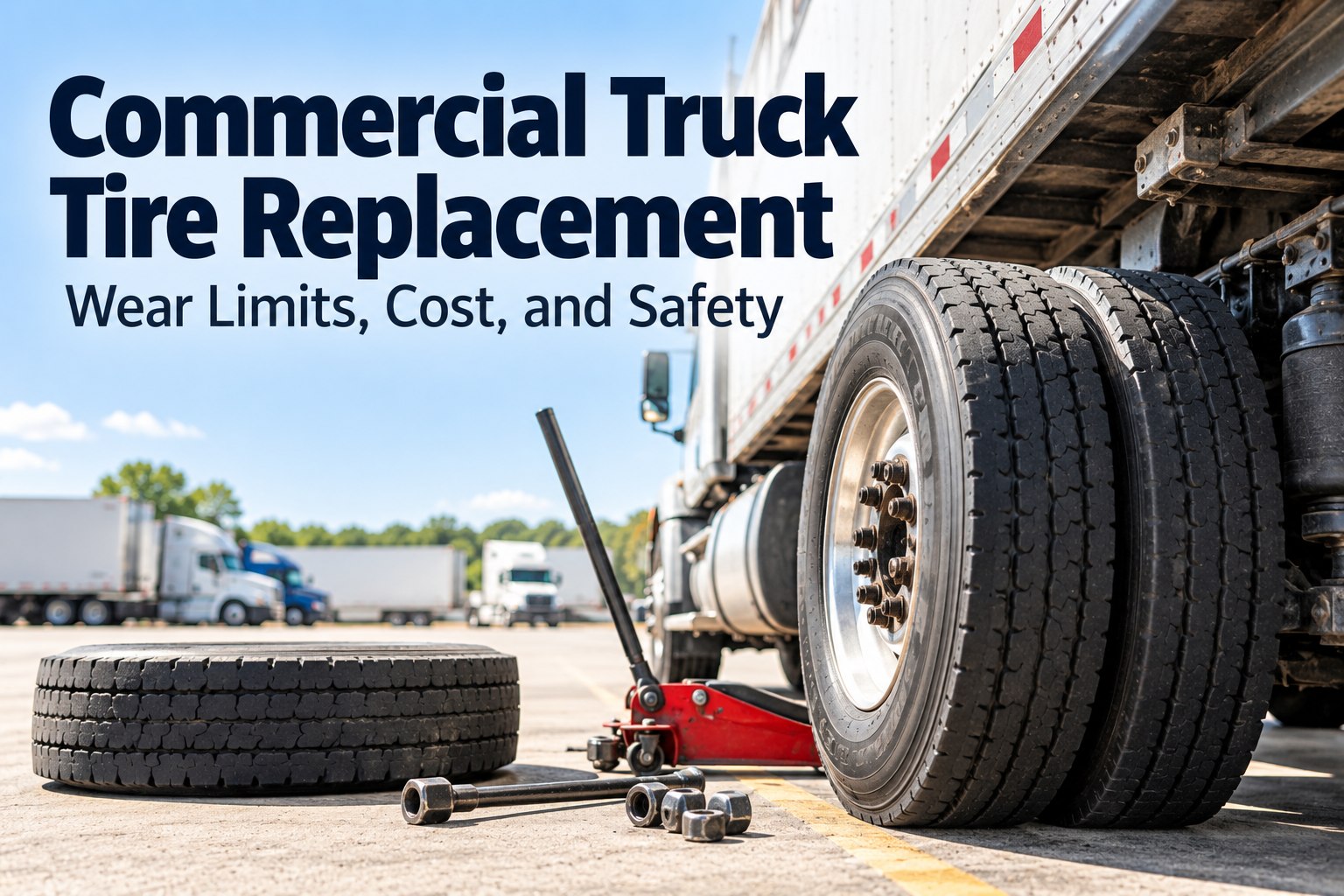
Commercial truck tires have two replacement points, and confusing them is expensive in both directions. The legal floor is set by 49 CFR 393.75: at least 4/32 of an inch of tread in a major groove on the front wheels of trucks, truck tractors and buses, and at least 2/32 on every other tire — measured at any point in a major groove, excluding tie bars, humps and fillets. The economic pull point comes earlier, because a casing pulled with tread still on it can be retreaded while one run to the cords cannot. Getting this right matters more than any other maintenance decision on the vehicle: in TMC and FleetNet America's roadside breakdown benchmarking, tires rank first among the systems causing unscheduled road calls, with tire and wheel work reaching 69% of repairs by reporting-standard system in one quarter and tire issues rising 25% over the hotter summer months. This guide covers the legal limits, the wear patterns that tell you what is actually wrong, the replace-repair-retread decision, inflation, and what each path costs. Book a 30-minute demo to see tread depth tracked by wheel position, or start free with 3 vehicles.
The Tire Tells You What's Wrong With the Truck. Most Fleets Only Read It as a Number.
For fleet mechanics, shop leads and maintenance managers: the federal tread limits, the wear patterns that name the real fault, and when to replace, repair or retread.
Tread minimums per 49 CFR 393.75. The pull point is a fleet policy decision, not a regulation.
The lawWhat 49 CFR 393.75 Actually Requires of a Commercial Truck Tire
Tread depth is the part everyone knows; the rest of the rule catches trucks just as often. Note that two of these conditions are absolute — a flat tire or an audible leak, and exposed ply or belt material — and neither depends on how much tread is left. Record tread readings and condition per position on a free account. Swipe the table on mobile.
| Requirement | What the rule says | Note |
|---|---|---|
| Flat tire or audible leak | No vehicle may be operated on a tire that is flat or has an audible leak | Out of service |
| Exposed ply or belt material | Through tread or sidewall separation | Out of service |
| Front wheels of trucks, tractors and buses | At least 4/32 in. in a major tread groove, at any point | Measured excluding tie bars, humps and fillets |
| All other tires | At least 2/32 in. in a major tread groove | Same measurement rule applies |
| Regrooved tires on front wheels | Prohibited on trucks and truck tractors where load capacity is 2,232 kg or greater | Buses: no regrooved, recapped or retreaded on front wheels |
| Load rating | No tire may carry weight above its sidewall marking or the maker's specification | Check both when spec'ing |
| Cold inflation pressure | Must not be less than that specified for the load being carried | Heat-induced increases are corrected out, not counted |
| Speed-restricted tires | Tires marked 55 mph or less must not be run above that rating | Check the sidewall on specialty tires |
Source: 49 CFR 393.75, Tires, current text on the eCFR. Confirm against the current rule and the CVSA out-of-service criteria for enforcement thresholds.
Road call figures: TMC and FleetNet America roadside breakdown benchmarking, as reported by Heavy Duty Trucking. Out-of-service share: CVSA 2025 International Roadcheck results.
Read the tireSteer Tire Wear Patterns and the Fault Each One Names
A steer tire wearing unevenly is reporting on alignment, suspension and wheel-end condition — replacing it without reading it means the new tire wears the same way. These patterns and their causes come from Michelin's commercial tire wear reference. We'll map your own scrap tires to these patterns in a demo. Swipe the table on mobile.
| Pattern | What it indicates | Action | Disposition |
|---|---|---|---|
| One-sided wear | Alignment — camber, toe or axle parallelism | Check alignment, inspect worn parts | Run to minimum tread depth |
| Feathering at rib edges | Excessive toe, or counter-steering for drive axle misalignment | Check alignment | Rotate or retread |
| Diagonal wear patches | Misalignment, runout, imbalance, loose bearings, worn steering parts | Check for mismount and worn parts | Reverse direction or retread |
| Center depression | Overloading, underinflation, faulty shocks, loose bearings, fast empty running | Check pressure, load and worn parts | Continue, rotate or retread |
| Shoulder depression | Faulty shocks, lateral runout, loose bearings, mismount, imbalance | Check the mechanical causes | Continue, rotate or retread |
| Multiple flat spotting | Faulty shocks, loose bearings, balance, pressure or diameter mismatch | Check mechanical items and verify pressure | Continue or retread |
Not every pattern is a fault
Two common appearances on slow-wearing radials need no corrective action at all: shoulder step wear, a depression of the inside or outside shoulder rib, and erosion or river wear, the circumferential worn areas along the sides of the tread ribs. Both are normal in slow-wear operations, and tires showing them stay in service. Knowing which patterns are noise is what keeps a fleet from chasing alignment problems it doesn't have.
Read the tireDrive and Trailer Wear Patterns, Where Mismatch Does the Damage
On duals, the recurring theme is mismatch — pressures and diameters that don't agree across an assembly force one tire to carry more than its share and wear in a signature way. Suspension condition is the other half. Track paired pressures and depths per assembly, free. Swipe the tables on mobile.
Drive position
| Pattern | Indicates | Action | Disposition |
|---|---|---|---|
| Heel and toe wear | Mismatched pressure or tire diameters in a dual assembly | Review tire maintenance practice | Continue or change rotation direction |
| Cupping or alternate lug wear | Mismatched pressure or diameters, slow wear rates, poor suspension maintenance | Check components, pressures and matched tread depths | Inspect before it spreads |
| Cuts and chunking | Rough surfaces, or a compound misapplied to the duty cycle | Review tire selection for the route | Return to service or consult the retreader |
| Brake skid damage | New brakes, an unbalanced system, frozen lines, or hard braking | Check the brake system | Retread if the casing is sound |
| Stone retention | Gravel operation; overinflation can contribute | Remove stones, hold correct pressure | Continue unless steel cable is exposed |
Trailer position
| Pattern | Indicates | Action | Disposition |
|---|---|---|---|
| Intermediate depression | Worn suspension, mismatched dual diameters or pressures, underinflation, bearing adjustment | Diagnose and correct the mechanical cause | Run to pull point, then retread |
| Diagonal flat spots | Bearing adjustment, misalignment, diameter or pressure mismatch | Identify and correct the cause | Reverse rotation, or retread if excessive |
| Shoulder step wear over 12 in. | Excessive camber, a misaligned or damaged axle, bearing adjustment | Correct the misalignment | Reverse rotation, or retread if excessive |
| Shoulder depression under 12 in. | Improper pressure or mismount, wheel-end imbalance | Review tire and wheel-end maintenance | Run to pull point, then retread |
| Cupping or scallop wear | Mismatched pressure or diameters, fast running light, poor suspension maintenance | Check components, pressures and tread depths | Run to pull point, then retread |
Wear patterns, causes and dispositions summarized from Michelin Commercial Tires' irregular wear reference. Always confirm disposition with your retreader before scrapping a casing.
Your Scrap Tires Are a Diagnostic Report Nobody Has Read Yet
Bring photos of your last ten pulled tires with their positions. We'll match each wear pattern to its likely cause, show which units keep producing the same pattern, and set up tread depth tracking per wheel position so the next one gets caught at the pull point instead of the roadside.
The decisionReplace, Repair or Retread — Choosing Between the Three
Most tires have more than one possible ending, and the casing decides. A sound casing pulled at the right depth is an asset; one run into the belts is scrap. Make this an explicit rule rather than a judgment call at the tire rack. We'll turn this into your disposition policy in a demo.
Repairs belong within the repairable area and to the industry limits your tire supplier specifies. A tire run flat, or one with exposed ply or belt material, is not a repair candidate.
Ask the supplier before committingThe Michelin dispositions above list retread as the outcome for many wear patterns, which only holds if the tire came off before the pattern destroyed the casing. Pull point discipline is what preserves that option.
Depends entirely on the pull pointExposed ply or belt material, a flat or audible leak, sidewall separation, or tread below the federal minimum for that position. Replacement is not a judgment call in these cases.
No discretion involvedInflationWhy Cold Inflation Pressure Is the Number That Governs Everything Else
Pressure sits behind more wear patterns than any other single variable — center depression, cupping, heel and toe, intermediate depression all list it among their causes. The rule is specific about how it is judged: cold inflation pressure must not be less than that specified for the load being carried, and heat-induced pressure increases are corrected out rather than counted in your favor. Put pressure checks on the daily record, free.
A tire checked after a run reads high. The rule is written around cold pressure for the load, which is why yard checks beat roadside ones.
Mismatched pressures inside an assembly are the named cause of heel and toe, cupping and several depression patterns.
Two tires at the same pressure but different worn diameters still fight each other. Pair by measured depth, not by age.
Pressure is specified against the weight being carried, so a fleet running mixed loads needs a policy per configuration, not one number on a wall.
CostWhat the Same Tire Costs at Four Different Moments
The tire price barely moves; everything around it does. A casing pulled at the yard is an asset with a second life, and the same tire failing on a shoulder is a road call, a tow risk and a delivery window. Industry benchmarking puts unplanned downtime at roughly $448 to $760 per truck per day before towing and repair, and ATRI puts 2025 repair and maintenance cost at $0.215 per mile, up 8.6%. Estimate your own exposure with our team.
Relative cost by where the tire comes off, illustrative — not prices. Downtime benchmark: FleetNet America and ATA's Technology & Maintenance Council via industry reporting; per-mile cost: ATRI.
The programWhat to Check Daily, at Every PM, and Every Quarter
Tire management is mostly measurement discipline, and it fails when the readings live on paper that nobody compares. Put the daily checks on the inspection report and the measured ones into preventive maintenance so each reading joins a history. Set the schedule free on 3 vehicles.
Visible damage, obvious low tires, anything flat or audibly leaking, debris lodged in the tread, valve caps present.
Cold pressures against the load specification, matched across every dual. A thumping tire test is not a pressure check.
Measured in a major groove at each wheel position and recorded, plus a wear pattern note on anything irregular.
Group the wear patterns by unit and position. Repeats on one position point at alignment, suspension or a wheel end, not at the tire.
MeasureThe Tire Program Numbers That Predict Your Next Road Call
Four measures turn tire spend from a line item into something you can act on before it becomes a breakdown. Start tracking them free.
QuestionsCommercial Truck Tire Questions Fleet Managers Ask Most
What is the legal minimum tread depth on a commercial truck?
At least 4/32 of an inch in a major tread groove on the front wheels of trucks, truck tractors and buses, and at least 2/32 on all other tires, measured at any point in a major groove and excluding tie bars, humps and fillets, per 49 CFR 393.75. See depths tracked per position.
When should we actually pull a tire?
Before the legal minimum. A pull point set above 4/32 and 2/32 protects the casing so the tire can be retreaded rather than scrapped, which is where most of the recoverable value sits. Set your pull point free on 3 vehicles.
What causes uneven tire wear on a truck?
It depends on the pattern. One-sided wear and feathering point at alignment; center or intermediate depression at pressure and load; cupping, heel and toe at mismatched pressures or diameters in a dual; diagonal wear and flat spotting at bearings, balance, runout and shocks. Map your own patterns with us.
Can a truck tire be repaired instead of replaced?
Sometimes, within the repairable area and the limits your tire supplier specifies. A tire run flat, or one with exposed ply or belt material or sidewall separation, is not a repair candidate — and those conditions put the vehicle out of service regardless of tread. Record dispositions per casing free.
Are retreads allowed on steer tires?
Buses may not run regrooved, recapped or retreaded tires on the front wheels, and regrooved tires are prohibited on the front wheels of trucks and truck tractors where load capacity is 2,232 kg or greater. Check the rule against your configuration. Review your tire policy with our team.
How often should pressures be checked?
Often enough to catch a slow leak before it damages the casing — weekly with a gauge on cold tires is a common fleet standard, matched across every dual. A cold reading against the load specification is what the rule is written around. Put it on the weekly checklist free.
Catch the Tire at the Pull Point, Not on the Shoulder
FleetRabbit records tread depth, pressure and wear pattern by wheel position, flags the positions that keep producing the same pattern, and turns a driver's tire report into a work order with that position's full history attached.
No credit card required. Start with your next PM.