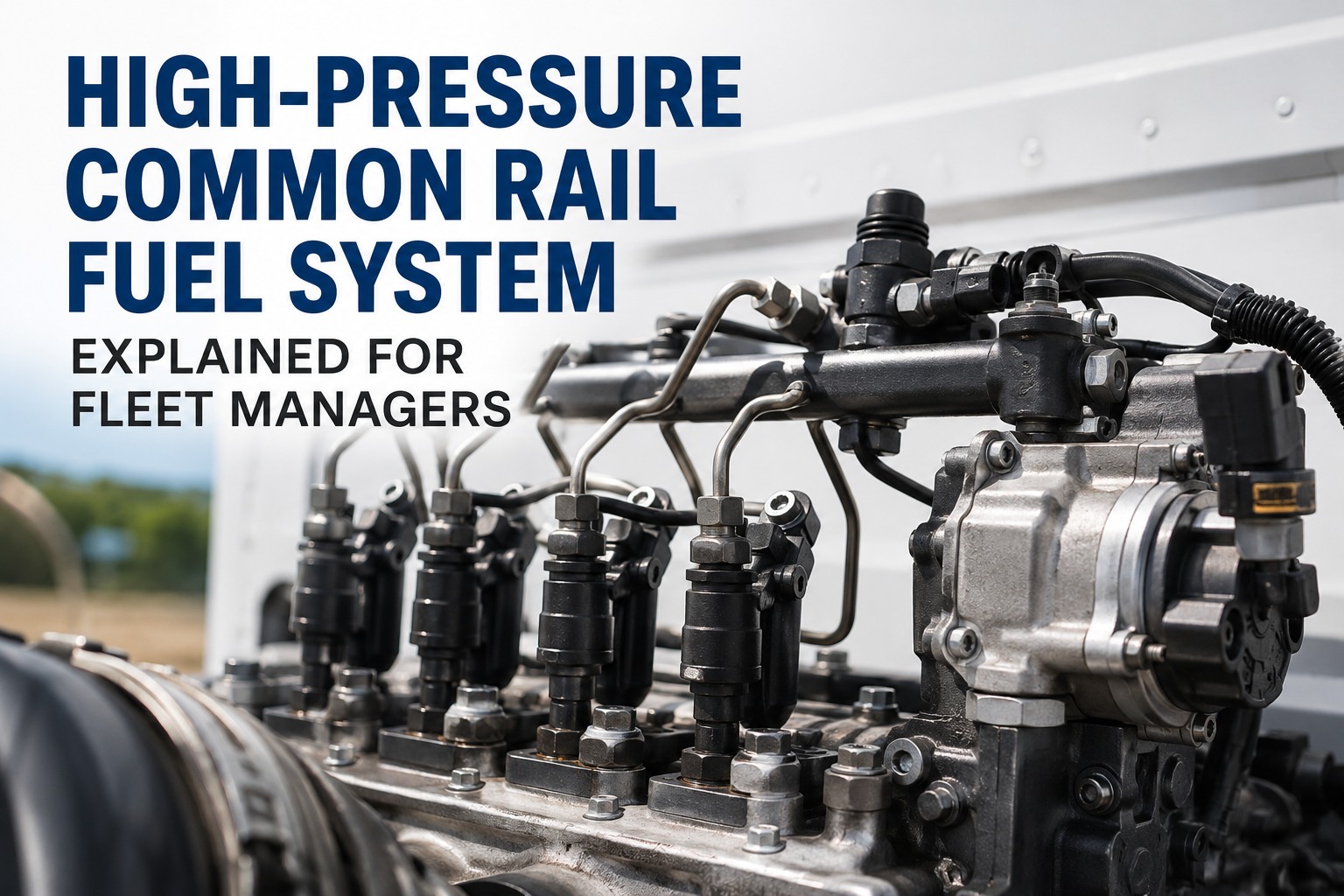
Every modern diesel in your fleet runs on a high-pressure common rail system, and understanding how it actually works changes how you maintain it. The defining idea is deceptively simple: instead of a mechanical pump timing each injection, an HPCR system stores fuel in a shared accumulator — the rail — at pressures exceeding 30,000 PSI, and lets the ECU fire each injector electronically, independent of engine speed. That decoupling is what enables five to seven separate injection events per combustion cycle, better fuel economy, and modern emissions compliance. It also means the entire system depends on precision components running at extreme pressure with microscopic tolerances, lubricated by the diesel itself — which is exactly why fuel quality and filtration matter so much more than they did on older mechanical systems. This guide walks fleet managers through how the system works component by component, why each part fails, and what to track in maintenance software to extend injector and pump life across the fleet. Start free trial or book a demo to track the fuel-system data that keeps HPCR components alive.
DIAGNOSTICS & REPAIR · SYSTEM ARCHITECTURE
The Rail Decouples Pressure From Timing — That's the Whole Idea
On older diesels, the pump made pressure and set timing at the same time. Common rail splits those jobs: the pump builds pressure into a shared accumulator, and the ECU decides independently when and how long each injector fires. Everything good about modern diesels — and everything fragile — follows from that.
RAIL PRESSURE
30,000
PSI and above
Some systems reach 2,500 bar — over 36,000 PSI — with tolerances measured in microns
5–7
Separate injection events per combustion cycle
7
Core components that make the system function
60M+
Bosch CP4 pumps produced globally to date
100%
Fuel-lubricated — the diesel is the pump's only lubricant
How Fuel Actually Moves Through the System
An HPCR system is a chain, and every link has a failure mode. Following the fuel from tank to cylinder is the fastest way to understand both how it works and where it breaks.
1
Low-Pressure Supply
A lift pump draws diesel from the tank and delivers it to the injection pump through the filters and water separator. Its only job is consistent supply — the pressure here has no direct effect on what leaves the injector nozzle.
Fails as: hard starting, power loss, low rail pressure codes
↓
2
High-Pressure Pump (CP3 / CP4)
A radial-piston pump driven by belts, chains, or cogwheels compresses fuel to rail pressure. A metering unit, commanded electrically by the ECU, supplies the pump only the fuel volume actually needed. This pump is lubricated by the fuel itself.
Fails as: pressure codes, whining, metal contamination on CP4
↓
3
The Rail (Accumulator)
A forged-steel accumulator stores pressurized fuel and dampens the pressure pulses created by the pump and by each injection event. An inline-six uses a single rail feeding all injectors; a V-configuration engine uses two, one per bank.
Fails as: pressure instability, leaks at high-pressure fittings
↓
4
Injectors, Fired by the ECU
Solenoid or piezoelectric injectors switch rail pressure to the nozzle on command. Because pressure is already waiting in the rail, the ECU controls timing, duration, and the number of events freely — enabling pilot, main, and post injections in one cycle.
Fails as: rough idle, smoke, misfires, balance-rate codes
↓
5
Return Circuit
Fuel not injected flows back to the tank through a low-pressure return line. This circuit doubles as a cooling loop, carrying heat away from the injectors and pump — which is why excessive return flow is itself a diagnostic clue.
Fails as: excessive return flow, no-build pressure, hot fuel
The Closed Loop That Holds It All Together
A pressure sensor in the rail continuously reports actual pressure to the ECU, which compares it against commanded pressure and adjusts the pump's metering unit or the pressure control valve to close the gap. This closed-loop control is why a rail pressure fault code is so informative — it means measured pressure diverged from target far enough, and long enough, that the loop could not correct it. It is also why a lying pressure sensor can trigger codes on a mechanically healthy system.
Five components, one shared failure cause: fuel quality.
Fleet Rabbit tracks filter intervals, water-separator drains, fuel-system symptoms, and fault codes per truck — the exact inputs that determine how long HPCR pumps and injectors survive.
The Seven Core Components and What Kills Each One
Knowing which component does what turns a vague "fuel system problem" into a targeted diagnosis. Here is the full component list, each part's job, and its characteristic failure mode. Swipe the table horizontally on mobile.
← Swipe to see all columns →
i
Why HPCR systems are so unforgiving: the high-pressure pump is fuel-lubricated, meaning the diesel passing through it is the only thing standing between metal surfaces moving at extreme pressure. There is no separate oil supply. That single design fact is why fuel quality and filtration became dramatically more critical when the industry moved to common rail — a contaminated or low-lubricity fuel doesn't just dirty the system, it removes the pump's lubrication. Everything a fleet does to protect HPCR components traces back to keeping that fuel clean.
See how filter and fuel-quality tracking protects the pump.
The CP4 Question Every Fleet Manager Should Know
The Bosch CP4 — short for Common Rail Pump, 4th Generation — is the most discussed component in the diesel world, and for good reason. It's a proven, high-volume design with over 60 million units produced, but its tolerance for poor fuel is famously low, and its failure mode is uniquely destructive.
What It Is
A fuel-lubricated, camshaft-driven high-pressure pump with one or two high-pressure elements, each in its own housing. The camshaft is driven by belts, chains, or cogwheels and moves the pistons that generate rail pressure.
Where You'll Find It
Common heavy-duty applications include the 2011–2016 LML 6.6L Duramax, the 2011–2016 6.7L Power Stroke, and the 2019–2020 Ram 6.7L Cummins — after which Ram returned to a CP3 design. Not every Cummins used a CP4.
Why It Matters
Because it's fuel-lubricated and runs at extreme pressure, fuel quality and filtration are critical. When a CP4 fails, it can send metal debris downstream through rails, injectors, and lines — contaminating the entire system.
What to Do About It
Tag CP4-equipped trucks in your maintenance system, hold their filter intervals tightly, source quality fuel, and treat any pressure-fault pattern on those units as urgent rather than routine.
Track the Inputs That Decide How Long HPCR Components Last
Fleet Rabbit logs filter intervals, water-separator drains, fuel-system symptoms, and rail-pressure fault codes against every truck — and flags the patterns that predict pump and injector failure while repairs are still cheap. Deploy at $5/vehicle/month, no hardware, live within 72 hours.
Filter & separator scheduling
Rail-pressure code tracking
Platform tagging (CP3/CP4)
Fuel-trend anomaly alerts
What Fleet Managers Should Track in Maintenance Software
HPCR components fail from a small set of causes, and nearly all of them leave a trail in maintenance data long before the breakdown. These are the specific things worth tracking per truck. Swipe the table horizontally on mobile.
← Swipe to see all columns →
How Maintenance Software Extends Pump and Injector Life
Every HPCR failure mode traces back to something a maintenance system can see coming. Here's how Fleet Rabbit turns those signals into longer component life across the fleet.
01
Filter & Separator Scheduling
Usage-based fuel filter and water-separator services keep contamination away from a fuel-lubricated pump — the single highest-leverage thing a fleet can do for HPCR life.
02
Rail-Pressure Code Tracking
Pressure fault codes are logged against the VIN with timestamps, so a recurring pattern on one truck — or across several — surfaces as a trend rather than a series of isolated events.
03
Platform Tagging
Tag each truck by pump platform so CP4-equipped units automatically get tighter filter intervals and faster escalation on any pressure-fault pattern.
04
Fuel-Trend Anomaly Alerts
Degrading injector spray patterns show up as fuel-per-mile drift long before a code sets, and trend alerts catch it against each truck's own baseline.
05
Driver Symptom Capture
Hard starts, power loss, and rough idle get logged from the driver's phone the day they appear — the earliest and cheapest point in any HPCR failure curve.
06
Complete Fuel-System History
Every filter change, drain finding, code, and repair lives against the VIN, so a technician sees the full picture instead of diagnosing the same truck from scratch each time.
Frequently Asked Questions
What is a high-pressure common rail fuel system?
It's a diesel fuel injection architecture that stores pressurized fuel in a shared accumulator — the rail — and delivers it through electronically controlled injectors, independent of engine speed. A high-pressure pump compresses fuel to rail pressure, the rail acts as a hydraulic accumulator that dampens pressure pulses, and the ECU commands each injector to fire in precisely timed bursts. Decoupling pressure generation from the injection event is what gives the ECU full authority over timing, duration, and pressure.
Book a demo.
How much pressure does a common rail system run?
Rail pressure at the outlet of the high-pressure pump can exceed 30,000 PSI, and some systems reach 2,500 bar — over 36,000 PSI. That extreme pressure, combined with tolerances measured in microns, is what makes these systems so sensitive to contamination: a particle that would pass harmlessly through an older mechanical injection system can score precision surfaces in an HPCR pump or injector. It's also why the fuel filter is the most important cheap component on the truck.
Book a demo.
What's the difference between the CP3 and CP4 pump?
Both are Bosch radial-piston high-pressure pumps, but they differ in design robustness and failure behavior. The CP4 — Common Rail Pump, 4th Generation — is a highly successful design with over 60 million units produced, appearing in applications like the 2011–2016 LML 6.6L Duramax, 2011–2016 6.7L Power Stroke, and 2019–2020 Ram 6.7L Cummins. Its reputation comes from its low tolerance for poor fuel quality and its destructive failure mode, which can send metal debris through the whole system. Notably, Ram returned to a CP3 design after 2020.
Book a demo.
Why is fuel quality so much more critical on common rail engines?
Because the high-pressure pump is fuel-lubricated — the diesel flowing through it is the only lubricant between metal surfaces moving under extreme pressure. There's no separate oil supply. Contaminated or low-lubricity fuel therefore doesn't just introduce dirt, it removes the pump's lubrication, accelerating wear directly. Combine that with injector tolerances measured in microns and rail pressures above 30,000 PSI, and it becomes clear why filtration discipline matters far more than it did on older mechanical systems.
Book a demo.
Why do common rail engines fire multiple injections per cycle?
Because the pressure is already stored in the rail, the ECU can open an injector whenever it wants without waiting for a pump stroke. Modern systems use this freedom to execute five to seven separate injection events per combustion cycle — typically a pilot injection to soften combustion noise, a main injection for power, and post injections to manage emissions and aftertreatment. This is the core advantage of the architecture and the reason common rail replaced mechanical injection across the industry.
Book a demo.
What should fleet managers track to extend HPCR component life?
Track the inputs that determine contamination and lubrication: fuel filter intervals with install mileage, water-separator drain findings, rail-pressure fault codes, fuel-per-mile trends, driver symptom reports, the pump platform on each truck, and the fuel source per fill. Together these predict nearly every HPCR failure mode before it happens — filter restriction leading to pump wear, water destroying lubricity, pressure codes revealing supply problems, and a shared bad fuel source explaining why several trucks failed at once.
Book a demo.
Protect the Most Expensive System on Every Truck You Run.
Fleet Rabbit tracks the filter intervals, water findings, pressure codes, and fuel trends that decide how long HPCR pumps and injectors survive — and flags the patterns that predict failure while the repair is still a filter, not a fuel system. Integrated with your existing systems in 5–7 working days, at $5/vehicle/month, with no new hardware required.
Free tier for up to 3 vehicles · No credit card required · No hardware installation
July 22, 2026By Robert Chen
All Blogs