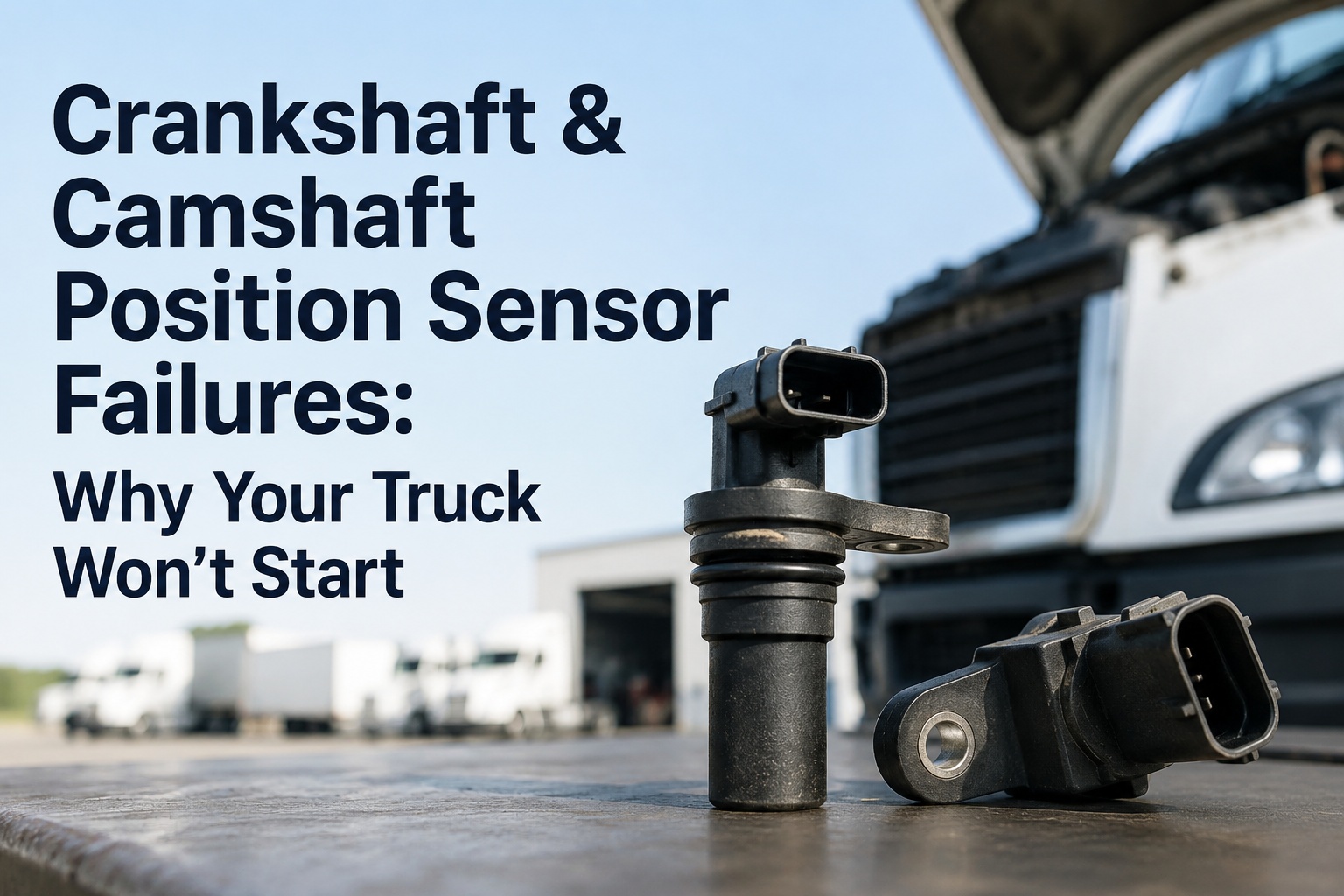
A truck that cranks but won't fire is one of the most expensive things a fleet can own for an afternoon, and the crankshaft and camshaft position sensors are among the most common reasons it happens. These two sensors tell the ECM exactly where the engine is in its rotation — without a valid signal the computer will not trigger the injectors at all, because guessing at timing would damage the engine. The good news is that a no-start caused by these sensors is one of the fastest faults to narrow down, and there is a single test that does most of the work: watch the tachometer while cranking. If it reads zero, you have a crank sensor problem. If it shows RPM and the engine still won't start, look at the cam sensor. This guide gives fleet teams the full triage — what each sensor does, how to tell P0335 from P0336 from P0340 from P0016, the platform-specific failure patterns on Duramax, Cummins, and Power Stroke engines, and how to document the repair so an intermittent fault doesn't come back to haunt the next technician. Start free trial or book a demo to document no-start diagnostics properly the first time.
DIAGNOSTICS & REPAIR · TIMING SENSORS
Cranks But Won't Start? Watch the Tachometer First.
One observation splits the diagnosis in half. If the tach reads zero RPM while cranking, the crank sensor signal is missing. If the tach shows RPM but the engine won't fire, the cam sensor is the likely culprit. Everything else follows from that.
0 RPM
Tach dead while cranking
↓
Crank sensor (CKP) is the primary fault
P0335
RPM shown
Tach reads but engine won't fire
↓
Cam sensor (CMP) is the likely culprit
P0340
Do Not Dispatch a Truck With an Active P0335
This is not a "finish the route" code. The engine can stall without warning at any moment — including in traffic — causing a sudden loss of power steering and braking assist, and it may then fail to restart and strand the truck. Stalling at idle and during steady highway cruise are the two most common failure points. Park it and diagnose it.
What Each Sensor Does — and Why Losing One Stops the Engine
The crank and cam sensors work as a pair. Together they give the ECM a complete picture of engine position, which is what makes precise injection timing possible. Understanding the division of labor explains why the failure symptoms differ.
CKP
Crankshaft Position Sensor
Reports the exact rotational position and speed of the crankshaft by reading teeth on a reluctor (tone) ring. This is the signal the ECM uses to know engine speed and when each piston reaches its position.
Lose it and: the ECM won't trigger the injectors at all — protecting the engine rather than guessing. Complete no-start, or sudden stalling if the failure is intermittent.
CMP
Camshaft Position Sensor
Identifies which cylinder is on its compression stroke, letting the ECM time the first injection event correctly and coordinate valve timing.
Lose it and: the ECM can't time the first injection, so the engine cranks longer before firing. Many engines will eventually start on the crank signal alone, with reduced power.
Reading the Codes: They're Not Interchangeable
Four codes in this family look similar and mean very different things. Confusing them sends you after the wrong component — and P0016 in particular points at mechanical timing, not a sensor at all. Swipe the table horizontally on mobile.
← Swipe to see all columns →
i
The relearn step nobody remembers. On some platforms, replacing a crankshaft position sensor requires a crank position variation relearn procedure afterward. Skip it and the truck sets P1336 — a fresh code immediately after a correct repair, which sends the next technician chasing a problem that doesn't exist. Building the relearn into the work order as a required step is a thirty-second addition that prevents a whole diagnostic cycle.
See how procedure steps attach to the work order.
The Intermittent Failure Pattern That Wastes the Most Time
A dead sensor is easy. The one that destroys shop hours is the sensor that works when cold and fails when hot — the truck strands a driver, gets towed in, and starts perfectly for the technician. Recognizing this pattern is what keeps it from repeating.
01
Runs Fine Cold, Dies Hot
The sensor becomes heat-sensitive and fails intermittently once the engine reaches operating temperature, then works again after cooling. Drivers describe it as "it dies, then starts again in twenty minutes."
02
Stalls at Idle or Steady Cruise
These are the two most common failure points — sitting at idle or holding highway speed. The engine dies suddenly, often restarting after a few attempts.
03
Extended Cranking Before It Fires
The engine eventually starts but takes noticeably longer than normal. On heavy-duty diesels this is the classic early cam-sensor complaint, weeks before an outright failure.
04
No Code Stored Yet
Intermittent faults may not set a code immediately, so a driver's stall report with a clean scan is not an all-clear — it's the earliest evidence you'll get.
"It stalled twice last week" is the most valuable sentence in this diagnosis.
Fleet Rabbit captures driver stall and hard-start reports the day they happen, so an intermittent heat-soak failure shows up as a documented pattern instead of a story nobody wrote down.
The Diagnostic Sequence
Work these in order. Most crank and cam faults resolve in the first four steps, and running them in sequence prevents the two classic mistakes: replacing a good sensor, and replacing a sensor when the reluctor ring or harness was the real problem.
1
Scan and Check Companion Codes
Confirm the code and look for companions. P0335 alongside P0340 tells a different story than either alone, and a P0016 correlation code redirects you to mechanical timing entirely.
2
Watch RPM While Cranking
The decisive early test. Zero or erratic RPM on the scan tool during cranking points at the crank sensor circuit; a normal reading with no start shifts focus to the cam side.
3
Inspect Wiring, Connector & Mounting
Look for wires melted against the exhaust, chafed against pulleys, or soaked in oil — a leaking cam cover gasket dripping onto CKP wiring causes intermittent faults that drive teams crazy. Check connector corrosion and that the sensor is seated and not cracked from over-torquing.
4
Wiggle Test the Harness While Cranking
The fastest way to catch an intermittent open. Flex the harness through its routing while someone cranks and watch for the signal to drop — this finds rub-through that a static inspection misses.
5
Check the Sensor Tip and Reluctor Ring
Magnetic debris on the sensor tip interferes with the signal, and missing or damaged teeth on the reluctor ring — or an incorrect air gap — produce a P0336-style erratic signal that no new sensor will fix.
6
Scope the Waveform, Then Resistance-Test
An oscilloscope showing the signal during cranking is the definitive check for a clean waveform. Follow with a resistance test compared against the OEM specification for the sensor.
7
Verify Battery and Charging Health
A weak battery or failing alternator can cause voltage droop on the sensor circuit, which the ECM may interpret as a sensor fault — especially under high-load cranking. Rule this out before condemning the sensor.
8
Check TSBs Before Ordering Parts
Manufacturers have issued service bulletins where the fix is a PCM reflash rather than a sensor, and out-of-date calibration data can flag a perfectly good sensor. Check before you buy — and remember the relearn procedure after replacement.
Document the No-Start Before the Truck Leaves the Bay
Fleet Rabbit records every code, test result, and driver stall report against the truck — so when an intermittent crank sensor comes back three weeks later, the next technician sees the wiggle test already passed, the harness was already inspected, and the sensor was already replaced. That's the difference between solving it and repeating it. Deploy at $5/vehicle/month, no hardware, live within 72 hours.
Driver stall reports
Diagnostic step logging
Relearn procedure reminders
Repeat-failure flags
Platform-Specific Failure Patterns
These sensors fail differently depending on the engine, and knowing your platform's weak point shortens the diagnosis considerably. Swipe the table horizontally on mobile.
← Swipe to see all columns →
Two things that look like a bad sensor but aren't. First, a stretched or misaligned timing component can cause the sensor to read an incorrect tooth count, producing a signal the ECM can't reconcile with expected engine position — the sensor is fine, the timing is not. Second, the ECM's own input stage for the crank sensor can develop internal faults, and outdated or corrupted calibration data can make it misread a perfectly good signal. Both of these produce codes identical to a failed sensor, which is exactly why the wiring check, the waveform, and the TSB search all come before the parts order.
Book a demo to keep the diagnostic trail with the truck.
How Fleet Software Prevents the Repeat Visit
Intermittent timing-sensor faults are the ones most likely to come back. Here's how Fleet Rabbit makes the second visit shorter than the first — or unnecessary.
01
Driver Stall & Hard-Start Reports
Drivers log stalls, long cranks, and no-starts from their phone the moment they happen — including the conditions, which is exactly the heat-soak evidence a technician needs when the truck starts fine in the bay.
02
Diagnostic Step Logging
Record which tests were actually run — wiggle test, waveform, reluctor inspection — so a returning fault starts from step five instead of step one.
03
Procedure Reminders on the Work Order
Attach the crank relearn requirement to the sensor replacement task so nobody skips it and creates a P1336 on an otherwise correct repair.
04
Repeat-Failure Flags
When the same code returns after a sensor was already replaced, the system flags it — pointing the technician toward wiring, the reluctor ring, or mechanical timing instead of a second identical part.
05
Platform Tagging
Tag each truck by engine so a P0335 on a Cummins ISX immediately surfaces the harness rub-through pattern, and one on a Duramax surfaces heat soak — before anyone starts guessing.
06
Complete Per-Truck History
Every code, repair, and part lives against the VIN, so the full timing-sensor history of the truck is one click away rather than scattered across three technicians' memories.
Frequently Asked Questions
How do I tell whether it's the crank sensor or the cam sensor?
Watch the tachometer or scan-tool RPM while cranking. If it reads zero, the crank sensor signal is missing and P0335 is your primary fault. If RPM registers normally but the engine still won't start, the cam sensor is the likely culprit and P0340 is the code to chase. This one observation resolves the majority of no-start diagnoses in under a minute, before any tools come out.
Book a demo.
Can I keep driving with a P0335 code?
No. The engine can stall without warning at any moment, which in traffic means a sudden loss of power steering and braking assist — a serious safety risk — and it may then fail to restart and strand the truck. Stalling at idle and during steady highway cruise are the most common failure points. Take the truck out of service and diagnose it rather than dispatching it.
Book a demo.
What's the difference between P0335 and P0336?
P0335 means a total loss of signal — the ECM receives nothing from the crank sensor, which usually points to a dead sensor or a broken wire. P0336 means the signal is present but erratic, which points instead to a damaged reluctor wheel or an incorrect air gap. That distinction matters enormously: with P0336 a brand-new sensor may not fix anything, because the problem is the toothed ring it's reading or how far it sits from it.
Book a demo.
Why does my truck only stall when it's hot?
That's the classic heat-soak failure pattern for a crank position sensor. The sensor works normally when cold and fails intermittently once the engine reaches operating temperature, then recovers after cooling — which is why the truck often starts perfectly by the time it reaches the shop. Duramax LB7, LMM, and LML engines are particularly known for this. The diagnostic implication is that you must test the truck fully warm, not just cold.
Book a demo.
I replaced the sensor and got a new code. What happened?
If it's P1336, the crank position variation relearn procedure was skipped after installation — a required step on some platforms that takes moments but sets a code if forgotten. If the original code returned instead, the sensor probably wasn't the fault: look at wiring rub-through and oil-soaked insulation, magnetic debris on the sensor tip, a damaged reluctor ring, weak battery voltage causing droop, or a TSB calling for a PCM reflash. A repeat code after a replacement is strong evidence the real fault is elsewhere.
Book a demo.
What does a P0016 code mean if the sensors are fine?
P0016 is a crank/cam correlation code, meaning both signals are present but out of sync with each other. That points to mechanical timing — commonly a jumped timing chain — rather than a sensor fault at all. Replacing either position sensor when P0016 is set fixes nothing and wastes the part. A stretched or misaligned timing component can also cause the sensor to read an incorrect tooth count, producing a signal the ECM can't reconcile.
Book a demo.
Diagnose the No-Start Once. Document It So It Stays Solved.
Fleet Rabbit captures driver stall reports the day they happen, records which diagnostic steps were performed, attaches relearn procedures to the work order, and flags repeat failures — so intermittent timing-sensor faults get solved at the root instead of returning three weeks later as a fresh mystery. Integrated with your existing systems in 5–7 working days, at $5/vehicle/month, with no new hardware required.
Free tier for up to 3 vehicles · No credit card required · No hardware installation
July 27, 2026By Emily Davis
All Blogs