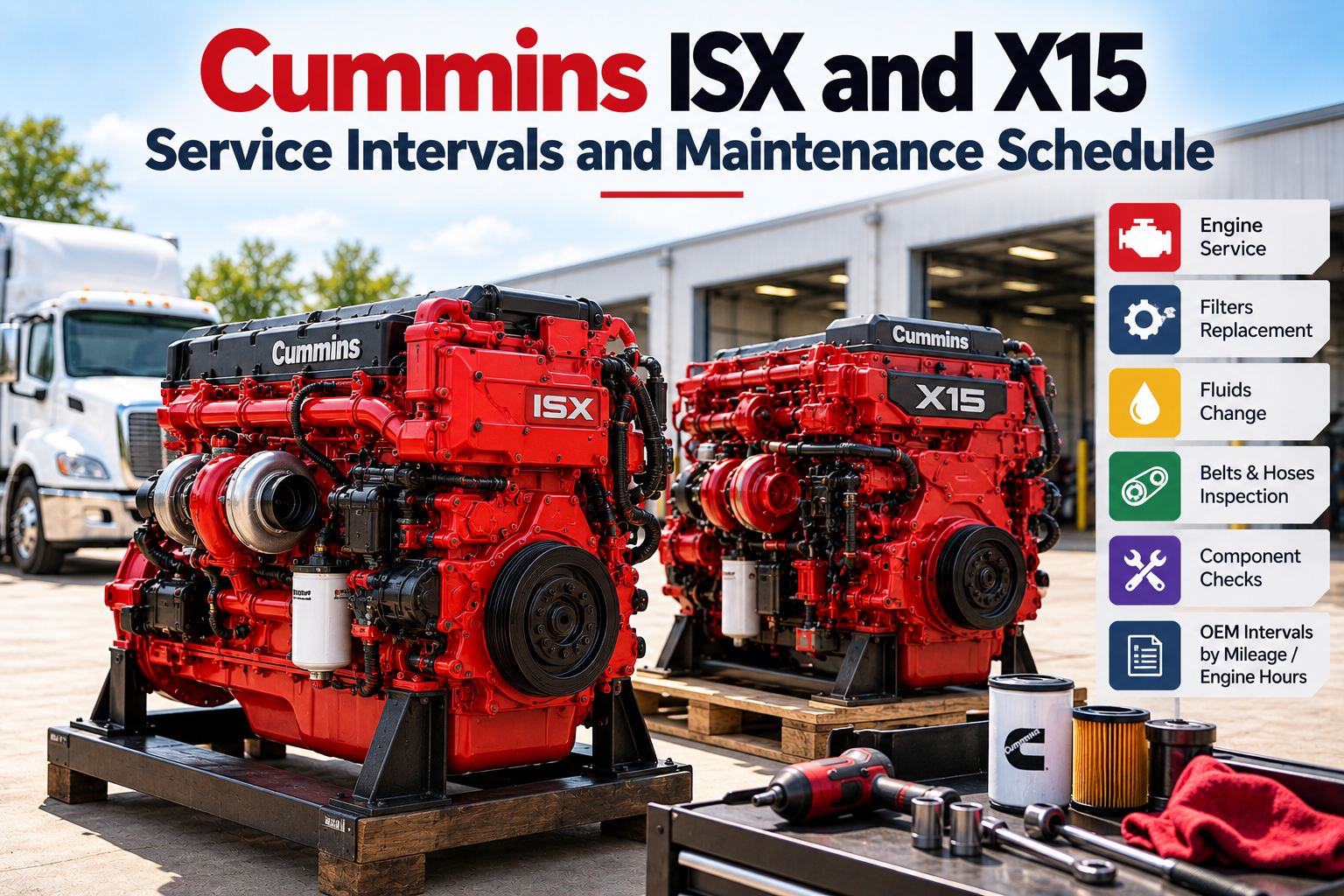
There is no single Cummins X15 service interval, and the reason is that the engine family has been through three published schedules. On the EPA 2013-era guide a light-duty unit ran 40,000 miles between oil changes. On EPA 2017 the same band ran 50,000. On EPA 2024 it runs 75,000 — nearly double the original figure on the same nameplate. The month cap doubled from 6 to 12 along the way, the hour cap halved and then became vocational-only, and at the latest generation the duty cycle bands themselves were redefined while two of the familiar names carried over. So a truck can change band without changing anything about how it runs. Model year is an input to the schedule, not a detail on the registration. Book a Cummins PM review.
The Same Engine, Three Schedules, 35,000 Miles Apart
What each emissions generation actually publishes, where the duty cycle bands moved underneath the names, which clocks changed, and the one interval that has stayed the same throughout.
Three Generations, Read Side by Side
Each guide stands on its own. Lined up, the direction of travel is obvious and the size of it is larger than most people assume.
Three bands: severe under 5.5 mpg at 20,000 miles, normal 5.5 to 6.5 at 30,000, light above 6.5 at 40,000. Every band capped at 1,000 hours and 6 months. DPF cleaning quoted at up to 200,000 miles. Oil change capacity 11.5 to 12 gallons depending on pan.
Same three band definitions, longer intervals: 25,000, 35,000 and 50,000 miles. The hour cap halves to 500. DPF becomes tiered by duty cycle, from 250,000 to 400,000 miles on severe up to 600,000 to 800,000 on light. OilGuard raises the oil interval to “up to 80,000 mi.”
Four bands on new definitions — 3 to 4.9, 5 to 5.9, 6 to 6.9 and 7-plus mpg — at 25,000, 50,000, 60,000 and 75,000 miles, with a separate 20,000 miles for vocational applications. The month cap doubles to 12. Hours now appear only on the vocational line.
The severe-duty band has moved very little — 20,000 to 25,000 miles across eleven years — while light duty has gone from 40,000 to 75,000. The spread widens as fuel economy improves, which means the risk of using the wrong generation's table is largest on your best-running trucks, and smallest on the ones working hardest.
Emissions generation is held against each unit, so the due point comes from the guide that actually applies to that engine rather than from whichever figure was entered when the fleet was set up.
Every Item, Across Every Generation
Oil is the headline, but almost everything else moved too. Swipe the table sideways on mobile.
| Item | EPA 2013 era | EPA 2017 | EPA 2024 |
|---|---|---|---|
| Duty cycle bands | 3 bands | 3 bands, same definitions | 4 bands, redefined |
| Severe duty oil drain | 20,000 mi | 25,000 mi | 25,000 mi |
| Normal duty oil drain | 30,000 mi | 35,000 mi | 60,000 mi |
| Light duty oil drain | 40,000 mi | 50,000 mi | 75,000 mi |
| Vocational line | Not stated separately | Not stated separately | 20,000 mi / 12 mo / 500 hrs |
| Hour cap | 1,000 hrs, all bands | 500 hrs, all bands | 500 hrs, vocational only |
| Month cap | 6 months | 6 months | 12 months |
| Fuel filter | 30,000–40,000 mi | 25,000–50,000 mi | 25,000–75,000 mi; extended type to 100,000 |
| DPF cleaning | Up to 200,000 mi | 250,000–800,000 mi by band | 250,000–800,000 mi by band |
| DEF filter | 300,000 mi / 6,750 hrs / 24 mo | 300,000 mi | 300,000 mi / 6,750 hrs |
| Overhead adjustment | 500,000 mi / 10,000 hrs / 60 mo | 500,000 mi / 10,000 hrs / 60 mo | 500,000 mi / 10,000 hrs / 60 mo |
The DPF line is the most dramatic. The earlier guide quoted cleaning at up to 200,000 miles flat; from EPA 2017 it becomes a duty-cycle range running as far as 800,000 miles. A fleet still planning ash cleaning around 200,000 miles on current engines is budgeting for work that may be three or four times further out than it needs to be.
Each item carries its own interval per generation, so the DPF, DEF filter and overhead all fall due on the correct figure for that engine instead of inheriting one number applied across the fleet.
The Band Names Stayed. The Definitions Did Not.
This is the subtle one, and it is the mistake most likely to be sitting in a maintenance system right now.
The EPA 2013 and EPA 2017 guides use identical bands: severe under 5.5 mpg, normal 5.5 to 6.5, light above 6.5. The EPA 2024 guide replaces them with four bands on new boundaries — 3 to 4.9, 5 to 5.9, 6 to 6.9 and 7-plus — and two of the names carry over. So a truck has not changed, but which band it belongs to may have.
| Measured economy | Older band | Older interval | EPA 2024 band | 2024 interval | What changed |
|---|---|---|---|---|---|
| 4.5 mpg | Severe | 25,000 mi | Severe (3–4.9) | 25,000 mi | No change |
| 5.2 mpg | Severe (<5.5) | 25,000 mi | Short haul (5–5.9) | 50,000 mi | Interval doubles |
| 5.7 mpg | Normal (5.5–6.5) | 35,000 mi | Short haul (5–5.9) | 50,000 mi | Band sounds worse, interval rises |
| 6.3 mpg | Normal (5.5–6.5) | 35,000 mi | Normal (6–6.9) | 60,000 mi | Same band name, +25,000 mi |
| 6.8 mpg | Light (>6.5) | 50,000 mi | Normal (6–6.9) | 60,000 mi | Demoted in name, longer interval |
| 7.4 mpg | Light (>6.5) | 50,000 mi | Light (7+) | 75,000 mi | Same band name, +25,000 mi |
Two rows are worth pausing on. A truck at 5.2 mpg was severe duty on the older table at 25,000 miles and is short haul on the newer one at 50,000 — the interval doubles. And a truck at 6.8 mpg moves from "light" to "normal", which sounds like a downgrade while the interval actually rises from 50,000 to 60,000. Reading across by band name rather than by generation gets both of these wrong.
The band is derived from measured economy against the correct generation's boundaries, so nobody has to remember which definition applied to which model year or notice that a name has been reused.
Which Cummins units are on the wrong table
If your PM interval was set once and applied across the fleet, the older engines are probably being run past interval and the newer ones serviced far too early — and with three generations in play the error can reach 35,000 miles. In thirty minutes we will sort your unit list by generation and measured economy onto the right schedules.
The Clocks Changed Character Too
Not just the mileage. The limits running alongside it were reshaped at each step, and they decide the outcome on low-mileage units.
On the EPA 2013-era guide every band carried a 1,000-hour cap and a 6-month cap. By EPA 2017 the hour cap had halved to 500 while the 6 months remained. On EPA 2024 the month cap doubles to 12 and hours appear only against the vocational line, at 500.
The practical effect depends entirely on the truck. A highway unit will hit mileage first on any of the three, so the change barely registers. A unit that idles, runs a power take-off, or covers little distance will hit hours or months first — and on the older guides it will do so roughly twice as often as the current table suggests. Anyone maintaining a mixed-age fleet from one remembered figure will be late on the older engines in exactly this situation.
All three limits run together on every unit. The work is raised by whichever arrives first, which on low-utilisation and PTO-heavy trucks is usually not the odometer.
The Conditions That Move You Off the Table
Two of them, pulling in opposite directions, and both easy to miss.
Downward: the current guide states that idle and power take-off time above 40% requires moving to the next lower interval tier. So a truck sitting comfortably in the 6 to 6.9 mpg band is not on 60,000 miles if more than two fifths of its engine time is stationary. It is on 50,000. That condition is invisible without idle share measured per unit.
Upward: oil monitoring can extend beyond the published figure. The EPA 2017 guide quotes OilGuard raising the drain to "up to 80,000 mi", and the current guide notes extended intervals are possible with its maintenance monitor. In both directions the principle is the same — the interval responds to measured conditions, and the fleet doing the measuring is the one that captures the benefit.
Note the asymmetry in how these should be treated. The idle condition is a requirement and applies whether or not you notice it. The monitoring extension is an option that has to be actively run, and taking the longer figure without the system behind it means carrying the risk without the evidence.
Idle and PTO share are tracked per unit and can demote a truck's tier automatically, while oil analysis results attached to the vehicle support an extended interval with the record to back it.
What Has Not Moved in Eleven Years
Worth knowing, because the stable items are the ones safe to schedule once and leave alone.
Overhead adjustment is published at 500,000 miles, 10,000 hours or 60 months on all three generations, unchanged. The DEF filter sits at 300,000 miles throughout, with 6,750 hours quoted alongside it on the guides that give hours. Those two are genuinely constant, and the 60-month and 24-month figures attached to them mean the calendar will usually arrive before the mileage on anything but a hard-running highway unit.
Oil capacity is worth checking per engine rather than assuming, because it varies by oil pan rather than by generation. The guides quote stamped steel and aluminium pans separately, with change capacities running from around 9 gallons at the low end to 12.5 at the high end. Ordering oil on a fleet average is how a shop ends up a gallon short on a Friday afternoon.
For the exact intervals on your own engines, the Cummins quick reference guide matching your engine's serial number and emissions certification is the authority, and your dealer can confirm which generation a given unit falls under. Everything here is drawn from the published guides and is not a substitute for the one that came with your engine.
How FleetRabbit Handles This
Four things, each aimed at a specific way a multi-generation Cummins fleet goes wrong on paper.
The guide that applies is decided by the engine's generation, so FleetRabbit holds it per unit and raises the work from the right table rather than from a fleet-wide default.
Because the 2024 definitions differ from the earlier ones, the same truck can belong to a differently named band. Measured mpg against the correct generation's bands settles it without anyone interpreting.
Miles, hours and months all moved between generations. Each interval carries its own set, and the job is raised on whichever arrives first.
An ISX-era unit and a current X15 on the same yard are on different schedules by several tens of thousands of miles. Both sit on one record with their own due points.
Questions Cummins Operators Ask
What is the oil change interval on a Cummins X15?
It depends on the emissions generation and your measured fuel economy. On the current guide it is 25,000 miles at 3 to 4.9 mpg, 50,000 at 5 to 5.9, 60,000 at 6 to 6.9 and 75,000 above 7, with 20,000 for vocational applications. On the EPA 2013-era guide the same engine family ran 20,000 to 40,000. Find your figure.
Is an ISX15 on the same schedule as an X15?
No, and the gap is substantial. The older guide's light-duty band was 40,000 miles against 75,000 on the current one. Running both on a single remembered interval leaves the older engines past due and the newer ones serviced far earlier than Cummins asks. Load Your Engine Data.
Our economy has not changed — why would the band change?
Because the boundaries moved. The older guides used under 5.5, 5.5 to 6.5 and above 6.5 mpg. The current one uses four bands at 3 to 4.9, 5 to 5.9, 6 to 6.9 and 7-plus. A truck at 6.8 mpg was "light" and is now "normal" without anything about the truck changing. Check your band.
Does heavy idling affect the interval?
Yes, and it is a requirement rather than a suggestion. Idle and PTO time above 40% moves you to the next lower tier, so a truck in the 6 to 6.9 band drops from 60,000 to 50,000 miles. It needs idle share measured per unit to be visible at all. Measure idle share.
Can we extend the drain interval?
Cummins provides for it through oil monitoring — the EPA 2017 guide quotes OilGuard at up to 80,000 miles, and the current guide allows extended intervals with its maintenance monitor. The condition is that you are actually running the monitoring, not simply adopting the longer number. Set up the evidence.
When does the DPF need ash cleaning?
On current engines Cummins publishes a duty-cycle range from 250,000 up to 800,000 miles. The EPA 2013-era guide quoted up to 200,000 flat, so a fleet still planning around that figure on newer engines is budgeting far too early. Plan the real window.
What can we schedule once and forget?
Overhead adjustment at 500,000 miles, 10,000 hours or 60 months is identical across all three generations, and the DEF filter sits at 300,000 miles throughout. On most fleets the 60-month and 24-month limits on those will arrive before the mileage does. Set the long cycles.
Can we run Cummins alongside other engine makes?
That is the normal case, and each make publishes its own ladder on its own logic. They belong on one maintenance record with per-unit intervals rather than in separate sheets that drift. Start Cummins Scheduling Free.
Schedule From the Right Table, Per Engine
FleetRabbit holds emissions generation, measured fuel economy and idle share against each unit, runs miles, hours and months together, and raises each item on the figure its own guide publishes — so an ISX-era truck and a current X15 can sit on the same yard without sharing a schedule neither of them should be on.
Free for 3 vehicles · no credit card required