def-fluid-quality-fleet-tracking

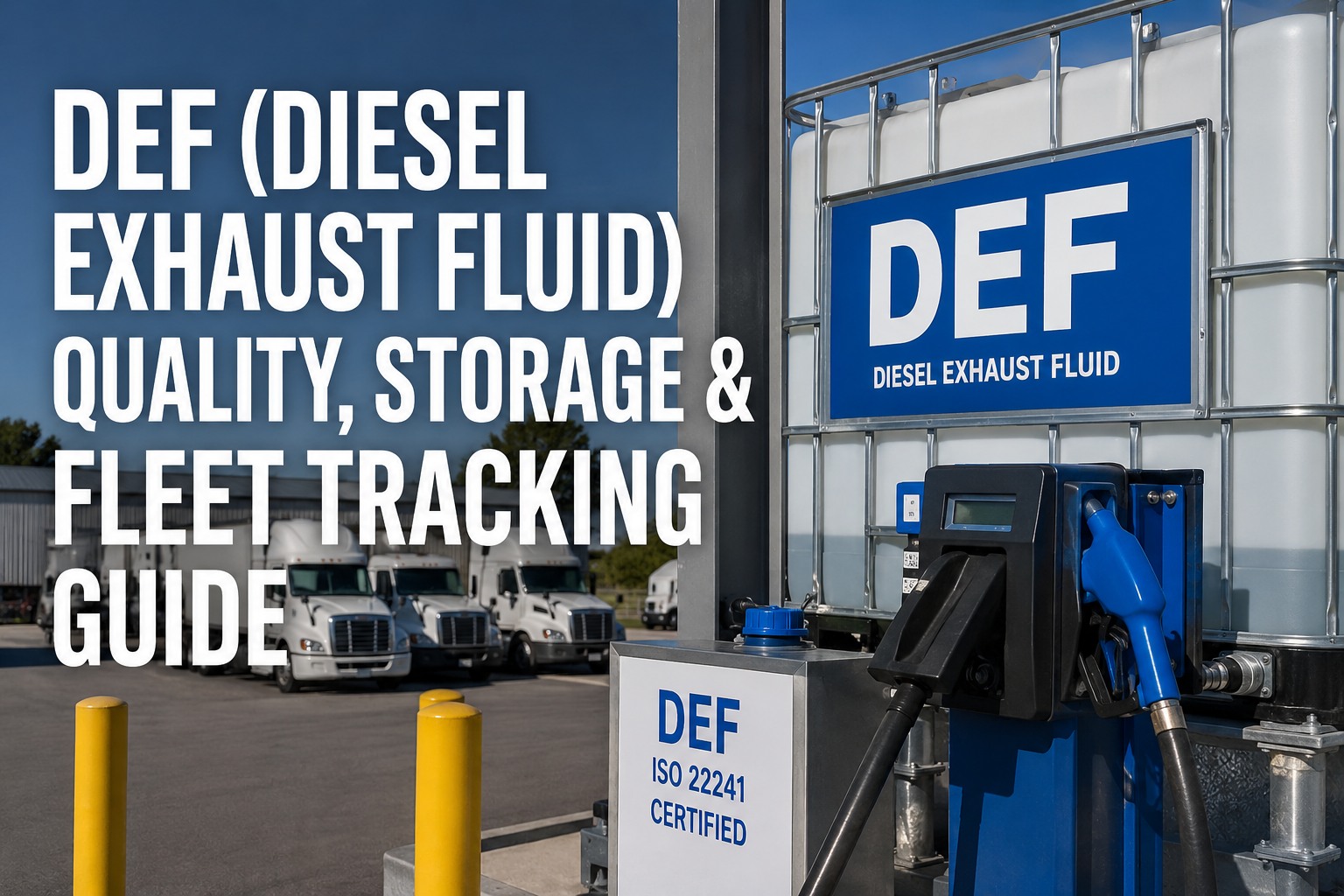
DEF (Diesel Exhaust Fluid) Quality, Storage & Fleet Tracking Guide

By Derek Goes on August 3, 2026

A single tank of bad Diesel Exhaust Fluid can put a truck on a hook. DEF contamination and quality faults are among the most common triggers of an SCR derate — the EPA-mandated power reduction that steps a modern diesel down to a 5 mph crawl and won't let it restart until a technician clears it. The frustrating part is that almost every DEF failure is preventable: it comes down to a fluid that's simple on paper — 32.5% high-purity urea in deionized water — but unforgiving about temperature, contamination, and age. This guide covers what the ISO 22241 quality standard actually requires, how DEF degrades in storage, the contamination signs that precede a derate, the escalating inducement stages that follow, and — the part most guides skip — how fleet software turns DEF from a roadside surprise into a tracked, predictable line item. Start a free trial or book a demo to see DEF and fluid tracking built into your fleet maintenance system.

PREVENTIVE MAINTENANCE · VEHICLE FLUIDS
DEF Quality, Storage & Fleet Tracking: The Complete Guide
Diesel Exhaust Fluid is simple chemistry with expensive consequences. Get the quality standards, storage rules, and contamination signs right — and track DEF in software before a quality fault derates a truck to 5 mph.
What DEF actually is
32.5%
high-purity urea
67.5%deionized water
ISO 22241the governing spec
Also called AUS 32 or AdBlue. The 32.5% ratio is the eutectic mix — the lowest possible freeze point at 12°F.
5 mph
the limp-mode speed a DEF quality fault ultimately forces
$4,500+
typical repair when off-spec DEF ruins the SCR catalyst
$800–1,500
per day in downtime while a derated truck sits
$25,000+
EPA tampering fine for bypassing the derate instead of fixing it

What ISO 22241 Actually Requires

DEF isn't just "urea and water" — it's a tightly specified chemical product. ISO 22241 defines the concentration and the maximum level of every impurity, because the SCR catalyst is engineered to work only within that window. Miss it, and conversion efficiency drops until the truck flags a fault. Swipe the table horizontally on mobile.

← Swipe to see all columns →
Property ISO 22241 Requirement Why It Matters
Urea concentration 32.5% target, 31.8–33.2% acceptable Outside this range, NOx conversion falls and the ECM flags a quality fault
Water 67.5%, deionized only Tap or mineral water adds contaminants that poison the catalyst
Biuret Maximum 0.3% A urea breakdown product that polymerizes and forms catalyst deposits
Aldehydes Maximum 5 mg/kg Contaminant from bad raw material that degrades SCR performance
Insoluble matter Maximum 20 mg/kg Particulate that blocks injectors and dosing systems
Trace metals Tightly limited (Ca, Fe, Cu, Zn, etc.) Even fertilizer-grade urea has metals that ruin a catalyst
!
The counterfeit trap: because DEF looks like clear water, off-spec or counterfeit fluid is impossible to spot by eye — and it causes irreversible catalyst damage that runs $4,500 or more to repair. Fertilizer-grade or "automotive urea" is not DEF; the trace metals that are harmless in a field will poison an SCR catalyst. Only fluid certified to ISO 22241 (look for API certification on the container) belongs in a DEF tank. See how batch and supplier tracking protects your fleet.

Five Things That Quietly Kill DEF in Storage

Good DEF goes bad in the yard, not on the truck. Every one of these storage failures degrades the fluid below spec before it's ever pumped — and each is fully preventable once you know what to watch.

1
Heat Above 86°F
Sustained storage above 86°F (30°C) decomposes urea into ammonia and biuret. It can cut shelf life from 2+ years of cool storage to under six months.
2
Direct Sunlight / UV
Ultraviolet light accelerates the breakdown of the urea solution. DEF must be stored out of direct sun — which is why proper DEF tanks and totes are opaque.
3
The Wrong Materials
DEF corrodes aluminum, copper, zinc, and brass, picking up metal contamination. Only stainless steel and HDPE are safe for tanks, lines, and nozzles.
4
Cross-Contamination
A funnel or nozzle that touched diesel, oil, or another chemical ruins a whole batch. ISO 22241-3 requires dedicated, DEF-only dispensing equipment.
5
Age & Forgotten Inventory
Even perfectly stored DEF has a 12–18 month shelf life (up to 24 in ideal cool, dark, sealed conditions). Drums that sit in the back of the yard past their date quietly drift out of spec — which is exactly the kind of thing that gets missed without a tracked first-in-first-out inventory.
The Storage Temperature Window
Below 12°FFreezes (slush). Chemically fine — returns to spec when thawed.
12°F – 86°FIdeal range. Longest shelf life, stable chemistry.
Above 86°FDegrades. Urea breaks down; shelf life collapses.
Good news on cold: freezing does not damage DEF. The freeze/thaw cycle is chemically reversible, so frozen DEF returns to full spec once it warms. Heat is the real enemy, not cold.

Reading the Warning Signs Before a Derate

A DEF quality problem rarely appears out of nowhere. There are field signs of contamination and a predictable dashboard escalation — catching either early is the difference between a top-off and a tow.

Contamination signs in the fluid
Cloudiness or discoloration in a clear container against a white background
Visible particles floating or settled at the bottom
A refractometer reading outside the 31.8–33.2% urea window
Crystalline deposits around the tank fill or dosing nozzle
An unusual smell beyond DEF's faint ammonia note
Dashboard signs on the truck
Solid amber DEF lamp — the earliest, no-power-loss warning
DEF quality or SCR fault message in the driver display
Check-engine (MIL) lamp appearing alongside the DEF lamp
Low-DEF warnings that typically begin below 10% tank level
A red DEF lamp — escalation has begun; a derate is imminent

The Derate Ladder: What Ignoring It Costs

Once a DEF quality or level fault is active, the EPA-mandated inducement sequence is built into every 2010-and-newer diesel ECM. It escalates on a timer or by miles, and it cannot be legally bypassed. This is the ladder every fleet manager is really trying to avoid.

Stage 1
Warning Only
Amber DEF lamp and a dash message. No power loss yet — a window of roughly 20 to 100 miles to act before it escalates.
Act here
Stage 2
25% Torque Derate
Red DEF lamp, check-engine light, and roughly a quarter of the engine's power gone. The truck struggles on grades and can't hold highway speed under load.
Stage 3
Speed & Power Limiting
Progressive torque reduction and a speed limit — often stepping to 55 mph, then lower. The truck is now a hazard on any route with traffic or hills.
Stage 4
5 mph Limp Mode + Restart Lockout
The truck limps to 5 mph, and once shut off it won't restart until a technician clears the fault. This is the tow, the lost load, and the $800–1,500-a-day downtime.
Too late
Every stage on that ladder is avoidable with visibility you don't have on paper.
The fleets that never see Stage 4 are the ones tracking DEF levels, usage, and quality flags in software — catching the problem at Stage 1, in the yard, not on the shoulder.

How Fleet Software Turns DEF Into a Tracked Line Item

Here's the part most DEF guides never get to. Knowing the chemistry is necessary but not sufficient — at fleet scale, the failures come from things no one was watching. Fleet maintenance software closes that gap by tracking DEF the way it tracks fuel and PM: continuously, per vehicle, with alerts before a fault becomes a derate.

Level & Consumption Monitoring
DEF runs about 2–3% of diesel usage. When a truck's consumption drifts off that ratio, it's an early signal of a dosing or quality problem — the software flags the outlier before the driver ever sees a lamp.
Batch & Supplier Traceability
Log which DEF batch, supplier, and delivery went into which vehicle. If a quality fault appears, you can trace it to a bad lot fleet-wide instead of chasing one truck at a time.
Shelf-Life & Inventory Alerts
Track yard DEF on a first-in-first-out basis with expiry dates, so aging drums get used or pulled before they drift out of spec — no more forgotten totes in the back corner.
Fault Flags to Work Orders
When a DEF or SCR fault is logged, it becomes a routed work order with the vehicle's history attached — so it's addressed at Stage 1 instead of discovered when the truck won't restart.
Track DEF Before It Ever Derates a Truck
Fleet Rabbit tracks DEF and vehicle fluids alongside fuel and preventive maintenance — level and consumption monitoring, batch traceability, shelf-life alerts, and DEF or SCR faults routed straight to work orders. Catch quality problems in the yard at Stage 1, not on the shoulder at Stage 4. At $5/vehicle/month, no hardware, live within 72 hours, free for up to three vehicles.
DEF level & usage tracking
Batch & supplier traceability
Shelf-life alerts
Faults to work orders

DEF Handling Quick-Reference

The rules that keep DEF in spec, in one place for the shop wall. Swipe the table horizontally on mobile.

← Swipe to see all columns →
Factor Do Don't
Temperature Store 12–86°F, out of direct sun Leave drums baking above 86°F or in sunlight
Materials Stainless steel or HDPE only Aluminum, copper, zinc, or brass
Equipment Dedicated DEF-only nozzles and funnels Share with diesel, oil, or coolant
Product ISO 22241 / API-certified DEF Fertilizer urea or "automotive urea"
Inventory First-in-first-out, watch expiry Let drums age past 12–18 months
Contamination Keep caps sealed, nozzles clean Top off from an open or dirty container

Frequently Asked Questions

What causes an SCR derate from DEF?
Two main things: running low or empty on DEF, and DEF that's out of spec — diluted, contaminated, degraded by heat, or simply counterfeit. In either case the SCR system's NOx conversion drops below the certified threshold, the ECM logs a fault, and the EPA-mandated inducement sequence begins, escalating from an amber warning to a 25% torque derate and ultimately to a 5 mph limp mode. Because the fluid looks like clear water, quality problems are invisible without testing or tracking, which is exactly the gap you can book a demo to see closed in software.
How long does DEF last in storage?
Typically 12 to 18 months, and up to about 24 months under ideal conditions — cool, dark, sealed, and between 12 and 86°F. The enemy is heat: sustained storage above 86°F decomposes the urea and can collapse shelf life to under six months, and direct sunlight accelerates it further. The practical problem at fleet scale isn't knowing the shelf life, it's tracking it across many drums and totes so aging inventory gets used first — a first-in-first-out system you can book a demo to see managed automatically rather than by memory.
Does freezing ruin DEF?
No — this is the one piece of good news in DEF storage. The 32.5% urea concentration is the eutectic mix, which freezes at 12°F, but the freeze/thaw cycle is chemically reversible: frozen DEF returns to full spec once it warms back up, with no damage to the fluid. Trucks are designed to thaw the DEF tank on startup, and cold-climate fleets simply plan around it. Heat, sunlight, and contamination are what actually destroy DEF quality, and tracking those risk factors across a fleet is something you can book a demo to explore.
How can I tell if DEF is contaminated?
In the field, pour a sample into a clean clear container against a white background and look for cloudiness, discoloration, or particles — good DEF is water-clear. A digital refractometer is the definitive field check: it confirms whether urea concentration sits in the 31.8–33.2% window, with readings outside that range indicating dilution or degradation. Crystalline buildup around the fill or dosing nozzle is another red flag. Catching these signs early keeps a top-off from becoming a catalyst replacement, and pairing field checks with software tracking is something you can book a demo to set up.
Can I use cheaper urea instead of certified DEF?
No, and it's an expensive mistake to try. DEF requires automotive-grade, high-purity urea meeting ISO 22241 — the trace metals, biuret, and aldehydes that are harmless in fertilizer-grade urea will poison the SCR catalyst, causing irreversible damage that runs $4,500 or more to repair. Certified DEF (look for API certification on the container) is the only safe fluid, and logging supplier and batch data protects you if a bad lot slips through, which is exactly what you can book a demo to see tracked per vehicle.
How much DEF should a truck use?
DEF consumption typically runs about 2 to 3% of diesel usage, varying with engine load and duty cycle. That ratio is actually a useful diagnostic: when a specific truck's DEF consumption drifts noticeably above or below its normal 2–3%, it often signals a dosing fault, a leak, or a quality issue developing in the SCR system — well before a dashboard lamp appears. Tracking consumption per vehicle so those outliers surface automatically is one of the most valuable things fleet software does with DEF, and it's something you can book a demo to watch in action.
Can I just bypass the derate to keep a truck running?
Legally, no — and it's not worth the risk. The inducement sequence is federally mandated on every 2010-and-newer diesel, and defeating it is emissions tampering that carries EPA fines of $25,000 or more, on top of the catalyst damage the underlying problem may already be causing. The right answer is to never reach a derate in the first place by catching DEF level and quality issues at the warning stage. Building that early-warning visibility into your maintenance workflow is precisely what you can book a demo to do.
How does fleet software actually prevent DEF derates?
By making the invisible visible before it becomes a fault. Fleet maintenance software tracks DEF level and consumption per vehicle and flags trucks drifting off the normal 2–3% ratio, logs batch and supplier data so a bad lot can be traced fleet-wide, alerts on aging yard inventory before it expires, and turns any DEF or SCR fault into a routed work order with vehicle history attached. Together that moves DEF from a roadside surprise to a managed, predictable line item — and seeing it run on your own fleet is exactly what you can book a demo to do.
Stop Letting DEF Derate Your Fleet
DEF quality faults are preventable — but not on paper. Fleet Rabbit tracks DEF and vehicle fluids alongside fuel and preventive maintenance, with consumption monitoring, batch traceability, shelf-life alerts, and faults routed to work orders, so you catch problems in the yard instead of on a tow hook. Integrated in 5–7 working days, at $5/vehicle/month, free for up to three vehicles, with no hardware required.
Free tier for up to 3 vehicles · No credit card required · No hardware installation

August 3, 2026By Derek Goes
All Blogs
def-fluid-quality-fleet-tracking

DEF (Diesel Exhaust Fluid) Quality, Storage & Fleet Tracking Guide

By Alex Rowan on August 19, 2026

Diesel exhaust fluid is the simplest thing on a modern truck and one of the least forgiving. It is 32.5% high-purity urea in 67.5% deionized water, nothing else — no dyes, no preservatives, no additives — and that exact ratio exists because it gives the lowest possible freeze point while still decomposing predictably when injected into hot exhaust. The trouble is that everything about DEF looks fine. Off-spec fluid looks like water, contaminated fluid looks like water, and fluid that has spent a summer at 95°F in the back of a service truck looks like water too. The first honest signal most fleets get is a dash lamp, and by then the clock on an EPA-mandated derate is already running. The variable that decides most of this is not time — it is heat. Start a free trial to see DEF quality and fluid tracking built into your maintenance records.

PREVENTIVE MAINTENANCE · DEF & SCR
DEF Quality, Storage and Fleet Tracking
What ISO 22241 actually requires, how heat rather than age destroys shelf life, the contamination sources that precede a derate, and what to record in software so a quality fault stops being a roadside surprise.
32.5% automotive-grade urea 67.5% deionized water
No dyes, no preservatives, no additives. Also sold as AUS 32, and as AdBlue in Europe — the same ISO 22241 fluid under a different trade name.

What the Standard Actually Specifies

ISO 22241 does not just set the urea concentration. It caps every impurity, because the SCR catalyst is engineered to work inside a narrow window and anything outside it reduces conversion efficiency until the engine control module flags a fault.

← Swipe to see all columns →
Property Requirement Why it matters
Urea concentration 32.5% The eutectic mix — lowest freeze point at roughly 12°F while still decomposing correctly in hot exhaust
Water 67.5%, deionized Tap water introduces minerals the catalyst cannot tolerate
pH Roughly 8.0–10.0 Outside the band, the fluid is no longer behaving as specified
Appearance Clear and colourless Cloudiness, particles or discolouration mean it is already off-spec
Certification API certification mark The practical proof of ISO 22241 conformance in North America
Additives None permitted Unmodified DEF contains no dyes, preservatives or performance additives
The counterfeit problem
Because DEF looks exactly like clear water, off-spec or counterfeit fluid cannot be identified by eye. The only field check that means anything is a digital refractometer reading of 32.5% concentration, plus the API certification mark on the container. Buying on price from an unfamiliar source is how fleets end up paying for SCR catalyst work that runs into thousands of dollars per truck.

Heat, Not Age, Kills DEF

Shelf life is quoted as a single number so often that fleets treat it as one. It is not — it is a function of storage temperature, and the spread between good and bad storage is roughly four to one.

Under 50°F
18–24 months
Sealed and cool. This is the number most people have in mind when they think DEF lasts a long time.
Around 75°F
About 12 months
The commonly quoted figure, and it assumes a stable indoor environment that many yards do not have.
Sustained 95°F
6 months or less
Above about 86°F the urea starts decomposing into ammonia and biuret. Sustained heat can cut a two-year shelf life to under six months.
Opened, in heat
Weeks
Once opened, shelf life shortens dramatically. A jug in the bed of a work truck through a Phoenix July can drop out of spec inside three months.
Two practical consequences. First, buy to a turnover schedule rather than to a price break — regular bulk delivery beats stockpiling quantities that will degrade before they are used, and in hot climates the realistic outdoor shelf life is closer to four to six months through summer. Second, record the manufacture date on receipt, not the delivery date. They are not the same, and only one of them starts the clock.
Fluid that expired in a yard is indistinguishable from fluid that did not.
Tracking DEF batches, manufacture dates and storage locations against the trucks they were dispensed into is what turns a derate into a traceable event rather than a mystery.

Where Contamination Comes From

Seven sources account for nearly all DEF quality faults, and six of them happen in your own yard rather than at the supplier.

Diesel in the DEF tankThe worst case by a distance. It will destroy the SCR catalyst, and even small amounts cause severe damage.
Water or washer fluid top-offSomeone topping up a low tank with whatever is nearby. Tap water carries minerals the catalyst cannot handle.
Off-spec or generic fluidProduct that does not meet ISO 22241 purity. Invisible on inspection, expensive on diagnosis.
Dirty funnels and shared cansCross-contamination from equipment previously used for fuel, oil or coolant. Dispensing gear must be dedicated to DEF.
Heat degradation in storageFluid that overheated in a shed or a trailer. Chemically off-spec while looking perfectly clean.
Freeze separationFreezing itself does not damage DEF and thawed fluid is usable — but repeated freeze-thaw cycling should be minimised.
Dust, dirt and open containersContainers left unsealed or stored in direct sunlight. UV accelerates breakdown of the urea solution.
The pattern worth noticingOnly one of these is a purchasing decision. The rest are handling and storage discipline, which means they are preventable at essentially no cost.

The Derate Ladder

The inducement schedule is built into every modern truck's engine control module and escalates predictably. Knowing the stages matters because the early ones are cheap to act on and the late ones are not.

Stage 1Amber lamp and warning messageSolid dash indicator, no power loss yet. This is the window in which a fluid change and a fault clear costs almost nothing.
Stage 2Escalating warningsIndicator becomes more insistent, often with an audible alert and a countdown. Still driveable, and still cheap to resolve.
Stage 3Power reductionThe engine begins limiting output. Route times slip, and the driver now has a problem that affects the schedule.
Stage 4Severe derate to a crawlSpeed limited to around 5 mph, and the truck will not restart normally until a technician clears the fault. This is a recovery event, not a maintenance one.
Regulatory attention is increasing
DEF system failures came under direct EPA scrutiny in February 2026, with the agency requesting warranty and failure data from the largest engine manufacturers. Whatever comes of it, the practical message for fleets is unchanged: proactive DEF inspection is cheaper than derates, DOT violations and catalyst damage — and it is now a topic regulators are actively watching.

Storage and Handling Rules

Eight rules that prevent almost every fault above. None of them requires equipment you do not already have.

1Store between roughly 23°F and 77°F wherever possible, and treat sustained exposure above 86°F as a shelf-life event.
2Use only DEF-compatible containers — stainless steel or approved HDPE. Never a container that previously held fuel, oil or chemicals.
3Keep containers sealed and out of direct sunlight. Dust, moisture and UV all degrade the fluid.
4Dedicate dispensing equipment to DEF exclusively, and verify it is clean before use.
5Label every container clearly. Most cross-contamination starts as an honest mistake at a busy fuel island.
6Check the API certification mark on containers and on bulk deliveries, not just on the purchase order.
7Test concentration with a digital refractometer on receipt of bulk, and periodically on stored stock in hot months.
8Never add DEF to the diesel tank or diesel to the DEF system. Both directions cause severe, expensive damage.

What to Track in Fleet Software

This is the part most DEF guides skip. Every fault above leaves a trail, and the trail is only useful if the records exist before the fault does.

DEF fill events per unitDate, quantity, source container or bulk tank. Consumption per mile is one of the earliest indicators of a dosing or quality problem.
Batch and manufacture dateRecorded on receipt, tied to the containers dispensed from. When a fault appears, this tells you which other trucks got the same fluid.
Refractometer test resultsConcentration readings logged against date and storage location, so a drift out of spec is visible before a truck finds it.
Storage location and conditionsWhich fluid sat where, for how long. In hot climates this is the difference between a twelve-month and a four-month working life.
DEF-related fault codesQuality faults, SCR efficiency faults and NOx sensor errors captured against the unit, so repeat offenders are identifiable.
Inspection completionThe DEF checks folded into your existing pre-trip and PM schedules, with completion recorded rather than assumed.
Make DEF a Tracked Line Item, Not a Roadside Surprise
Fleet Rabbit records DEF fills, batches, test results and fault codes against each unit, folds DEF checks into your existing inspection and PM schedules, and shows consumption trends before a quality fault turns into a derate.
DEF fill and batch tracking Fluid checks in PM schedules Fault code history per unit Runs on existing devices

Frequently Asked Questions

How long does DEF actually last?
It depends almost entirely on storage temperature. Sealed and stored under 50°F, DEF holds spec for roughly 18 to 24 months. At around 75°F, about 12 months. At sustained 95°F, six months or less — and once a container is opened, life shortens dramatically, to weeks rather than months in hot conditions. The shelf-life concern is heat and contamination rather than time alone, which is why a jug in a hot truck bed can go off-spec inside three months.
Can I tell bad DEF by looking at it?
Only sometimes. Cloudiness, particles, discolouration or floating debris all mean the fluid is off-spec — but the reverse does not hold. Fluid that has degraded through heat, or counterfeit product that never met the standard, looks exactly like clear water. The reliable field checks are a digital refractometer reading of 32.5% concentration, a pH within roughly 8.0 to 10.0, and the API certification mark on the container.
Does freezing ruin DEF?
No. DEF freezes at about 12°F, and freezing does not damage the chemistry — thawed fluid is fully usable. Modern DEF tanks include heaters and the engine controller delays SCR injection on cold starts, so the tank itself is rarely the winter problem. Frozen supply lines are the more common cold-weather fault. Repeated freeze-thaw cycling is still worth minimising, but a single freeze is not a reason to discard a container.
What happens if diesel gets into the DEF tank?
It is the single worst contamination scenario and it will destroy the SCR catalyst. Even small amounts of cross-contamination cause severe damage, and the resulting repair typically runs into thousands of dollars per vehicle depending on the truck. Do not run the engine. The tank and lines need draining and flushing before the system is used again, and the fault has to be cleared by a technician. The same applies in reverse — DEF must never go into the diesel tank.
What does a DEF quality fault actually do to the truck?
It triggers the EPA inducement schedule, which escalates in stages: a solid amber lamp and warning first, then more insistent warnings, then power reduction, and finally a severe derate limiting the truck to roughly 5 mph with no normal restart until a technician clears it. Poor DEF quality can also cause injector clogging, SCR efficiency faults and NOx sensor errors along the way. The first stage is the cheap one — treat an amber DEF lamp as an immediate work order, not a monitoring item.
Is AdBlue different from DEF?
No — AdBlue is the European trade name for the same ISO 22241 fluid, and AUS 32 is another designation for it. All three describe 32.5% automotive-grade urea in 67.5% deionized water with no additives. What matters is not the name on the container but whether it carries the API certification mark and meets the standard, since off-spec product sold under any name causes the same catalyst damage.
How much DEF should we hold in stock?
Enough to cover your turnover window at your actual storage temperature, and no more. Bulk delivery on a regular schedule beats stockpiling quantities that degrade before use — and in hot climates the practical outdoor shelf life through summer can be as short as four to six months. Size the order to consumption rather than to a price break, record manufacture dates on receipt, and rotate stock properly. Start a free trial to track fills, batches and consumption per unit.
Catch It at the Amber Lamp
A fluid that cannot be judged by eye needs a record instead — batch dates on receipt, concentration tested in hot months, dedicated dispensing equipment, and DEF checks folded into the inspections you already run.
Free tier available · No credit card required · No hardware to install
August 19, 2026By Alex Rowan
All Blogs

Share This Story, Choose Your Platform!

From our blog

Get Fleet Rabbit App
#1 Truck Fleet Management Software

Download Our App
Scroll