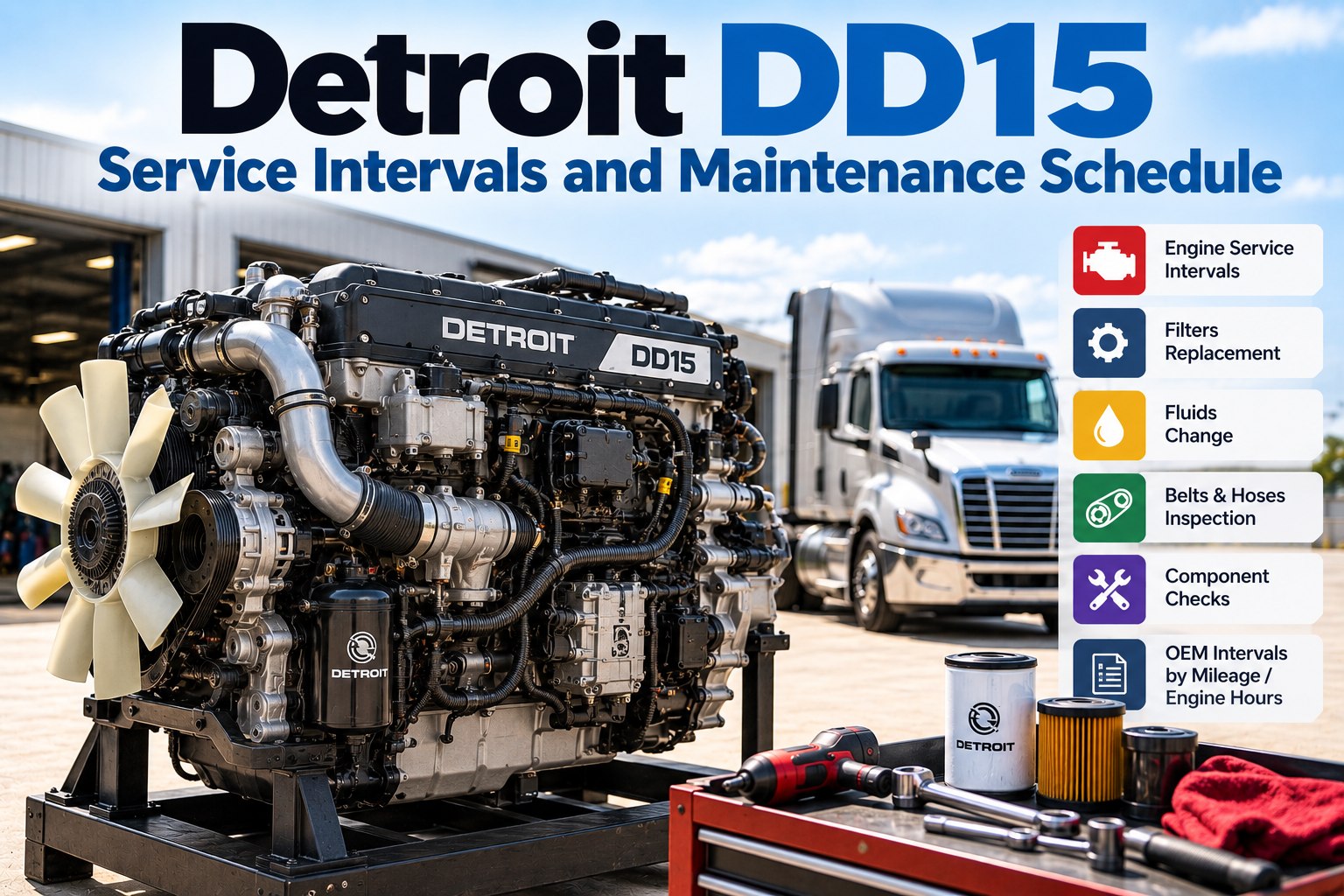
A Detroit DD15 is a 14.8-litre six rated between 425 and 505 horsepower, and Detroit's published schedule asks for rather more across its life than the oil interval most fleets plan around. Over 700,000 miles on the best duty cycle tier that means nine oil services, a belt replacement at 200,000, a standard coolant change at 300,000, valve lash and the DEF pump filter at 500,000, extended-life coolant at 600,000, and a diesel particulate filter ash cleaning somewhere between 455,000 and 640,000. The oil is the item everyone remembers, because it comes round often enough to become a habit. The rest happens once or twice in the engine’s life, has no rhythm attached to it, and is where the surprises live — a missed coolant change at 300,000 miles does not announce itself. Book a DD15 service review.
Everything a DD15 Asks For, in the Order It Asks
Not just the oil interval. The complete published schedule laid out across the life of the engine, what moves when the duty cycle changes, and the four milestones that routinely never get done at all.
The Engine, in Four Numbers
Worth setting out plainly, because two of these four are maintenance figures rather than performance ones.
Detroit describes the current generation as delivering "up to 3% better fuel economy" than the engine before it through downspeeding and a swirl piston design, with a "Ball Bearing Simple Geometry Turbo" that lets peak power and torque arrive sooner, and an aftertreatment system reworked to "do more with less space, increasing ATS maintenance intervals." The direction of all three is the same: fewer moving parts in the airpath, longer gaps between visits, and more of the diagnostic work done remotely through Detroit Connect rather than in the bay.
That matters for how you schedule it. An engine designed around longer intervals puts more weight on not missing them, because there are fewer touchpoints at which someone might notice something else. A missed 300,000-mile coolant change on a schedule with services every 15,000 miles gets caught. On a schedule with services every 75,000 miles, it does not.
The Whole Life on One Axis
Everything the published schedule asks for, plotted where it actually falls rather than listed as intervals.
The purple ticks are the oil services. Everything else happens once or twice in 700,000 miles, which is precisely why those items are the ones that get missed — they have no rhythm to them and no habit attached. The DPF window is shown as a band because Detroit publishes it as an estimate rather than a fixed figure, running from below 455,000 miles on hard-worked units to beyond 640,000 on the cleanest.
Milestone by Milestone
Each one, what it is, how often it comes round and the thing worth knowing about it.
The one everybody plans. On the efficient long haul tier it recurs nine times inside 700,000 miles. On severe duty it recurs twenty times.
Raised on miles, hours and the 12-month limit together, whichever lands first.
Replacement rather than inspection, and it halves to 100,000 miles with a 2,600-hour cap once a unit is on short haul or severe duty.
Moves automatically when the unit changes tier, rather than being re-entered by hand.
The first of two coolant events, and the one most likely to be missed because it does not scale with duty cycle — it is the same figure on every tier.
Held as a fixed-mileage item so it does not inherit a duty-cycle adjustment it should not have.
Published as a band rather than a date, with the cleanest operations above 640,000 miles or 14,000 hours and the hardest below 455,000 or 10,000 hours.
Tracked as a planning window against both miles and hours so the shop slot can be booked ahead.
Constant across the three upper tiers and then cut to 200,000 miles on severe duty — a 60% reduction on an item few people think of as duty-cycle sensitive.
The severe-duty reduction applies as part of the tier change, not as a separate edit someone has to remember.
Same mileage as the overhead, so they can share a shop visit — but the three-year limit will arrive first on anything that is not a hard-running highway unit.
The three-year clock runs alongside the mileage, which is what catches low-utilisation units.
Only applies if the unit is actually filled with extended-life coolant. On standard formulation the 300,000-mile figure governs and this milestone does not exist.
Coolant type is recorded against the unit, so the right one of the two figures is the one that fires.
Coolant at 300,000 and overhead at 500,000
Both fall once in an engine's life, neither has a habit attached, and both are usually beyond the horizon of whoever set the schedule up. They are the two items we most often find missing entirely from a DD15 fleet's PM programme. In thirty minutes we will load the full milestone set against your units and show what is already overdue.
Which Tier the Engine Is On
The milestones above are the efficient long haul figures. Detroit decides the tier with two tests rather than one.
More than 60,000 miles a year and better than 7.0 mpg
75,000 miMore than 60,000 miles a year and 6.0 to 6.9 mpg
60,000 mi30,000 to 60,000 miles a year and 5.1 to 5.9 mpg
45,000 mi or 1,000 hrsUnder 30,000 miles a year, or under 5.0 mpg, or severe operating conditions
35,000 mi or 750 hrsNote the asymmetry. The three upper tiers require both conditions to be satisfied; severe duty is reached by any one of three on its own. So a DD15 covering 80,000 miles a year at 4.9 mpg is a severe-duty engine despite the distance, and its overhead adjustment is due at 200,000 miles rather than 500,000.
The Same Items, Across All Four Tiers
What actually changes when the engine moves tier, and what does not. Swipe the table sideways on mobile.
| Item | Efficient long haul | Long haul | Short haul | Severe |
|---|---|---|---|---|
| Engine oil and filters | 75,000 mi | 60,000 mi | 45,000 mi or 1,000 hrs | 35,000 mi or 750 hrs |
| Belts | 200,000 mi | 200,000 mi | 100,000 mi or 2,600 hrs | 100,000 mi or 2,600 hrs |
| Valve lash adjustment | 500,000 mi | 500,000 mi | 500,000 mi | 200,000 mi |
| Coolant, standard | 300,000 mi | 300,000 mi | 300,000 mi | 300,000 mi |
| Coolant, extended life | 600,000 mi | 600,000 mi | 600,000 mi | 600,000 mi |
| DEF pump filter | 500,000 mi or 3 yrs | 500,000 mi or 3 yrs | 500,000 mi or 3 yrs | 500,000 mi or 3 yrs |
Two things stand out. The coolant and DEF filter rows are flat across every tier — they genuinely do not care how the truck is used, so they are safe to schedule once. And valve lash is flat across three tiers and then falls by 60% on the fourth, which makes it the single most likely item to be left on the wrong figure after a unit's work changes.
What Can Override the Schedule
The intervals are the plan. Detroit also publishes the conditions under which the plan no longer applies.
Alongside the drain intervals sit oil analysis warning limits with an instruction to change the oil immediately if contamination exceeds them: soot at 4.5%, water at a maximum of 3,000 ppm, and fuel dilution capped within a 2.5% to 7% range. A DD15 halfway through a 75,000-mile interval with soot over that limit is due now, not in another 37,000 miles.
Two hard requirements go with it. Detroit states that supplemental filters are not allowed on the DD5, DD8, DD13, DD15 and DD16 — so an aftermarket filter fitted to stretch a drain is a prohibition rather than a judgement call. And the fuel must be ultra-low sulphur at below 15 ppm. On oil, approved specifications are API FA-4, CK-4 or CJ-4 certified, in 15W-40 or 5W-30 and 10W-30 grades according to specification — and the older CJ-4 specification carries its own shorter interval table.
That last point is worth a figure. On CJ-4 approved oils the published intervals are 50,000 miles for long haul, 35,000 miles or 895 hours or one year for short haul, and 25,000 miles or 640 hours or six months on severe duty. So a DD15 that would run 60,000 miles on current specification oil runs 50,000 on the older one — same engine, same route, 10,000 miles of difference decided entirely by what the shop filled it with. If the schedule in your system assumes the longer table and the barrel is the older specification, nothing will flag it.
For the exact figures on your own engines, the Detroit operator's manual for your model year and emissions configuration is the authority and your dealer can confirm which generation a serial number falls under. Everything here comes from Detroit's published platform documentation and is not a substitute for the manual that shipped with the engine.
How FleetRabbit Handles This
Four things, aimed squarely at the once-in-a-life items rather than the oil change you already remember.
The 300,000-mile coolant and the 500,000-mile overhead are the ones that fall off hand-kept schedules, because nobody is looking that far ahead when the truck is new.
When a DD15 drops to severe duty the oil halves and the valve lash falls from 500,000 to 200,000. Both move together rather than one being noticed and the other missed.
Miles, engine hours and the calendar, with the work raised on whichever arrives first — which is how Detroit writes these and where the three-year DEF limit catches people.
The 300,000 or 600,000 coolant figure depends on what is in it, and the oil interval depends on whether the fill meets the current specification. Both are fields, not assumptions.
Questions DD15 Operators Ask
What is the oil change interval on a Detroit DD15?
On current approved oils it runs 75,000 miles at the efficient long haul tier, 60,000 at long haul, 45,000 or 1,000 hours at short haul and 35,000 or 750 hours on severe duty. Which tier applies depends on both your annual mileage and your measured fuel economy. Confirm your tier.
What gets missed most often on a DD15?
The standard coolant change at 300,000 miles and the valve lash adjustment at 500,000. Both happen once, neither has a habit attached, and both usually sit beyond the horizon of whoever set the schedule up when the truck was new. Track Your DD15 Fleet.
Does severe duty change anything besides the oil?
Yes. Valve lash falls from 500,000 to 200,000 miles and belts from 200,000 to 100,000 with a 2,600-hour cap. Coolant and the DEF pump filter stay put. Shortening only the oil interval leaves two items badly over-extended. Apply the full change.
When does the DPF need ash cleaning?
Detroit publishes a band rather than a figure — above 640,000 miles or 14,000 hours at the cleanest end, down to below 455,000 miles or 10,000 hours at the other, with two bands in between. Treat it as a planning window and book the slot ahead. Plan the window.
Can we fit a supplemental oil filter to extend the drain?
No. Detroit states supplemental filters are not allowed on the DD5, DD8, DD13, DD15 and DD16. If one is on a unit, it is worth knowing about before a warranty conversation rather than during one. Audit your units.
Does the coolant figure depend on what is in it?
Yes — 300,000 miles on standard formulation and 600,000 on extended life, so the two are not interchangeable figures. Recording which coolant a unit holds is what decides which of them is correct for that engine. Record coolant type.
Our trucks do not cover many miles. Does that help?
It usually does the opposite. Under 30,000 miles a year puts a DD15 on severe duty, and the DEF pump filter's three-year limit will arrive long before its 500,000 miles. Low utilisation shortens the schedule rather than stretching it. Check the calendar items.
Can DD15 units sit alongside other engines?
Yes, and they should. Each make publishes its own ladder on its own logic, so they belong on one maintenance record with intervals held per unit rather than in separate sheets that drift apart. Start Free on Three Units.
Schedule the Whole Life, Not Just the Oil
FleetRabbit holds every milestone against the unit from the day it arrives — oil, belts, both coolant figures, valve lash, the DEF filter and the DPF window — on miles, hours and the calendar together, so the once-in-a-life items fall due instead of falling off.
Free for 3 vehicles · no credit card required