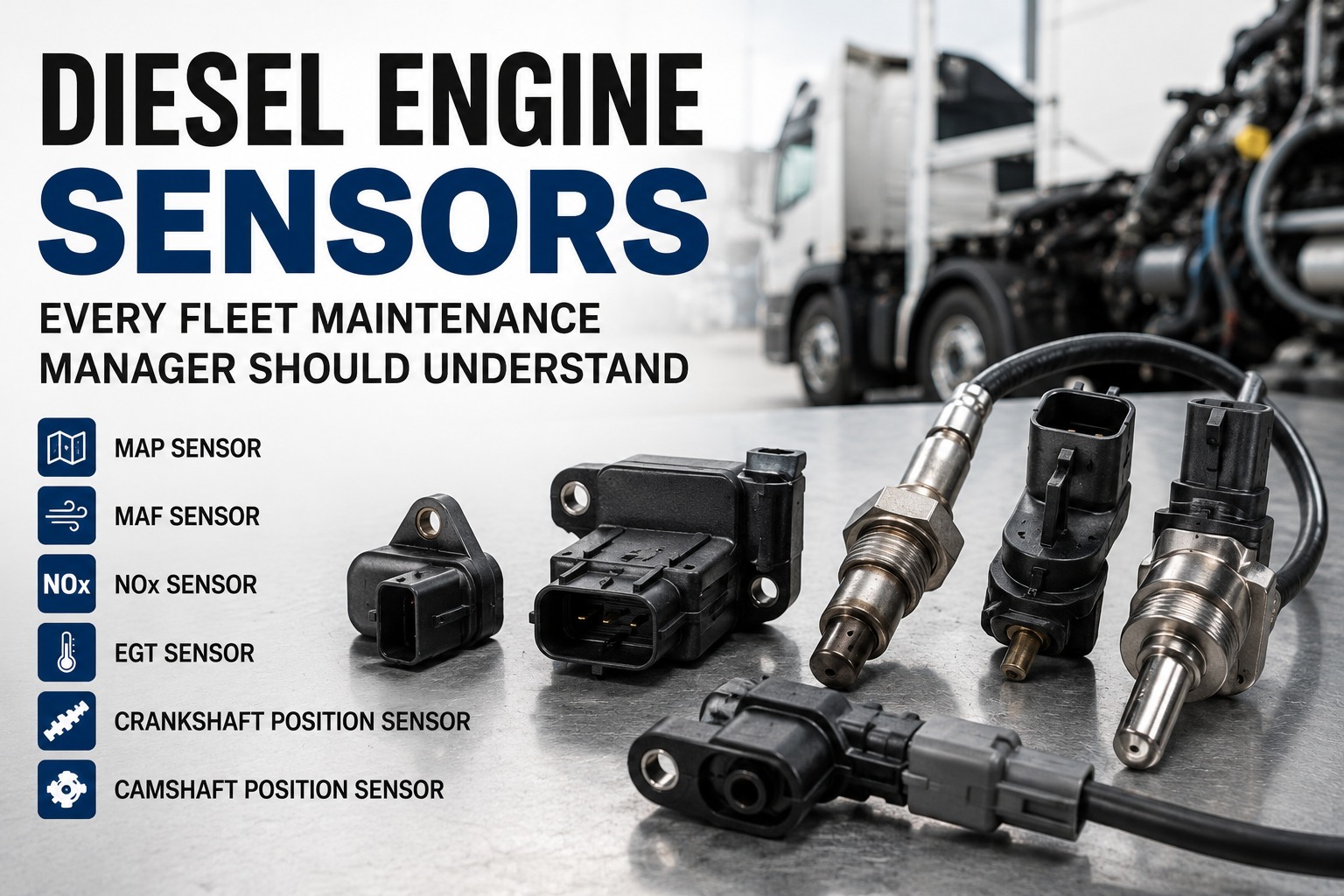
A modern diesel doesn't run on fuel and air alone — it runs on data. A dozen sensors feed the ECM a continuous picture of pressure, temperature, airflow, position, and exhaust chemistry, and the engine's timing, fueling, boost, and emissions dosing are all calculated from those readings. That makes sensors the highest-leverage components on the truck for a maintenance manager to understand: when one lies, the ECM acts on the lie, and a healthy engine can be derated, misdiagnosed, or repaired with parts it never needed. The most expensive version of that mistake is routine — industry suppliers sell several thousand NOx sensors a year to fleets replacing "the messenger" instead of fixing the upstream fault that triggered the code. This guide walks fleet managers through the sensors that matter most — MAP, MAF, NOx, EGT, crank, and cam — what each one does, the codes it throws, what it costs, and how fleet software turns recurring sensor failures into a pattern you can actually act on. Start free trial or book a demo to track sensor failures across every truck you run.
DIAGNOSTICS & REPAIR · ENGINE SENSORS
When a Sensor Lies, the ECM Believes It — and Your Truck Pays
Every fueling, timing, boost, and DEF-dosing decision is calculated from sensor data. Understanding what each sensor measures, and which codes it throws, is what separates a targeted repair from replacing an expensive part that was never the problem.
100–200
Miles before a persistent NOx fault triggers a power derate
5–25
MPH limp-home speed once the derate countdown completes
$400–$1,100
Per OEM NOx sensor, before labor
300K–700K
Typical cam/crank sensor life in miles on heavy-duty diesels
The Six Sensors That Matter Most
Dozens of sensors sit on a modern diesel, but a handful account for most of the codes, downtime, and misdiagnoses a fleet will face. Here's what each one does, how it fails, and the codes it sets.
Manifold Absolute Pressure
Measures pressure in the intake manifold so the ECM can calculate air density and control boost. Some diesels rely on MAP alone; others pair it with a MAF.
Fails as: boost control problems, reduced power, nonsensical readings that conflict with throttle and crank position data.
Boost/pressure circuit codes
Mass Air Flow
Measures the actual mass of air entering the engine, letting the ECM match fueling and EGR flow to real airflow rather than an estimate.
Fails as: contamination from oil or dirt is the most common failure mode — producing rough idle, hesitation on acceleration, and rising fuel consumption.
Airflow range/circuit codes
Nitrogen Oxide (Upstream & Downstream)
The upstream sensor, before the SCR, measures how much NOx the engine produces so the ECM can meter DEF. The downstream sensor, after the SCR, is the report card confirming the conversion worked.
Fails as: increased DEF consumption, erratic idle, MIL, and a power derate within 100–200 miles. Contaminated DEF poisons the ceramic element and shortens life dramatically.
SPN 3217SPN 3227SPN 4094P2201
Exhaust Gas Temperature
A network of sensors across the aftertreatment system reports exhaust temperature, governing regeneration, EGR operation, and DEF dosing decisions.
Fails as: the extensive sensor network for emissions compliance creates multiple failure points — and a bad EGT reading cascades into EGR, DEF, and NOx sensor faults.
EGT circuit/range codes
Crankshaft Position
Tracks crankshaft position and speed so the ECM knows exactly where every piston is. Together with the cam sensor, it synchronizes injection to piston position.
Fails as: can fail suddenly, causing a no-start condition. If both crank and cam sensors fail, the engine usually won't start at all.
P0335P0016 correlation
Camshaft Position
Identifies which cylinder is on its compression stroke so the ECM can time the first injection event and coordinate valve timing.
Fails as: extended cranking is the classic heavy-duty symptom — if a truck cranks normally but takes 3–5 seconds longer than usual to fire, suspect the cam sensor. Redundant-signal engines may start on the crank sensor alone.
P0340P0341P0344SPN 723
The most expensive habit in sensor diagnostics: shooting the messenger. When NOx data comes back out of tolerance, the ECM throws a code and may derate the truck — but the root cause could be any number of upstream problems. Industry suppliers report selling several thousand NOx sensors annually, with experts agreeing that unnecessary replacement remains a systemic problem, often done in haste and leaving the real fault unresolved. A failed sensor reading is frequently a symptom, not the disease. The discipline that saves money is verifying the sensor is actually wrong before replacing it.
See how code history exposes the real root cause.
Sensor Codes, Symptoms & Costs at a Glance
This is the quick-reference every maintenance manager should have: what each sensor throws, what the driver reports, and what it costs to put right. Swipe the table horizontally on mobile.
← Swipe to see all columns →
The same code on the same truck three times isn't a bad sensor. It's a bad diagnosis.
Fleet Rabbit logs every fault code against the VIN with the repair that followed — so a repeat failure shows the tech immediately what was already replaced and where to look instead.
How to Verify a Sensor Before You Replace It
Every unnecessary sensor replacement follows the same pattern: a code appeared, the part got swapped, the code came back. These verification steps break that loop and are worth building into your shop's standard practice.
1
Read the Specific SPN/FMI, Not Just the Light
Start with a scan tool to identify the exact code and failure mode. An FMI 3 (failed high) and FMI 5 (failed open) point to different problems on the same sensor circuit.
2
Check Whether the Readings Are Rational
Watch live data at operating temperature. Does the value respond sensibly to throttle and load changes? A sensor reading zero, pegged at maximum, or frozen regardless of engine state is telling you something.
3
Compare Sensors Against Each Other
On NOx, if the downstream sensor reads higher than upstream, that's physically impossible with a working SCR — so one or both sensors are bad. Cross-checking beats guessing every time.
4
Inspect Wiring and Connectors First
Damaged or corroded harness wiring produces the same codes as a dead sensor at a fraction of the repair cost. This is the cheapest check available and it's skipped constantly.
5
Look for Companion Codes
P0340 often appears alongside P0335 or P0016. A correlation code points toward mechanical timing rather than a sensor at all — replacing the sensor there fixes nothing.
6
Check the Truck's Own Repair History
If this sensor was already replaced on this truck recently, the sensor is almost certainly not the problem. Repeat failures are the clearest signal that the real fault is upstream.
Turn Repeat Sensor Codes Into a Root Cause You Can Fix
Fleet Rabbit logs every fault code against the specific truck with the repair that followed, flags sensors replaced more than once, and surfaces the same code appearing across multiple units — so you fix the underlying fault instead of buying the same part twice. Deploy at $5/vehicle/month, no hardware, live within 72 hours.
Per-truck code history
Repeat-failure flags
Fleet-wide code patterns
Derate-risk alerts
What to Track in Fleet Software
Sensor problems are pattern problems. A single code is a repair; the same code recurring, or spreading across trucks, is information that changes what you actually fix. Swipe the table horizontally on mobile.
← Swipe to see all columns →
How Maintenance Software Closes the Loop
The gap between a code appearing and the right repair happening is where fleets lose money. Here's how Fleet Rabbit narrows it.
01
Per-Truck Fault-Code History
Every code is logged against the VIN with a timestamp and tied to the work order that followed, so the next technician starts from what's already been tried instead of from scratch.
02
Repeat-Failure Flags
When the same sensor is replaced twice on one truck, the system flags it — the clearest available signal that the sensor was never the actual problem.
03
Fleet-Wide Code Patterns
The same code hitting several trucks in a short window points to a shared cause — contaminated DEF, a bad fuel source, or a problem part batch — rather than six independent failures.
04
Derate-Risk Prioritization
NOx faults trigger a derate countdown within 100–200 miles. Flagging those codes as urgent gets the truck into the bay before it drops to limp-home speed with a load aboard.
05
Driver Symptom Capture
Long cranking, hesitation, and power complaints get logged the day they appear — often weeks before a code sets, and exactly the context a tech needs to diagnose correctly.
06
Parts & Cost Reporting
See what you're actually spending on sensors across the fleet, and which trucks are consuming a disproportionate share — the numbers that justify a better diagnostic process.
Frequently Asked Questions
Which diesel engine sensors fail most often?
NOx sensors are the most frequently replaced, though industry experts note many of those replacements are unnecessary. MAF sensors commonly fail from oil or dirt contamination, producing rough idle, hesitation, and higher fuel use. EGT sensors create multiple failure points simply because emissions systems use so many of them. Cam and crank position sensors are more durable — typically 300,000 to 700,000 miles on heavy-duty diesels — but heat, vibration, and oil exposure shorten that.
Book a demo.
What happens if I ignore a NOx sensor code?
The ECM enforces a derate countdown that reduces engine power within roughly 100–200 miles of the first persistent code, ultimately dropping the truck to limp-home speed in the range of 5–25 mph. You can typically run a few hundred miles, but not long term. Beyond the power loss, ignoring it risks damage to the SCR catalyst and can mean failed inspections and emissions violations. The cost of the derate — a lost load and a recovery — usually exceeds the sensor.
Book a demo.
How do I know if a NOx sensor is really bad?
Watch live data with a scan tool at operating temperature and check whether the readings are rational. If the upstream sensor reads zero, sits pegged at maximum, or doesn't change with throttle, it's bad. If the downstream sensor reads higher than the upstream — physically impossible when both are working — one or both are bad. If both read normally but SCR efficiency or DEF quality codes persist, the catalyst is the issue, not the sensors. Also inspect wiring first, since harness faults throw identical codes.
Book a demo.
What's the difference between the cam and crank position sensors?
The crankshaft sensor tracks crank position and speed; the camshaft sensor identifies which cylinder is on its compression stroke. The ECM compares both signals to synchronize injection timing with piston position. If the cam sensor fails, most engines will limp along on the crank signal alone with longer cranking and reduced power. If both fail, the engine usually won't start at all. Watch for companion codes — P0340 alongside P0335 or a P0016 correlation code points toward mechanical timing rather than a sensor.
Book a demo.
Can I drive with a bad camshaft position sensor?
Short term, usually yes — most engines will limp home using the crankshaft sensor alone. But you'll lose power, burn more fuel, and on emissions-controlled engines you may go into derate. The classic warning sign is a truck that cranks normally but takes three to five seconds longer than usual to fire. Running a working truck for weeks on a failing cam sensor is asking for a no-start at the worst possible moment, so schedule it rather than living with it.
Book a demo.
How does fleet software reduce unnecessary sensor replacements?
By making the history visible at the moment of diagnosis. Every code is logged against the truck with the repair that followed, so a technician immediately sees that this sensor was already replaced two months ago — the strongest possible evidence the real fault is upstream. Repeat-failure flags catch that automatically, and fleet-wide pattern detection reveals when the same code across several trucks points to contaminated DEF or a bad fuel source rather than six coincidental sensor failures. That's how you stop buying the same part twice.
Book a demo.
Stop Replacing the Messenger. Start Fixing the Fault.
Fleet Rabbit logs every sensor code against the truck with the repair that followed, flags repeat replacements, surfaces fleet-wide code patterns, and prioritizes derate-risk faults — so your shop diagnoses from history instead of guessing, and expensive sensors get replaced only when they're actually bad. Integrated with your existing systems in 5–7 working days, at $5/vehicle/month, with no new hardware required.
Free tier for up to 3 vehicles · No credit card required · No hardware installation
July 22, 2026By Emily Davis
All Blogs