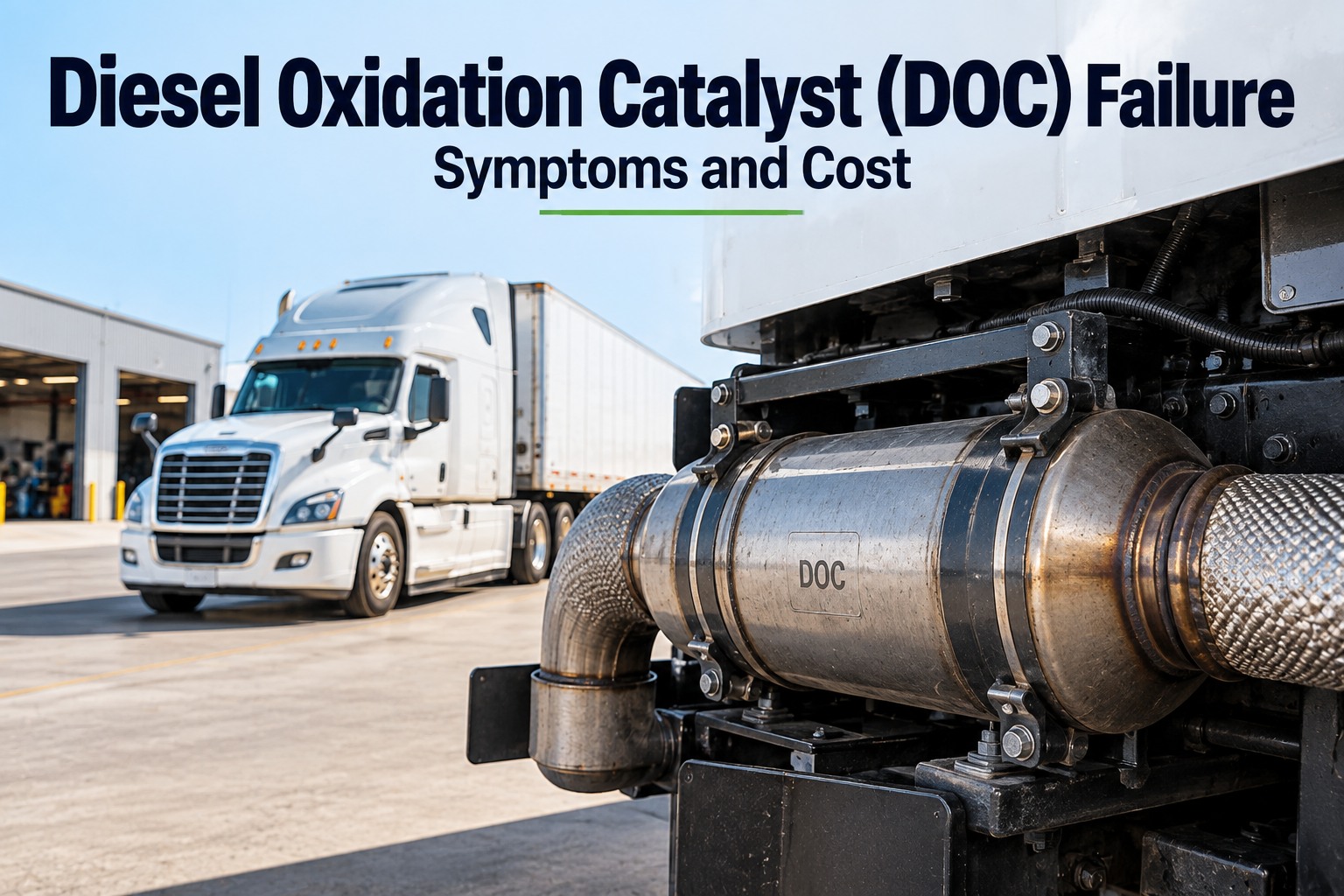
Diesel oxidation catalyst (DOC) failure usually shows up as failed or frequent DPF regenerations, high exhaust backpressure, lost power, aftertreatment fault codes and sometimes a derate — and in most cases the DOC is a victim, not the cause. The catalyst gets face-plugged by soot when exhaust stays too cool, poisoned by oil, fuel or coolant from an engine problem upstream, or cracked by uncontrolled heat. A plugged DOC can often be cleaned; a poisoned or cracked one has to be replaced, and either way the upstream cause must be fixed or the new part fails the same way. This guide explains what the DOC does, the four ways it fails, the symptoms to watch, a pressure test that tells a plugged DOC from a plugged DPF, when to clean or replace, what drives the cost and how to prevent the next failure. Book a demo to see aftertreatment faults tracked to the repair, or create a free account to start with your own trucks.
Aftertreatment · Diesel oxidation catalyst
The DOC Rarely Fails on Its Own. Find What Killed It Before You Buy Another.
For maintenance managers, technicians and fleet owners dealing with failed regenerations, backpressure codes or derates — how to confirm a DOC problem, decide between cleaning and replacing, and stop it coming back.
Typical light-off temperature cited in a heavy-duty engine patent (US 7,308,788).
What a Diesel Oxidation Catalyst Does in a Heavy-Duty Truck's Aftertreatment System
The DOC sits first in the aftertreatment line, and the parts behind it depend on it doing three jobs well. When it can't, the diesel particulate filter (DPF) loads up faster and regenerations fail, which is why a DOC problem often looks like a DPF problem. You can track each aftertreatment component's faults per truck on a free account.
Burns off carbon monoxide and hydrocarbons
Oxidizes unburned fuel and CO in the exhaust into carbon dioxide and water.
Creates heat for active DPF regeneration
During a regeneration, fuel dosed ahead of the DOC burns across the catalyst to raise exhaust temperature high enough to burn soot in the DPF.
Helps the DPF clean itself on the highway
Converts some nitric oxide into nitrogen dioxide, which helps burn soot in the DPF during normal hot running.
Four Ways a Diesel Oxidation Catalyst Fails and What Each One Looks Like
DOC failures fall into four groups, and the group decides whether the catalyst can be saved. Face plugging is usually reversible; contamination and heat damage usually aren't. We can sort your own aftertreatment history into these groups in a demo. Swipe the table on mobile.
| Failure mode | What causes it | What you notice | Usually |
|---|---|---|---|
| Face plugging | Soot and sticky hydrocarbon residue on the inlet face when exhaust stays below light-off — idling, short trips, light loads, cold weather | High backpressure, failed regenerations, power loss | Clean |
| Contamination or poisoning | Engine oil, excess fuel or coolant reaching the exhaust; coolant is especially damaging to the catalyst | Smoke, fluid loss, falling catalyst efficiency codes | Replace |
| Thermal damage | An uncontrolled burn of heavy fuel or soot deposits that overheats the substrate | Cracked or melted catalyst, rattles, sudden efficiency loss | Replace |
| Aging | Gradual loss of catalyst activity over a long service life | Slow decline in regeneration success and efficiency | Replace when codes confirm |
Failure groups summarized from engine-maker service information, SAE research on DOC face plugging and aftertreatment supplier guidance.
DOC Failure Symptoms Drivers and Technicians Usually Notice First
A failing DOC rarely has one clear symptom; it shows up as a pattern across the aftertreatment system. The earlier signs are in the data, the later ones are on the road. Log these signs against each truck for free so the pattern is visible early.
Regenerations happening more often or taking longer
The earliest sign: the DOC isn't producing enough heat, so the DPF needs more help.
EarlyRegenerations that fail or won't complete
A plugged or weak DOC can't reach the temperature a regeneration needs.
DevelopingAftertreatment pressure or efficiency fault codes
Backpressure and inlet pressure codes, or catalyst efficiency codes, stored by the engine computer.
DevelopingLoss of power and higher fuel use
Restricted exhaust flow makes the engine work harder.
SeriousEngine derate or check engine light with regen warnings
The system is protecting itself; the truck needs a shop soon.
Act nowHow to Tell a Plugged DOC From a Plugged DPF Before Ordering Parts
A plugged DOC and a plugged DPF produce similar symptoms, but the DOC inlet pressure during a parked regeneration tells them apart. A Detroit Diesel technical bulletin filed with NHTSA explains the test: if DOC inlet pressure starts high and stays high — about 10 kPa (1.5 psi) or more on a one-box system, 13 kPa (1.9 psi) on a two-box system — the DOC is plugged; if it starts high and falls, the DPF was plugged and the regeneration cleared it. See regen and fault history side by side in a demo.
DOC inlet pressure during a parked regeneration
Illustrative shapeThresholds and test logic: Detroit Diesel technical service bulletin 13TS-15 on EPA10 DOC face plugging (SPN 3251/FMI 2), filed with NHTSA. Check your engine maker's procedure for other platforms.
Why Idling and Short Trips Plug the DOC: The Light-Off Temperature Problem
A DOC only works once exhaust reaches its light-off temperature, typically around 270°C according to engine patent literature, and light loads, low speeds and cold weather keep exhaust below it. SAE research on DOC face plugging found that incomplete oxidation of hydrocarbons at those conditions leaves hard-to-burn residue on the inlet face. That makes duty cycle the first thing to check on a truck with a plugged DOC. Compare idle time and regen history per truck on a free account.
Illustrative comparison of typical exhaust temperature against the light-off line (dashed). Actual temperatures vary by engine, load and weather.
Which of your trucks run too cold for their DOC?
Bring your idle and regeneration data. In 30 minutes we'll show which units are most at risk of face plugging and how FleetRabbit flags them before the next failed regen.
Clean or Replace: Deciding What to Do With a Failed Diesel Oxidation Catalyst
The right repair depends on what the DOC looks like once it's out, and on whether the cause upstream has been fixed. Cleaning a contaminated DOC or replacing one without fixing the source wastes the money either way. Walk through this decision on your own trucks with us.
Face plugging. Clean it, then fix the duty cycle, idle time or fueling issue that caused it.
Clean + fix causeContamination. Find the leak or overfueling source first; the catalyst is usually not recoverable.
Fix source + replaceThermal damage. Replace, and find what caused the uncontrolled burn.
Replace + investigateWhat DOC Failure Costs and Why Fixing the Upstream Cause Matters Most
The DOC repair itself is only part of the bill. The larger costs come from downtime and repeat failures: benchmarking by FleetNet America and ATA's Technology & Maintenance Council puts unplanned downtime at about $448 to $760 per truck per day before towing and repair, and a new DOC fitted without fixing a leaking injector, a coolant leak or a low-temperature duty cycle can fail the same way. Track aftertreatment repair cost per truck free.
The expensive pattern
Failed regens are ignored, the DPF overloads, the truck derates on the road, and a replaced DOC plugs again because the cause was never found.
Relative cost order is illustrative. Downtime benchmark: FleetNet America and TMC, via industry reporting.
Preventive Maintenance That Keeps the Diesel Oxidation Catalyst Working
DOC failures build slowly, so scheduled checks catch most of them before a derate. Put these tasks into your preventive maintenance schedule and log anything found on a work order. See these tasks scheduled automatically in a demo. Swipe the table on mobile.
| When | Task | What it protects against |
|---|---|---|
| Every trip | Watch for new smoke, fluid loss and regeneration warnings on the DVIR | Contamination caught early |
| Weekly | Review idle time and regeneration frequency per truck | Face plugging from cold duty cycles |
| Every PM | Read aftertreatment codes; check for exhaust leaks, oil and coolant loss | Poisoning and efficiency loss |
| When codes appear | Test injectors and the aftertreatment fuel doser for overfueling or dribbling | Residue and uncontrolled burns |
| Per maker's interval | Aftertreatment cleaning service, with the DOC face inspected | Plugging before it restricts flow |
Diesel Oxidation Catalyst Failure Questions Fleet Managers Ask Most
What are the symptoms of a failing diesel oxidation catalyst?
More frequent or failed DPF regenerations, high exhaust backpressure, aftertreatment pressure or efficiency codes, loss of power, higher fuel use and eventually a derate. See these patterns across your trucks.
What causes DOC failure?
Face plugging from low exhaust temperatures during idling and light loads, contamination from oil, fuel or coolant, thermal damage from an uncontrolled burn, and gradual aging. An engine problem upstream is often the real cause. Track root causes per truck free.
Can a diesel oxidation catalyst be cleaned?
A face-plugged DOC with an intact substrate can usually be cleaned. A DOC contaminated by oil or coolant, or cracked by heat, generally needs replacing. Review clean-or-replace decisions with us.
How do I know if it's the DOC or the DPF?
Watch DOC inlet pressure during a parked regeneration. In Detroit Diesel's procedure, pressure that stays high points to a plugged DOC; pressure that starts high and drops points to a DPF that the regeneration cleared. Log regen results free.
How much does DOC failure cost?
Cleaning is the lowest-cost fix, replacement costs more, and ignoring symptoms until the DPF is damaged costs the most. Downtime adds roughly $448 to $760 per truck per day by industry benchmarks. Estimate your exposure with our team.
How can we prevent DOC failure?
Limit unnecessary idling, give low-speed trucks regular highway runs or scheduled regenerations, fix oil, coolant and fuel leaks quickly, test injectors and dosers when codes appear, and follow the maker's cleaning interval. Build that PM schedule free.
Catch DOC Problems in the Fault History Before They Plug the DPF
FleetRabbit keeps every aftertreatment code, regeneration issue and repair on each truck's record, so rising regen frequency, repeat codes and the upstream cause show up before the derate does.