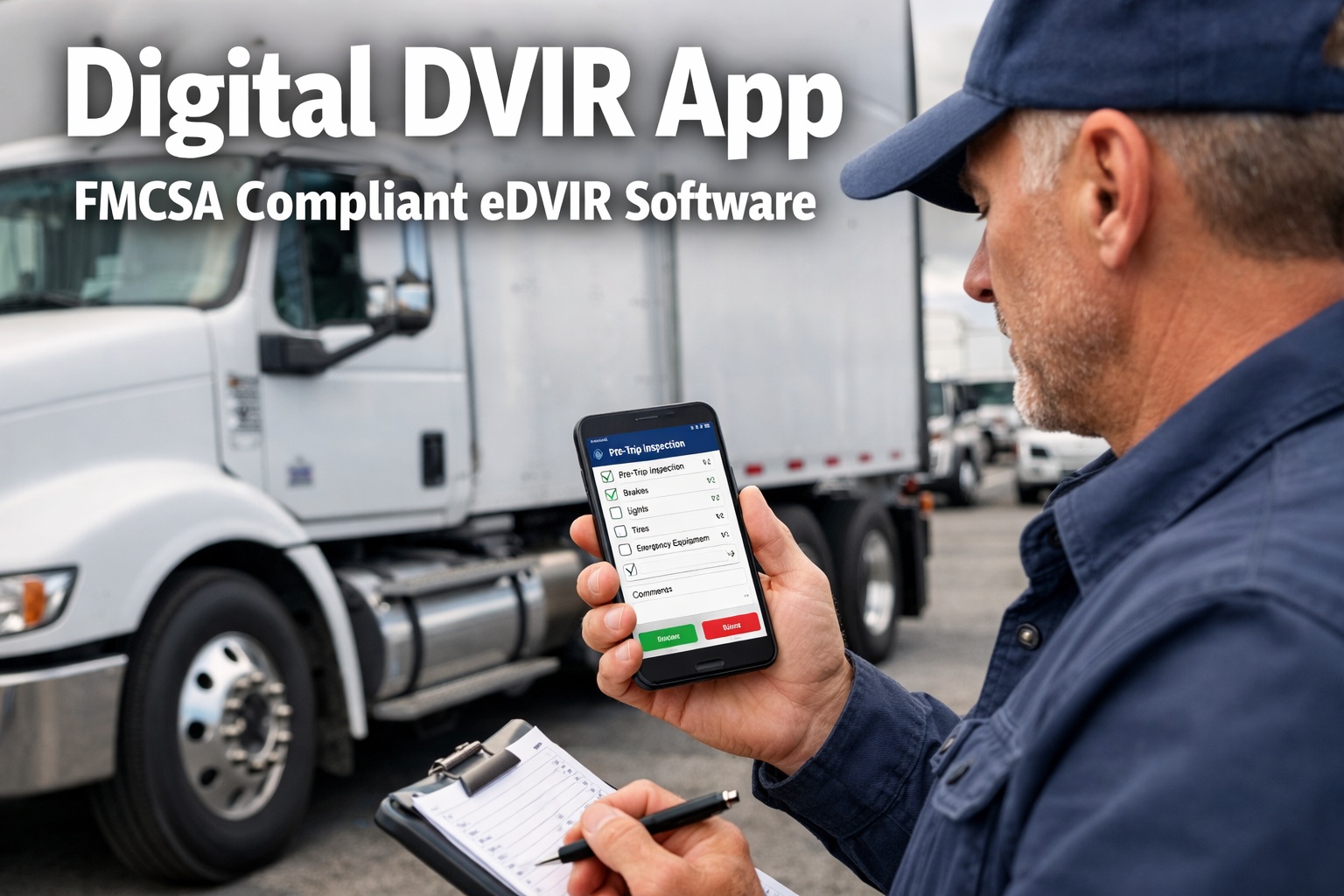
Fleet maintenance teams lose an average of 3.5 hours per day to manual inspection processes searching for paper DVIRs, chasing signatures, and tracking down who certified what repair. When a driver reports a brake defect, the average time to create a work order manually is 23 minutes. With FleetRabbit's digital DVIR app, that same defect generates a timestamped report, triggers a mechanic alert, and creates a work order in under 10 seconds. Fleets using digital DVIR systems report 60% faster inspection cycles and near-complete elimination of the signature-chain,violations that tank DOT audits. Book a free FleetRabbit demo to see how it works for your fleet.
Driver Inspects. Defect Flagged. Work Order Created. Repair Tracked.
FleetRabbit auto-creates work orders from DVIR defects, enforces the full 3-signature chain, GPS-verifies every walk-around, and keeps your fleet audit-ready 24/7 — all without paper.
What Is a Digital DVIR App — and What Does It Actually Do?
A digital DVIR app replaces the paper Driver Vehicle Inspection Report with a structured, mobile-guided workflow. Drivers complete FMCSA-required checklists on a smartphone or tablet, photograph defects with GPS-verified timestamps, and submit reports that are instantly routed to maintenance — all without paper.
The real value isn't just "going paperless." It's enforcement. The signature chain is automated. Defect alerts go out in real-time. Dispatch is blocked until repairs are certified. No step gets skipped. In 2026, FMCSA explicitly authorized eDVIRs under 49 CFR §396.11 — so there's no legal gray area left. Start your free trial today.
Confirms driver was physically at the vehicle — critical defense in DOT audits and litigation.
Works in dead zones and remote yards. Syncs automatically when connectivity returns. Zero data loss.
Timestamped photos attached to every defect — visual proof for audits, insurance, and court.
Mechanics get instant notifications with photos and vehicle ID. Response drops from hours to minutes.
The 2026 FMCSA Final Rule: What Changed for eDVIR
On February 19, 2026, FMCSA published its final rule explicitly adding eDVIR authorization to 49 CFR §396.11 and §396.13 — effective March 23, 2026. The ambiguity that made carriers hesitant is now completely gone.
Creating, maintaining, and signing DVIRs digitally is now unambiguously authorized under §396.11 and §396.13. No legal gray area, no risk of a technicality citation from using digital records.
The 2026 CSA overhaul creates a separate scoring category for defects drivers should catch during walk-arounds. Poor eDVIR quality now directly affects your CSA scores — inspection thoroughness is measurable for the first time.
FMCSA didn't ban paper. But digital records produce timestamped, GPS-tagged, photo-verified audit trails that paper simply cannot match — in a roadside inspection, a DOT audit, or a courtroom.
The 3-Signature Loop: The Biggest DVIR Trap Most Fleets Miss
Most fleet managers know a DVIR needs a driver signature. Fewer realize FMCSA 396.11 requires up to three separate signatures per defect — and missing any one of them is among the most cited violations in DOT audits nationwide.
Paper DVIR vs. Digital DVIR: Side-by-Side
Fleet managers sometimes say they don't have time to switch. Here's what the paper-based status quo actually costs.
Paper: Manual, frequently incomplete. Digital: Automated — all 3 enforced, dispatch blocked until closed.
Paper: A handwritten checkmark. Digital: GPS-verified, photo-documented, timestamped record.
Paper: Weak — hard to prove inspection quality. Digital: Strong — every record is court-ready from day one.
Paper: High risk — quality invisible to scoring. Digital: Protected — consistent, documented inspections on record.
Ready to End DVIR Violations Permanently?
FleetRabbit automates the full 3-signature chain, GPS-verifies every inspection, and keeps your fleet audit-ready 24/7.
5 Features That Separate a Real eDVIR App from a Digital Form
Not all digital DVIR apps are built the same. Some are glorified PDFs. Here's what actually matters for FMCSA compliance and fleet protection.
Covers all components under 49 CFR 396.11 — brakes, steering, lights, tires, mirrors, and more. Any gap is a compliance gap.
All 11 items with guided prompts. Sequential — drivers cannot skip any component.
Timestamped, GPS-tagged photos attached to defect records. Visual proof in audits and insurance claims.
Photos are required fields for defects — report won't submit without them. Try it free.
Defect flagged → work order created instantly → mechanic notified. No manual handoffs, no delays.
Open API connects to your existing TMS or maintenance platform without disruption.
FMCSA requires 3-month retention — but lawsuits run years. The regulatory minimum leaves you exposed.
Indefinite cloud storage, instantly searchable. Audit next week or lawsuit in 3 years — records are there. See a demo.
Your Next DOT Audit Doesn't Have to Be Stressful
FleetRabbit's digital DVIR app gives you GPS-verified inspections, automated signature chains, and audit-ready records — from your very first inspection.
Frequently Asked Questions
Is a digital DVIR app fully compliant with FMCSA 396.11?
Yes. FMCSA's final rule effective March 23, 2026 explicitly added eDVIR authorization to 49 CFR §396.11 and §396.13. As long as your app captures all 11 required inspection components, maintains the 3-signature chain, and retains records per FMCSA requirements, it is fully compliant — and more defensible than paper in audits and litigation.
Do drivers need to file a DVIR if no defects are found?
Property-carrying CMV drivers are not required to file a DVIR if no defects are found — but the pre-trip physical inspection under §392.7 is still mandatory. Most safety-conscious fleets complete DVIRs daily regardless, since consistent records build a stronger compliance and litigation defense. Passenger-carrying drivers must submit a DVIR at the end of every day's work.
What are the fines for DVIR violations?
Failure to file a required DVIR can result in fines of $1,270 per day per violation. Falsifying a DVIR can reach $12,700. Dispatching a vehicle with known unrepaired defects carries fines up to $15,420. Beyond fines, DVIR failures that contribute to accidents create serious civil liability — nuclear verdicts in trucking cases routinely run into the tens of millions.
How long must DVIR records be kept?
FMCSA requires carriers to retain DVIRs, repair certifications, and driver acknowledgments for three months. Annual periodic inspection documentation must be kept for 14 months. For litigation protection, FleetRabbit retains records indefinitely in the cloud — personal injury cases involving commercial vehicles can take years to resolve.
Can small fleets afford a digital DVIR app?
Yes — and small fleets often see the fastest ROI. Without a dedicated compliance team, owner-operators are most exposed to the gaps paper creates. The cost of a single DVIR-related fine typically exceeds an entire year of FleetRabbit's cost. Start free — no credit card needed.