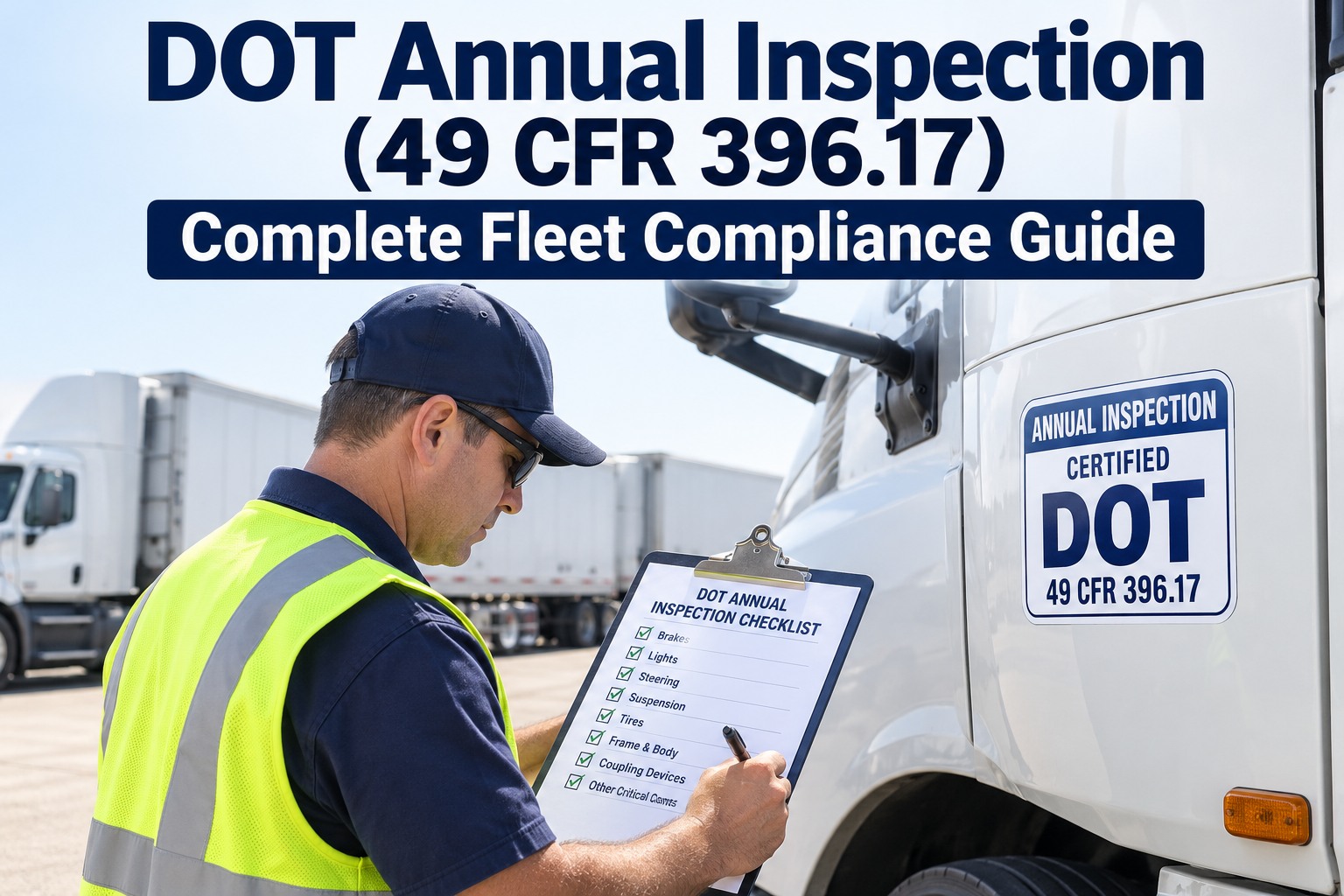
The DOT annual inspection under 49 CFR 396.17 is one of the highest-stakes compliance checkpoints in commercial fleet operations. Every power unit and trailer over 10,001 lbs must pass a full periodic inspection at least once every twelve months, and the moment that sticker expires the vehicle is one roadside stop away from an out-of-service order. Fleet Rabbit tracks every annual inspection expiration, qualified inspector qualification file, and Appendix A defect in real time, so safety directors stop chasing paper folders and start managing compliance from a single dashboard. Automated 60/30/14/7-day alerts, VIN-bound inspection reports, and one-click 14-month retention exports turn audit season into a filter-and-send task instead of a lost weekend. Start free trial or book a demo to deploy inspection compliance monitoring across your fleet today.
12 mo
Maximum interval between periodic inspections under 49 CFR 396.17 — no grace period, no rolling window
$41,150
Annual compliance exposure for a 40-truck fleet tracking stickers on spreadsheets and paper folders
14 mo
Retention window every inspection report must survive at the location where the vehicle is housed
12 items
Appendix A component groups a qualified inspector must sign off on every annual inspection
Expired Stickers Ground Trucks. Fleet Rabbit Keeps Every Annual Inspection Ahead of the Deadline.
Fleet Rabbit binds every annual inspection report to the VIN, the qualified inspector's active file, and an automated expiration timer — so no truck rolls on a lapsed sticker and no auditor finds a missing retention record.
The Four Rules That Decide Every Annual Inspection Audit
Before investing in any tracking system, it helps to understand exactly what an FMCSA auditor checks against. 49 CFR 396.17 doesn't leave much room for interpretation — four unambiguous rules govern the annual inspection process, and a driver who can't produce the record or a sticker that lapsed yesterday is treated the same as a truck that has never been inspected at all.
The 12-Month Rule
Every commercial motor vehicle with a GVWR of 10,001 lbs or greater must pass a periodic inspection at least once every 12 months. The clock starts on the last inspection date and expires exactly one year later — no calendar-year grace, no rolling window.
The Qualified Inspector Rule
Only a person meeting the training and experience thresholds in §396.19 may sign the inspection form. A shop rubber stamp or a mechanic without a documented qualification file does not satisfy the rule — the report is invalid on its face.
The Sticker & Report Rule
Under §396.17(c) the vehicle must either display a compliant decal or carry a copy of the inspection report in the cab. Missing either grounds the truck at the roadside, even if the paperwork exists in an office filing cabinet.
The 14-Month Retention Rule
The motor carrier must keep the original or a copy of every inspection report for 14 months from the report date, at the location where the vehicle is housed or maintained. Retention at a distant corporate HQ does not count.
The Twelve Appendix A Component Groups Every Inspector Must Sign Off
Appendix A to Part 396 lists the minimum items an annual inspection must cover. Miss any one group and the inspection is invalid, even if the sticker on the truck looks perfect. Fleet Rabbit ships with a pre-loaded Appendix A template so nothing gets skipped and every defect links straight to a work order.
01
Brake System
Service brakes, parking brake, drums and rotors, hoses, tubing, low-pressure warning, tractor protection valve, air compressor, and ABS. Brake defects alone drive nearly one in five out-of-service orders during CVSA Roadcheck weeks.
02
Coupling Devices
Fifth wheels, pintle hooks, drawbar or towbar eye, safety devices and chains, saddle-mounts and lower half assemblies — checked for a worn jaw, cracked mounting, or excessive play.
03
Exhaust System
No leakage forward of or directly below the driver or sleeper compartment, secure mounting, and no discharge beneath the fuel tank. DEF and after-treatment fluid leaks fall under this and the fuel system check.
04
Fuel System
Tanks securely mounted, no leaks at fittings, cap in place, and lines protected from chafing or heat. Diesel weeping at the injection lines or a loose mounting strap fails the inspection.
05
Lighting Devices
Headlamps, tail, stop, turn, identification, clearance and marker lights — all required lamps operational and visible from the required angles, plus reflective conspicuity tape.
06
Safe Loading
Cargo securement devices in serviceable condition, protection against shifting, and tailgates and doors latched and undamaged. Cut or knotted straps that reduce working load limit below §393.106 fail.
07
Steering Mechanism
Steering wheel free play within limits, steering column, gear box, pitman arm, drag link, tie rods, ball joints, king pins, and power steering — any play beyond §393.209 limits is a defect.
08
Suspension
Springs, air suspension, bushings, U-bolts, torque rods, axles, and axle attaching parts — nothing cracked, missing, or loose. Sagging or broken leaf springs are common failure points.
09
Frame
Frame members, cross members, body-to-frame mountings, and floor panels free from cracks, sagging, or corrosion holes through any load-bearing member.
10
Tires
Minimum 4/32" tread on steer axles, 2/32" on all others, no exposed fabric or cord, no leaks, and proper load rating for the axle. Tread depth must be recorded per axle position.
11
Wheels & Rims
No cracks, no unseated locking rings, no loose or missing lug nuts, no elongated stud holes, and no re-welded discs. Two loose lug nuts on the same hub is an automatic out-of-service.
12
Windshield & Wipers
Glazing free of damage in the swept area, wipers operational, washer system functional, and defroster clearing the driver's view. Damage over three-quarters of an inch in the driver's line of sight fails.
How Fleet Rabbit Keeps Every Inspection Audit-Ready
Fleet Rabbit integrates with your existing maintenance and telematics systems to provide structured inspection compliance without new hardware. Every report is captured at source and presented in audit-ready formats for safety and operations teams. See a live demo focused on expiration tracking, inspector qualification files, and retention exports.
01
Fleet-Wide Expiration Dashboard
Every unit's annual inspection date lives in a single color-coded dashboard, filterable by yard and unit. Automatic push alerts fire at 60, 30, 14, and 7 days out to the safety director and shop foreman.
02
Inspector Qualification File Linkage
Every report links to the signing inspector's active §396.19 qualification file — training records, experience letters, and identity — so an auditor sees signer and report together in one export.
03
VIN-Bound Reports & Stickers
VIN and unit number are pre-bound at report creation, eliminating the typos and unit-number mismatches that turn a valid inspection into a documentation failure at the roadside.
04
One-Click Retention Export
Filter by carrier, yard, or date and export 14 months of Appendix A reports as PDF or CSV in under 60 seconds — no boxes, no manual formatting, no lost weekend before an audit.
05
Defect-to-Work-Order Linking
Every Appendix A defect noted on a report links straight to a work order with parts, labor, and mechanic signature — the repair certification an auditor demands for any noted defect.
06
CSA Defect Trending
The dashboard flags repeat Appendix A defects by unit, surfacing the brake, tire, and light issues that drive roadside violations before they become CSA points on your profile.
Regulatory Framework Support for Inspection Documentation
Fleet Rabbit supports the compliance documentation commercial fleets face around periodic inspections, roadside enforcement, and audit readiness.
49 CFR 396.17 & 396.21
Annual inspection reports and sticker data structured to satisfy the periodic inspection and decal requirements, with timestamped, tamper-evident documentation.
§396.19 Inspector Qualification
Inspector training, experience, and identity records maintained and linked to every signed report, kept for the inspector's tenure plus one year after separation.
FMCSA Recordkeeping
Digital DVIR and preventive maintenance logs linked to annual inspection data, supporting compliance-review audit requests with a filtered, exportable trail.
CVSA Out-of-Service Criteria
Appendix A defect tracking mapped to CVSA inspection categories, helping fleets correct roadside-relevant issues before a Level I inspection escalates.
Stop Chasing Expiration Dates. Start Managing Inspection Compliance from One Dashboard.
Fleet Rabbit's fixed-scope onboarding means no open timelines, no hardware installation, and no months of customization before you gain visibility. Deploy at $5/vehicle/month and begin tracking within 72 hours.
Deployment Approach for Inspection Compliance Monitoring
Fleet Rabbit follows a structured onboarding process designed for dispersed fleet operations — delivering initial visibility within the first week and full feature activation within two weeks. No hardware installation required.
01
Asset & VIN Import
Map every power unit and trailer with VINs and current sticker dates
02
Inspector Files
Load §396.19 qualification records for every signing inspector
03
Alert Configuration
Set 60/30/14/7-day expiration thresholds and recipients
04
Team Training
Onboard safety directors and shop foremen
05
Go-Live & Review
Activate monitoring and schedule 30-day check-in
Typical Timeline and Expected Outcomes
Every Fleet Rabbit engagement follows a defined onboarding sequence with measurable milestones. Results vary by fleet size, operating conditions, and follow-through. Request the full onboarding scope document tailored to your fleet profile.
Days 1–3
Import and Baseline
Import fleet roster, VINs, and current annual inspection sticker dates
Load §396.19 inspector qualification files and link to signers
Configure expiration alert thresholds and notification recipients
Days 4–10
Pilot Monitoring
Activate expiration tracking on the highest-utilization vehicle segment
Review upcoming expirations and flag any units already past due
Identify quick wins such as missing retention files or unqualified signers
Days 11–14
Full Activation
Expand tracking to the full fleet with all configured parameters
Enable one-click retention exports and defect-to-work-order linking
Schedule 30-day review to assess audit readiness and alert response
REALISTIC EXPECTATIONS: AUDIT-READY IN UNDER TWO WEEKS WITH CONSISTENT FOLLOW-THROUGH
Fleets that centralize annual inspection tracking — replacing spreadsheet reminders with automated alerts and VIN-bound reports — typically eliminate expired-sticker incidents within the first cycle and cut audit prep from weeks to hours. Results depend on operational follow-through and baseline conditions.
0
Expired-sticker OOS orders
94%
Faster audit response
60d→3d
Retention retrieval
Use Cases from Annual Inspection Deployments
These examples reflect common scenarios where Fleet Rabbit has supported DOT annual inspection compliance. Outcomes depend on fleet size, operating conditions, and follow-through. Request additional details for the use case most relevant to your operations.
A regional carrier tracked annual inspection dates on a shared spreadsheet and nearly ran four trucks on expired stickers in a single month. Fleet Rabbit's color-coded dashboard flagged the cluster weeks ahead, and automated alerts routed to both the shop and safety desk eliminated the near-miss entirely.
0
Expired-sticker incidents
Book a Demo
A compliance manager facing a Tuesday audit needed 14 months of Appendix A reports across multiple yards. With Fleet Rabbit, the entire retention package exported as a single filtered PDF on Friday afternoon — the first clean compliance review in four years, with no weekend spent digging through boxes.
Book a Demo
A single-yard refuse operator qualified its own senior technicians under §396.19 instead of outsourcing every annual. Fleet Rabbit kept each inspector's qualification file linked to their signed reports, so auditors saw signer, training record, and Appendix A report in one export — cutting third-party inspection spend substantially.
In-house
Inspection model
Book a Demo
What Fleet Teams Say About Fleet Rabbit
We had four stickers about to expire in the same month and nobody knew until Fleet Rabbit's dashboard flashed red. It would have been four out-of-service trucks on a payday Friday if we'd stayed on the spreadsheet. Now audit prep is a filter-and-export instead of a lost weekend.
Fleet Safety Director
Regional Dry Van Carrier
Frequently Asked Questions
What vehicles are covered by 49 CFR 396.17?
Every commercial motor vehicle in interstate commerce with a GVWR or GCWR of 10,001 lbs or more, or designed to transport more than eight passengers including the driver for compensation (15 not for compensation), or that transports placardable quantities of hazardous materials. In practice, that's almost every straight truck, tractor, and trailer in a commercial fleet.
Book a demo.
Does an annual inspection have to be done every calendar year or every 12 months?
Every 12 months from the date of the last inspection — not by the end of a calendar year. A vehicle inspected on 18 July 2026 must be re-inspected by the end of July 2027 and goes out-of-service the moment 1 August begins. There is no grace period built into §396.17.
Book a demo.
Can our own shop staff perform the annual inspection, or does it have to be a third party?
In-house inspection is fully allowed as long as the inspector meets the §396.19 qualification standard — documented training, experience identifying defects, and a qualification file on record. Many carriers save meaningful cost by qualifying their own senior technicians. Fleet Rabbit keeps those files linked to every signed report.
Book a demo.
What happens if the sticker is expired but the report is on file at the yard?
Under §396.17(c) the vehicle needs either a decal displayed on it or a copy of the inspection report in the cab. If the sticker is expired and the driver has no current report, the roadside officer treats the vehicle as if it had no inspection at all — the out-of-service order issues on the spot, regardless of paperwork in the office.
Book a demo.
How does Fleet Rabbit keep us ahead of every expiration?
Every unit's annual inspection date lives in a single color-coded dashboard. Automatic push alerts fire at 60, 30, 14, and 7 days out to the safety director and shop foreman, and each report is bound to the inspector's active §396.19 file and the VIN — so audit exports are one click, not one weekend.
Book a demo.
Can Fleet Rabbit scale with fleet growth?
Yes — from 10 to 10,000+ vehicles. Add vehicles, locations, and users without re-implementation. Pricing is $5/vehicle/month with no volume minimums and a free tier for up to 3 vehicles.
Book a demo.
Be Audit-Ready Before Your Next Annual Inspection Cycle.
Fleet Rabbit gives commercial fleets real-time expiration tracking, §396.19 inspector qualification files, Appendix A defect trending, and one-click 14-month retention exports — integrated with existing systems in 5–7 working days, at $5/vehicle/month, with no new hardware required.
60/30/14/7-day expiration alerts
§396.19 inspector file linkage
One-click 14-month retention exports
Appendix A defect trending & CSA insight
July 18, 2026By Emily Davis
All Blogs