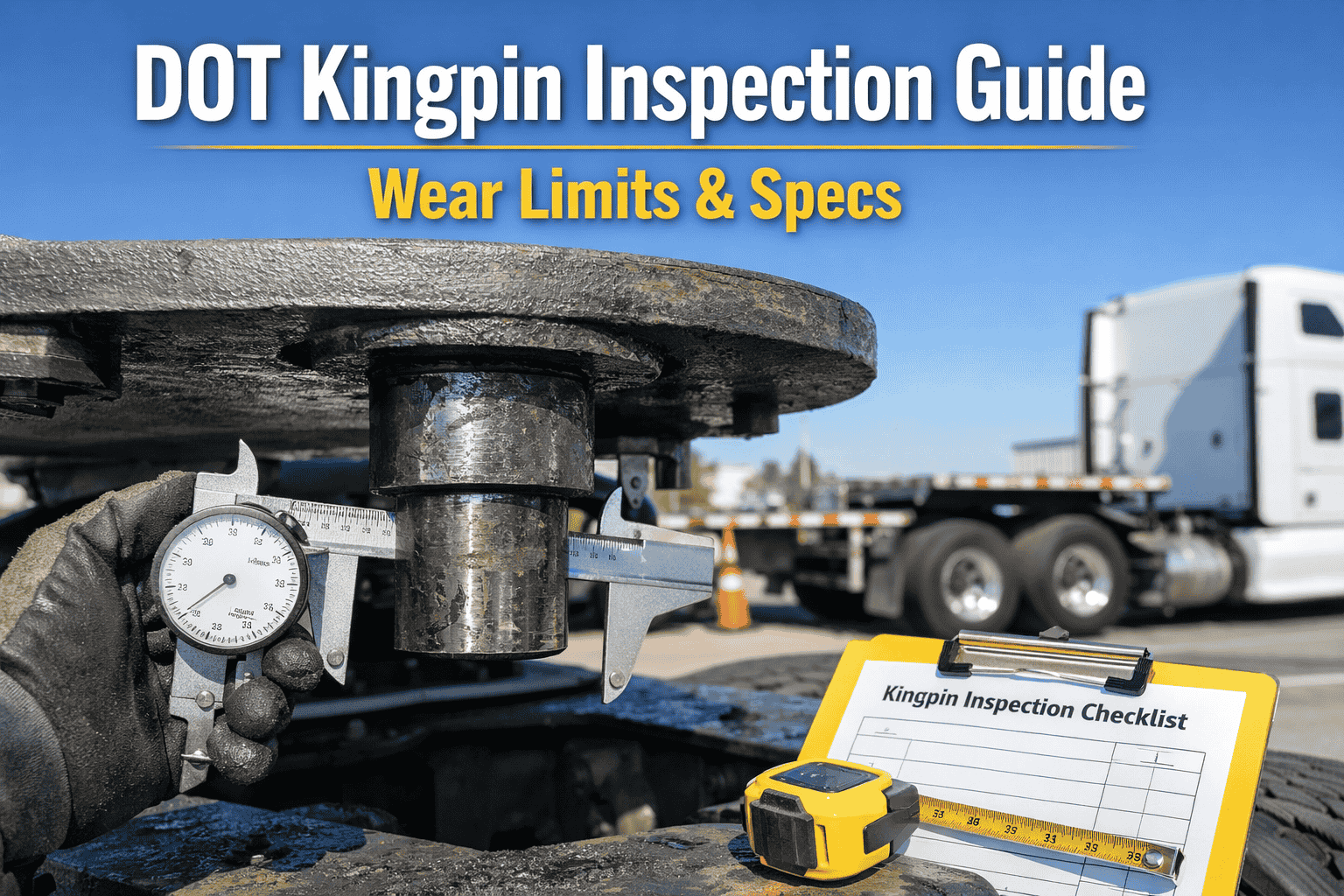
DOT Kingpin Inspection Guide | Understand FMCSA 393.70 requirements, SAE J700 wear limits, measurement procedures, and out-of-service criteria to keep your trailers compliant and your drivers safe.
A worn kingpin doesn't announce itself with a warning light. It fails when 70,000 pounds of loaded trailer separates from the tractor at highway speed. This guide covers the exact tolerances, measurement procedures, and inspection requirements that keep that from happening.
Every coupling and uncoupling event wears the kingpin slightly and in high-frequency drop-and-hook operations, that wear adds up faster than most fleet managers realize.
The complete guide to kingpin inspection: FMCSA regulations, SAE J700 wear limits, go/no-go gauge procedures, out-of-service criteria, and the inspection frequency that prevents coupling failures before they happen.
What the Regulations Actually Require
FMCSA 49 CFR 393.70 governs coupling devices. It requires that the fifth wheel locking mechanism prevent separation unless manually released, and that the kingpin engage properly with the fifth wheel jaws. The regulation doesn't specify exact wear tolerances — that's where SAE standards and CVSA out-of-service criteria come in.
Fifth wheel locking mechanism must prevent separation. Kingpin must be properly engaged. Upper coupler must be securely mounted.
Maximum wear 0.125" on 2" or 2.875" diameters. Kingpin must not exceed 1° bend. Inspection every 90 days or 30,000 miles.
Kingpin movable by hand = OOS. Kingpin not properly engaged = OOS. Any cracks = OOS. Horn reduced >20% = OOS.
Kingpin Anatomy & Wear Points
The primary measurement point. This is where the fifth wheel jaws lock. Wear beyond 0.125" means the jaws can't grip securely — replacement required.
Upper contact surface. Same 0.125" wear limit applies. Often overlooked — check both measurement points with the gauge.
Must be flat within tolerance. Check with 48" straightedge. Warping causes uneven fifth wheel contact and accelerated wear.
Track kingpin inspection dates, record measurements, and get automated alerts before the 90-day interval expires. Book a FleetRabbit demo to see trailer-specific inspection tracking in action.
Go/No-Go Gauge Measurement Procedure
A visual inspection is not sufficient. You need a kingpin wear gauge — a precision tool that physically checks whether the kingpin has worn beyond the SAE tolerance. Here's the procedure:
Remove all grease, road grime, and rust with a wire brush. Hidden cracks and wear are invisible under contamination.
Place the center opening of the gauge over the kingpin shaft. The gauge should slide on easily from any direction.
Attempt to fit the "no-go" slot onto the neck. If it fits, wear exceeds 0.125" — kingpin must be replaced.
Repeat the measurement at the shoulder. Same criteria — if the no-go slot fits, replacement is required.
Wear is often uneven. Check all sides of the kingpin at both measurement points to catch oval wear patterns.
Use the gauge's height slot and a square to verify the kingpin isn't bent (>1°) and is the correct length for the upper coupler plate thickness.
Out-of-Service Criteria: What Fails Instantly
CVSA inspectors apply these criteria during Level I and terminal inspections. Any of these conditions means immediate out-of-service:
If the kingpin can be moved by hand in any direction when uncoupled, it's loose in the upper coupler — immediate OOS.
Fifth wheel jaws not fully closed around kingpin. Coupling incomplete. Separation risk under load — OOS.
Any cracks in kingpin or upper coupler welds — immediate OOS. No field repair permitted on kingpins.
Fifth wheel horn section reduced more than 20% by wear when coupled. Visible wear inspection.
Upper coupler attachment bolts missing or ineffective per TTMA TB-110 requirements.
Cracks extending through 20% or more of original weld/parent metal on fifth wheel plate.
Kingpins are quenched and tempered alloy steel. Welding destroys the heat treatment, creating a brittle failure point. There is no approved repair procedure — worn or damaged kingpins must be replaced.
Inspection Frequency: When to Check
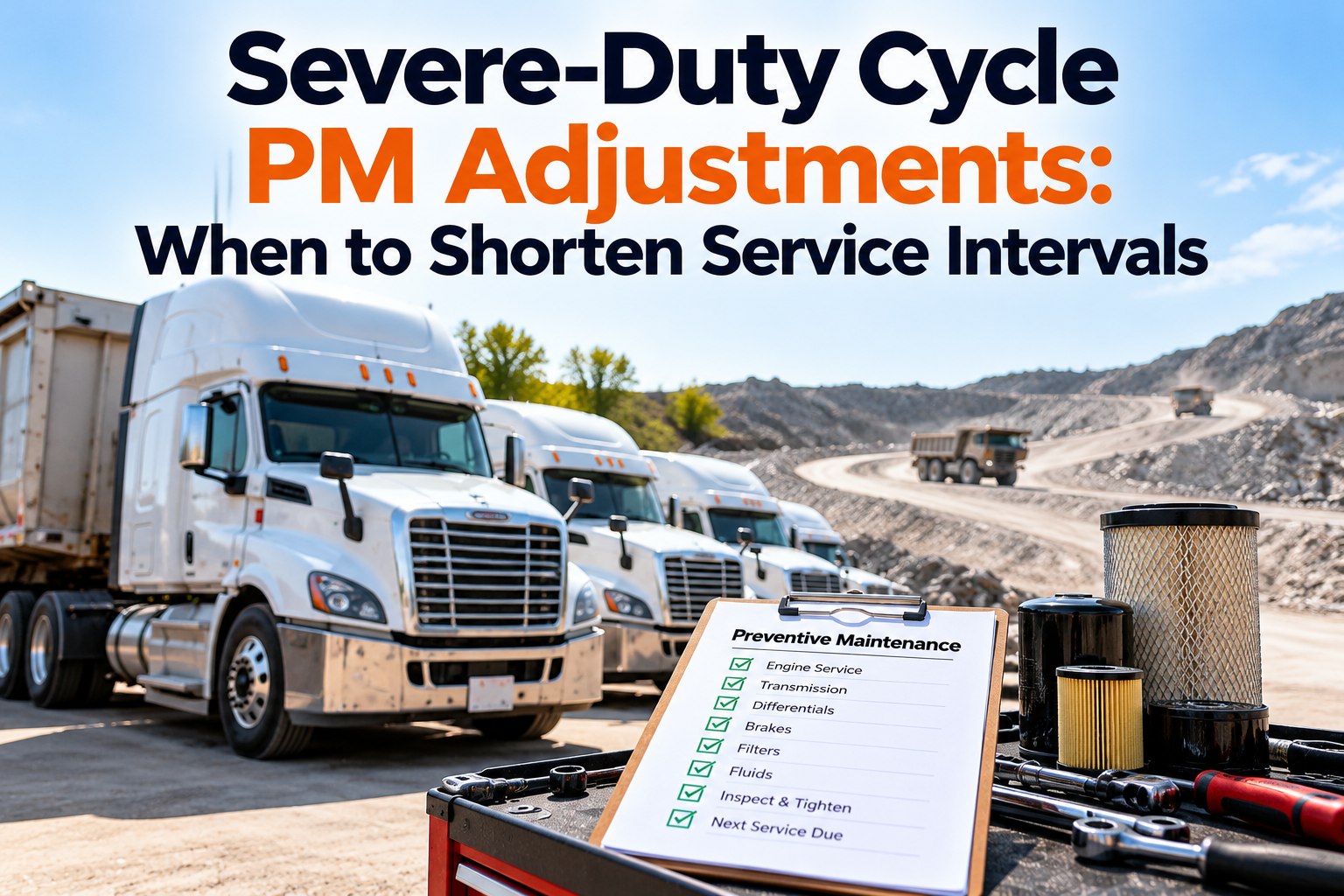
SAF-Holland recommends every 90 days or 30,000 miles based on SAE J2228. For fleets with intensive drop-and-hook operations — food service, intermodal, regional LTL — that interval should be 60 days. A fleet averaging 25-30 drops per trailer per month can wear a kingpin to replacement in 12-18 months.
Track trailer-specific inspection intervals automatically. See how FleetRabbit Digital DVIR generates custom inspection checklists for your trailer fleet — with kingpin, coupling, and upper coupler checks built in.
Frequently Asked Questions
Automated Kingpin & Coupling Inspection Tracking
FleetRabbit tracks inspection intervals per trailer, generates digital checklists with photo documentation, and alerts you before the 90-day window expires. No missed inspections. No OOS surprises.