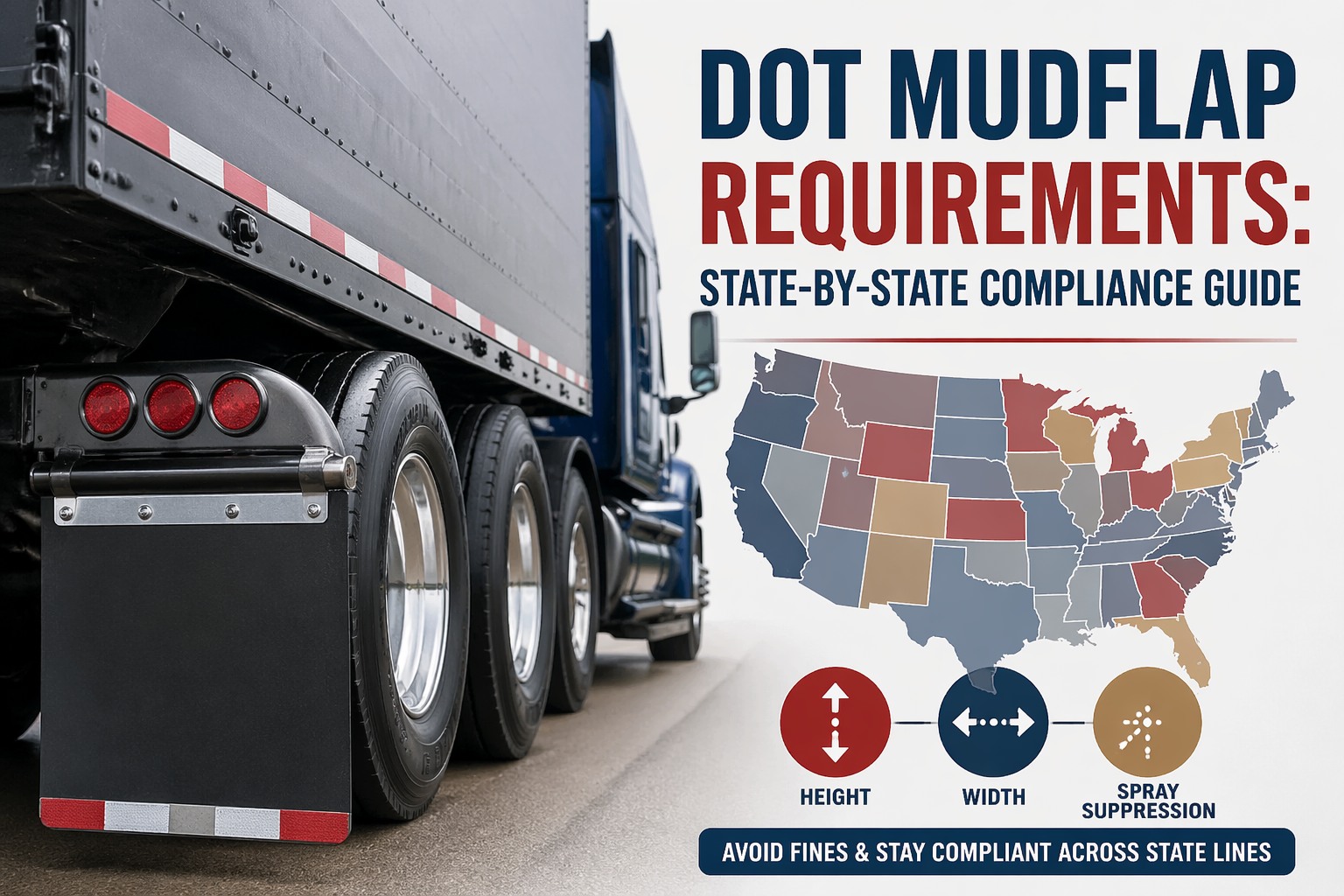
A mudflap violation is the most deceptive compliance trap in trucking — there is no single federal measurement to learn, and the exact rule changes the moment your driver crosses a state line. A setup that keeps you legal in California (10-inch ground clearance) will earn you a citation in Texas (8-inch max), and both of those will get flagged in Maryland, which uses a tire-width formula instead of a fixed number. In CY 2024, FMCSA logged nearly 19,000 mud flap violations (codes 392.2SLLMF and 392.2WC) each one a 1-point hit to the Vehicle Maintenance BASIC of your CSA score, and each one a "gateway violation" that invites inspectors to tear down the rest of your truck looking for more. This guide breaks down exactly which states have strict rules, which have none, the universal safe standard that keeps you legal everywhere, and the maintenance platform that turns pre-trip mudflap checks into compliant, audit-ready records across your entire fleet.
Legal in Texas. Cited in California. Same Truck.
Mudflap rules are state-regulated, not federal — and they contradict each other. Here is the full breakdown of which states have teeth, which have none, and the one universal standard that keeps you compliant on every interstate run.
TX · AZ · DE · MO
CA · IL · MI · OK · PA · many more
IN · KY · NM · NC · ND · SC · WV · WY
The Federal Rule — and Why It Does Not Save You
Let's clear up the confusion first. The Federal Motor Carrier Safety Regulations (49 CFR Part 393) do mention splash and spray suppression, and 49 CFR Part 393.86 says if a truck's rear tires are not fully covered by fenders or body panels, you need mud flaps wide enough to cover full tire tread. That is the full extent of federal guidance on mudflaps — no specific ground clearance, no deflection angle, no material spec. Everything else — height off the ground, side-spray rules, tangent-angle performance tests — comes from the state your driver is currently rolling through.
"If the rear wheels are not covered at the top by fenders, body, or other parts of the vehicle, the flap or other protective means must be extended at least to a point directly above the center of the axle." Federal language establishes the principle, not the numbers. State DOT laws carry the enforcement weight — and they vary wildly.
The Four Compliance Tiers Every Fleet Manager Must Know
Across 50 states + DC, mudflap rules cluster into four distinct tiers. Understanding which tier each state falls into is how you build a fleet equipment standard that works from Miami to Seattle without equipment swaps. Here is the complete breakdown.
The tightest standard in the country. Your mudflap's bottom edge must sit within 8 inches of the ground at all times. Easy to violate on highway-empty trailers where suspension ride height is higher. A flap that measures 9.5" under inspection = immediate citation.
Moderate tier — more forgiving but still enforceable. California caps at 10", several Midwest and Southern states at 12" (matching the federal guideline in § 393.86 where it appears), Alaska at 14". A flap set for Tier 1 compliance automatically clears Tier 2.
These states use math, not a fixed inch. Maryland requires the flap length to equal the tire width (12" tire = 12" flap). Michigan, Oklahoma, and Pennsylvania use a 22-degree tangent-angle deflection test. Mississippi covers 2/5 of the vertical tire area. A disciplined fleet standard ignores these and over-engineers to Tier 1 compliance.
8 states plus DC have no specific CMV mudflap regulation. But do not read that as permission to run without flaps — federal § 393.86 still applies if your rear tires are exposed, and these states still enforce general fender laws. Most interstate fleets ignore Tier 4 and simply run Tier 1-compliant equipment everywhere.
The Universal Safe Standard: Build Once, Run Everywhere
The smart play for any multi-state fleet is to ignore the state-by-state complexity and engineer every rig to one standard that clears all 50 states automatically. Here is the specification that every interstate fleet should adopt as the internal equipment minimum — no exceptions, no regional variations.
Build your fleet to this spec and cross-state compliance stops being a daily problem. The only thing left is verifying that every vehicle actually meets it on every dispatch — which is where most fleets still fail.
Stop Catching Mudflap Violations at the Inspection Station
Fleet Rabbit's digital pre-trip inspection forces drivers to verify mudflap clearance and coverage before every dispatch — logged, timestamped, photo-verified.
Anatomy of a Compliant Mudflap — What Inspectors Check
When a DOT or CVSA inspector walks your rig, the mudflap gets a 15-second visual scan. Here is exactly what they are looking for, in the order they check it. Know the checklist and your flaps pass every time.
Is there a flap behind every rear-most wheel? Missing flap = immediate violation. Placement must be directly behind the wheel, not offset inward or outward.
Tape measure or visual estimation from the flap's bottom edge to the ground. 8 inches is the tightest state standard (TX/AZ/DE/MO). 6 inches is the universal safe target.
Does the flap cover the full tread of the tire behind it? Flaps narrower than the tire leave edges exposed — federal violation under § 393.86.
No cracks, major tears, or missing chunks. A flap split down the middle or hanging by one bolt is worse than no flap — it appears maintained while offering zero spray suppression. Auto-citation.
Mounting brackets secure, bolts torqued, no zip ties or field repairs. Inspector checks that the flap does not fold backward > 30° when deflected by hand — if it collapses freely, it fails the performance test.
If your flaps use anti-sail brackets, they must be intact and properly positioned. Broken or missing anti-sail hardware that lets the flap fly horizontally at speed = performance violation in states using the 22° tangent rule.
The Real Cost of a Mudflap Violation
A mudflap ticket looks cheap on the citation — a few hundred dollars, some paperwork. The actual cost is measured in what happens after, not the fine itself. Understanding the true cost is what turns mudflap compliance from a nice-to-have into an operational priority.
Each 392.2SLLMF or 392.2WC violation is logged in the Vehicle Maintenance BASIC of your CSA score. Points compound over a 24-month window — several mudflap tickets can push you into the FMCSA intervention threshold.
Roughly 19,000 mud flap violations were written across both federal codes in CY 2024 — out of approximately 878,000 total 392.2 parts-and-accessories violations. Not rare. Very much on inspector radar.
Mud flap tickets are "gateway" citations — the 30-second visual catch that gives inspectors a reason to dig deeper into your brakes, lights, tires, and load securement. One flap ticket routinely becomes a 6-violation inspection report.
CSA Vehicle Maintenance BASIC is one of the top three BASICs insurance underwriters pull before renewal. Repeated flap-category violations = higher premium at policy renewal and reduced availability of preferred carriers.
Brokers and shippers running safety-rated load boards filter carrier bids by CSA score. A Vehicle Maintenance BASIC above threshold means lost load opportunities, period. Small violations compound into lost freight. Book a Demo to Protect Your CSA Score →
What States Actually Specify — Quick Reference
Here is a rapid-fire reference for 12 of the most common states your drivers will encounter on interstate routes. Use this to train new drivers, audit equipment standards, and pre-empt roadside surprises.
| State | Ground Clearance | Width | Key Notes |
|---|---|---|---|
| Texas | ≤ 8" | Full tread | Strict enforcement, heavy truck corridors |
| Arizona | ≤ 8" | Full tread | Rear splash guards mandatory on trucks, trailers, buses |
| California | ≤ 10" | Full tread | Commercial trucks + trailers required; passenger exempt |
| Missouri | ≤ 8" | Full tread | 12" for dump trucks; trucks > 24,000 lb GVW specifically cited |
| Delaware | ≤ 8" | Full tread | Strict 8" standard, well-enforced |
| Maryland | Formula | Full tread | Flap length = tire width (unique tire-width rule) |
| Michigan | Performance | Full tread | 22° tangent-angle test — must deflect spray > 22° from vertical |
| Oklahoma | Performance | Full tread | 22° tangent test + mandatory on trucks, trailers, semis |
| Pennsylvania | Performance | Full tread | 22° tangent test; applies to most vehicle classes |
| Washington | ≤ 12" (typical) | Full tread | Mandatory on trucks, buses, similar vehicles |
| Oregon | ≤ 12" (typical) | Full tread | Fenders or flaps required to reduce spray |
| Alaska | ≤ 14" | Full tread | Most permissive among regulating states |
Full NTEA coverage exists for all 50 states + DC, but the twelve above handle most cross-country freight lanes. A fleet running the Universal Safe Spec (≤ 6" clearance, full tread) clears all twelve without adjustment.
Building a Mudflap Compliance Program That Actually Works
The fleets that never get mudflap violations aren't getting lucky — they're running five disciplined practices that turn a state-by-state regulatory mess into a solved operational problem. Here is the playbook.
Pick one equipment standard — ≤ 6" clearance, full tread coverage, rigid rubber with anti-sail brackets — and put it in your fleet spec document. Every new truck, every replacement flap, every trailer on lease: same spec. No exceptions for regional rigs.
Paper DVIR forms let drivers check a box without actually looking. Digital DVIRs with mandatory photo capture force a real visual verification of every flap before the truck moves. The photo is timestamped, GPS-tagged, and archived — defensible in any audit.
When a driver reports a cracked, torn, or missing flap, the platform should immediately create a prioritized work order for the shop — with vehicle number, defect type, photo, and GPS location. No email inbox delays, no sticky notes lost between shifts.
Mudflaps are a 10-minute swap with the right bracket. Every maintenance facility should carry at least 10 spare flaps matched to your fleet spec. Shop downtime for a "we have to order one" is inexcusable when the part costs under $50.
Run a full-fleet mudflap audit every quarter. Log photos of every flap, measure clearance, document any near-threshold units for preventive replacement. Regular audits catch drift before inspectors do — and the audit record protects you during DOT reviews.
How Fleet Rabbit Automates Multi-State Mudflap Compliance
A five-state interstate run means five different regulatory environments. Fleet Rabbit turns that complexity into a single standardized workflow — with digital DVIR, photo verification, auto work orders, and audit-ready reporting that keeps every rig compliant on every mile of every route.
Drivers cannot advance past the mudflap check field without uploading a photo. GPS locks the location, timestamp locks the moment. No more "I inspected it but didn't actually look."
See a Live Walkthrough →Driver flags a cracked or missing flap — work order auto-creates in the shop queue with photo, vehicle ID, GPS, and priority tag. Shop sees it instantly, not at shift end.
Each truck's route is mapped against the state-tier compliance library. If a California-bound truck is running 9" clearance, the system flags it before dispatch — not after the citation.
Book a Personalized Demo →Every DVIR entry, every work order, every photo — archived and export-ready for DOT audits. DataQs challenges to disputed mudflap violations become 10-minute exercises instead of 10-hour archive digs.
Generate a full-fleet mudflap audit report in one click. Every flap, every vehicle, every clearance measurement and photo. Hand it to your safety manager — or to DOT — with zero prep.
See the Audit Dashboard →Every replacement flap swap auto-decrements inventory. When stock drops below threshold, re-order is triggered automatically. No more "we'll order it Monday" delays.
Frequently Asked Questions
Not specifically. The Federal Motor Carrier Safety Regulations (49 CFR Part 393) mention splash and spray suppression, and § 393.86 requires flaps if rear tires are exposed — but no specific measurements are set federally. All detailed rules are state-level.
Texas, Arizona, Delaware, and Missouri each require ≤ 8 inches of ground clearance — the tightest standard in the US. Any multi-state fleet should build to this standard plus a 2-inch buffer (≤ 6" target) to cover all jurisdictions with margin. Book a Demo to Automate State Rule Checks →
Eight states plus Washington DC have no specific CMV mudflap statute: Indiana, Kentucky, New Mexico, North Carolina, North Dakota, South Carolina, West Virginia, and Wyoming. However, federal § 393.86 still applies if your rear tires are exposed — and fleets crossing state lines must meet the rules of every state on the route.
The ticket itself is typically a few hundred dollars, but the real cost is CSA Vehicle Maintenance BASIC point accumulation, gateway-inspection exposure (one flap violation often becomes a 6-violation report), higher insurance premiums at renewal, and lost shipper opportunities when brokers filter by CSA score.
No. State mudflap laws cover rear-most axles only — tractor drive axles and trailer axles. Steer tires don't throw debris backward at other vehicles, so they are universally exempt. Some states require splash guards on dual rear-wheel trailers, front and rear.
Michigan, Oklahoma, and Pennsylvania use a performance-based rule instead of a fixed clearance — the mudflap must be able to deflect water and debris that leaves the tire at a tangent angle of 22 degrees or more. In practice, rigid flaps set at 6–8" clearance always meet this test. Schedule a Demo Today →
Turn State-by-State Chaos Into One Audit-Ready Workflow
Photo-verified DVIRs, auto-generated work orders, multi-state rule libraries, CSA score protection, and quarterly audit dashboards — all in one platform. Used by 500+ fleets to keep equipment compliant on every route, every state, every inspection.