The driver's daily vehicle report is the one piece of maintenance paperwork that starts with the person who drove the truck. Federal rules call it a driver vehicle inspection report, or DVIR, and they are specific about what it covers: eleven named parts and accessories, any defect that could affect safety or cause a breakdown, the driver's signature, and a repair certification before the truck runs again. They are also specific about when it isn't needed, a point many fleets still get wrong. This guide shows what to record on a daily vehicle report, how to write a defect a mechanic can act on, how the report, repair and next driver's review link together, and how long to keep them. To see the records and reminders running on your own fleet, book a short demo with our team.
Anatomy of a compliant daily vehicle report
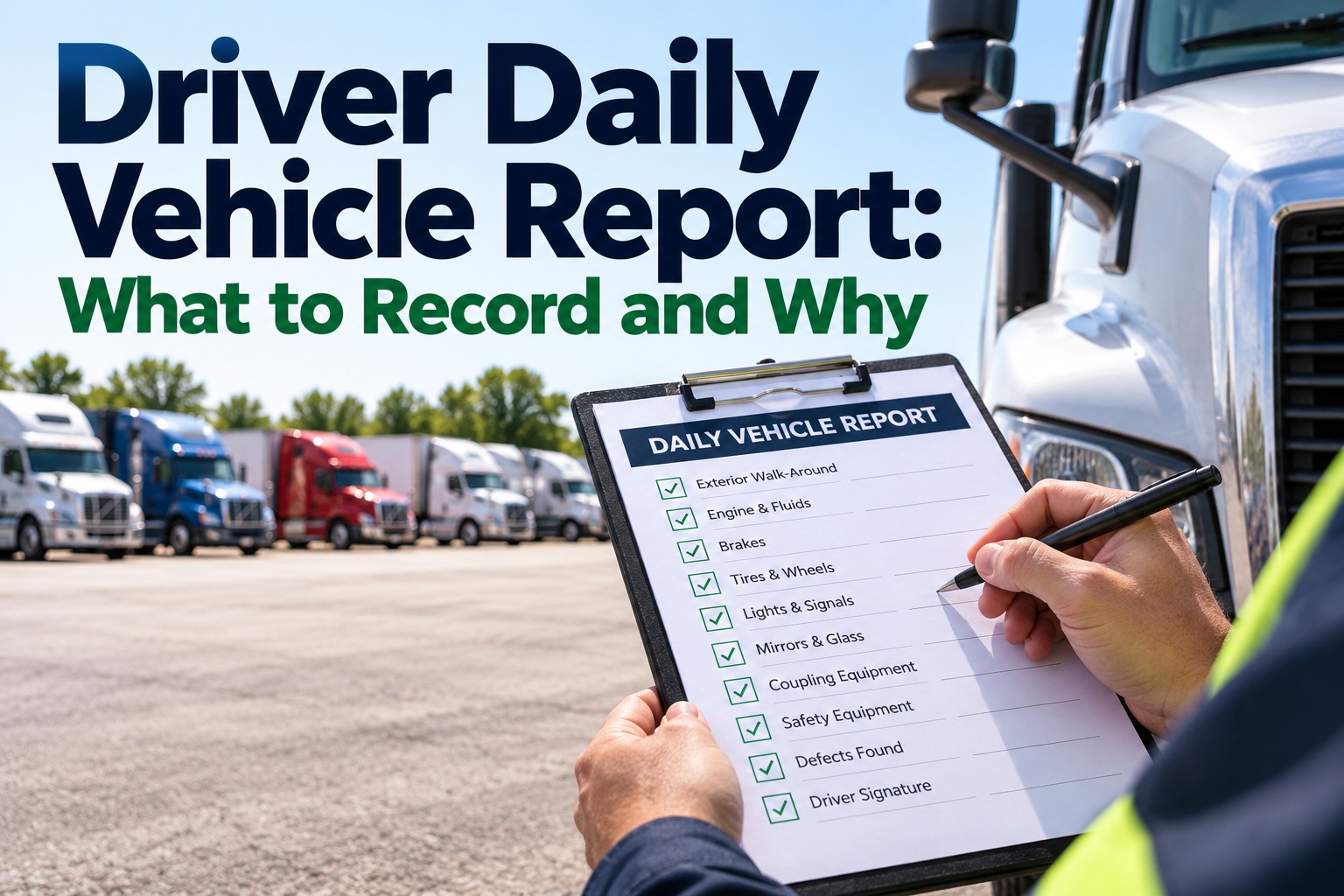
Section 396.11 requires the driver to prepare a written report at the completion of each day's work on each vehicle operated. The report has to identify the vehicle, cover the eleven parts and accessories below, list any defect or deficiency that would affect safe operation or result in a mechanical breakdown, and be signed by the driver. If no defect is found, the report says so, though as the next section explains, it may not need to be filed at all.
No defects found? Federal rules stopped requiring the report in 2014 and 2020
For decades, drivers had to submit a report every day whether or not anything was wrong. FMCSA ended that for property-carrying trucks in a rule effective December 18, 2014, noting that around 95% of reports said "no defects" and estimating about $1.7 billion a year in savings. A 2020 final rule extended the same relief to passenger carriers, citing roughly 2.4 million paperwork hours a year.
Three things didn't change. Drivers still inspect the vehicle; 396.13 still requires them to be satisfied it is in safe operating condition before driving. A report is still required whenever a defect is found or reported. And carriers can still require a daily report on every vehicle as company policy, which many do, because a no-defect record is useful evidence after a crash or a customer complaint. Intrastate carriers should check their state's rules, which may not have adopted the change.
Pre-trip or post-trip: which inspection the daily report comes from
The written report in 396.11 is a post-trip document, prepared at the end of the day's work on each vehicle. The pre-trip side sits in two other rules. Section 392.7 requires the driver to be satisfied before driving that the same core items are in good working order, and the 2014 rule aligned the pre-trip and post-trip lists so drivers check one set of eleven items both times. Section 396.13 then adds two steps before driving: review the last report if one was required, and sign it if it listed defects. In practice, the cleanest routine is one inspection habit run twice a day, with the evening report closing the loop and the morning review opening the next one.
Two trucks in one shift, trailers and intermodal chassis
A report is required for each vehicle operated, so a driver who swaps tractors at lunch owes two reports if both had defects. The trailer is covered through the items on the power unit's report, including trailer brake connections, coupling devices, lights, tires and wheels. Intermodal chassis follow their own rule: under 396.12, the driver reports defects in intermodal equipment to the equipment provider, which must repair them. Keep those reports in the same file as the tractor's, because a roadside inspector sees the whole combination as one vehicle.
Write the defect so the mechanic can fix it without calling the driver
Most daily reports fail in the remarks box. A vague entry satisfies the form but leaves the shop to rediscover the problem, and it gives an auditor no way to match the defect to the repair. These are the details that make an entry usable.
| Vague entry | Usable entry | What the extra detail does |
|---|---|---|
| Brakes bad | Left front brake chamber, audible air leak with parking brake set | Names the position and the symptom |
| Light out | Trailer right rear clearance lamp out, lens intact | Separates a bulb from a damaged lamp |
| Tire low | Drive axle right outer, 70 psi cold against 100 psi spec | Gives a reading the shop can check |
| Mirror loose | Passenger-side convex mirror bracket cracked, mirror vibrates at speed | Tells the shop which part to bring |
| Pulls | Pulls left under braking above 40 mph, started this afternoon | Separates a brake fault from alignment |
| Wipers | Driver-side wiper streaking, blade split | Turns a complaint into a part number |
A photo does more than a paragraph. When the report is digital, the driver can attach one in seconds, and the mechanic sees the defect before the truck reaches the bay.
Daily vehicle report checklist: tap each item as you inspect
Tap each item as you check it; the chip turns green and shows "Checked". The first row is the eleven items the rule requires. The others are what most fleets add. Print the page and the chips become a daily vehicle report template.
Three months, three documents, kept together
Section 396.11 requires the carrier to keep the original report, the certification of repairs and the certification of the driver's review for three months from the date the report was prepared. Kept separately, they prove very little. Kept together, they show the whole loop: what was found, what was done and who confirmed it. A digital DVIR and DOT inspection workflow stores all three against the same unit and date automatically.
What an auditor checks in a stack of daily reports
During a compliance review, investigators sample reports that listed defects and follow each one forward. Was there a repair or not-needed certification? Was it signed before the truck was dispatched again? Did the next driver sign the review? They also compare daily reports with roadside inspection reports, which carry their own deadline: under 396.9, a carrier must certify that the violations on a roadside report were corrected and return it within 15 days. A defect a driver noticed but didn't write up, which then shows up on a roadside report the following week, is the pattern that turns a routine review into a finding.
Where daily reports break down in practice
Most compliance problems with daily vehicle reports aren't about the inspection itself. They happen in the hand-offs between people, which is why carriers that look fine on paper still get cited in a compliance review.
Electronic daily reports count, if the record holds up
FMCSA's rules on electronic documents and signatures in 49 CFR 390.32 allow a carrier to keep required records electronically and to accept electronic signatures, as long as the record is accurate, can't be altered without a trace, and can be produced or printed when an investigator asks for it. That covers the driver's report, the repair certification and the next driver's review. The practical test is simple: could you hand an auditor every report with a defect from last month, with its repair and review attached, in a few minutes? A shoebox of carbon copies usually fails that test; a searchable digital record usually passes it.
FleetRabbit keeps the report, the repair and the review in one record from the moment the driver taps submit
- Reminders: drivers who haven't filed, defects left open and reviews not signed are flagged automatically
- Retention: every report kept and searchable well past the three-month minimum
- Policy control: require a daily report every day, or only on defects, per fleet or per unit
- Trends: repeat defects on a unit grouped so the real fix gets scheduled
Daily reports are the front end of maintenance. Defects that drivers find should flow into preventive maintenance planning, and FleetRabbit's fleet maintenance tools keep each repair on the same unit history as the report that started it.