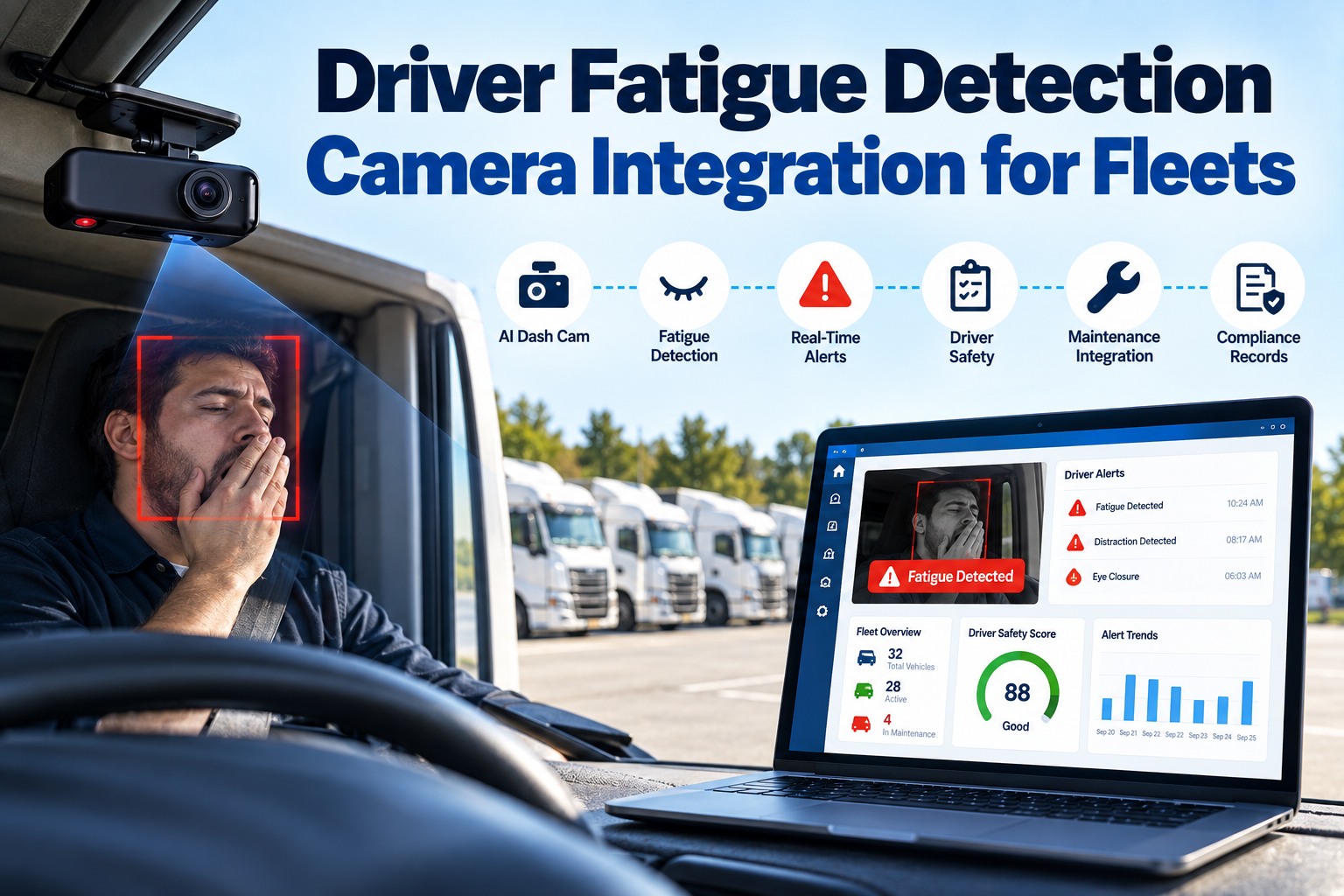
Fatigue detection cameras are a good sensor pointed at the last few minutes of a problem that was created hours earlier. That is worth saying plainly before any procurement decision, because it determines where the value actually sits. FMCSA's own figures put fatigue in the picture on a substantial share of truck crashes — the Large Truck Crash Causation Study found 13 percent of commercial motor vehicle drivers were considered to have been fatigued at the time of their crash — and the agency's starkest framing is that being awake for 18 hours produces crash risk equivalent to a blood alcohol concentration of 0.08 percent. Against that, the measure most of these cameras rely on is PERCLOS, the percentage of time the eyes are more than 80% closed. A peer-reviewed review found it the most accurate indicator for detecting lapses among several measures, including EEG and blink rate — and also concluded that no single index is currently available as an optimal marker for detecting drowsiness during driving or other real-world situations. Both things are true. A camera that fires a useful alert into a workflow nobody has designed is money spent on a recording device. This guide covers where fatigue is actually created, what the camera can and cannot see, how to escalate an alert without destroying driver trust, the objections your drivers will raise, and the ten questions to put to a vendor. See the alert-to-action workflow in a demo, or pilot it on three vehicles.
The Camera Is the Easy Part. The Alert That Reaches Nobody Is the Expensive Part.
For safety directors, fleet risk managers and operations leaders: an honest account of what fatigue detection measures, where it is documented as weak, and how to build the escalation path that turns an in-cab alert into something that actually prevented a crash.
No credit card required. Alerts, inspections and PM records against the same unit.
Equivalence per FMCSA's commercial motor vehicle driver fatigue guidance. It is the single most useful sentence in a driver briefing, because it reframes fatigue from a matter of toughness into a matter of impairment — and no driver argues with the alcohol comparison.
Where Fatigue Is Created, and Where a Camera Can See It
Read this from the top. Only the middle of it is visible to any in-cab sensor, and the cheapest interventions are all above the point where the camera starts working. Walk this through with your own roster data.
Sleep debt accumulates. Extended work hours, strenuous non-work activity, irregular meals. Nothing on the road yet.
No camera can see this. It is a scheduling and rostering problem, and it is where most fatigue is actually created.
Alertness is already reduced but performance still looks normal to the driver and to any sensor watching the face.
Cameras are largely blind here. This is the window where dispatch decisions still cost nothing to change.
Frequent yawning, heavy eyes, blurred vision — the indicators FMCSA lists. The driver usually knows and keeps going.
A camera can start to see this. Yawning and eyelid behaviour are exactly what these systems measure.
Eyes spend a rising share of time more than 80% closed. Reaction time degrades measurably before anything visible happens to the truck.
This is the camera's strongest window, and the only one where an in-cab alert can still be preventive rather than reactive.
Seconds of absence with the eyes open or closed. At highway speed a four-second lapse covers over 350 feet of road.
Detected, and an audible alert may recover the driver — but the margin is now measured in seconds.
Now the vehicle is moving wrong. Lane-departure and following-distance systems trip here.
Recorded rather than prevented. Everything upstream had a cheaper chance to stop this.
Warning signs — frequent yawning, heavy eyes and blurred vision — and the causes listed at the top of the chain are per FMCSA's driver fatigue guidance, which attributes fatigue to a lack of adequate sleep, extended work hours, strenuous work or non-work activities, or a combination of other factors. Stopping distance is arithmetic at highway speed, not a measured figure from any single study.
What the Measure Actually Is
PERCLOS
The percentage of time that the eyes are more than 80% closed, with the eye counted as closed when the eyelid is less than 20% open. In vigilance testing it has outperformed EEG and blink rate as an indicator of attentional lapses, which is why it became the industry's default.
Definition and the comparison against EEG and blink rate per a 2023 review of PERCLOS-based technologies in SLEEP Advances. The same review notes that definitions of PERCLOS have varied greatly across studies, which is why two vendors quoting the same acronym may not be measuring quite the same thing — a fair question to put to both.
The Honest Ledger
Any safety director who presents these systems as comprehensive will be contradicted by their own drivers within a fortnight. Present them as a good sensor with known blind spots and the programme survives.
- Long eyelid closure and slow blink patterns
- Yawning and repeated heavy-eye behaviour
- Head nodding and sustained head-down posture
- Eyes-off-road duration, which is distraction rather than fatigue
- Phone handling, smoking and seatbelt state on most systems
- A recorded clip to attach to a coaching conversation
- Sleep debt built up before the driver got in the cab
- Moderate drowsiness, where the measure is documented as weak
- Fatigue in some older drivers, who showed no rise in one review
- Fatigue that presents as inattention rather than eye closure
- Anything happening behind sunglasses, heavy glare or a mask
- Why the driver is tired — roster, load times, sleep disorder
The limitations column is drawn from the SLEEP Advances review, which reports that PERCLOS was not affected by drowsiness manipulations in moderate drowsiness conditions and in older adults, that it may not be sufficiently sensitive for detecting drowsiness caused by factors other than falling asleep such as inattention or distraction, and that no single index is currently an optimal marker for real-world driving. The review's own recommendation is integration with additional behavioural and physiological measures rather than reliance on PERCLOS alone.
What Happens Between the Alert and the Bay?
Most fatigue camera deployments stop at a dashboard. The version that changes outcomes puts the event against the unit and the driver, next to the inspection record and the open work orders, so a clustered pattern is visible to the person building next week's roster. That is a thirty-minute conversation, not a project.
Escalation That Does Not Burn Driver Trust
The single decision that determines whether this technology works is what happens after an alert. Get it wrong and drivers defeat the sensor, which leaves you worse off than before you bought it. Swipe the table on mobile.
| The pattern | The response | Why |
|---|---|---|
| Single alert, driver recovered, clean history | No action beyond logging | A record, not an incident. Reacting to every alert individually is how a programme loses driver trust in a month |
| Two or more alerts in one shift | Contact the driver during the shift | This is the intervention that actually prevents something. It is also the one most fleets are not staffed to do |
| Alerts clustered between midnight and 6 a.m. | Review the roster, not the driver | FMCSA identifies 12 a.m. to 6 a.m. as a natural drowsy window. A cluster there is a scheduling finding |
| Alerts clustered between 2 and 4 p.m. | Review load and break timing | The second natural drowsy window. Often fixable by moving a break rather than coaching anybody |
| Repeated alerts across weeks, same driver | Confidential conversation, and offer a medical route | Persistent fatigue despite adequate rostering can indicate a sleep disorder, which is a health matter and not a performance one |
| Alerts stop entirely on one unit | Check the camera, not the driver | A lens obstructed, a cable pulled or a device offline looks exactly like a well-rested driver |
| Alert alongside a lane-departure or hard-brake event | Escalate immediately and preserve the clip | Two independent systems agreeing is the strongest signal these tools produce |
The two drowsy windows are FMCSA's: 12 a.m. to 6 a.m. and 2 p.m. to 4 p.m. The agency also recommends naps of roughly 10 to 45 minutes with at least 15 minutes to recover before driving, and specifically warns against relying on alertness tricks such as coffee, a loud radio or an open window — worth knowing, because those are the three things a tired driver will tell you they are already doing.
The Four Objections You Will Hear in the First Week
These are not obstacles to manage around. They are reasonable questions, and having a straight answer to each is the difference between a programme drivers tolerate and one they use.
You are putting a camera on my face because you do not trust me.
The camera is inward-facing on the road, not on the driver as a person, and the honest framing is that it protects the driver in a dispute as often as it exposes one. Fleets that publish the review rules before installation, and that show drivers their own footage, get a different reception from fleets that install quietly and explain afterwards.
It goes off when I am wide awake.
It will, and pretending otherwise loses the room. PERCLOS definitions have varied greatly across studies, the measure is documented as weak in moderate drowsiness, and glare or eyewear degrade it further. The answer is to tell drivers the false-alert rate you actually see, and to never discipline on a single unreviewed alert.
Is somebody watching me all day?
On almost all systems, no — footage is event-triggered, not continuous, and the retention window is a setting you should be able to state in one sentence. If you cannot say who can view footage, under what circumstances, and for how long it is kept, that is the thing to fix before the cameras go in.
What happens to me if I get an alert?
This is the question that decides whether the programme works. If the answer is a coaching conversation with the clip, drivers engage. If the answer is a disciplinary letter generated automatically, drivers learn to defeat the sensor, and you have bought an expensive way to make fatigue invisible.
Ten Questions for the Vendor
Take this into the demo. The answers to questions six and seven are where most products quietly fall short, because an alert that only reaches a manager the next morning was never going to prevent anything.
- What exactly does the system measure, and is it eyelid closure, head pose, or both?
- What is your measured false-alert rate on trucks like ours, in our climate?
- How does it behave with sunglasses, prescription glasses, night driving and low sun?
- Is footage event-triggered or continuous, and what is the retention period?
- Who can view footage, and is every view logged?
- Does the alert reach the driver in the cab, or only a manager afterwards?
- Can an alert create a record in our maintenance and inspection system automatically?
- Can a driver see and dispute their own events?
- What happens to alerts while the vehicle has no connectivity?
- Will you provide the raw event data, or only your dashboard?
Put the resulting events where the rest of the vehicle record lives — alongside the inspection report and the preventive maintenance schedule — so a pattern on one unit or one driver is visible to whoever is building next week's roster.
Building the Case Without Overclaiming
You do not need to promise a crash reduction figure you cannot defend. Three numbers carry the argument on their own.
Crash figure per FMCSA. Downtime benchmark: FleetNet America and ATA's Technology & Maintenance Council via industry reporting. Drowsy windows per FMCSA. Deliberately no crash-reduction percentage is claimed here, because the evidence base for camera-attributable reduction is thinner than vendor material generally implies, and a safety case built on a number you cannot source is a safety case that collapses in the first review meeting.
Fatigue Detection Questions Safety Teams Ask
How does driver fatigue detection actually work?
Most systems watch the driver's face with an inward-facing camera and compute PERCLOS — the percentage of time the eyes are more than 80% closed, with the eye counted as closed when the eyelid is less than 20% open. Many add head pose, yawning and eyes-off-road duration. The alert is usually audible in the cab, with an event clip sent for review. See an event flow end to end.
How accurate is it?
Good in its strongest window, documented as weak outside it. A 2023 review found PERCLOS the most accurate indicator of attentional lapses among several measures including EEG and blink rate, while also concluding that no single index is currently available as an optimal marker for detecting drowsiness during real-world driving, and that it may not be sensitive to drowsiness presenting as inattention rather than eye closure. Ask every vendor for their measured false-alert rate on trucks like yours. Pilot it on three vehicles first.
Does a fatigue camera replace hours-of-service compliance?
No, and treating it as a substitute is a serious mistake. Hours-of-service is a legal duty with its own records; a camera is a real-time sensor with blind spots. The two answer different questions, and a fleet that relaxes rostering discipline because it has cameras has increased its exposure rather than reduced it. Discuss how they sit together.
Will my drivers accept in-cab cameras?
That depends almost entirely on whether you can answer four questions before installation: who can view footage, under what circumstances, for how long it is retained, and what happens to a driver who gets an alert. Fleets that publish those answers first, show drivers their own footage, and never discipline on a single unreviewed event get cooperation. Fleets that install quietly get defeated sensors. Start a pilot with a small group.
What should happen when an alert fires?
Log a single recovered alert and do nothing else. Contact the driver during the shift on the second alert in one shift, because that is the intervention with a real chance of preventing something. Review the roster rather than the driver when alerts cluster in FMCSA's drowsy windows. Escalate immediately when a fatigue alert coincides with a lane-departure or hard-brake event, since two independent systems agreeing is the strongest signal these tools produce. See the escalation rules configured.
Can fatigue events be tied to maintenance and inspection records?
They should be. An event that lives only in a camera vendor's dashboard cannot be read alongside the unit's inspection history, its open defects or its roster, which is where the pattern usually becomes obvious. Keeping all of it against the same unit is the difference between a recording and a safety programme. Put them in one place free.
What if a driver keeps triggering alerts despite good rest?
Treat it as a health matter, confidentially, and offer a medical route. Persistent fatigue in a properly rostered driver can indicate an underlying sleep disorder, and handling that as a performance problem is both wrong and counterproductive — the driver simply stops cooperating with the system. Talk through the policy side with us.
An Alert Is Only Worth What Happens Next
FleetRabbit holds fatigue and camera events against the same unit and driver as the inspection record, the open defects and the work orders — so a cluster of 3 a.m. alerts reaches the person writing next week's roster instead of sitting in a dashboard nobody opens. Bring your own event data to the session and we will map the escalation path against it.
No credit card required. Bring one week of alerts and we will work through them live.