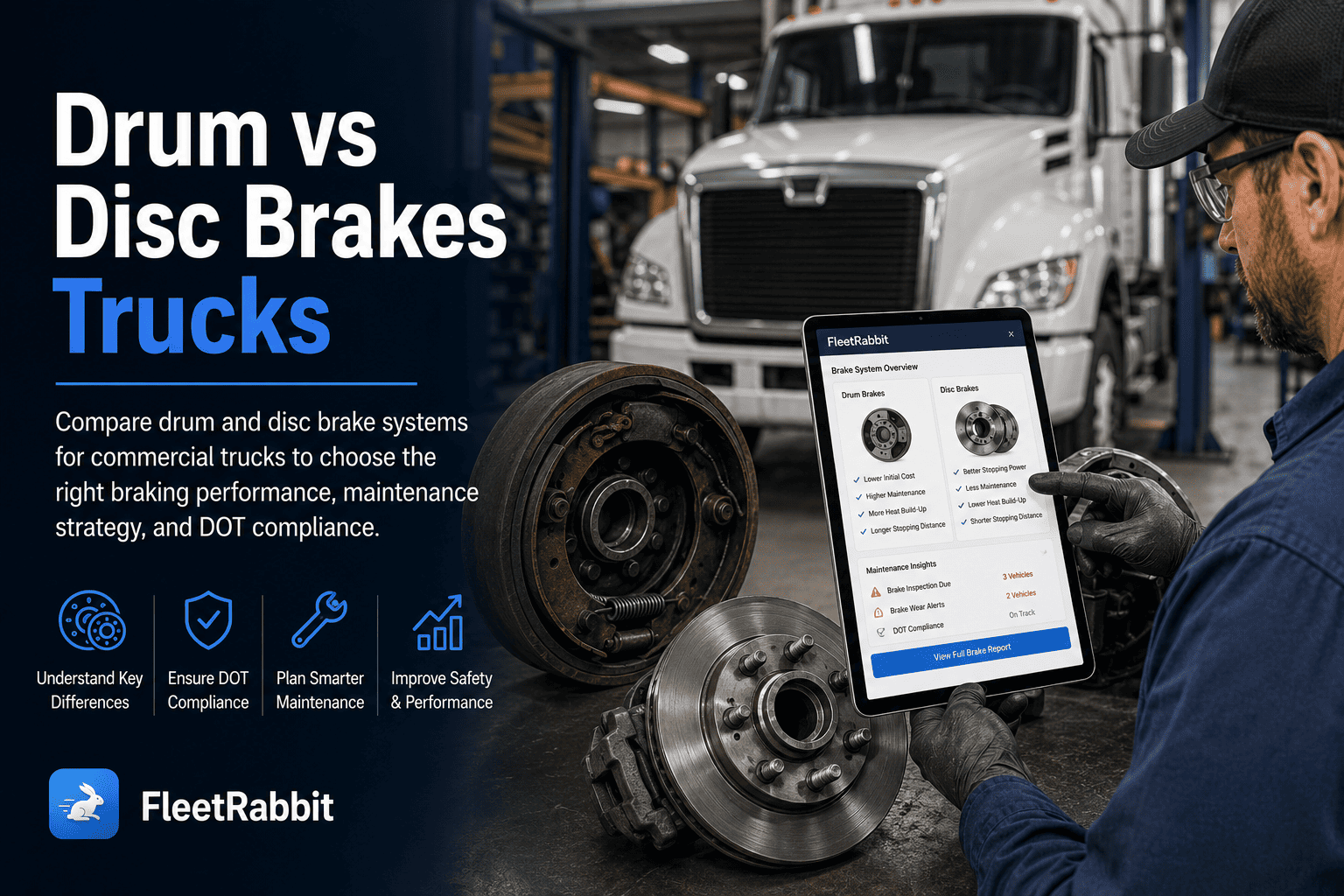
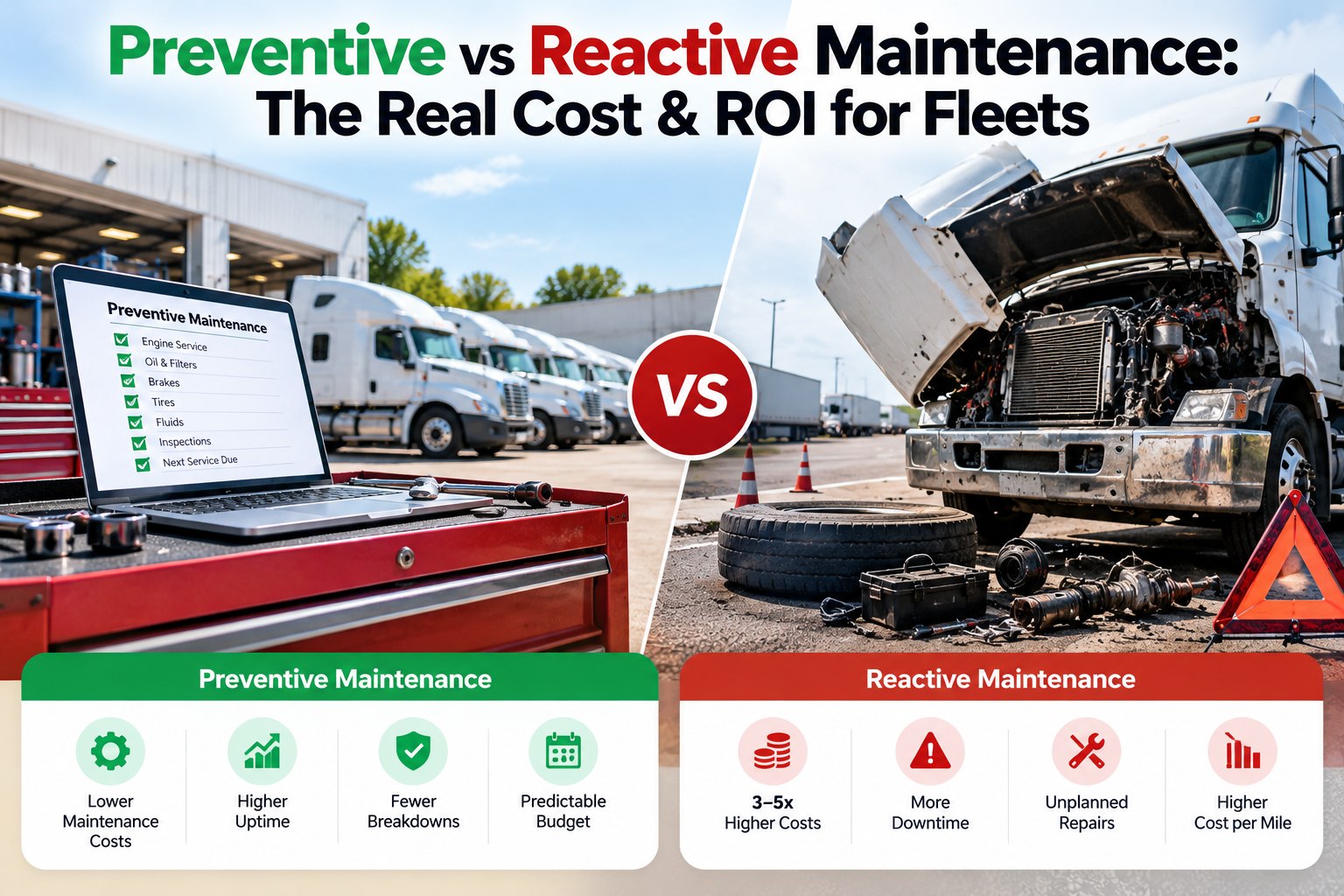
Commercial truck operators choosing between drum and disc brake systems face critical decisions impacting safety, maintenance costs, and regulatory compliance. Drum brakes offer lower upfront costs and proven durability in heavy-load applications, while disc brakes provide superior stopping power, heat dissipation, and reduced maintenance intervals. Fleet Rabbit helps fleets track brake inspection schedules, monitor wear patterns through digital DVIR, and maintain DOT-compliant maintenance records—ensuring optimal brake performance regardless of system type. Book a Demo to see brake maintenance tracking in action.
30–40%
Reduction in brake-related roadside violations with systematic inspection tracking
$1,200–$2,800
Annual maintenance savings per vehicle through predictive brake wear alerts
98.5%
DOT audit pass rate for fleets using digital brake inspection documentation
6–9 hrs
Monthly admin time saved through automated brake maintenance reporting
Brake System Choices Impact Safety, Costs, and Compliance. Fleet Rabbit Helps You Optimize Both.
Whether your fleet runs drum, disc, or mixed brake systems, Fleet Rabbit centralizes inspection schedules, wear tracking, and compliance documentation—reducing downtime and keeping your vehicles road-ready without replacing existing maintenance workflows.
Common Brake Management Challenges in Commercial Fleets
Before selecting or optimizing brake systems, fleet operators must address operational gaps that impact safety and compliance. Reactive maintenance, inconsistent inspections, and manual recordkeeping create preventable risks.
Reactive Brake Maintenance Leading to Downtime
Waiting for brake issues to surface during roadside inspections or driver reports results in unplanned repairs, missed deliveries, and higher emergency service costs.
Inconsistent DVIR Brake Inspection Protocols
Paper-based or manual DVIR processes lead to missed brake checks, incomplete documentation, and compliance gaps during FMCSA audits.
Lack of Brake Wear Trend Analysis
Without historical wear data, fleets cannot predict replacement needs, optimize inventory, or identify vehicle-specific patterns requiring attention.
Compliance Documentation Gaps
Manual maintenance logs are prone to errors, missing signatures, or lost records—creating liability risks during DOT inspections or incident investigations.
How Fleet Rabbit Supports Brake System Management
Fleet Rabbit integrates with existing maintenance workflows to provide structured brake tracking, digital inspections, and compliance automation. See a live demo focused on brake maintenance, DVIR, and compliance reporting.
01
Digital DVIR with Brake-Specific Checklists
Customizable inspection forms for drum/disc systems with photo capture, signature validation, and automatic flagging of critical defects.
02
Predictive Brake Wear Alerts
Track mileage, usage patterns, and inspection history to forecast replacement needs before failures occur—reducing emergency repairs.
03
Maintenance History & Work Order Tracking
Centralized logs for all brake services with parts used, labor hours, and technician notes—supporting warranty claims and cost analysis.
04
DOT Compliance Automation
Auto-generate FMCSA-ready maintenance reports with timestamped, tamper-evident records for brake inspections and repairs.
05
Fleet-Wide Brake Performance Analytics
Compare wear rates, repair costs, and downtime across vehicle classes, routes, or brake types to inform procurement and maintenance decisions.
06
Mobile-First Technician Workflow
Offline-capable mobile app for field technicians to log brake inspections, attach photos, and sync data when connectivity is restored.
Regulatory Framework Support for Brake Compliance
Fleet Rabbit supports documentation requirements for brake-related regulatory standards across key operating regions.
FMCSA §393.47 Brake Standards
Digital records of brake adjustments, replacements, and inspections formatted for roadside inspection verification and audit requests.
UK DVSA Brake Testing
Supports roller brake test documentation and annual inspection records with exportable reports for operator licensing compliance.
Canada CVSA Inspections
Aligns with Commercial Vehicle Safety Alliance criteria for brake system evaluations, with digital defect reporting and correction tracking.
UAE Federal Transport Standards
Generates maintenance logs meeting UAE commercial vehicle requirements, including brake system certification and periodic inspection documentation.
Deployment Approach for Brake Maintenance Optimization
Fleet Rabbit follows a structured onboarding process designed for maintenance-focused fleets—delivering initial brake tracking within the first week and full feature activation within two weeks. No hardware installation required.
01
Brake System Audit
Map vehicle brake types, inspection intervals, and maintenance history
02
DVIR Configuration
Customize brake-specific checklists for drum/disc systems
03
Alert Setup
Define wear thresholds and predictive maintenance triggers
04
Team Training
Onboard drivers and technicians on digital inspection workflows
05
Go-Live and Review
Activate monitoring and schedule 30-day brake performance review
Typical Timeline and Expected Outcomes
Every Fleet Rabbit engagement follows a defined onboarding sequence with measurable milestones. Results vary by fleet size, brake system types, and maintenance discipline. Request the full onboarding scope document tailored to your brake maintenance profile.
Days 1–3
Integration and Baseline
Import vehicle brake system data and historical maintenance records
Configure DVIR checklists specific to drum/disc brake inspections
Set wear threshold alerts based on manufacturer guidelines
Days 4–10
Pilot Monitoring
Activate digital brake inspections on highest-mileage vehicles
Review initial wear trends and defect reports with maintenance team
Identify quick-win opportunities such as overdue adjustments
Days 11–14
Full Activation
Expand brake tracking to full fleet with all configured parameters
Enable automated DOT compliance reporting for brake maintenance
Schedule 30-day review to assess reduction in brake-related downtime
REALISTIC EXPECTATIONS: MEASURABLE IMPROVEMENTS WITH CONSISTENT USE
Fleets that systematically track brake inspections, act on predictive alerts, and maintain digital compliance records typically see reductions in roadside violations and emergency repairs within the first 60–90 days. Results depend on operational follow-through and baseline maintenance practices.
25–35%
Reduction in brake-related violations
15–22%
Lower emergency repair costs
8–12 hrs
Monthly admin time saved
Stop Guessing Brake Health. Start Tracking It Systematically.
Fleet Rabbit's fixed-scope onboarding means no open timelines, no hardware installation, and no months of customization before you gain visibility into brake performance. Deploy at $5/vehicle/month and begin tracking within 72 hours.
Use Cases from Fleet Brake Management Deployments
These examples reflect common scenarios where Fleet Rabbit has supported brake system optimization. Outcomes depend on fleet size, operating conditions, and maintenance discipline. Request additional details for the use case most relevant to your operations.
A mixed-fleet operator struggled with inconsistent DVIR completion and missed brake adjustments. Fleet Rabbit's digital checklists with mandatory photo capture improved inspection compliance. Predictive alerts flagged vehicles approaching wear limits before roadside inspections.
32%
Fewer brake violations
A long-haul fleet sought to reduce premature disc brake replacements. Fleet Rabbit's wear tracking correlated mileage, load data, and route terrain to refine replacement intervals. Maintenance costs decreased while maintaining safety margins.
18%
Lower brake parts cost
An operator managing both drum and disc brake vehicles needed unified inspection standards. Fleet Rabbit's customizable DVIR templates ensured consistent checks across system types, with automated compliance reporting for UAE transport authorities.
100%
Protocol standardization
5 hrs/wk
Reporting time saved
What Fleet Maintenance Teams Say About Fleet Rabbit
Fleet Rabbit transformed how we track brake maintenance. Digital DVIR with photo evidence cut our audit prep time significantly, and predictive alerts helped us avoid two major roadside failures last quarter. It is a practical tool for day-to-day brake management.
Maintenance Director
Regional Trucking Fleet, US
Frequently Asked Questions
Does Fleet Rabbit support both drum and disc brake inspection workflows?
Yes. Fleet Rabbit's customizable DVIR templates allow fleets to define brake-specific checklists for drum, disc, or mixed systems, with photo capture, defect flagging, and technician signature validation.
Can Fleet Rabbit integrate with existing maintenance software?
Yes. Fleet Rabbit connects to major maintenance platforms via REST API, allowing synchronization of work orders, parts inventory, and technician schedules without replacing existing systems.
How does predictive brake wear alerting work?
Fleet Rabbit analyzes mileage, usage patterns, inspection history, and manufacturer guidelines to forecast replacement windows. Alerts trigger when vehicles approach defined wear thresholds, enabling proactive scheduling.
What compliance reports can Fleet Rabbit generate for brake maintenance?
Automated FMCSA-ready maintenance logs, DVIR completion reports, defect correction tracking, and audit-ready documentation with timestamped, tamper-evident records exportable in PDF or CSV formats.
Can technicians use Fleet Rabbit offline for brake inspections?
Yes. The mobile app supports offline DVIR completion with photo capture and signature validation. Data syncs automatically when connectivity is restored, ensuring no inspection data is lost in remote locations.
Track Brake Health. Prevent Violations. Optimize Maintenance in Two Weeks.
Fleet Rabbit provides commercial fleet teams with digital brake inspections, predictive wear alerts, automated compliance reporting, and maintenance analytics—integrated with existing workflows in 5–7 working days, at $5/vehicle/month, with no new hardware required.
Custom DVIR checklists for drum/disc systems
Predictive alerts for brake wear and replacement
Automated FMCSA/DOT compliance documentation
Offline-capable mobile app for field technicians
May 23, 2026By John Polus
All Blogs