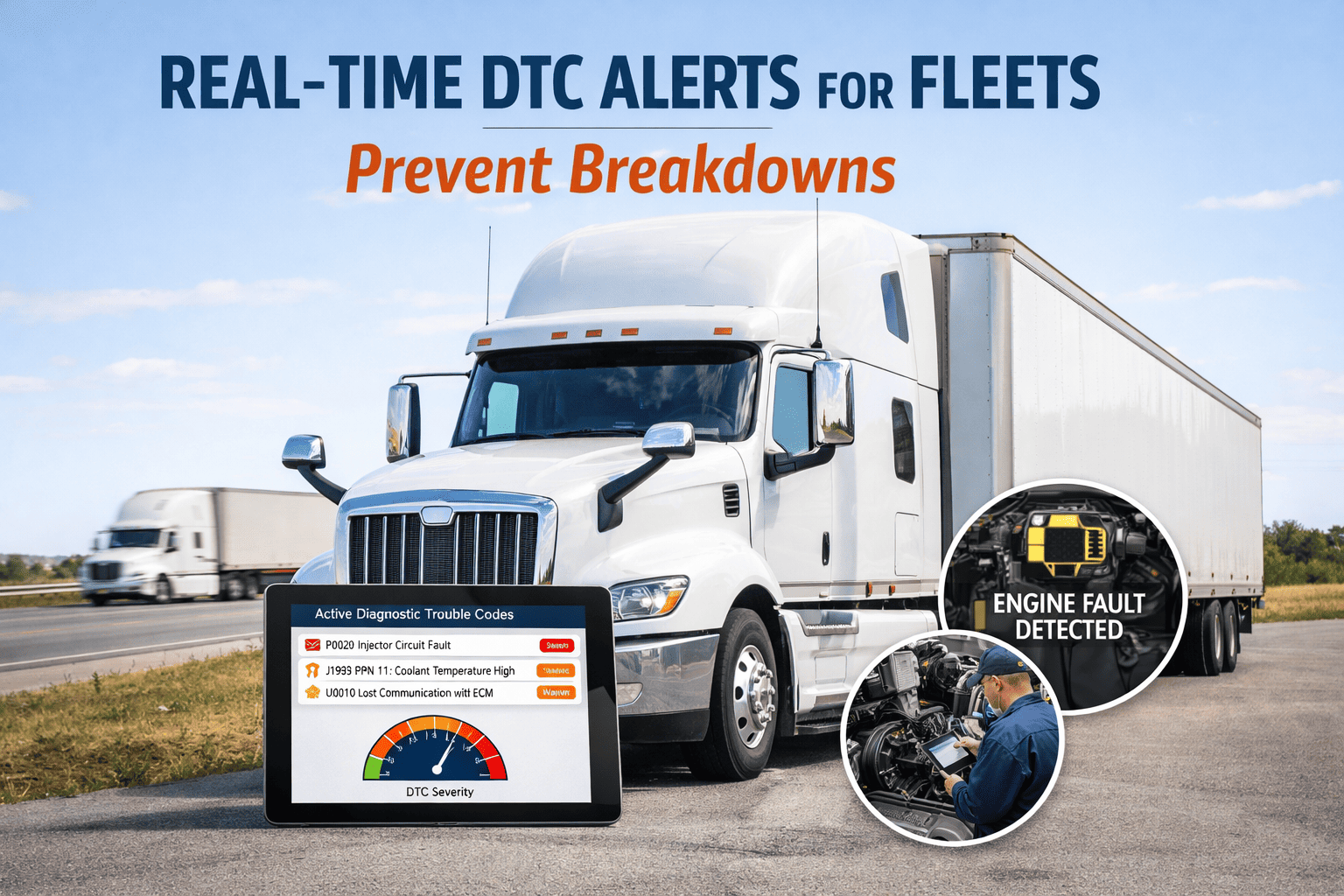
Fleet vehicles generate Diagnostic Trouble Codes the moment engine sensors detect abnormal readings - often weeks before any warning light appears on your dashboard. The difference between a $200 scheduled repair and an $8,000 roadside emergency comes down to one thing: whether you capture these codes in real-time or discover them when your truck is stranded 400 miles from the nearest service bay. Unplanned breakdowns now cost fleets $448-$760 per vehicle per day. Emergency repairs run 3-9x more than planned maintenance. But fleets with real-time DTC monitoring reduce breakdowns by 75% and cut unplanned, downtime in half. This is not theoretical - it is documented performance from operations running predictive diagnostics in 2026. Book a free FleetRabbit demo to see live fault alerts in action.
Real-Time DTC Alerts for Fleets: Catch Faults Before Breakdowns
Diagnostic Trouble Codes are your fleet's early warning system. Learn how real-time DTC monitoring, automated severity scoring, and predictive workflows prevent breakdowns, cut repair costs by 3-9x, and keep trucks on the road.
DTCs are standardized fault signals generated when your vehicle's ECU detects sensor readings outside acceptable parameters. Every modern fleet vehicle - from light-duty vans to Class 8 trucks - continuously monitors dozens of systems: engine temperature, oil pressure, battery voltage, emissions, transmission, and more. When something drifts outside acceptable ranges, the computer logs a code and stores it for retrieval.
Standard 5-character codes (P/B/C/U prefix). Required on all US vehicles since 1996. Generic codes work across all makes.
SPN (Suspect Parameter Number) + FMI (Failure Mode) + OC (Occurrence Counter). Standard for Class 6-8 commercial vehicles.
By the time a check engine light illuminates, the problem has already occurred. But the real cost is not the initial fault - it is what happens when that fault escalates without intervention. A pending code caught early might cost $200 to address. The same issue discovered roadside costs $2,000-$8,000+ including towing, emergency parts, hotel stays, and missed deliveries.
Stop Paying the Breakdown Tax
FleetRabbit monitors DTCs in real-time, scores severity automatically, and creates work orders before problems strand your trucks.
Not every fault code demands the same response. A loose gas cap (P0457) can wait until next scheduled service. A transmission overtemperature warning (P0218) requires immediate action. FleetRabbit's DTC system automatically scores severity and routes alerts to the right response workflow - critical codes alert drivers and dispatch instantly, warnings create scheduled work orders, and informational codes queue for the next PM cycle.
Major damage or safety hazard if operation continues. Stop vehicle now.
Schedule repair soon. Continued operation may accelerate damage.
Address at next scheduled maintenance. No immediate impact.
Modern telematics devices connect to your vehicle's OBD-II port (light-duty) or J1939 data bus (heavy-duty), streaming diagnostic data continuously. When the ECU generates a fault code, the system captures it instantly - not during the next shop visit. Over 90% of 2026 vehicles ship with embedded telematics, making real-time monitoring easier than ever.
Sensor data exceeds defined threshold parameters
Telematics captures and sends DTC in real-time
AI scores severity, routes to right responders
Automated ticket with full diagnostics info
Every fleet sees different code patterns based on vehicle age, operating conditions, and maintenance practices. These are the most common DTCs across commercial fleets in 2026, with severity ratings and recommended actions.
FleetRabbit integrates with all major telematics providers via standard APIs. Over 90% of vehicles manufactured in 2026 ship with embedded telematics - if your trucks have GPS tracking, they likely have DTC capability waiting to be activated. No additional hardware purchase required for most fleets.
Your Telematics Already Has DTC Data. Are You Using It?
FleetRabbit connects to your existing hardware and turns raw fault codes into actionable maintenance intelligence.
Frequently Asked Questions
A pending code appears when an issue is detected intermittently - the ECU sees parameters drifting outside acceptable ranges but not consistently enough to trigger the check engine light. A stored (hard) code means confirmed failure requiring repair. Catching pending codes early prevents escalation to stored codes and avoids breakdowns.
With real-time telematics integration, alerts reach dashboards within seconds. FleetRabbit sends instant notifications for critical codes via email, SMS, or push notification based on your preferences. Warning codes create work orders automatically. Informational codes queue for review at next scheduled service.
No. Critical codes (engine overtemp, low oil pressure) require immediate action - stop the vehicle. Warning codes should be addressed within 24-48 hours. Informational codes can wait for the next scheduled maintenance. Automated severity scoring handles this triage so your team responds appropriately to each code type.
Yes. Fleets using predictive DTC monitoring reduce breakdowns by up to 75% and cut unplanned downtime by 50%. Early detection allows scheduled repairs at 3-9x lower cost than emergency roadside service. The ROI is measurable within the first quarter of deployment. Schedule a demo to see documented results.
If you already have telematics installed (Geotab, Samsara, Motive, Verizon Connect, or OEM systems), you likely have DTC capability already. FleetRabbit integrates via API - no additional hardware purchase required. Over 90% of 2026 vehicles ship with embedded telematics that support fault code transmission.
Stop Breakdowns Before They Start
FleetRabbit monitors DTCs across your entire fleet in real-time, automatically scoring severity and creating work orders. See fault alerts the moment they happen - not when trucks are stranded.