eaton-allison-transmission-fluid-pm

Eaton & Allison Transmission Fluid Service: Fleet PM Schedule

By Emily Parker on August 3, 2026

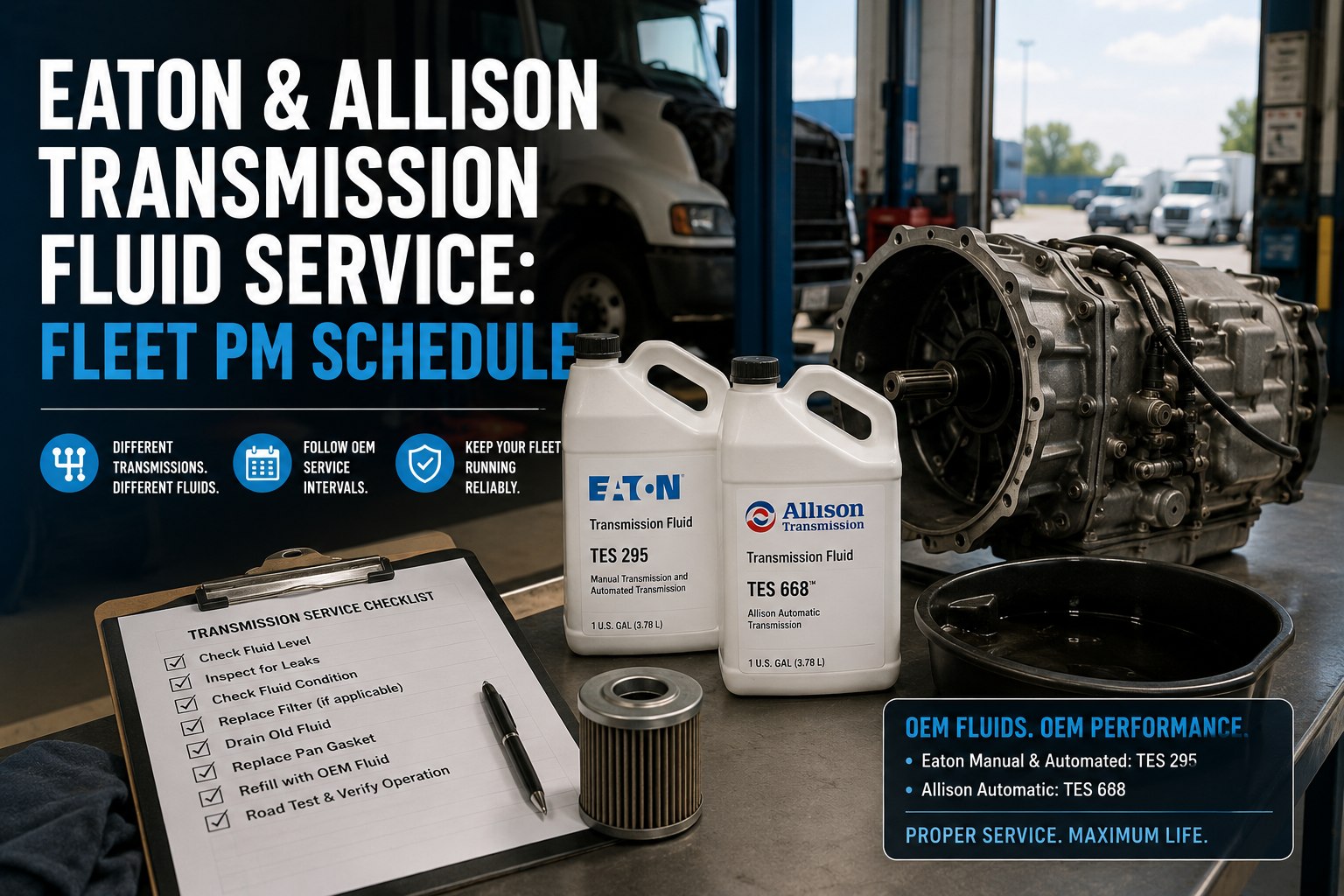
The fastest way to turn a healthy transmission into a warranty claim is to put the wrong fluid in it. Eaton and Allison — the two brands under most heavy trucks in North America — do not share a fluid, and within each brand the correct spec depends on the model, the vocation, and even the year. Allison automatics want a TES-approved fluid; Eaton manuals and automated manuals want PS-386; and using a generic ATF or the wrong grade can cause shift problems within 10,000 miles and void the OEM warranty outright. This guide lays out the actual fluid specs for each brand — TES 295, TES 668, PS-386 — the real service intervals for general versus severe duty, why fluid analysis beats guessing, and how PM software keeps every different spec and interval straight across a mixed fleet so nothing gets the wrong fluid or a missed service. Start a free trial or book a demo to see transmission PM scheduling built for a mixed Eaton and Allison fleet.

PREVENTIVE MAINTENANCE · VEHICLE FLUIDS
Eaton & Allison Transmission Fluid Service: A Fleet PM Guide
Two brands, different fluids, different intervals — and a wrong-fluid mistake that voids the warranty. Get the exact spec for each transmission, the real general and severe-duty intervals, and let PM software keep every spec straight across the fleet.
The Warranty-Voiding Mistake
Generic ATF like DEXRON-VI is no longer approved in commercial on-highway Allison transmissions, and using a non-approved fluid can cause shift problems within 10,000 miles and void the transmission warranty. Eaton is just as strict: since January 1, 2017, warranty coverage requires a PS-386 approved lubricant. The fluid on the shelf that "looks close enough" is how a five-figure transmission becomes an out-of-pocket repair.

Eaton vs. Allison: The Fluid Split

These are two fundamentally different transmission families with different fluids. The first rule is knowing which brand — and which spec — each truck in your fleet actually takes.

EATON
Manual & Automated Manual
Required fluid: PS-386
Applies toEndurant HD/XD, UltraShift PLUS, Fuller Advantage, FR & RT Series
Fluid typeFull synthetic, non-EP
Linehaul interval~500,000 miles
Vocational interval~120,000 miles
Special caseProcision dual-clutch uses PS-278 only
PS-386 replaced the older PS-164 rev7 and is mandatory for warranty since 2017. The differential still runs 75W90 EP-5 gear lube — never put EP gear oil in the transmission.
ALLISON
Automatic
Required fluid: TES 295 / TES 668
Applies to1000, 2000, 3000 & 4000 Series automatics
Fluid typeFull synthetic ATF (TranSynd & approved)
General duty~50,000 miles
Severe duty25,000 mi / 2,000 hrs
Best practiceFluid analysis every ~12,500 mi
TES 668 is the newest spec and supersedes TES 295 — it's backward-compatible and keeps the same drain intervals. TES 389 is older and gives shorter intervals. High-capacity filters extend service life.

Decoding the TES and PS Spec Numbers

The alphabet soup of transmission fluid specs isn't marketing — each code is a specific OEM approval, and mixing them up is how the wrong fluid ends up in a transmission.

TES 668
Allison's newest fluid specification, superseding TES 295. Full synthetic with better oxidation stability and wear protection; backward-compatible with 295/389/468 and keeps the same drain intervals. The direction Allison is moving all fleets.
TES 295
The long-standing synthetic Allison spec required for 3000/4000 series and for Extended Coverage. Enables the long drain intervals. Still fully valid and widely stocked while fleets transition to 668.
TES 389
An older, conventional Allison fluid. Usable in some traditional on-highway units but does not deliver the extended drain or filter intervals of TES 295 — the cheaper fluid that costs more in service frequency.
PS-386
Eaton's synthetic spec for manual and automated transmissions, required for warranty since 2017. Non-EP, reduces sump temperatures, and supports the long linehaul drain intervals. Replaced the obsolete PS-164 rev7.
PS-278
The only approved lubricant for the Eaton Procision dual-clutch transmission. Do not use it in other Eaton models, and don't substitute PS-386 in a Procision — this is a common cross-up.
Not Approved
DEXRON-VI and C4 fluids are no longer recommended in commercial on-highway transmissions. Generic ATF may cause shift problems within 10,000 miles and voids the OEM warranty. "Universal" is not a spec.

Service Intervals by Brand & Duty Cycle

The single biggest interval mistake fleets make is running a severe-duty truck on the general-duty schedule. Duty cycle changes everything. Swipe the table horizontally on mobile.

← Swipe to see all columns →
Transmission Fluid General / Linehaul Severe / Vocational
Allison 3000/4000 TES 295 / 668 ~50,000 mi 25,000 mi or 2,000 hrs
Allison 1000/2000 TES 295 / 668 Per Allison schedule Shorter, per vocation
Eaton Fuller / FR / RT PS-386 ~500,000 mi (linehaul) ~120,000 mi (vocational)
Eaton Endurant PS-386 Per Eaton schedule To 2,000 hrs / 5 years
Eaton Procision PS-278 only Per Eaton schedule Per Eaton schedule
Severe-duty triggers Any — Refuse, transit, on/off-highway, >1 stop per mile, retarder
i
Change the fluid AND the filters, on whichever comes first: Allison's rule is to change fluid and filters at or before the recommended mileage, months, or engine hours — whichever elapses first. A truck with a dense stop-and-go duty cycle often hits the hour limit long before the mileage limit, so tracking by miles alone quietly overshoots the real interval. This is exactly why Allison recommends fluid analysis as the primary method for setting intervals, not the odometer. See multi-trigger interval tracking in action.
4×
faster fluid degradation at 240°F versus normal
Heat Is What Actually Ages the Fluid
Transmission fluid life is governed by temperature as much as mileage. As a rule of thumb, every 20°F above 200°F roughly halves fluid life — so a transmission running at 240°F is destroying its fluid about four times faster than one at 200°F. Overheating usually traces to low fluid level, clogged cooler lines, a failed cooler fan, an overloaded route, or excessive idle in heat. Catching a temperature trend early is what turns a fluid change into a save instead of a rebuild.
One fleet, five different fluid specs and intervals — spreadsheets can't hold that.
Fleet Rabbit stores the exact fluid spec on each transmission and schedules its service by miles, hours, and time — so no Allison runs on Eaton's interval and no truck ever gets the wrong fluid.

Why Transmission PM Is a Multi-Spec Tracking Problem

A mixed fleet might run three Allison series and four Eaton models, each with its own fluid, interval, and duty classification. The chemistry is knowable; keeping it all straight across dozens of trucks is where it breaks down — and where PM software pays for itself.

Fluid Spec on Every Asset
Each transmission's exact fluid — PS-386, TES 668, PS-278 — lives on its record, so the tech doing the service sees precisely what to use and the wrong-fluid warranty risk disappears.
Multi-Trigger Scheduling
Service triggers on whichever comes first — miles, engine hours, or months — so a dense-cycle truck that hits its hour limit early gets serviced on time instead of at the mileage overshoot.
Duty-Cycle Aware Intervals
Flag a vehicle as severe duty and it gets the shorter interval automatically — no more running a refuse or transit truck on the linehaul schedule and wearing it out early.
Fluid Analysis & History Logs
Record oil-analysis results and every service into one history, so you can follow Allison's advice to set intervals by fluid condition and prove the maintenance for warranty and resale.
Keep Every Transmission on Its Own Correct Schedule
Fleet Rabbit stores the exact fluid spec for every Eaton and Allison transmission, schedules service by miles, hours, and months on whichever comes first, applies severe-duty intervals automatically, and logs fluid analysis into a full history — so no truck gets the wrong fluid and no service slips. At $5/vehicle/month, no hardware, live within 72 hours, free for up to three vehicles.
Fluid spec per transmission
Miles / hours / months triggers
Severe-duty aware
Fluid analysis logs

Transmission Service Do's & Don'ts

The rules that keep a transmission — and its warranty — intact, in one place for the shop. Swipe the table horizontally on mobile.

← Swipe to see all columns →
Topic Do Don't
Fluid choice Use the exact OEM-approved spec per model Use "universal" ATF or DEXRON-VI
Filters Change filters with the fluid, every interval Change fluid but reuse old filters
Interval basis Track miles, hours, and months together Rely on odometer alone
Duty cycle Apply severe-duty intervals when they fit Run vocational trucks on linehaul intervals
Eaton diff Keep 75W90 EP-5 in the differential Put EP gear oil in the transmission
Overheating Investigate coolers, fans, fluid level Ignore a rising transmission temp

Frequently Asked Questions

Can I use the same fluid in Eaton and Allison transmissions?
No. Eaton manual and automated transmissions require a PS-386 approved synthetic, while Allison automatics require a TES-approved automatic transmission fluid such as TES 295 or the newer TES 668 — they are different fluids for fundamentally different transmission designs. Using the wrong one risks shift problems and a voided warranty. On a mixed fleet the safest approach is to store each transmission's exact spec on its record so no truck gets the wrong fluid, which is something you can book a demo to see set up across your whole roster.
What's the difference between TES 295 and TES 668?
TES 668 is Allison's newest fluid specification and it supersedes the long-standing TES 295. It's a full synthetic with better oxidation stability and wear protection, it's backward-compatible with TES 295, 389, and 468, and importantly it keeps the same drain intervals — so switching is straightforward. Allison isn't forcing an immediate change but is steering fleets toward 668 over time. Understanding which of your Allison units are on which spec, and tracking that transition, is something you can book a demo to manage on each asset record.
How often should I change Allison transmission fluid?
It depends heavily on duty cycle. General on-highway service with an approved TES 295 or 668 fluid and high-capacity filters runs around 50,000 miles, but severe duty — refuse, transit, on/off-highway, or more than one stop per mile — drops to roughly 25,000 miles or 2,000 hours, whichever comes first. Allison actually recommends fluid analysis every 12,500 miles or so as the primary way to set the interval rather than a fixed number. Tracking those multiple triggers per vehicle is exactly what you can book a demo to automate.
How often should I change Eaton transmission fluid?
For Eaton Fuller, FR, and RT series running PS-386 synthetic, linehaul applications typically go about 500,000 miles between services, while vocational applications run closer to 120,000 miles because of the harder duty cycle. Endurant models follow their own schedule, often expressed to 2,000 hours or five years. The wide spread is exactly why the vocation classification matters so much, and applying the right interval to each truck automatically is something you can book a demo to see handled by duty cycle.
Does using non-approved fluid really void the warranty?
Yes. Allison no longer recommends DEXRON-VI or C4 fluids in commercial on-highway transmissions, and generic ATF can cause shift problems within about 10,000 miles while voiding the OEM warranty. Eaton has required PS-386 approved lubricant for warranty coverage since January 1, 2017. Beyond the warranty issue, the wrong fluid genuinely damages seals, clutches, and friction materials. Keeping the approved spec visible to every technician is the simplest protection, and it's something you can book a demo to build into your service workflow.
Do I change the filters every time I change the fluid?
Yes — for Allison, the rule is to change fluid and filters together at or before the recommended interval, and high-capacity filters are what enable the extended drain intervals in the first place. Reusing an old filter with fresh fluid undercuts the whole service and can shorten the fluid's effective life. Scheduling the filter change as part of the same PM event, with the right filter part number on the record, is something you can book a demo to see bundled automatically so it never gets skipped.
Why does transmission temperature matter for fluid life?
Because heat ages fluid faster than miles do. As a rule of thumb, every 20°F above 200°F roughly halves the fluid's life, so a transmission running at 240°F degrades its fluid about four times faster than one at 200°F. Persistent high temperatures usually point to low fluid, clogged cooler lines, a failed cooler fan, an overloaded route, or heavy idle time. Watching for a temperature trend and acting on it can save a transmission, and building that awareness into your maintenance triggers is something you can book a demo to explore.
How does PM software help with mixed Eaton and Allison fleets?
By holding every transmission's spec and schedule in one place instead of a technician's memory or a spreadsheet. It stores the exact fluid — PS-386, TES 668, PS-278 — on each asset, schedules service on whichever of miles, hours, or months comes first, applies severe-duty intervals to the trucks that need them, and logs fluid analysis into a full history for warranty and resale. Across a fleet with several transmission families that's the difference between every truck on its correct schedule and a warranty-voiding mistake, and seeing it run on your own equipment is exactly what you can book a demo to do.
Never Put the Wrong Fluid — or Miss a Service — Again
Fleet Rabbit keeps every Eaton and Allison transmission on its own correct schedule — the exact fluid spec on each asset, service triggered by miles, hours, and months, severe-duty intervals applied automatically, and fluid analysis logged for warranty. Protect the most expensive driveline component on every truck. Integrated in 5–7 working days, at $5/vehicle/month, free for up to three vehicles, with no hardware required.
Free tier for up to 3 vehicles · No credit card required · No hardware installation

August 3, 2026By Emily Parker
All Blogs
eaton-allison-transmission-fluid-pm

Eaton & Allison Transmission Fluid Service: Fleet PM Schedule

By Alex Rowan on August 19, 2026

Transmission fluid service is the maintenance item most often scheduled wrong, and the reason is that fleets schedule it against the truck rather than against the driveline. A single spec of tractors can carry an Eaton manual, an Eaton automated and an Allison automatic, and those three need different fluids, different filters and intervals that differ by hundreds of thousands of miles. Worse, the interval is not a property of the transmission at all — it is the product of four separate variables, and changing any one of them moves the number. Allison is explicit about this: extended fluid and filter intervals are only permitted with an approved fluid and high-capacity filters, and the change is due at or before the recommended mileage, months or hours have elapsed, whichever comes first. Get the combination wrong and you are running an extended-interval schedule on a standard-interval system. Start a free trial to schedule fluid and filter service per unit instead of per fleet.

PREVENTIVE MAINTENANCE · DRIVELINE
Eaton and Allison Transmission Fluid Service
Three transmission families, three fluid regimes and intervals that range from 120,000 to 750,000 miles — plus the four variables that decide which number applies to which truck.
Eaton manual
FR and RT Series
Approved Eaton fluid
Eaton automated
Endurant, UltraShift PLUS, Fuller Advantage
Approved Eaton fluid
Allison automatic
1000, 2000, 3000, 4000, TC10
TES 668 / TES 295 / TES 468

Four Variables Set the Interval

The transmission model is only the first of them. All four have to be known for the interval on the work order to be the right one.

01Which fluid is in itExtended drain intervals are permitted only with an approved fluid. A lesser-spec product may be usable in some applications but does not deliver the same drain or filter intervals.
02Which filters are fittedAllison's high-capacity filters are what allow extended filter change intervals, and only when paired with an approved fluid. Standard filters mean standard intervals regardless of what fluid is in the sump.
03VocationSevere vocation covers on/off highway, refuse, city transit and shuttle transit. General vocation is everything not classified as severe — and the difference between the two is measured in tens of thousands of miles.
04Prognostics on or offWhere the transmission control module runs prognostics, the fluid change is called by the controller rather than by a fixed mileage. Turned off or uncalibrated, the fixed table applies instead.
The rule that overrides all four
Change fluid and filters at or before the recommended mileage, months or hours have elapsed — whichever occurs first. A truck that idles heavily will hit the hour figure long before the odometer figure, and a low-mileage unit will hit the calendar limit before either. Scheduling on miles alone quietly skips the interval on a meaningful share of any mixed fleet.

The Allison Fluid Ladder

Specification names look interchangeable and are not. This is the current hierarchy and what each one buys you.

TES 668
Current approved specRecommended alongside TES 295 to extend drain intervals and enhance performance and durability across all operating environments in on-highway products.
TES 295
Approved, extended intervalThe long-standing extended-drain specification, still approved and widely used. Fresh fluid is bright red.
TES 468
Usable wherever TES 295 is specifiedAnd required for H 40/50 EP products specifically. Also permitted with prognostics.
TES 389
Traditional on-highway onlyMay be used in traditional on-highway products but does not provide the same drain or filter change intervals as an approved TES 295 fluid. Choosing it shortens the schedule.
Not approved
C4 fluids and DEXRON-VINo longer recommended in any commercial on-highway transmission. Generic ATF is not a substitute for an approved fluid in these units.
Approved-fluid lists change. Allison publishes current TES 668 and TES 295 approved fluid lists on its own site, and the practical discipline is to check the list at purchase rather than assume a product that qualified two years ago still does. Prognostics adds a further constraint — where it is in use, it must only be run with approved TES 668, TES 295 or TES 468 fluids.
Scheduling
Four variables per unit is exactly the kind of thing software should hold, not a technician.
Fluid spec, filter type, vocation class and prognostics status recorded against the asset, with the interval derived rather than remembered.

How the Allison Intervals Are Structured

Figures vary by product family, so always work from the current Allison table for the specific unit. What does not vary is the shape — fluid and filters on separate schedules, general and severe vocation split, and prognostics changing the fluid trigger entirely. These example figures are from one product series to show the structure.

← Swipe to see all columns →
Item Prognostics off or uncalibrated Prognostics on Notes
Fluid, general vocation 500,000 miles / 20,000 hours / 60 months When indicated by the controller, or 60 months Requires an approved TES 668 or TES 295 fluid
Internal filter, general 75,000 miles / 3,000 hours / 36 months Per the controller and interval table High-capacity filters are what enable the extension
Internal filter, severe 25,000 miles / 1,000 hours / 12 months Per the controller and interval table On/off highway, refuse, city transit, shuttle transit
Lube / auxiliary filter, general 75,000 miles / 3,000 hours / 36 months Per the controller and interval table Tracked separately from the internal filter
Lube / auxiliary filter, severe 25,000 miles / 1,000 hours / 12 months Per the controller and interval table Severe vocation triples the filter frequency
Plan the fluid loss into the job
Filter changes are not dry jobs. Approximate fluid loss per filter runs to about a pint on a 1000/2000 series control main filter, around two quarts on a 3000/4000 main filter, and roughly eight quarts on a lube filter. A lube filter change that arrives without eight quarts of the correct approved fluid on the bench becomes a truck sitting on a lift.

The Eaton Side

Different structure entirely. Eaton's approved fluid covers manual and automated families alike, and the interval range across applications is enormous — which is exactly why "the Eaton interval" is not a usable phrase in a mixed fleet.

One approved fluid, many boxes
Approval covers Eaton transmissions including Endurant, UltraShift PLUS, Fuller Advantage, FR and RT Series — formulated to protect higher-torque transmissions coupled to increased-horsepower engines.
Drain intervals vary by application
From as much as 750,000 miles down to as low as 180,000 depending on the application. That is a four-fold spread on the same fluid, which makes application classification the deciding input rather than the transmission model.
Axles are a separate schedule
Differential lubes remain 75W90 EP-5 gear lube, with Meritor specifying O76-N and O76-E and Dana SHAES-256 Rev C. Linehaul applications typically run 500,000 miles between service events while vocational applications run 120,000.
Do not fold axles into the transmission PM
Different fluid, different spec, different interval, different failure mode. Fleets that bundle them into one driveline service end up applying whichever interval is shorter to everything, or whichever is longer to something that needed the shorter one.

What to Inspect While You Are There

Six checks that cost minutes and prevent the failures that no fluid specification protects against.

1Leaks, however smallEven small leaks can have catastrophic consequences through low lube levels. A weep that looks trivial at 50,000 miles is a bearing failure at 200,000.
2The ventRoad dirt blocking the vent causes leaks by pressurising the case. Cleaning it takes seconds and it is almost never on a checklist.
3Gear oil level at the plugWith the truck level, the oil should sit at the bottom of the fill plug. Anything lower is a top-up and an investigation, not just a top-up.
4Allison level check procedureEngine running, transmission warm, truck level, reading between the hot minimum and maximum marks. Low fluid causes harsh shifting and slipping; overfilling causes foaming and erratic shifts.
5Fluid condition by eye and noseFresh TES 295 is bright red. Dark brown or black means the service is overdue. A burnt smell indicates internal damage from overheating and changes the job from a service to a diagnosis.
6Stored fault codesTransmission codes such as P0700, P0730 and P0741 flag control-system, gear-ratio and torque-converter clutch faults. Pulling them during a fluid service is free diagnosis.

Setting It Up in PM Software

Seven things worth automating, because every one of them is a place where a correct procedure gets applied to the wrong unit.

Transmission model per unitFamily and series on the asset record, so the work order carries it. Three families in one spec is normal, and nobody should be identifying them at the lift.
Fluid specification per unitTES 668, TES 295, TES 468, TES 389 or the Eaton approved fluid — recorded, not inferred. It determines the interval and the parts order.
Filter type flagHigh-capacity or standard. This single field is the difference between an extended and a standard filter schedule.
Vocation classGeneral or severe, per Allison's definition. Applied per unit rather than per fleet, because a refuse body on the same chassis changes the answer.
Miles, hours and calendar togetherThree triggers on the same task, firing on whichever arrives first. Mileage-only scheduling misses the hour and calendar limits entirely.
Fluid and filters as separate tasksThey fall due at wildly different points. Bundling them into one service means doing one of them far too often or far too late.
Parts tied to the taskIncluding the fluid volume lost during a filter change, so the job is kitted correctly before the truck comes in.
One spec, three transmissions, seven schedules
Fleet Rabbit stores transmission model, fluid spec, filter type and vocation class per unit, schedules fluid and filter service as separate tasks on miles, hours and calendar simultaneously, and kits the parts — including the fluid a filter change consumes — before the truck arrives.

Frequently Asked Questions

What is the difference between TES 295 and TES 668?
Both are Allison-approved fluids that permit extended drain intervals, with TES 668 the more recent specification. Allison recommends using an approved TES 668 or TES 295 fluid to extend drain intervals and enhance transmission performance and durability in on-highway products. TES 468 can be used anywhere TES 295 is specified and is required for H 40/50 EP products. The practical point is that all three sit in the extended-interval group, while TES 389 does not.
Can I use generic ATF in an Allison?
No. C4 fluids and DEXRON-VI are no longer recommended in any commercial on-highway transmission, and using a non-approved fluid forfeits the extended drain intervals the unit was specified around — quite apart from any warranty consequence. If prognostics is in use, the constraint is tighter still: it must only be used with approved TES 668, TES 295 or TES 468 fluids. Check the current approved list at purchase rather than relying on a product that qualified previously.
Why do two identical trucks have different intervals?
Because the interval is set by four variables, not one. Which approved fluid is in it, whether high-capacity filters are fitted, whether the vocation is classified general or severe, and whether prognostics is turned on and calibrated. A tractor pulling linehaul and an identical chassis running refuse are in different vocation classes, and severe vocation can triple filter frequency. The transmission model is the starting point, not the answer.
What does prognostics actually change?
It replaces the fixed mileage trigger for the fluid change with a controller call — the fluid is changed when indicated by the transmission control module, or at the calendar limit, whichever comes first. Prognostics monitoring fluid and filter life was introduced for the 1000, 2000, 3000 and 4000 product families from model year 2009. It only works correctly with approved fluids, so a non-approved fill undermines the feature you are relying on to tell you when to service.
What is the Eaton drain interval?
There isn't a single one, and that is the important part. With Eaton-approved fluid, drain intervals vary from as much as 750,000 miles down to as low as 180,000 depending on the application, across a family that includes Endurant, UltraShift PLUS, Fuller Advantage, FR and RT Series. Application classification is therefore the deciding input. Record it per unit and derive the interval from it, rather than applying one number across the fleet and hoping it is conservative enough.
Should axle service run with the transmission service?
No — keep them as separate schedules. Differential lubes remain 75W90 EP-5 gear lube against Meritor O76-N and O76-E or Dana SHAES-256 Rev C, and typical service intervals run around 500,000 miles for linehaul and 120,000 for vocational applications. Those figures do not align with transmission intervals, so bundling them means one of the two is always being done at the wrong time. Different fluid, different spec, different schedule.
How do I keep this straight across a mixed fleet?
Put the four variables on the asset record and let the schedule derive from them, rather than expecting a technician to reconstruct them at the lift. Transmission family and series, fluid specification, filter type and vocation class — with fluid and filters as separate tasks triggered on miles, hours and calendar simultaneously. The failure mode in mixed fleets is almost never a bad procedure; it is a correct procedure applied to the wrong truck. Start a free trial to set it up against your own units.
Schedule the Driveline, Not the Truck
Four variables recorded per unit, fluid and filters on separate tasks, miles and hours and calendar all live, and the approved fluid list checked at purchase rather than assumed.
Always confirm intervals against the current OEM table for the specific unit · Free tier available · No credit card required
August 19, 2026By Alex Rowan
All Blogs

Share This Story, Choose Your Platform!

From our blog

Get Fleet Rabbit App
#1 Truck Fleet Management Software

Download Our App
Scroll