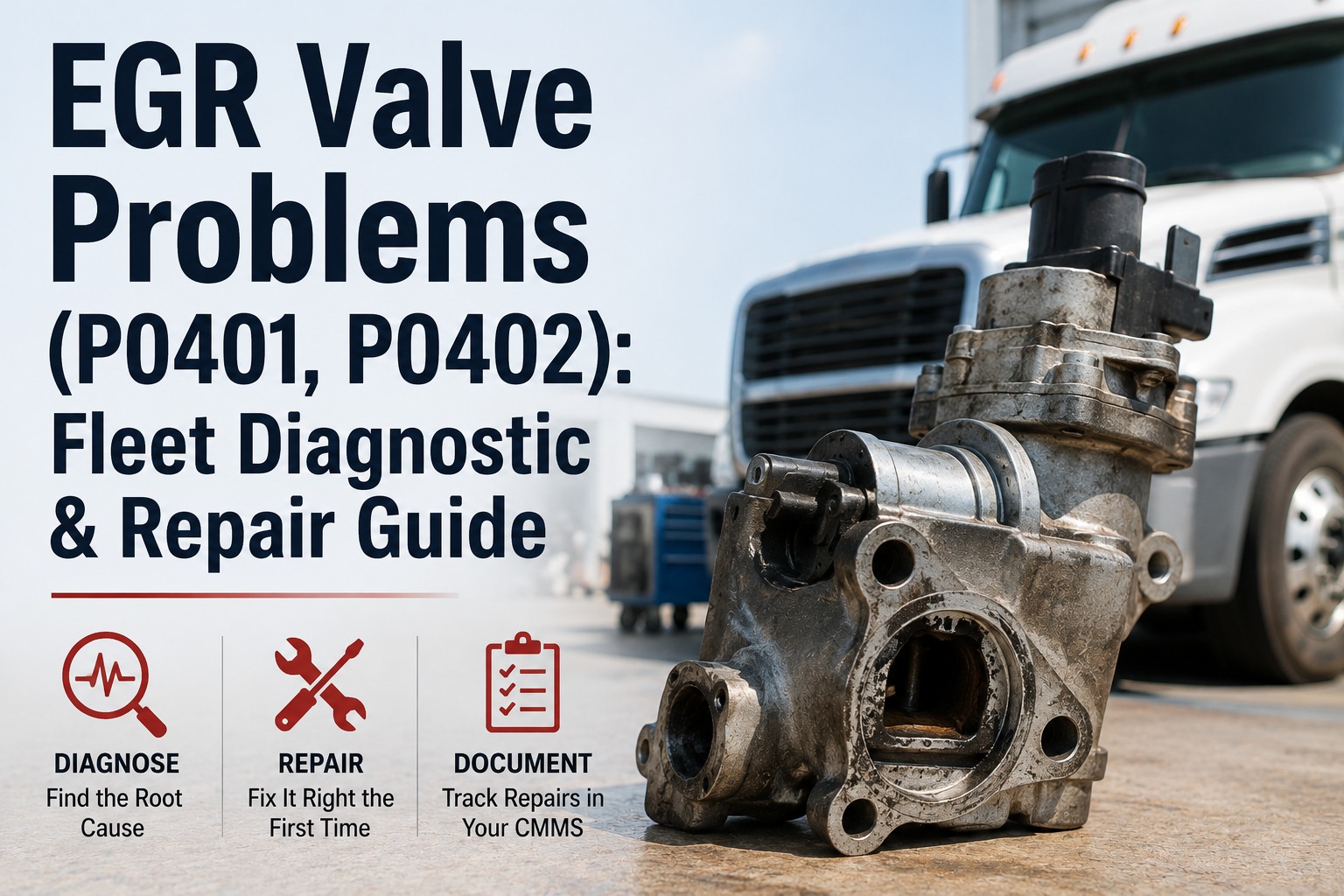
EGR faults are among the most common codes a diesel fleet sees, and among the most misdiagnosed — because two nearly opposite failures share one component. P0401 means insufficient exhaust gas flow, usually a valve stuck closed or passages plugged with carbon. P0402 means excessive flow, usually a valve stuck open and dumping exhaust into the intake constantly. They produce different symptoms, damage different things, and demand different repairs. In practice P0401 outnumbers P0402 roughly ten to one, for a simple reason: carbon accumulation is a one-directional process, and EGR components only get dirtier over time. The trap is that both codes can also be thrown by a healthy valve reporting through a bad sensor, or by a plugged cooler the valve has no control over — which is why replacing the valve without testing leads to repeat repairs so often. This guide covers the diagnostic split, the scan-tool command test that settles it, EGR cooler failure signs, and how documenting the repair in your CMMS stops the same fault returning every few months. Start free trial or book a demo to track recurring EGR failures across your fleet.
DIAGNOSTICS & REPAIR · EMISSIONS SYSTEM
Two Opposite Faults, One Valve — and a 10-to-1 Split
Stuck closed starves the intake of exhaust gas and drives combustion temperatures up. Stuck open floods it, kills throttle response, and contaminates the oil. Carbon only accumulates in one direction, which is why insufficient flow is by far the more common failure.
P0401
EGR Flow Insufficient
Valve stuck CLOSED
Carbon-clogged valve, passages, or cooler
Raises peak combustion temperatures
Engine knock and reduced fuel economy
Guaranteed emissions test failure
Overheating risk under sustained load
Roughly 10× more common
P0402
EGR Flow Excessive
Valve stuck OPEN
Carbon fragment wedged in the valve seat
Dilutes intake oxygen — sluggish throttle
Rough idle and stalling at low RPM
Black smoke under acceleration
Severely contaminates engine oil
Less common, faster damage
10:1
How much P0401 outnumbers P0402 in the field
Under $50
A thorough cleaning, when the valve is salvageable
$150–$750
Typical total repair range, parts and labor
Days
Not weeks — how long you can defer before damage compounds
The Command Test That Settles It
Before any part comes off the truck, one test tells you whether the valve is mechanically stuck. It takes minutes and it prevents the most common wasted repair in the EGR system.
1
Command the Valve Open
Use a scan tool to command the valve open on an electronic system, or apply vacuum on a vacuum-operated one. Watch what the engine does.
2
The Engine Should Stumble or Stall
A working valve opening at idle dumps exhaust into the intake and visibly upsets the engine. That stumble is proof the valve moves and the passages flow.
3
Compare Commanded vs. Actual Position
Watch the position feedback while cycling the valve. If actual doesn't track commanded, the valve is failing mechanically — and a P0404 alongside P0401 confirms a position mismatch.
4
No Stumble? Look Past the Valve
If the valve opens correctly but the code persists, the restriction is downstream of it — check the EGR passages in the intake manifold and the cooler for carbon blockage.
i
The mistake that causes repeat repairs: replacing parts without testing. A P0401 can be set by a stuck valve, plugged passages, a clogged EGR cooler, a failed differential pressure feedback sensor, a faulty MAP sensor, or simple wiring damage — and only one of those is fixed by a new valve. On older Ford trucks in particular, DPFE sensor failure is more common than a bad EGR valve, and on VW TDI platforms a cracked DPF can cause a secondary clog in the low-pressure EGR circuit. Test the valve, test the sensor, inspect the passages, and only then order a part.
See how documented test results prevent the repeat.
Valve or Cooler? They Fail Differently
The EGR valve and the EGR cooler are separate components with separate failure modes, and confusing them is expensive because the cooler is the costlier repair. Here's how to tell them apart. Swipe the table horizontally on mobile.
← Swipe to see all columns →
Cleaned the EGR six months ago? That's the most important fact in this diagnosis.
Fleet Rabbit stores every EGR cleaning, valve replacement, and code against the truck — so a returning P0401 tells you whether it's carbon again or something the cleaning never addressed.
The Full Diagnostic Sequence
Work these in order. Most EGR faults resolve in the first four steps, and the sequence is designed to catch the cheap causes — sensors, hoses, carbon — before you commit to a valve or cooler.
1
Confirm the Code and Its Companions
Scan for P0401, P0402, and related circuit codes. A P0404 alongside P0401 points at a valve position mismatch; codes in the P0403–P0408 range point at circuitry or the sensor rather than flow itself.
2
Inspect the Valve, Hoses & Connections
Visually check the EGR valve, vacuum hoses, and electrical connections. A cracked vacuum hose or damaged connector produces flow codes on a mechanically perfect valve.
3
Run the Command Test
Command the valve open with a scan tool or vacuum pump. The engine should stumble. No movement means stuck; movement that doesn't match the command means failing.
4
Test the Feedback Sensor
On DPFE-equipped platforms, test the sensor and its hoses for cracks or blockage — sensor failure is more common than valve failure on some trucks. A faulty MAP sensor can also throw a P0401.
5
Inspect and Clean the Passages
Check the EGR passages and intake manifold for carbon deposits. Use an EGR-specific solvent or a suitable cleaner, rod the passages carefully, and avoid damaging the valve seat.
6
Inspect the Cooler
On diesels, check the EGR cooler for blockage and internal leaks. Unexplained coolant loss is the tell — pressure-test the system rather than assuming the valve is at fault.
7
Check for a Calibration Update
Some EGR faults are resolved by an ECU reprogram rather than a part. Check for applicable bulletins before ordering — it's a free step that occasionally solves the whole thing.
8
Replace — With the Cause Documented
Replace the valve, solenoid, sensor, or cooler once testing has identified which one failed, and record what the tests showed so a recurrence starts from evidence rather than guesswork.
Turn Recurring EGR Codes Into a Root Cause You Can Fix
Fleet Rabbit records every EGR cleaning, valve replacement, cooler inspection, and code against the specific truck — so when P0401 returns for the third time on the same unit, the history shows what's already been tried and points you at the cracked DPF, the failing sensor, or the fuel quality driving the carbon. Deploy at $5/vehicle/month, no hardware, live within 72 hours.
EGR service history per truck
Repeat-failure flags
Cleaning interval tracking
Defect-to-work-order routing
Repair Costs and What Drives Them
EGR repairs span a wide range, and where you land depends almost entirely on how early the carbon was caught. Swipe the table horizontally on mobile.
← Swipe to see all columns →
On deferring the repair, and on deletes. An EGR fault is moderately severe: driving a few days generally won't worsen it, but weeks will — insufficient flow raises peak combustion temperatures, and excessive flow severely contaminates engine oil. If the fault produces hesitation or stalling, that becomes a do-not-drive condition on safety grounds alone. As for EGR delete kits: they permanently stop the code, and they are not legal for road use. Deleting the EGR removes a federally mandated emissions control device, so for any on-highway fleet vehicle this is not an option regardless of how tempting the recurring-carbon problem makes it.
Book a demo to solve the carbon problem legally.
How CMMS Documentation Breaks the Recurrence Cycle
EGR carbon comes back. The question is whether it comes back as a mystery or as a documented pattern you can act on. Here's how Fleet Rabbit makes it the second one.
01
Full EGR Service History
Every cleaning, valve replacement, cooler inspection, and sensor test is logged against the VIN — so the next technician knows exactly what's been done and when, instead of starting over.
02
Repeat-Failure Flags
When P0401 returns after a valve was already replaced, the system flags it — redirecting attention to the passages, the cooler, a cracked DPF, or the sensor rather than a second identical part.
03
Cleaning Interval Tracking
Trucks that carbon up fast can be scheduled for proactive EGR cleaning rather than waiting for the next code and the next derate — turning a breakdown into planned shop time.
04
Diagnostic Test Records
Record whether the command test passed, whether the position tracked, and whether the cooler was pressure-tested — evidence that makes the second visit dramatically shorter.
05
Defect-to-Work-Order Routing
A driver's report of rough idle, black smoke, or lazy throttle becomes a tracked defect and a scheduled work order automatically, catching EGR problems before the code sets.
06
Fleet-Wide Pattern Detection
EGR carbon accumulating fast across multiple trucks points at fuel quality or duty cycle rather than component defects — a fleet-level fix no individual repair will achieve.
Frequently Asked Questions
What's the difference between P0401 and P0402?
They're opposite faults in the same system. P0401 means EGR flow is insufficient — typically a valve stuck closed or passages plugged with carbon — which raises peak combustion temperatures and hurts fuel economy. P0402 means flow is excessive, usually a valve stuck open or leaking past its seat because a hardened carbon fragment is wedged inside, which dilutes intake oxygen, causes rough idle and black smoke, and severely contaminates engine oil. P0401 outnumbers P0402 roughly ten to one because carbon accumulation only moves in one direction, which is why tracking each truck's cleaning history — something you can
book a demo to see — tells you whether a P0401 is fresh carbon or a deeper fault.
Can I clean the EGR valve instead of replacing it?
Often, yes. When the problem is carbon buildup and the valve is still mechanically sound, a thorough cleaning with an EGR-specific solvent can resolve a P0401 for well under $50 in materials — soaking, brushing, and carefully rodding the passages without damaging the valve seat. Replacement becomes necessary when the valve is mechanically stuck, when the actuator is failing, or when commanded and actual position won't match. Clean first, test after, and replace only if the fault persists — and logging which of those you did is exactly the record you can
book a demo to walk through so the next tech doesn't start over.
How do I know if it's the EGR valve or the EGR cooler?
Run the command test first. If the valve opens on command and the engine stumbles, the valve works — so a persisting flow code points to plugged passages or a blocked cooler downstream of it. The clearest cooler-specific tell is unexplained coolant loss, which indicates an internal leak; white smoke alongside coolant consumption points the same way. Pressure-test the cooling system rather than assuming. The distinction matters because the cooler is the substantially more expensive repair, so keeping the command-test and pressure-test results on the truck — as you can
book a demo to see — stops a valve job being billed for a cooler fault.
Is it safe to keep driving with an EGR code?
For a few days, generally yes — but not for weeks. Insufficient EGR flow raises peak combustion temperatures and can contribute to engine knock, reduced fuel economy, and overheating under sustained load. Excessive flow severely contaminates engine oil. And if the fault causes hesitation or stalling, it becomes a genuine do-not-drive condition, since losing power at highway speed or in an intersection is a safety hazard. It's also an automatic emissions inspection failure either way, so routing a driver's rough-idle or stalling report straight to a work order — which you can
book a demo to see — gets it caught before it becomes a roadside problem.
Why does my EGR code keep coming back after a repair?
Usually because the part replaced wasn't the actual fault. A P0401 can be set by a stuck valve, plugged passages, a clogged cooler, a failed feedback sensor, a faulty MAP sensor, or wiring damage — and replacing parts without testing leads directly to repeat repairs. On some platforms the feedback sensor fails more often than the valve, and on others a cracked DPF causes a secondary EGR clog that no valve replacement will fix. If carbon itself is recurring quickly, look at fuel quality and duty cycle rather than the components — the kind of fleet-wide carbon pattern you can
book a demo to surface across trucks instead of chasing it one valve at a time.
Is an EGR delete a legitimate fix for recurring carbon?
Not for a road-going fleet vehicle. EGR delete kits remove the valve and cooler entirely and will permanently stop the codes, but deleting the EGR removes a mandated pollution control device and violates emissions law for on-highway use. For a commercial fleet the exposure — failed inspections, penalties, and the compliance record — far outweighs the convenience. The legitimate path is diagnosing why carbon accumulates so quickly on that truck and addressing fuel quality, duty cycle, and cleaning intervals, and scheduling proactive cleaning on the trucks that carbon up fastest is exactly what you can
book a demo to see.
Test Before You Replace. Document So It Doesn't Come Back.
Fleet Rabbit records every EGR cleaning, test result, and part replacement against the truck, flags repeat failures, and schedules proactive cleaning on the units that carbon up fastest — so recurring EGR codes become a solved pattern instead of a quarterly parts order. Integrated with your existing systems in 5–7 working days, at $5/vehicle/month, with no new hardware required.
Free tier for up to 3 vehicles · No credit card required · No hardware installation
July 27, 2026By Emily Parker
All Blogs