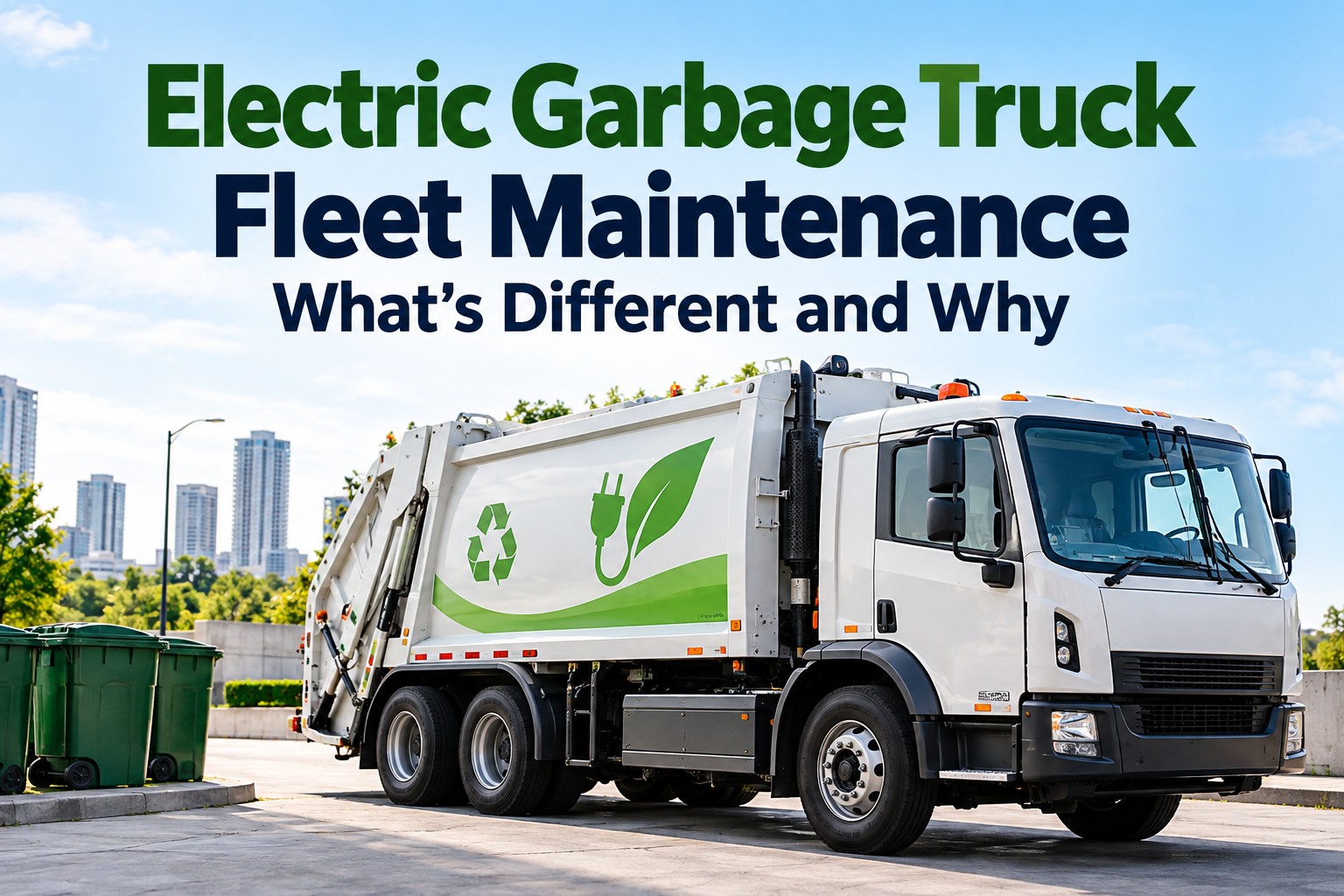
Refuse is the vocation where electrification makes the most mechanical sense, and the reason sits in the duty cycle rather than in anything about batteries. NREL's vocational drive-cycle work puts refuse trucks at 2.68 stops per mile against 0.24 for drayage, at an average driving speed of 21.26 mph, with 50.62% of cycle time spent at zero speed — the highest of every cluster measured. That profile is close to worst-case for a diesel and close to best-case for a battery. What it does to your maintenance schedule is more interesting than the headline, though, because the chassis gets dramatically simpler while the body does not change in any respect at all. See a mixed diesel and electric fleet in one view.
The Duty Cycle That Punishes a Diesel Is the One an EV Is Built For
For fleet managers, municipal directors and workshop leads running or evaluating electric refuse: what genuinely leaves the maintenance schedule, what does not change at all, and the new items nobody budgets for until the first one bites.
Why This Vocation, Specifically
The general case for electric trucks is an efficiency argument. The refuse case is a duty-cycle argument, and it is much stronger, because every feature of the route that hurts a diesel helps a battery.
NREL's analysis notes that "refuse and transit vocations stand out in their usage as compared to the rest of the sample." Read the three figures mechanically. Nearly three stops every mile means a diesel converts kinetic energy into brake heat roughly eleven times more often per mile than a drayage truck does, and a battery vehicle recovers a large part of that instead. Half the cycle at zero speed means a diesel burns fuel and accumulates engine hours producing nothing, while a battery draws almost nothing. And a 21 mph average means aftertreatment rarely reaches the temperature it needs, which is why refuse is notoriously hard on DPF and SCR systems in the first place.
What Actually Leaves the Schedule
Not "fewer moving parts" in the abstract. These are specific recurring lines that come off a refuse PM sheet.
- Engine oil and filtersThe single biggest recurring line on a diesel refuse PM sheet, gone entirely. No oil, no filters, no oil analysis programme, no disposal.
- AftertreatmentNo DPF, no DEF, no SCR, no regeneration cycles — and no forced regens on a vehicle whose duty cycle never gets hot enough to passively regenerate, which is the specific reason refuse is hard on aftertreatment.
- Fuel systemNo injectors, rails, lift pumps, filters or water separators. No fuel theft, no fuel quality problems, no cold-weather gelling.
- Cooling system chemistryThermal management still exists and still matters, but the wet-liner cavitation problem that drives coolant testing on a diesel does not.
- Most friction brakingThis is the big one on this duty cycle. At 2.68 stops per mile, regenerative braking does the majority of the decelerating, and friction pads and drums stop being a consumable you plan around.
- Idle fuel and idle hoursHalf the shift at zero speed costs a diesel fuel and engine hours. On a battery vehicle it costs neither, which changes both the fuel line and the interval clock.
The brake line is the one worth dwelling on, because it is duty-cycle dependent in a way the others are not. On a highway tractor regen saves comparatively little friction braking. At 2.68 stops per mile it saves a great deal, which means the maintenance benefit of the same technology is substantially larger in refuse than the general figures quoted for trucking suggest.
What Does Not Change At All
This is the half that gets skipped in vendor material, and it is the half that determines whether your workshop is actually ready. Roughly everything above the frame rails is identical.
Unchanged. The blade, the pump, the cylinders, the tailgate and the hydraulic circuit are the same equipment doing the same work the same number of times a day.
Still a scheduled fluid with a scheduled analysis. On many electric refuse trucks the hydraulics are electrically driven rather than PTO-driven, which changes what powers the pump, not what the pump needs.
Unchanged, and in some cases working harder — battery packs are heavy, and axle loads matter to tire life and to your bridge formula compliance.
Regen reduces pad wear; it does not remove the brake system, the air system, or the obligation to measure and record stroke. Less wear is not less inspection.
Every federal obligation is identical. The vehicle is a commercial motor vehicle with the same coupling, lighting, brake and structural requirements as the diesel parked beside it.
Containers, lids, contamination, overloaded bins, blocked access. The hardest part of refuse operations was never the drivetrain.
Put plainly: you have replaced the drivetrain, not the truck. The packer still cycles hundreds of times a shift, the hydraulics still need oil and analysis, the tires still wear — faster, if anything, given pack weight — and every federal inspection and record-keeping obligation applies exactly as before. A workshop that budgeted for "EVs need less maintenance" and planned accordingly tends to discover this in month three.
Running diesel and electric on the same yard?
Then you are running two chassis schedules and one body schedule, and most systems force you to choose. In thirty minutes we will set up one of each so the intervals differ where they should and match where they should, with battery health and charger uptime tracked alongside.
The New Items on the Schedule
Six things that did not exist on a diesel sheet. The first is a compliance and training matter rather than a mechanical one, and it is the one most likely to be underestimated.
Work on the propulsion system needs trained, qualified technicians with the right insulated tools and PPE, plus a documented de-energise and lockout procedure. This is a training and records obligation, not just a tooling purchase.
A new measurement with no diesel equivalent. Capacity fade determines whether a truck can still finish its route, so it belongs on the schedule as a recorded value and trended, not checked when somebody worries.
Battery cooling has its own loop, its own fluid and its own failure modes. It is the component most likely to be treated as absent because it does not look like an engine cooling system.
The chargers are now fleet assets with uptime that affects your operation. A dispenser out of service is a truck out of service, and nothing on a vehicle PM schedule covers it.
Drivetrain behaviour changes with a firmware release. Knowing which version is on which unit becomes part of diagnosis in a way it rarely was on a mechanical diesel.
How aggressively regen is set changes both range and brake wear. It is a tunable that affects two maintenance outcomes at once, which makes it worth recording when it changes.
How FleetRabbit Handles This
Four things, and the first is the one that makes a mixed fleet manageable rather than two parallel systems.
A diesel packer and an electric packer need different intervals on the chassis and identical intervals on the body. Both run per unit rather than per fleet, so neither inherits the other's schedule.
State of health logged per unit and trended, so range loss becomes a forecast you plan routes around instead of a surprise on a Tuesday.
Dispensers, cables and connectors tracked like any other asset, because a charger fault takes a truck off the road just as effectively as a flat tire.
Packer cycles, hydraulic analysis and cylinder work stay on the vehicle record whatever is driving the pump, so switching drivetrain does not restart the body's history.
Range, Routes and Why They Are a Maintenance Question
On a diesel fleet, route planning and maintenance planning are separate conversations. On an electric fleet they are the same conversation, and that is the operational change people find hardest.
Battery capacity fades with use, so the range a truck had when it was new is not the range it has in year four. If a route was assigned on day-one capacity with no margin, capacity fade turns into a route that cannot be completed — and the first symptom is a truck coming back early, not a fault code. That makes state of health a planning input, which means it has to be measured on a schedule and stored as a value, not checked when somebody becomes suspicious.
The same logic applies to charging. A depot with just enough dispensers for its fleet has no redundancy, so a single charger fault removes a truck from service exactly as effectively as a mechanical failure would. Treating chargers as assets with their own preventive maintenance and their own uptime record is the difference between a known constraint and a morning surprise.
Refuse has one genuine advantage here that other vocations do not: the routes are fixed, repeated and well understood, and the trucks come back to the same depot every night. That makes both the energy requirement and the charging window far more predictable than for most freight operations — which is another reason this vocation electrifies more comfortably than the general case.
Questions Fleets Ask
Do electric garbage trucks really need less maintenance?
The chassis does, substantially — no oil, filters, fuel system or aftertreatment, and much less friction braking on a duty cycle with 2.68 stops per mile. The body does not, at all. Since the packer and hydraulics are a large share of a refuse truck's maintenance in the first place, the honest expectation is a meaningful reduction rather than a transformation. Track both halves separately.
What about brake life specifically?
This is where refuse benefits more than other vocations, because regen does most of the decelerating on a route that stops constantly. Expect pads and drums to last considerably longer — but keep measuring and recording stroke on the normal interval, because the inspection obligation is unchanged and a brake that is barely used can still be out of adjustment. Review your brake intervals.
Can our existing technicians work on them?
On the body, hydraulics, brakes, tires and structure, yes — that work is unchanged. On the high-voltage propulsion system, no, not without qualification, insulated tooling, PPE and a documented de-energising procedure. Plan the training and the records for it before the first vehicle arrives rather than after. Log qualifications per technician.
What does it cost to maintain compared with diesel?
Per-mile comparisons published so far come mostly from transit bus programmes rather than refuse, and they vary widely by fleet, so treat any single figure with suspicion — including favourable ones. The defensible way to answer it for your own operation is to track the two schedules separately from the first vehicle, so after a year you have your own number instead of somebody else's. Set up the comparison properly.
How do we know when a battery needs replacing?
By trending state of health against the energy your routes actually need, rather than against a warranty threshold. A pack can be well within warranty and still unable to finish a long route, and that is an operational failure before it is a warranty question. Measure it on a schedule and store the value. Start trending capacity free.
Does the DOT inspection change?
No. It is a commercial motor vehicle, and the brake, coupling, lighting, tire and structural requirements are the same ones that applied to the diesel. Nothing about the powertrain reduces the inspection or the records you keep for it — which is worth saying clearly, because "simpler vehicle" is sometimes heard as "lighter compliance". Check your inspection setup.
We only have two EVs so far. Is it worth systemising?
That is the easiest time to do it. Two units means the second schedule is small enough to get right deliberately, and the habits you form now are the ones the next twenty inherit. Retrofitting structure onto a mixed fleet after it has grown is considerably harder, here and across the rest of your maintenance programme, so the cheapest moment to get the second schedule right is while it still only covers two trucks. Set it up on two units.
One Fleet, Two Drivetrains, One Record
FleetRabbit runs diesel, electric and CNG units side by side — different chassis intervals, identical body and inspection intervals, with battery state of health and charger uptime tracked as values you can plan routes against.
Free for 3 vehicles · no credit card required