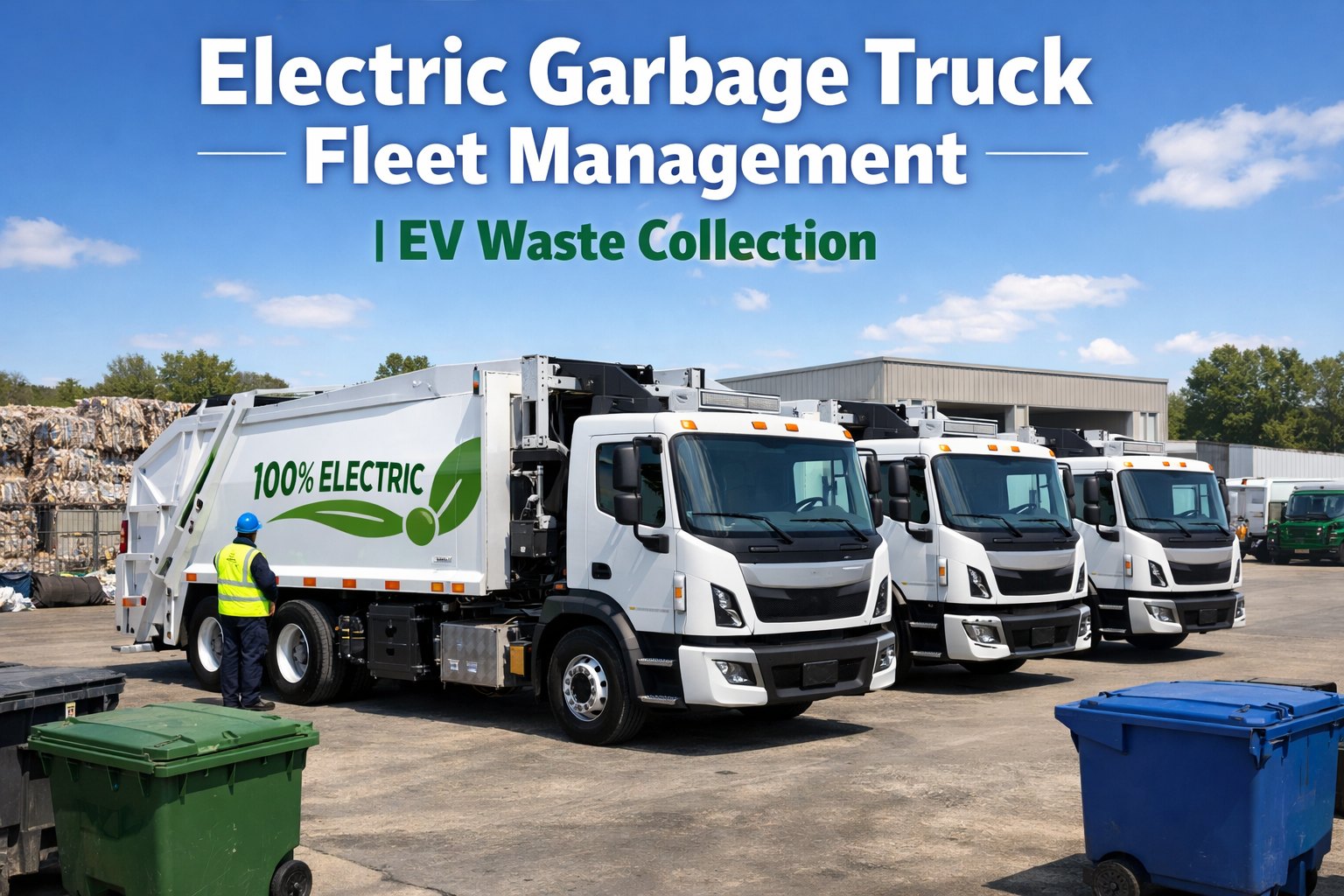
The waste industry is undergoing its biggest transformation in decades and electric garbage trucks are leading the charge. With cities like Los Angeles, New York, and Seattle mandating zero-emission waste collection by 2035, fleet managers face a critical challenge: how do you ensure battery-electric refuse vehicles complete demanding stop-and-go collection routes without running out of charge? The answer lies in intelligent fleet management that combines EV-specific route optimization, real-time battery monitoring, and depot charging coordination. FleetRabbit's electric garbage truck fleet management platform helps waste fleets transition from diesel to electric while maintaining — and often improving — operational efficiency. Book a demo to see how we're helping sanitation fleets go electric without sacrificing productivity.
Electric refuse vehicles operate differently than any other commercial EV application. The constant stopping, compacting, and lifting creates unique energy demands that standard EV fleet software can't handle. A garbage truck might stop 1,000+ times per route, and each compaction cycle draws significant battery power beyond driving alone. FleetRabbit's waste-specific EV management accounts for these variables — modeling energy consumption based on stop density, load weight progression, compaction cycles, and terrain — ensuring your electric garbage trucks finish every route with charge to spare. Start your free trial today.
Zero-Emission Waste Collection Without Range Anxiety
EV-optimized routing, real-time battery monitoring, and depot charging coordination for electric refuse fleets.
Why Electric Garbage Trucks Need Specialized Management
Electric refuse vehicles face operational challenges that don't exist for delivery vans, buses, or other commercial EVs. Standard EV fleet software wasn't designed for waste collection's unique demands — extreme stop frequency, auxiliary power for compaction, and progressive load weight throughout routes.
Far more than any other commercial vehicle. Each stop-start cycle consumes battery power that must be accurately modeled for range prediction.
Each compaction uses as much energy as driving half a mile. Hydraulic systems draw significant power beyond propulsion.
Trucks start empty and finish heavy. Energy consumption increases dramatically as load weight grows throughout collection.
Trucks must be fully charged overnight without overwhelming depot electrical capacity or incurring peak demand charges.
EV-Optimized Route Planning for Waste Collection
Standard route optimization focuses on minimizing distance or time. Electric garbage truck routing must also ensure every vehicle returns to depot with adequate charge — while accounting for energy variables unique to refuse collection. Book a demo to see EV route optimization in action.
Real-Time Battery Monitoring & Alerts
Knowing battery state-of-charge in real-time prevents stranded trucks and incomplete routes. FleetRabbit provides continuous visibility into every vehicle's energy status with predictive alerts when intervention is needed.
State of Charge Tracking
Real-time battery percentage for every truck, updated every 30 seconds. Historical data shows discharge patterns by route, driver, and conditions for continuous optimization.
Predictive Range Alerts
Alerts trigger when projected route completion would leave less than 15% charge reserve. Dispatchers can reassign stops to another vehicle before problems occur.
Battery Health Analytics
Track degradation over time, identify cells performing below spec, and predict replacement timing. Prevent unexpected capacity loss that could strand trucks mid-route.
Consumption Analysis
Compare actual vs. predicted energy use by route. Identify inefficient driving behaviors, routes consuming more than modeled, and optimization opportunities.
Depot Charging Infrastructure Management
Managing overnight charging for 10, 20, or 50+ electric garbage trucks requires careful coordination of electrical capacity, charge scheduling, and cost optimization. FleetRabbit's depot management ensures every truck is ready for morning routes without overwhelming your electrical infrastructure or triggering expensive peak demand charges.
Smart Charge Scheduling
Automatically sequences charging to stay within electrical capacity limits. Prioritizes trucks with early morning routes and lowest state-of-charge. No manual coordination required.
Demand Charge Avoidance
Shifts charging to off-peak hours when electricity rates are lowest. Prevents demand spikes that trigger expensive peak charges — often the largest component of commercial EV electricity bills.
Charger Assignment & Monitoring
Tracks which truck is at which charger, session duration, and energy delivered. Alerts maintenance when chargers malfunction or underperform expected charge rates.
Load Balancing
Distributes charging load across available chargers and time windows. Prevents circuit overloads while maximizing trucks charged per night within infrastructure limits.
Diesel vs Electric: Total Cost of Ownership
Electric garbage trucks have higher upfront costs but dramatically lower operating expenses. Here's how the total cost of ownership compares over a 12-year vehicle lifecycle — the typical replacement cycle for refuse trucks:
Based on $4.00/gallon diesel, $0.12/kWh electricity, 15,000 miles annually. Federal/state EV incentives can reduce purchase price by $100,000-$150,000. Book a demo for fleet-specific analysis.
Sustainability & Emissions Reporting
Electric garbage truck fleets generate zero tailpipe emissions — a major advantage for municipalities with climate commitments. FleetRabbit automatically tracks and reports environmental impact for sustainability compliance and grant applications.
Automated Reports Generated
- Monthly emissions avoidance summary for sustainability reporting
- Fleet carbon footprint tracking with year-over-year comparisons
- Municipal sustainability compliance documentation
- Grant application support with verified environmental data
Compatible Electric Refuse Vehicles
FleetRabbit integrates with all major electric garbage truck manufacturers. Our telematics integration pulls battery data, energy consumption, and charging status directly from vehicle systems. We also support mixed fleets during diesel-to-electric transition periods.
"We transitioned 12 trucks to electric last year and were terrified about range. FleetRabbit's energy modeling was spot-on — we've completed 99.4% of routes without any range issues. The charging optimization alone saved us $18,000 in electricity costs by avoiding peak demand charges. Our city council loves the emissions reports."
Frequently Asked Questions
Yes — modern electric refuse trucks have 150-200+ mile ranges and 400-600 kWh battery capacities designed specifically for waste collection. With proper route optimization accounting for stop density, compaction cycles, and load weight, electric trucks reliably complete routes that diesel trucks handle. FleetRabbit ensures routes are designed within each vehicle's capability with 15-20% reserve built in.
With 60kW DC chargers (common for depot charging), trucks charge from 20% to 100% in 6-8 hours — perfect for overnight. Higher-powered 150kW chargers reduce this to 3-4 hours. FleetRabbit's scheduling ensures all vehicles are ready for morning routes without requiring expensive chargers for every spot.
FleetRabbit's predictive monitoring identifies potential range issues hours before they become problems. Dispatchers receive alerts with time to reassign remaining stops. With proper planning, mid-route charging should be exceptionally rare — our customers average 99%+ route completion without intervention.
Cold weather reduces battery capacity by 20-30%. FleetRabbit automatically adjusts range projections based on forecasted temperatures, reducing assigned stops on cold days. Many electric refuse trucks also feature battery preconditioning while plugged in, preserving range for actual routes.
Most depots install 60-150kW DC chargers, typically one charger per 2-3 trucks with smart scheduling. A 10-truck fleet might need 500-800kW of additional electrical capacity. FleetRabbit helps model scenarios and connects you with infrastructure partners specializing in waste fleet electrification.
We integrate with BYD, Lion Electric, Mack LR Electric, Peterbilt 520EV, Autocar E-ACTT, and others. We also support mixed diesel/electric fleets during transition. Contact us to confirm compatibility with your specific vehicles.
Ready to Electrify Your Waste Fleet?
See how FleetRabbit helps sanitation fleets transition to electric without range anxiety or operational disruption.
Free for 3 vehicles · Full EV features · Setup in 2 weeks