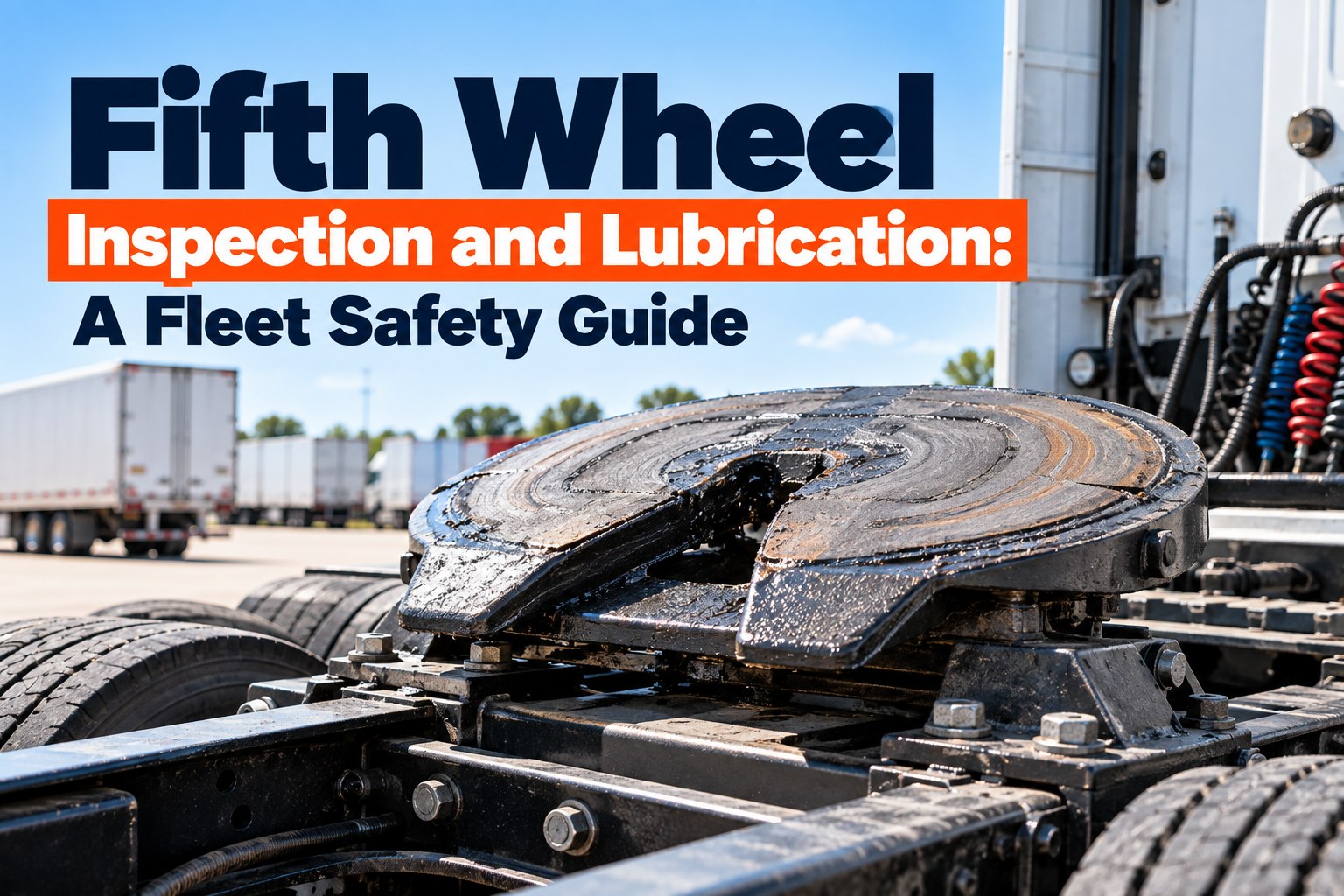
Almost every component on a truck degrades in a way that gives you warning. A fifth wheel is different: its failure mode is that the trailer leaves. That is why the regulation covering it carries no tolerance at all — the halves must not separate unless a positive manual release is activated — while the maintenance that keeps it that way is a grease gun on a 30,000-mile interval. Everything in between is measurable: a quarter of an inch of free movement is the limit, a closed lock has a defined gap, and a bracket has a minimum thickness. Which means this is not a component you inspect by feel. It is one you inspect with a ruler and write the number down. See a coupling check recorded against a tractor.
Fifth Wheel Inspection Is a Measurement, Not a Glance
For fleet maintenance managers, shop supervisors and safety leads: what 49 CFR 393.70 actually demands of a coupling, the manufacturer's published intervals and wear limits, the order to inspect in, and how to turn all of it into scheduled work with recorded readings.
What the Regulation Actually Demands
Worth reading closely, because the wording is unusually absolute for a maintenance standard. There is no allowance for a lock that mostly holds.
"Every fifth wheel assembly must have a locking mechanism. The locking mechanism, and any adapter used in conjunction with it, must prevent separation of the upper and lower halves of the fifth wheel assembly unless a positive manual release is activated." Where the design is readily separable, "the fifth wheel locking devices shall apply automatically on coupling."
— 49 CFR 393.70(b)
The mounting requirements are equally specific. The lower half must be secured to the frame "with properly designed brackets, mounting plates or angles and properly tightened bolts of adequate size and grade, or devices that provide equivalent security" — and the installation "must include a device for positively preventing the lower half of the fifth wheel from shifting on the frame." The upper half must be fastened "with at least the same security." The regulation also prohibits an installation that causes "cracking, warping, or deformation of the frame."
Read the mounting clause next to the locking clause and the inspection order writes itself. A perfect lock on a lower half that is creeping on the frame is not a compliant coupling, and elongated bracket holes are therefore a regulatory finding rather than a housekeeping note. Take your own compliance advice on how this applies to your operation.
The Intervals, and Why the Calendar Matters as Much as the Odometer
Two intervals, two clocks, and whichever arrives first wins. This catches fleets out on low-mileage units — a yard tractor or a seasonal unit hits the three-month limit long before it sees thirty thousand miles.
SAF-HOLLAND publishes these for its FW35 series: lubricate the locking mechanism "every three (3) months or 30,000 miles"; clean thoroughly "every six (6) months or 60,000 miles"; check adjustment at "a minimum of every 60,000 miles or if excessive movement between the kingpin and fifth wheel is noticed"; move a slide base fore and aft "at least once a year"; and in winter conditions, lubricate "every spring in addition to routine lubrication." Intervals differ by manufacturer and model, so confirm yours rather than adopting these.
The Numbers That Decide Pass or Fail
This is the part that makes fifth wheel inspection genuinely objective. Almost every check resolves to a measurement, which means it can be recorded, trended and argued with. Swipe on mobile.
| What you measure | Limit | What it means |
|---|---|---|
| Free vertical movement at the top plate | 1/4″ (6.4 mm) | Above this, the top plate comes off for inspection. It is a ruler measurement, not a judgement call. |
| Gap between the lock jaws, closed | 1/4″ (6.35 mm) or less | This is what a properly closed lock looks like. More than that and the lock is not doing what the regulation requires of it. |
| Pocket insert thickness | 1/16″ (1.6 mm) | At or below this, replace. Inserts are consumable; the bracket they protect is not. |
| Bracket cap thickness | 3/8″ (9.5 mm) | At or below this, replace the bracket. This is structure, not wear surface. |
| Upshock cushion hole elongation | 1-3/8″ (34.9 mm) | Beyond this the hole has stretched and the cushion no longer locates anything. ILS-style parts use 1-1/2″ (38.1 mm). |
| Bracket pin retention fasteners | 50–60 ft-lbs (68–81 N·m) | A torque figure, which means a wrench rather than a feel. Record it. |
Figures above are SAF-HOLLAND's for the FW35 series. Other makes publish their own, and a Fontaine or Jost unit deserves its own manual rather than these numbers applied by analogy. The transferable point is that every one of them is a number — so a fifth wheel inspection that produces no figures has not really been carried out.
The Order to Inspect In
Sequence matters here, because the structural checks can condemn the unit before you spend time on the lock.
- Look underneath before you touch anythingMounting bolts, brackets and the frame rail. You are looking for cracks, elongated holes, missing or loose fasteners, and any sign the lower half has moved on the frame — which the regulation specifically requires a device to prevent.
- Check the top plate for free vertical movementA quarter inch is the limit. More than that and the plate comes off, because the wear is in something you cannot see from below.
- Couple to a test kingpin and check the lockThe jaws should close to a gap of a quarter inch or less, automatically, with no manual help. If the lock needs persuading, that is the finding.
- Try to separate it without releasingThe whole regulatory standard is that the halves cannot come apart unless a positive manual release is activated. This is the test of that, and it is pass or fail.
- Clean, then grease the named pointsYoke tips, cam profile, yoke shaft, secondary lock contact areas, release handle and kingpin contact zones, with a water-resistant lithium-based grease. Light oil on the cam pivot. Air cylinders get two to four drops of air tool oil.
- Record the readings, not just the tickThe vertical movement figure and the jaw gap are numbers. Written down over three intervals they predict the rebuild; ticked as OK they predict nothing.
Six grease points, two clocks, six measurements
That is more than anybody reliably carries in their head, which is why it ends up as a tick against the word "greased". In thirty minutes we will build it as a recorded task against one tractor — both interval clocks, the measured values, and the driver's coupling complaint arriving as a work order.
How FleetRabbit Handles This
Four things, and the second one is what turns an inspection into a forecast.
Three months or 30,000 miles, whichever lands first — tracked per tractor against both clocks, so a low-mileage unit still comes up on time.
Free vertical movement and jaw gap go in as numbers, so the third reading tells you the wear rate rather than repeating the word OK.
Reported on the inspection, it arrives as a work order with the report attached, so the shop sees what the driver actually felt.
Six named points and two different lubricants. A template means the sixth one gets done on a wet Friday afternoon too.
Coupling Technique Is Half the Wear
Most of the damage an inspection eventually finds was put there during coupling, not during running. Four habits account for a disproportionate share of it. Swipe on mobile.
| The habit | What it does to the assembly | What to do instead |
|---|---|---|
| Backing under too fast | The impact loads the top plate, the brackets and the bolt holes all at once. Elongated mounting holes and cracked brackets are usually a coupling-technique history, not a materials problem. | Approach slowly, and let the kingpin find the throat rather than driving it there. |
| Coupling at the wrong height | Too low and the trailer nose rides up over the plate; too high and the kingpin catches the front edge. Either way the load goes somewhere that was not designed for it. | Set the landing gear so the trailer sits slightly below the plate, so it lifts as you reverse. |
| Skipping the tug test | The one check that actually proves the lock engaged. A visual look at the jaws confirms position; a tug confirms function, and those are different things. | Pull against the locked coupling with the trailer brakes set, every time, before the walk-around. |
| Leaving the release handle out | If the handle has not returned, the lock has not fully seated. It is the most visible warning on the whole assembly and the easiest to walk past. | Look at the handle position as part of the same glance that checks the jaws. |
This is why a fifth wheel that keeps producing findings is often a driver-training question rather than a parts question — and why the inspection record is worth reading by unit. If one tractor keeps showing elongated bracket holes and the rest do not, the assembly is reporting on how it is being coupled.
What Actually Goes Wrong
Five failure patterns, and the first one causes more of the rest than anything else on the list.
By far the most common, and the cheapest to prevent. Grease is what keeps the cam and yoke moving freely; without it the lock stiffens, stops closing fully, and wears where it should slide.
Bolts back off, holes elongate, the lower half starts to move on the frame. The regulation demands a device that positively prevents that shifting, which is why elongated bracket holes are a serious finding and not a cosmetic one.
Consumable parts doing their job. Left past 1/16″ they stop protecting the bracket, and the next replacement is structural rather than a wear item.
Left in one position for a year, a slide base seizes. Then it will not adjust for weight distribution, and freeing it becomes a workshop job rather than a lever pull.
Grinding compound in a lubricated joint. The manufacturer's own answer is an extra lubrication every spring, on top of the routine interval.
Questions Fleets Ask
How often should a fifth wheel be greased?
SAF-HOLLAND gives every three months or 30,000 miles for the locking mechanism on its FW35 series, with a thorough clean at six months or 60,000 miles, and an extra lubrication each spring where winter conditions apply. Whichever limit arrives first is the one that counts, which matters most on units that do low mileage. Check your own manufacturer's figures. Schedule both clocks free.
What grease should be used?
A water-resistant lithium-based grease on the yoke tips, cam profile, yoke shaft, secondary lock contact areas, release handle and kingpin contact zones; light oil on the cam pivot point; and two to four drops of air tool oil in air cylinders. Two different lubricants and six named locations is precisely the sort of detail a checklist exists for. Get the grease-point template.
How much play is too much?
A quarter of an inch of free vertical movement at the top plate is the point at which the plate comes off for inspection, and a closed lock should show a jaw gap of a quarter inch or less. Both are ruler measurements rather than opinions, which is exactly why they should be recorded as values. Record the readings free.
What does a fifth wheel inspection cost?
Done on schedule it is a labour item — clean, inspect, grease, measure — and it is one of the cheapest preventive tasks on a tractor. The costs that matter are the ones on the other side: a bracket replaced because inserts ran past 1/16″, a seized slide freed in the shop, or a unit out of service over a coupling defect. Ask your shop to quote the scheduled version and the neglected version separately. Talk through the trade-off.
Is this a driver check or a shop check?
Both, at different depths. A driver checks security and looks for the obvious on coupling. The measured checks, the top plate removal and the grease work belong to the shop on an interval. The failure mode is that each assumes the other is covering the measurements, which is an argument for the task existing somewhere with a name against it. Split the checks properly.
Do we need to move the slide if we never adjust it?
Yes — that is precisely why. The manufacturer says move it fore and aft at least once a year, and the reason is that a slide left in one position seizes. The time you discover it is the day you actually need to redistribute weight, and by then freeing it is a workshop job. Add it as an annual task.
Can these figures be applied to any fifth wheel?
No. The intervals and limits quoted here are SAF-HOLLAND's for the FW35 series, and Fontaine, Jost and others publish their own. Use the manual for the unit in front of you. What does transfer is the approach, and it works across the rest of your maintenance programme just as well: find the published numbers for the unit in front of you, put them on both clocks, and record values rather than ticks. Set up your own limits.
A Quarter Inch, Measured and Recorded
FleetRabbit tracks the three-month and 30,000-mile clocks in parallel per tractor, holds the grease points as a template, and stores the vertical movement and jaw gap as values you can trend rather than ticks you cannot.