Compliance used to be paperwork. In 2026, it is a financial risk category — and a growing one. FMCSA closed over 12,300 investigations last year, and 94% of those audits uncovered at least one violation. Average settlement: $7,155 per closed case, with some reaching $125,000. An HOS infraction alone now runs up to $19,277. A Clearinghouse miss tops $16,000. Vehicle maintenance violations span $13,300 to $53,203 depending on severity. For the average 20-truck carrier running on spreadsheets and filing cabinets, one bad audit wipes out a full quarter of profit. The fleets that survive and scale in this environment run compliance as software, not as paperwork — with automated deadline alerts, digitized driver qualification files, photo-verified DVIRs, and audit-ready reporting that produces any document in 30 seconds. This guide breaks down what fleet compliance management software actually does, the 8 pillars it must cover, the new 2026 FMCSA scoring rules, and how Fleet Rabbit turns compliance from a constant fire drill into a quiet, automated background process.
Pass Every Audit. Protect Every Asset. Without the Paperwork.
Fleet compliance software centralizes DOT, FMCSA, EPA, and state regulatory requirements into one dashboard — with automated alerts that prevent 90% of violations, 75% faster audit prep, and measurable ROI in under three months.
The Cost of Non-Compliance Most Carriers Ignore
Before we get into what the software does, let's look at what it prevents. Compliance failures are not abstract. They cost real money, and the 2026 enforcement environment makes every lapse more expensive than it was a year ago.
Add secondary costs — CSA score damage, insurance premium hikes of 10-30%, shippers filtering you out of load boards, and out-of-service orders that freeze revenue — and a single citation can compound into tens of thousands of dollars in downstream losses. Compliance software is the insurance policy most carriers don't realize they need until after the first audit.
The 8 Compliance Pillars Every Software Must Cover
DOT and FMCSA compliance is not one thing — it is eight distinct regulatory categories, each with its own documentation requirements, recordkeeping rules, and violation penalties. A fleet compliance platform that only covers ELD or DVIR leaves you exposed. Here are the pillars a complete system must handle.
USDOT number status, MC authority filings, BOC-3 process agent, and liability insurance minimums ($750K for general freight, up to $5M for hazmat). Lapses trigger immediate operating authority suspension.
Part 391 requires: employment application, MVR (pulled annually), road test certificate, medical examiner's certificate, previous employer safety history, and ongoing recordkeeping. DQF issues caused 62,000+ violations in the last five years.
Pre-employment testing, random pool (50% drugs / 10% alcohol rates), post-accident testing, SAP program for violations. Clearinghouse pre-employment full queries and annual limited queries are mandatory — 7,000+ Clearinghouse violations in 2025 alone.
FMCSA-certified ELD hardware with 14-hour/11-hour/70-hour tracking, 30-minute break rule, and sleeper berth provisions. HOS accounted for 32.4% of driver OOS violations at the 2025 CVSA Roadcheck. Accurate real-time HOS monitoring is the first line of defense.
Annual DOT periodic inspections, daily driver vehicle inspection reports (DVIRs), defect-to-repair documentation chains, and recall tracking. Vehicle maintenance is the single largest violation category by volume — and in 2026, it was split into two CSA categories for more granular scoring.
DOT-recordable accidents must be logged for 3 years including date, location, injuries, fatalities, and any hazmat release. Crash data feeds directly into the CSA Crash Indicator BASIC — carriers with incomplete registries get flagged faster.
Written safety policy, documented corrective action plans, driver training records, and safety meeting logs. This is the first file auditors request during a compliance review — missing it signals systemic neglect.
Quarterly fuel tax filing for interstate operations, International Registration Plan apportioned tags, and jurisdictional mileage reporting. Late or missed filings trigger state-level penalties plus interest on unpaid tax.
Manual vs Software: The Real Efficiency Gap
Here is what actually changes when a fleet moves from spreadsheets and filing cabinets to a modern compliance platform. The numbers are not marketing — they come from fleets that have made the switch and tracked the before/after data.
| Compliance Task | Manual Method | Fleet Compliance Software |
|---|---|---|
| Audit Document Retrieval | 3–5 business days of file digging | 30 seconds — 1-click export |
| Medical Card Expiration Tracking | Manual spreadsheet, easy to miss | Auto alerts at 90 / 60 / 30 days |
| DVIR Documentation | Paper forms, lost in truck | Digital, photo-verified, GPS-stamped |
| Annual Inspection Reminders | Calendar entries, prone to drift | Auto-scheduled with 90/30/14-day alerts |
| Clearinghouse Query Tracking | Manual log per driver | Automated pre-employment + annual queries |
| Violation Prevention Rate | Reactive — catch after citation | Proactive — 90% reduction |
| Audit Preparation Time | 2–3 weeks scrambling | 2–4 hours, automated |
| Staff Time Per Week | 15–25 hours per 20 trucks | 2–4 hours per 20 trucks |
The ROI is direct: fewer violations, lower fines, faster audits, insurance premium control, and dramatically reduced administrative overhead. Most fleets recover the software cost within 60–90 days from violation prevention alone.
Every Day on Spreadsheets Is a Day Closer to a Citation
Stop chasing paperwork across filing cabinets, driver glove boxes, and email attachments. One dashboard. Every record. Audit-ready in seconds.
What's New in 2026: FMCSA Scoring Overhaul
2026 is the year FMCSA rolled out the biggest CSA Safety Measurement System overhaul in a decade. If your compliance process was built for the old BASICs, it is already out of date. Here are the changes every fleet manager must know.
FMCSA now scores "Driver-Observed" maintenance separately from mechanic-detected issues. DVIR quality directly affects your CSA score for the first time — photo-verified inspections are no longer optional for fleets that care about rating.
Paper medical examiner's certificates expired as of January 10, 2026. Compliance now requires MVR verification to confirm driver medical status — a significant workflow change for fleets that still run paper DQFs.
The old 1–10 severity scale is being replaced with a two-point system. Serious violations (OOS orders) carry heavier weight; minor paperwork issues now matter less. The math is simpler, but the impact of "serious" violations is greater.
Some CSA categories now only calculate scores if there has been a violation in the past 12 months. Old violations age out faster, but recent ones count more. A clean 6-month streak moves your percentile significantly.
FMCSA is actively revoking CDLs for drivers with unresolved "prohibited" status in the Drug & Alcohol Clearinghouse. Missed queries can now cost a carrier a driver — permanently, until the return-to-duty process completes.
Pandemic-era remote audits are gone. 80%+ of FMCSA audits are now conducted on-site with full document review, driver interviews, and vehicle inspections. More scrutiny, more findings, more penalties.
Essential Features a Fleet Compliance Platform Must Have
Not every compliance tool covers the full scope. Before you evaluate vendors, use this checklist to screen features. If a platform fails more than two of these, keep looking.
All DOT, FMCSA, and state compliance documents in one searchable cloud archive — no more scattered folders, lost emails, or filing cabinet searches.
SMS + email + in-app notifications at 90/60/30/14 days before expirations. Drivers get reminders in the cab; safety managers get dashboards at the desk.
Mobile-first inspection forms with mandatory photo fields, GPS and timestamp lock, and automatic work-order generation on defect reports. Satisfies the new 2026 Driver-Observed CSA category.
Built-in pre-employment full-query workflow and annual limited-query scheduling. No driver gets missed; no CDL gets revoked for an overlooked query.
Complete DOT audit package — DQFs, DVIRs, maintenance records, annual inspections, Clearinghouse queries — exported as a single organized PDF in 30 seconds.
Live view of each BASIC percentile, trend lines, and intervention-threshold proximity. Predict where FMCSA will focus before the warning letter arrives.
Connects to major ELD platforms, GPS telematics, and OBD-II hardware. HOS data flows in; compliance flags flow out — no manual re-entry.
Drivers, safety managers, shop techs, and executives each see exactly what they need — no more, no less. Every action logged with user, time, and IP for audit defensibility.
Platforms that check every box above are rare — most vendors specialize in ELD-only or DQF-only verticals. A unified fleet compliance platform that covers all eight pillars is the difference between surviving an audit and thriving in the 2026 regulatory environment. Book a Free Demo →
How Fleet Rabbit Delivers End-to-End Compliance
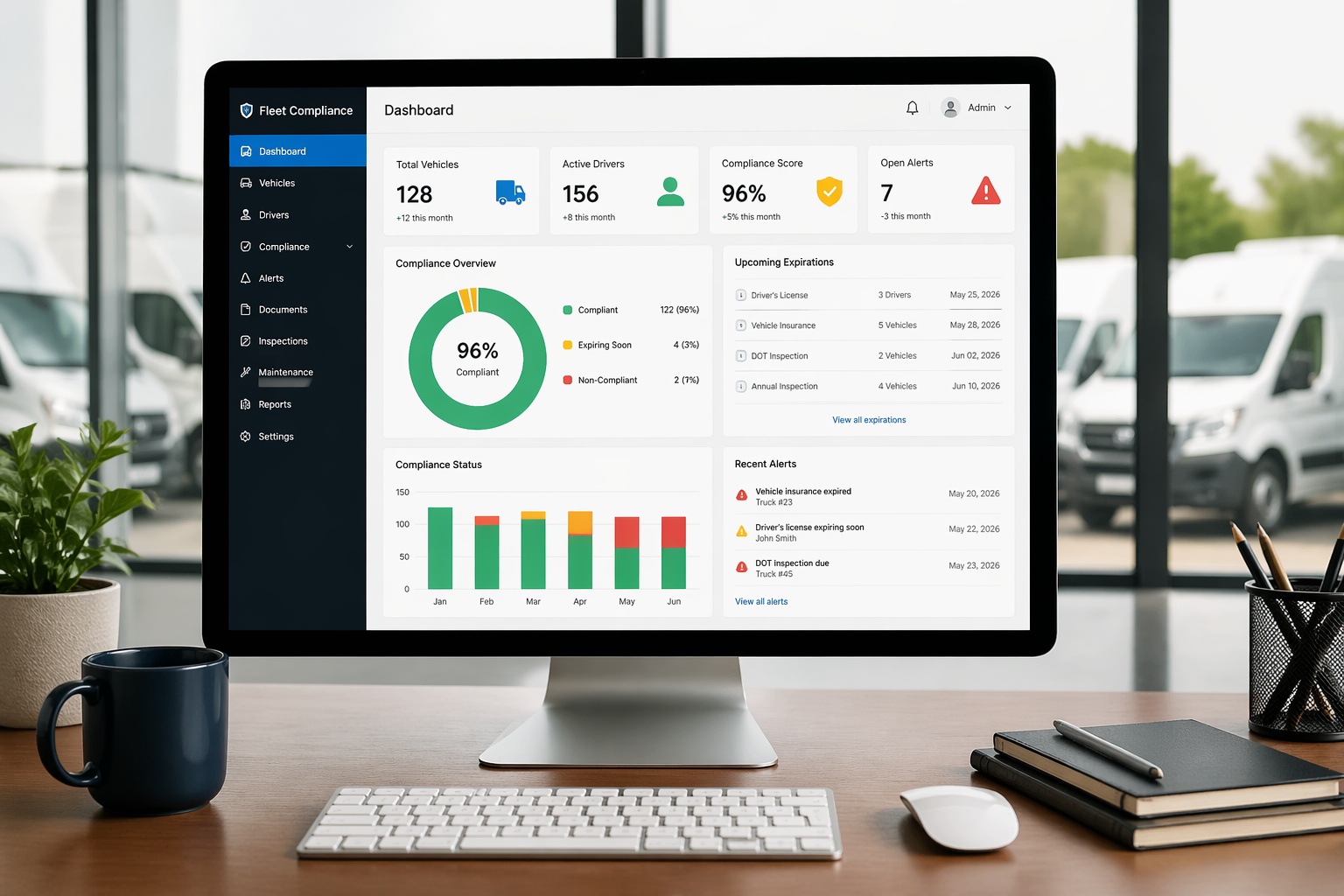
Fleet Rabbit was built around a simple premise: compliance should never be the thing that keeps a fleet manager awake at night. The platform covers every DOT and FMCSA requirement in one unified dashboard — and does it with the kind of automation that turns compliance from a daily fire drill into a background process you can forget about until audit day.
Every document Part 391 requires — application, MVR, road test, medical card, Clearinghouse queries — in one driver profile. Automated expiration alerts ensure no file goes stale. When FMCSA calls, you export a complete DQF package in a single click.
Drivers complete pre-trip and post-trip inspections on the mobile app with mandatory photo capture for critical items. GPS and timestamp lock the record. Defects auto-generate work orders visible to the shop instantly — no email delays, no paper forms lost. Schedule a Live Walkthrough →
Condition-based PM triggered by miles, engine hours, or fault codes — not by a calendar someone forgot to update. Every service interval is logged, every defect tracked, every repair certified — all in one dashboard. Request a Demo of Automated PM →
Every vehicle's annual DOT periodic inspection scheduled and reminded 90/30/14 days in advance. VIN-matched recall tracking flags affected vehicles before a CVSA inspector does. Included with every plan — no add-on modules.
Real-time CSA BASIC tracking, violation trend analysis, and compliance KPIs by vehicle, driver, and terminal. Complete audit export in 30 seconds. Full analytics and reporting dashboards show you exactly where your fleet stands at all times. See the Live Dashboard →
ROI: What Compliance Software Actually Saves
Software costs money. Non-compliance costs more. Here is the real math on what a well-implemented compliance platform returns, based on fleet-reported before/after data across the industry.
Automated deadline alerts catch expiring certifications, overdue inspections, and stale DQFs before they become citations.
What used to take 2–3 weeks of scrambling now takes 2–4 hours. One-click exports replace filing-cabinet digs.
Violation prevention alone typically recovers the software cost within the first quarter of implementation.
Better CSA scores translate directly into premium negotiations. Insurance underwriters pull SMS data at every renewal.
A 25-truck regional carrier running manual compliance saw 11 DOT violations and a conditional safety rating in 2024. After migrating to automated fleet compliance software, the fleet went 14 months without a single violation, upgraded to Satisfactory, and negotiated a 12% insurance premium reduction at renewal. Total software cost for the year: less than two months of the old violation settlements.
How to Choose the Right Fleet Compliance Platform
The compliance software market is crowded, and vendors often specialize narrowly — ELD-only, DQF-only, or telematics-only. Use these five questions to separate the real platforms from the single-purpose tools.
If you need to bolt on three other tools to get full DOT/FMCSA coverage, the integration overhead cancels the efficiency gain. Unified beats modular for compliance — always.
Real-time HOS data, GPS tracking, and OBD-II fault codes should flow in automatically. Manual data re-entry from your ELD to your compliance tool is a non-starter.
Ask for a demo export — a full DOT audit package PDF with DQFs, DVIRs, maintenance logs, and Clearinghouse records. If the vendor can't show it in real time, walk away.
Deadline-focused tools should be operational in 1 day with 2–3 weeks to full rollout. Enterprise TMS suites take months. Match the timeline to your pain threshold.
Per-driver, per-vehicle, or flat-fee — all are fine. What is NOT fine is setup fees, module add-ons, or premium tiers for features listed as "standard." Read the contract carefully.
Frequently Asked Questions
It centralizes and automates every DOT, FMCSA, EPA, and state regulatory requirement into one dashboard. Driver qualification files, vehicle inspections, maintenance records, Clearinghouse queries, HOS data, and audit-ready reporting — all in one platform with automated alerts that prevent 90% of preventable violations.
Deadline-focused tools start around $15–25 per user per month. Full integrated platforms range $50–150 per driver/vehicle per month depending on features. Fleet Rabbit offers free access for up to 3 assets — no credit card required. Book a Demo to Get Custom Pricing →
Most fleets are operational within 1 day for basic compliance tracking and fully rolled out within 2–3 weeks. Implementation time scales with fleet size and data migration complexity. Bulk driver/vehicle imports accelerate the process.
Yes. Fleet Rabbit covers all 8 DOT/FMCSA compliance pillars plus state-level inspection, IFTA filing, and environmental reporting requirements in one unified platform — built specifically for multi-state interstate operations.
FMCSA typically issues a 48-hour document request, followed by findings and potential penalties — averaging $7,155 per case with some reaching $125,000. Severe findings trigger Conditional or Unsatisfactory safety ratings, which can suspend operations. Compliance software dramatically reduces audit failure risk by ensuring documentation is always complete and current.
Absolutely. FMCSA recordkeeping obligations are identical for 5 drivers and 500 — a single expired medical card or incomplete DQF can put any driver out of service. Small fleets typically save 15–25 hours per week on compliance administration after implementation, with full ROI within 60–90 days.
Stop Chasing Paperwork. Start Running a Compliant Fleet.
One dashboard for every DOT, FMCSA, and state compliance requirement. Automated alerts that prevent 90% of violations. Audit-ready exports in 30 seconds. Used by 500+ fleets to survive audits, protect CSA scores, and cut compliance administration time by 80%.