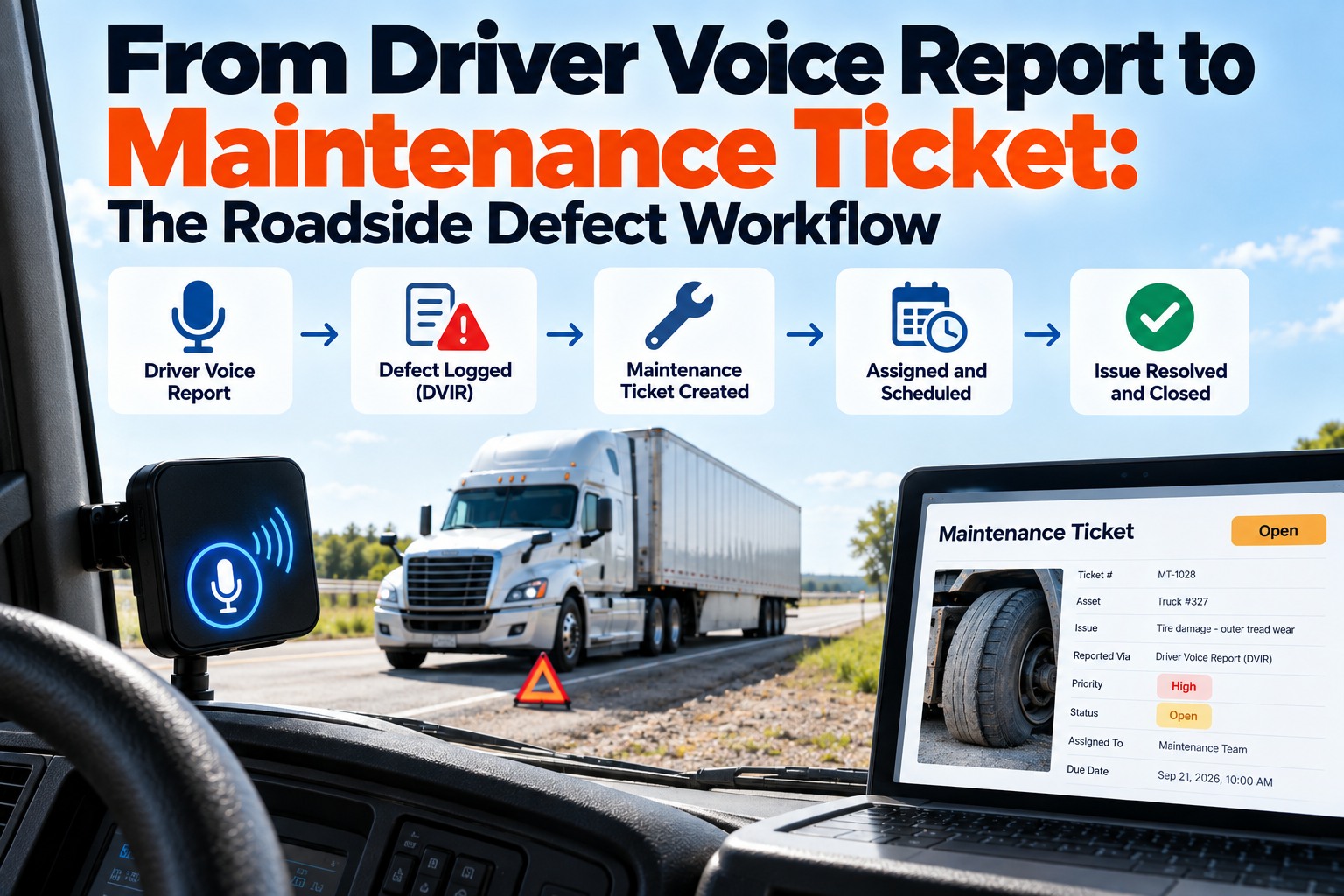
When a driver finds a defect on the road, two clocks start at once. The safety clock comes from 49 CFR 396.7: a vehicle must not be operated in a condition likely to cause an accident or breakdown, which governs whether the truck moves at all. The paperwork clock comes from 396.11 and 396.13: the defect has to reach the written inspection report, be repaired or certified as not needing repair, and be reviewed by the next driver before the truck is dispatched. A phone call starts both clocks but satisfies neither on its own — and voice intake is only useful when it ends in a maintenance ticket, a decision and a record. This guide covers the two clocks, the six questions worth asking at intake, a three-way keep-driving decision, the hands-free rules that shape the call, and what to do about recording consent. Book a 30-minute demo to hear a defect call become a work order, or start free with 3 vehicles.
Roadside defects · Intake to ticket
The Driver Found It an Hour Ago. Your Shop Will Hear About It Tonight, in Someone Else's Words.
For maintenance managers, dispatchers and safety leads: how a roadside defect report should travel from the driver's voice to a maintenance ticket without losing the detail or breaking DVIR rules.
49 CFR 396.7 prohibits operating a vehicle in a condition likely to cause an accident or breakdown.
Answered in minutes396.11 and 396.13: the defect on the report, repaired or certified, and reviewed by the next driver.
Answered before dispatchA phone call starts both clocks. It satisfies neither by itself.
Why Roadside Defects Lose Their Detail Between the Driver and the Shop
Most fleets already get the report — by phone, text or a message at the end of the day. What they lose is everything around it: which unit, where, what the driver actually heard, whether lamps were on, and whether the truck was loaded. By the time it reaches a work order, the description has passed through two people and lost the parts a technician needs. You can capture the whole report on the unit's record with a free account.
"Noise at the front end" is what survives; "grinding on left turns above 40" is what the technician needed.
Location, load and lamp status decide whether the truck rolls or waits. They are rarely in the message.
Without a time and place, a later inspection or claim has nothing to rely on.
Written from memory at the end of the shift, which is where defects quietly disappear.
The Six Questions That Turn a Defect Call Into a Usable Maintenance Ticket
Whether a person or a voice agent takes the call, these six answers are what the shop needs. Ask them in this order and the ticket writes itself. We'll set these as your intake script in a demo.
Questions are ordered so the safety decision can be made before the call ends.
Keep Driving, Nearest Shop, or Stop Where You Are
The answer follows the defect, not the schedule. Write the three-way rule down so dispatchers and drivers make the same call at 2 a.m. as they would at noon, and so nobody is deciding alone under load pressure. Set your own triage rules free on 3 vehicles.
Anything that makes continued operation likely to cause an accident or breakdown. Park safely and arrange help.
The truck moves, but not past the next qualified shop. Dispatch adjusts the load, not the decision.
Complete the run, and the defect is on the DVIR and scheduled before the next dispatch.
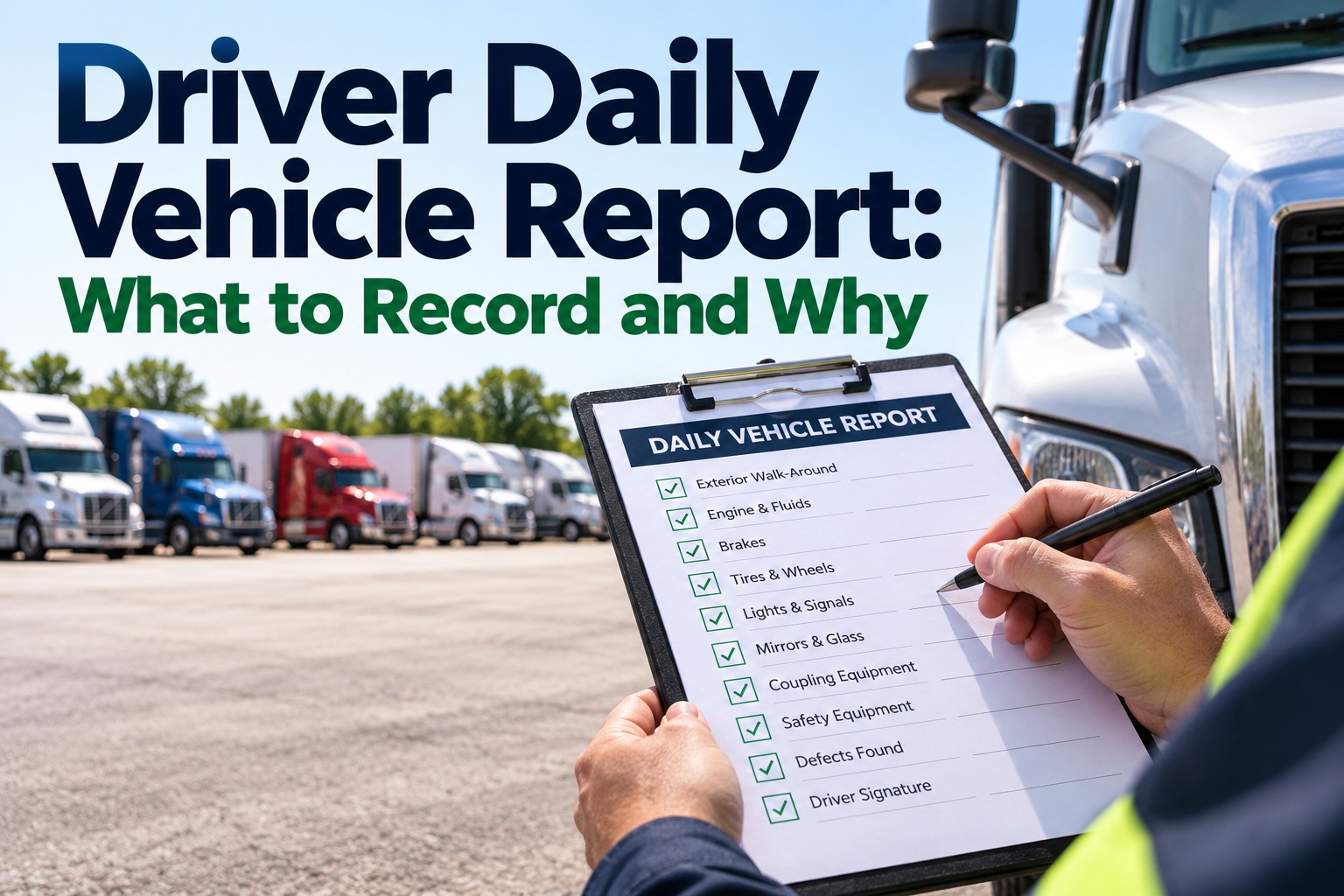
A call is not a DVIR, and a DVIR is not a repair
The report still has to appear on the driver vehicle inspection report, the repair or certification has to be recorded, and the next driver has to review it before the truck goes out. Voice intake makes that chain faster — it doesn't replace any link in it.
What the Federal Hands-Free Rule Allows While the Truck Is Moving
If drivers report while driving, the workflow has to fit 49 CFR 392.82: no holding a mobile phone, no more than one button to start or end a call, and the device reachable from a normal seated position. FMCSA's research behind the rule found dialing raised the odds of a safety-critical event roughly six times, with eyes off the road averaging 3.8 seconds. Everything that needs reading or typing waits until the truck is parked. We'll check your workflow against this in a demo.
Fits the rule
- Hands-free device within reach from the seat
- One touch to start or end the call
- Spoken description, spoken confirmation
Waits until parked
- Typing a defect into a form
- Taking or reviewing photos
- Signing the inspection report
Bring one real defect report to the demo
We'll run it through intake live and show the maintenance ticket it produces, with unit, location, lamp status and priority already filled in — plus where it lands on the DVIR.
Recording Consent When Drivers Cross State Lines Every Day
Voice intake records or transcribes, and recording law isn't uniform: several states require every party's consent rather than one party's, and drivers routinely cross those lines mid-shift. Plan for the strictest rule on the route — announce recording at the start of the call, cover it in the driver handbook, and state how long audio and transcripts are kept. Keep the resulting work order as the durable record, free.
A short spoken notice removes most ambiguity for drivers and for you.
Handbook language signed at onboarding, covering what's captured and why.
State the period for audio and transcripts; the work order is the record that lasts.
What Faster Defect Intake Is Worth Against a Roadside Failure
The value is the hours between finding a defect and scheduling the repair. Industry benchmarking puts unplanned downtime at roughly $448 to $760 per truck per day before towing and repair, CCJ reports unplanned repairs costing $700 to $1,500 in lost revenue per day, and ATRI puts 2025 repair and maintenance cost at $0.215 per mile. A defect that reaches the shop while the truck is still rolling is the cheapest version of that repair. Estimate your own exposure with our team.
Roadside Defect Reporting Questions Fleets Ask Most
Can a driver report a defect by phone instead of the DVIR?
A call is a fast way to start the process, but the defect still has to appear on the written inspection report, be repaired or certified, and be reviewed by the next driver before dispatch. See the full chain in a demo.
Who decides whether the truck keeps driving?
Your written rule should, not the load. Safety-critical defects stop the truck under 396.7; power loss and developing faults go to the nearest shop; non-safety items finish the run and get scheduled. Set the rule on 3 vehicles free.
What should intake capture every time?
Unit and location, the driver's own description, when it started and whether it is worsening, lamp status, load, and a photo once parked. Those six answers write the work order. Use our intake script.
Is voice reporting legal while driving?
Hands-free use is allowed under 49 CFR 392.82 if the driver doesn't hold the phone, uses one touch at most, and can reach the device from a seated position. Typing, photos and signatures wait until parked. Try a compliant flow free.
Do we need consent to record defect calls?
Several states require all-party consent and drivers cross state lines, so plan for the strictest rule: announce recording, cover it in policy, and keep retention short. Review the policy with our team.
How do we stop defects being reported only at end of shift?
Make reporting take seconds and make the shop respond visibly the same day. Drivers report early when something happens after they do. Start free and close the loop.
Turn Every Roadside Defect Into a Ticket While the Truck Is Still Rolling
FleetRabbit captures the report with unit, location, time and photos, opens a work order with a priority, keeps it tied to the DVIR chain, and shows the next driver the repair status before dispatch. Pair it with your PM schedule so repeat defects pull the next service forward.
No credit card required. Works with the phones your drivers already carry.