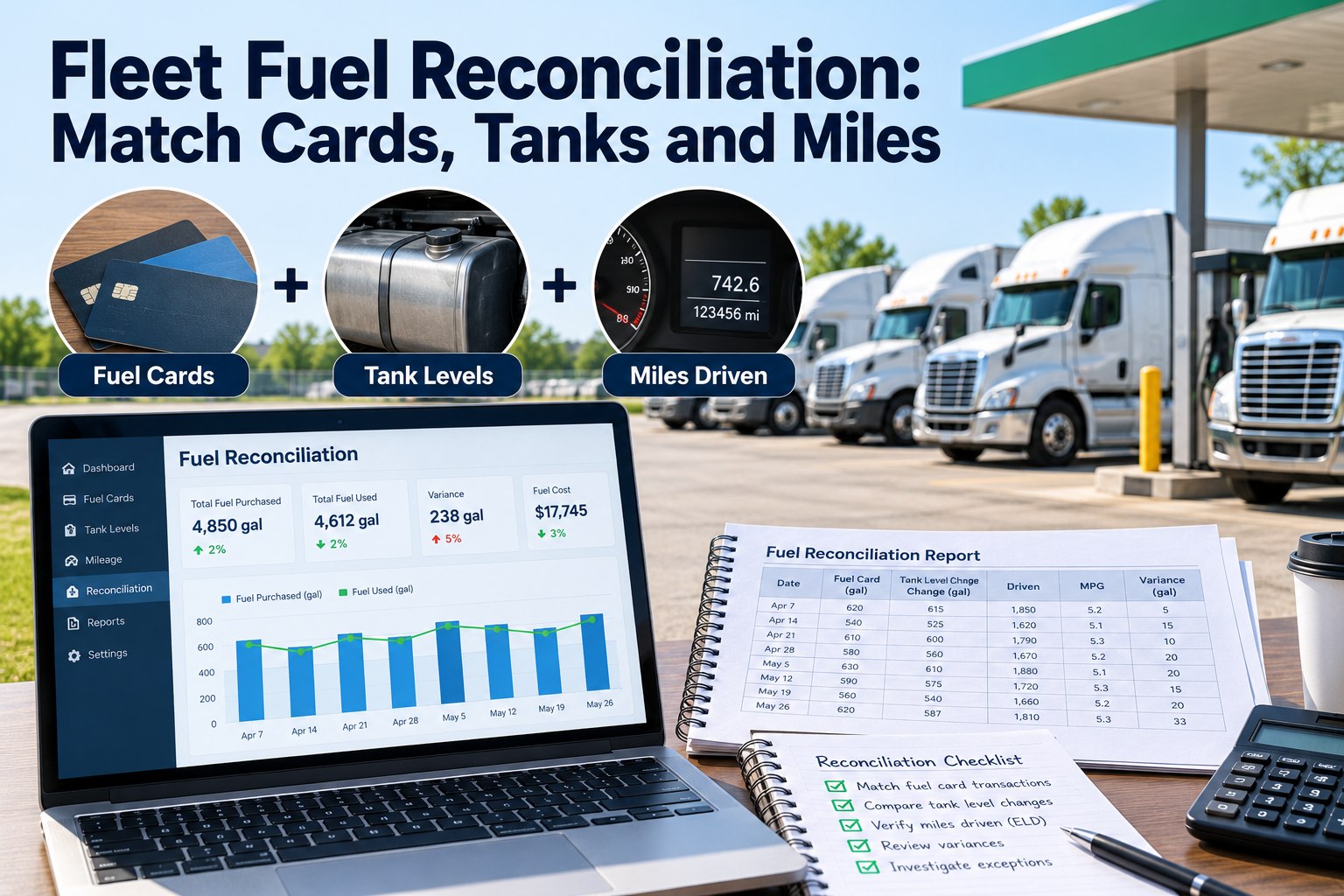
Fleet fuel reconciliation matches three records that should agree: the gallons your cards bought, the fuel your tanks lost and the miles your trucks drove. When they disagree, you have a leak, a theft, a data error or a billing mistake, and a weekly match shows which. This page gives a simple fuel reconciliation process, the variance signals worth acting on, and a cost example. Schedule a call to set up fleet fuel reconciliation.
How Fleet Fuel Reconciliation Works: Matching Gallons Bought, Fuel in the Tank and Miles Driven
Expected gallons come from miles and a baseline MPG, and the gap to what you bought is the variance
Divide each truck's weekly miles by its own baseline MPG to get expected gallons, then compare with the card gallons. The example below uses our own illustrative numbers. The 5 and 8 percent lines are screening and investigation thresholds that an Autosist article, published August 19, 2026, describes as common industry practice without naming a source, so set your own from a few months of data.
| Input | Example (illustrative) |
|---|---|
| Miles driven this week | 1,200 |
| Baseline MPG for this truck | 6.0 |
| Expected gallons | 1,200 / 6.0 = 200 |
| Gallons on card this week | 214 |
| Variance | +14 gallons, 7 percent above expected |
| Result | Above a 5 percent screen, below an 8 percent investigation line: review the transactions |
The Weekly Fuel Reconciliation Checklist: What to Set Up Once and What to Check Every Week
Setup makes the match possible, and the weekly steps keep it from turning into a month-end scramble
Geotab's audit checklist makes the same setup points: log tank size and fuel type per vehicle, confirm card assignments weekly and check each fill against tank size, because a fill larger than the tank is impossible and should be investigated. Reconcile before invoices are paid or returns are filed, and keep a log of each resolution as your audit trail.
Seven Fuel Variance Signals Worth Investigating, Ranked by How Fast You Should Act
Location mismatches, persistent overbuying and returning variance deserve escalation, and the rest can wait for the weekly review
| Variance signal | Suggested tier |
|---|---|
| Single fill above tank capacity or historical maximum | Investigate this week |
| Purchase location does not match vehicle GPS | Escalate now |
| Persistent purchased-over-consumed variance | Escalate now |
| Persistent consumed-over-purchased variance | Investigate this week |
| Step change after months of stability | Investigate this week |
| Same pattern follows one driver across vehicles | Investigate this week |
| Variance returns after a fix | Escalate now |
The tiers come from the same Autosist article, which ranks signals by dollar exposure, recurrence and fraud or safety risk. Treat them as a starting policy, not a standard.
Reading the Match: What Each Variance Pattern Usually Means and What to Check First
The direction of the gap and whether it repeats point to leak, theft, data error or billing mistake
| What the match shows | Possible causes | First check |
|---|---|---|
| Bought more than consumed | Fuel moved to another vehicle or container, card sharing, wrong vehicle on the card, or a leak | Receipt, vehicle assignment, GPS location, tank level |
| Consumed more than bought | Fuel bought on another card or from bulk tank, odometer error, unrecorded use | Odometer, other cards, bulk withdrawals |
| Fill larger than tank | Impossible for one vehicle: data error, card sharing or fuel moved | Tank size on record, receipt, prior fuel level |
| Location does not match GPS | Card in another vehicle or unauthorized detour | Route, GPS history, card holder |
| Step change after stability | Mechanical loss, idling, new driver or route | Maintenance records and idle time |
| Duplicate or odd billing | Billing error | Invoice against transaction detail |
Autosist's card-exception article, dated June 17, 2026, sets no universal thresholds and says each fleet defines its own rules for hours, locations, gallons, grade and purchase frequency. It suggests weekly review for most small and midsize fleets, with daily monitoring of serious exceptions for high-volume fleets, and tracking repeat exceptions within 30 days.
What Unexplained Fuel Costs a Fleet: A Simple Monthly Example at 10, 50 and 100 Vehicles
Even two unexplained gallons per vehicle per month adds up once the fleet grows
The chart multiplies the article's own example assumptions, 2 unexplained gallons per vehicle per month at $3.60 per gallon, across fleet sizes. It is our arithmetic and a conservative case, not a measured loss.
How FleetRabbit Handles Fuel Reconciliation Across Cards, Bulk Tanks and Telematics
Transactions are checked against location, tank capacity and mileage, and you set the follow-up routine
FleetRabbit's fuel reconciliation page says it pulls fuel card transactions, bulk tank data and vehicle telematics into a single reconciled view, checks each transaction against GPS location, tank capacity and mileage and flags location and volume mismatches the same day. The page does not describe how thresholds are configured, or name variance reports or tank sensors, so confirm those on a call. Free for up to 3 vehicles, then $5 per vehicle per month.