Food delivery has become a $1.4 trillion global industry but here's the reality most fleet managers face: 72% of organisations report rising demand for refrigerated foods while cold chain failures cost the industry billions annually in spoiled cargo, FDA violations, and customer chargebacks. A single temperature excursion doesn't just ruin a shipment it triggers recalls, insurance claims, and the kind of reputation damage that sends customers to competitors. Whether you're delivering meal kits, fresh produce, or frozen goods, your fleet's ability to maintain temperature integrity determines whether you're building customer loyalty or shipping liability. See how FleetRabbit solves this — book a free 30-min demo →
Why Food Delivery Fleet Management Is Uniquely Complex
A standard delivery fleet manager tracks vehicles and routes. A food delivery fleet manager tracks vehicles, routes, temperatures, compliance documentation, delivery windows measured in minutes and cargo that becomes worthless — or dangerous — if any single link in the cold chain breaks.
Refrigerated cargo requires constant temperature verification — not hourly checks, not at delivery, but continuously. A 15-minute door opening or a failing compressor can push cargo into the danger zone before anyone notices.
Hot food cools. Cold food warms. Fresh produce wilts. Unlike package delivery where "same day" is fast, food delivery windows are measured in 30-minute increments — and every missed window is a refund, a complaint, or a lost customer.
The FDA requires provable temperature records throughout transport. Paper logs are insufficient for modern audits. Starting January 2026, you need temperature tracking at every node with 2-year retention — and 24-48 hours to produce data when auditors arrive.
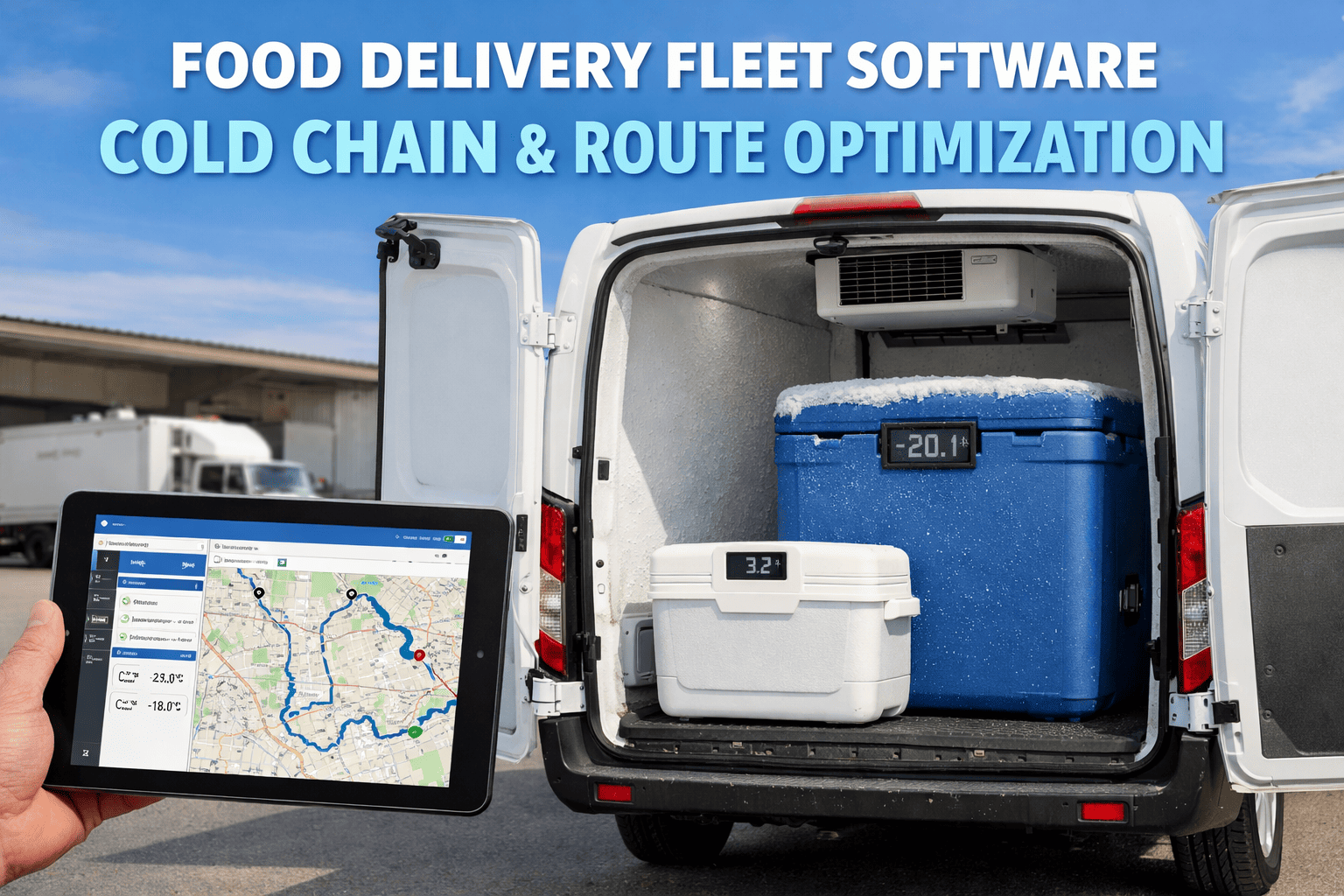
Modern food delivery requires frozen (-18°C), chilled (2-4°C), and ambient zones — often in the same vehicle, on the same route. Each zone has different compliance requirements and failure modes that must be monitored independently.
When cargo temperature exceeds safe limits, there's no "fix it later" option. The product is compromised. The delivery is rejected. The customer files a chargeback. Unlike mechanical issues that can be repaired, temperature failures destroy cargo permanently.
Food spoilage isn't just lost product cost — it's the delivery fee you can't charge, the replacement shipment you send free, the customer you lose permanently, and the insurance claim that raises your premiums. One bad day can erase a month of margin.
Every Type of Food Delivery Fleet — One Platform
Food delivery spans restaurants, grocery chains, meal kit services, and specialised cold chain logistics — each with different temperature requirements, delivery patterns, and compliance needs. FleetRabbit handles all of them in a single unified system with operation-specific templates and a consolidated dashboard.
Hot food cools rapidly — 30-minute delivery windows are standard. Track driver location in real-time, optimise routes for fastest delivery, and prove food arrived within safe temperature range to resolve customer disputes before they escalate.
Frozen, chilled, and ambient products in the same vehicle on the same route. FleetRabbit monitors each temperature zone independently with zone-specific alerts. Meet tight subscription delivery windows for recurring customers who expect consistency.
FDA FSMA requires complete, provable temperature records throughout transport. FleetRabbit generates FDA-compliant documentation automatically — structured electronic records that satisfy auditors and can be produced within 24-48 hours on demand.
Multi-stop event deliveries with different temperature requirements at each stop. Coordinate hot and cold items for the same event. Track on-time performance for corporate clients where late delivery means lost contracts.
What FleetRabbit Does for Food Delivery Fleets
Six capabilities that transform food delivery operations from reactive temperature checks and paper logs to proactive, data-driven cold chain management.
IoT sensors transmit temperature data continuously — at 1-5 minute intervals, not hourly, not at delivery. Multi-zone monitoring tracks frozen and chilled sections simultaneously in the same vehicle. If a reefer unit struggles or fails, you know before the cargo is lost. Instant push alerts to drivers, dispatchers, and fleet managers when any zone exceeds thresholds.
Every minute a refrigerated vehicle sits in traffic is fuel waste and cold chain risk compounding simultaneously. AI sequences deliveries to minimise total transit time, prioritises routes by cargo perishability, and adjusts in real-time for delays — rerouting drivers before delivery windows close. 20-30% reduction in miles driven and total delivery time.
Digital proof-of-delivery captures timestamp, GPS location, driver ID, cargo condition confirmation, and temperature log — automatically, at every stop. Complete temperature chain documentation auto-generated per delivery. FDA audit packages produced in seconds, not days. 2-year record retention meets January 2026 enforcement requirements.
Driver behaviour directly affects cold chain integrity. Unnecessary door openings, extended loading bay wait times, and poor idle management all degrade cargo temperature. Track cold-chain-specific metrics — door open duration per stop, time-at-dock reporting, idle time with reefer running — to create accountability that protects cargo quality.
Refrigeration unit failure is the #1 cause of cold chain breaks. FleetRabbit tracks reefer runtime hours, compressor cycles, and temperature stability patterns to predict failures before they happen. Schedule maintenance during planned downtime rather than discovering problems mid-route with a truck full of spoiling cargo.
When customers dispute delivery condition, you need proof. FleetRabbit captures photo documentation at delivery with GPS timestamp and temperature reading. Resolve disputes immediately with verifiable evidence rather than he-said-she-said. Reduce chargebacks and protect your reputation with documentation that stands up to scrutiny.
See Cold Chain Monitoring in Action — Live Demo
Our 30-minute demo shows real-time temperature tracking, AI route optimisation, and FSMA-ready documentation for your specific operation type — restaurant, grocery, catering, or cold chain logistics.
Temperature Zones & Compliance — What You're Managing Every Delivery
Different food categories require different temperature ranges, monitoring frequencies, and documentation standards. FleetRabbit tracks all of these automatically with zone-specific alerts and compliance reporting.
Measured Results Across Food Delivery Fleet Deployments
FleetRabbit integrates with 200+ telematics and IoT providers including major temperature sensor and reefer systems. Your existing hardware connects via API without replacement. Start free — connect your temperature sensors in under 24 hours →
Frequently Asked Questions
FleetRabbit supports monitoring from ultra-cold (-70°C for specialised biologics) to frozen (-18°C to -25°C) to refrigerated (0°C to 4°C) to hot holding (60°C+). Multi-zone monitoring tracks different temperature setpoints simultaneously in the same vehicle — frozen, chilled, and ambient sections all visible in one dashboard with independent alerts for each zone.
Yes — FleetRabbit integrates with 200+ telematics and IoT hardware providers including major temperature sensor and refrigeration unit systems like Carrier, Thermo King, and most aftermarket IoT sensors. Your existing hardware connects via API without replacement. For vehicles without sensors, we can recommend compatible IoT temperature devices that work with the FleetRabbit platform.
FleetRabbit auto-generates structured electronic records for every delivery: timestamp, GPS location, continuous temperature log, driver ID, and cargo condition confirmation. When FDA auditors request data within 24-48 hours — as required by the January 2026 enforcement update — you can produce complete documentation in seconds. We maintain 2-year record retention as mandated by FSMA, with tamper-evident audit trails that satisfy regulatory requirements.
FleetRabbit's free tier supports up to 3 vehicles with full features including temperature monitoring, route optimisation, and compliance documentation. No credit card required to start. Paid plans begin at just $3/vehicle/month — significantly less than enterprise cold chain platforms that charge $15-45/vehicle for comparable features. No vehicle minimums, no contracts, no setup fees.
With IoT sensors transmitting at 1-5 minute intervals, FleetRabbit detects temperature deviations within minutes — not hours. Instant push alerts notify drivers, dispatchers, and fleet managers the moment any zone exceeds its threshold. This gives you time to act: reroute the driver, adjust the reefer, or make an emergency stop before cargo is compromised.
Most food delivery fleets are fully operational within 3-7 days. FleetRabbit connects to your existing telematics and temperature sensor hardware (200+ providers supported) — no new hardware procurement required. Vehicle and driver data imports via CSV. Temperature zones are configured for each vehicle on day one. Unlike enterprise cold chain platforms that require months of implementation, FleetRabbit is designed to be live before your next delivery shift.
Yes. FleetRabbit tracks both hot holding (60°C+) and cold chain temperatures. For restaurant and catering fleets delivering prepared hot food, the platform monitors that food stays above the 57°C safety threshold. For cold chain operations, it tracks frozen, chilled, and cool zones with independent alerts for each. The same driver can deliver hot prepared meals and cold items on the same route with separate temperature tracking for each cargo type.
Stop Losing Product to Temperature Failures — Start Protecting Your Cold Chain Today
FleetRabbit gives food delivery fleet managers real-time cold chain visibility, AI-optimised routes, and FSMA-ready documentation — without the complexity and cost of enterprise platforms. Start free, no contracts, live in days.
Trusted by food delivery fleets from 5 to 500+ vehicles · Setup in days, not weeks · No contracts