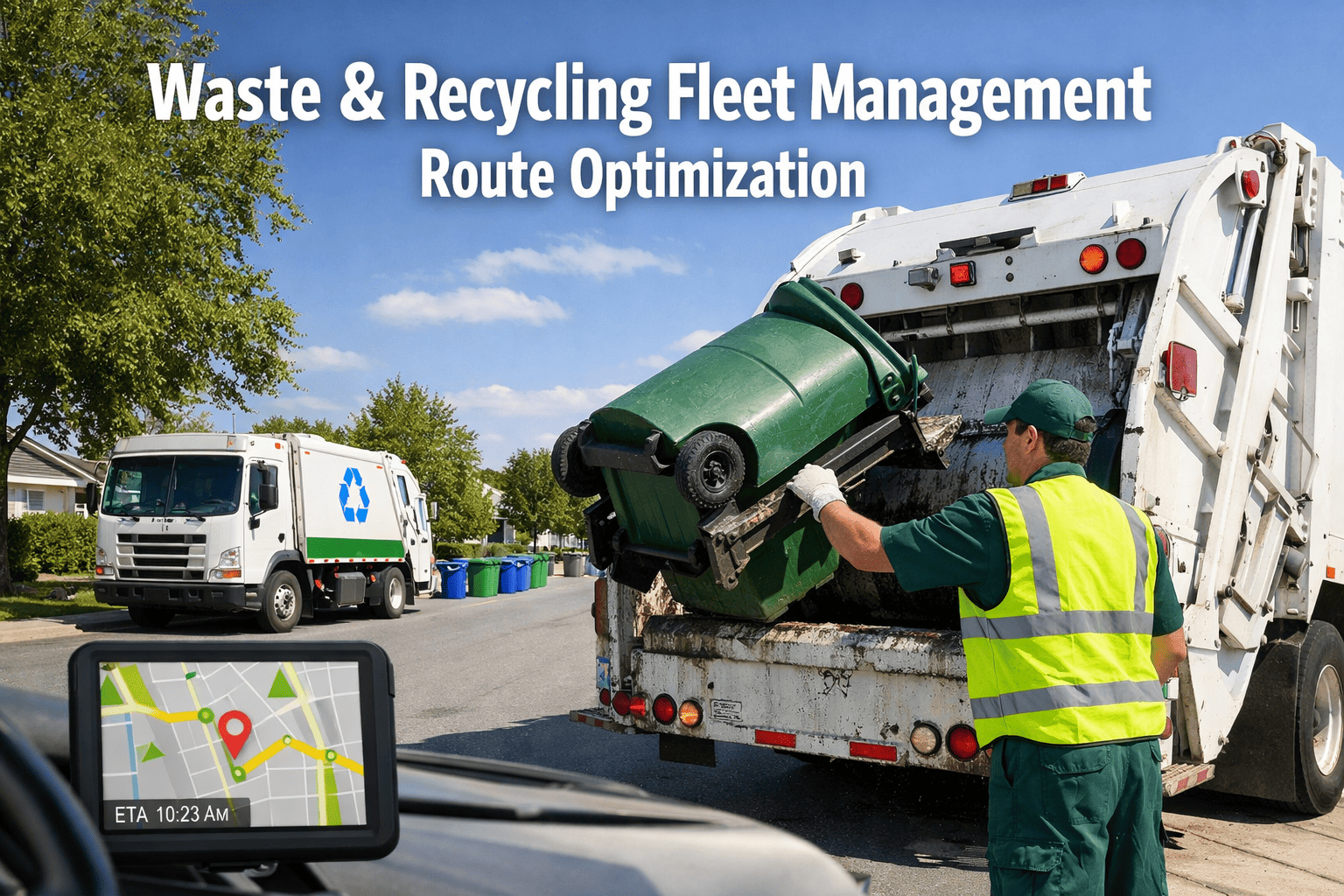
Every garbage truck running an unoptimised route wastes fuel. Every hydraulic failure mid-shift costs $2,000–$8,000. Every missed pickup risks a customer contract. For waste management companies still running on paper logs and static schedules, these are daily events — not exceptions. FleetRabbit is purpose-built to change that.
Backtracking constantlyStops at empty binsDrivers finish at different times15–25% excess miles
320 miles
per truck per shift
AI
Optimises
Optimised Routes — With FleetRabbit
DEPOT
Logical zone-by-zone sweepSkips empty containersAll drivers finish same time25–30% fewer miles
230 miles
per truck per shift
Every Waste Stream — One Platform
Residential
800–1,200 stops/shift
Rear-load routing rules
Compactor cycle PM
Weekly/bi-weekly schedule
Commercial
60–120 stops/shift
Fork arm PM cycles
Service proof photos
Dispute GPS evidence
Recycling
300–500 stops/shift
Split-body truck logic
Contamination capture
Baler mechanism PM
Roll-Off
8–20 containers/shift
Cable & winch tracking
Container locations
Rental duration alerts
Organics
200–400 stops/shift
Seasonal scheduling
Odour zone time rules
Compliance tracking
All streams · One dashboard · One FleetRabbit login
How FleetRabbit Works for Waste Fleets — Step by Step
1
Import Routes
Upload your existing stop lists and route data. FleetRabbit maps every address and builds your service universe — residential, commercial, recycling and roll-off.
Day 1
→
2
AI Optimises
The routing engine sequences every stop zone-by-zone, accounting for truck weight limits, alley access, one-way streets and balanced driver finish times.
Day 1–3
→
3
Drivers Go Live
Optimised routes push to drivers' mobile devices. Digital DVIR, GPS tracking, and stop-by-stop progress all activate the same day — no hardware to install.
Day 3–5
→
4
Dispatchers See All
Live GPS, route completion rates, open defects and PM alerts — all on one dashboard. No radio check-ins. Exceptions surface automatically.
Ongoing
→
5
Savings Compound
Routes improve every cycle as the AI learns your operation. Fuel savings, prevented failures and eliminated overtime add up — typically $200K+ in year one.
Week 1 onward
What happens in your 30-minute setup session
Your routes imported and AI-optimised during the session itself
Hydraulic PM schedule configured for your specific truck types
First truck tracked on live GPS before the call ends
No pitch — you leave with a working system, not a follow-up email
FleetRabbit Feature Scorecard for Waste Operations
Feature
What it does for waste fleets
Impact
AI Route Optimisation
Sequences 800–1,200 stops per truck with waste-specific rules — alley logic, weight limits, balanced finish times
Very High
Hydraulic PM Alerts
Engine-hour and cycle-based maintenance triggers for compactors, lift arms, PTO systems — before they fail on route
Very High
Digital DVIR + Photo Proof
GPS-stamped service verification at every stop — eliminates missed pickup disputes and DOT inspection violations
High
Live Dispatcher Dashboard
Real-time truck locations, route progress, open defects and PM alerts — all without radio check-ins
High
DOT Compliance Tracking
Registrations, insurance, driver medicals and inspection records with 90/60/30-day alerts — audit-ready in 60 seconds
Medium-High
Why Waste Trucks Break Down — And How FleetRabbit Prevents It
A garbage truck is not a delivery van. It runs hydraulic compactors, lift arms and PTO systems through thousands of cycles per shift. Standard mileage-based PM misses the actual wear entirely. Sign up free — configure your first hydraulic PM alert today.
Commercial client calls — says truck never came. No proof. Dispatcher spends 40 min investigating.
4:30 PM
Two drivers still on route. 90 min overtime each. Paper DVIR filed incorrectly — missing 3 entries.
Day cost: $4,200+ in fuel, overtime, repair & credits
FleetRabbit Changes Everything
With FleetRabbit
6:00 AM
Driver opens app — optimised route loaded, 3 stop changes already reflected. DVIR completed in 4 min.
7:30 AM
AI routing guides zone-by-zone. No backtracking. Dispatcher sees live progress on dashboard.
9:45 AM
No hydraulic failure — compactor PM alert fired 2 weeks ago. Serviced in shop for $380. Truck running fine.
11:00 AM
Client calls about missed stop. Dispatcher pulls GPS record in 28 seconds — time, location, photo. Dispute closed.
3:00 PM
All drivers finish on time. Route balanced by AI. Digital DVIRs GPS-stamped, audit-ready automatically.
Day cost: $320 in software. Net savings vs without: $3,880+
500+ Waste Fleets · Free for 3 Trucks · No Sales Pitch · Live in 5 Days
See Your Optimised Routes in 30 Minutes — Free
We import your routes, configure hydraulic PM, and track your first truck — all during the setup session. No pitch. No follow-up pressure. No credit card.
No credit card · No contract · No hardware required · Cancel anytime
Frequently Asked Questions
How is FleetRabbit different from generic fleet software for waste operations?
+
Generic fleet tools were built for delivery vans — mileage-based PM and basic GPS. FleetRabbit has pre-built configurations for garbage trucks: hydraulic cycle tracking, PTO-based PM alerts, compactor schedules, waste-specific DVIR templates and route optimisation with refuse-specific rules like alley access, weight limits and cul-de-sac logic. Book a demo to see waste-specific features live.
How quickly can we go live with optimised routes?
+
Most waste fleets are running AI-optimised routes within 5 business days. During the demo session we import your existing stop lists, build optimised sequences and push to driver mobile devices. No 6-month enterprise implementation. Free for up to 3 vehicles to validate savings before scaling to your full fleet.
Can FleetRabbit prove service was completed when a customer disputes a missed pickup?
+
Yes — every stop is GPS-timestamped with the truck's exact location at service time. Optional photo capture records the bin at the moment of collection. Dispatchers pull the record in under 30 seconds: time, GPS coordinates, driver ID and photo. Most disputes close instantly, eliminating goodwill credits and protecting contract revenue. Sign up free to activate service verification.
Does FleetRabbit handle hydraulic and PTO maintenance for refuse trucks?
+
Yes — PM is triggered by engine hours and equipment cycles, not mileage. FleetRabbit tracks compactor cycles, PTO hours and hydraulic pressure data separately from the vehicle odometer. When a threshold approaches, an alert fires to your mechanic with the specific service required. Work orders auto-create. Hydraulic failures in the shop: $400. On the route: $8,000.
What does FleetRabbit cost for a waste management fleet?
+
Free for up to 3 vehicles — no credit card, no time limit. Paid plans start from $3 per vehicle per month, no contracts. For a 50-truck fleet that is $1,800 per year — less than the cost of a single hydraulic failure on the road. No hardware purchase. No reseller markup. Book a demo to get a savings estimate for your fleet size.