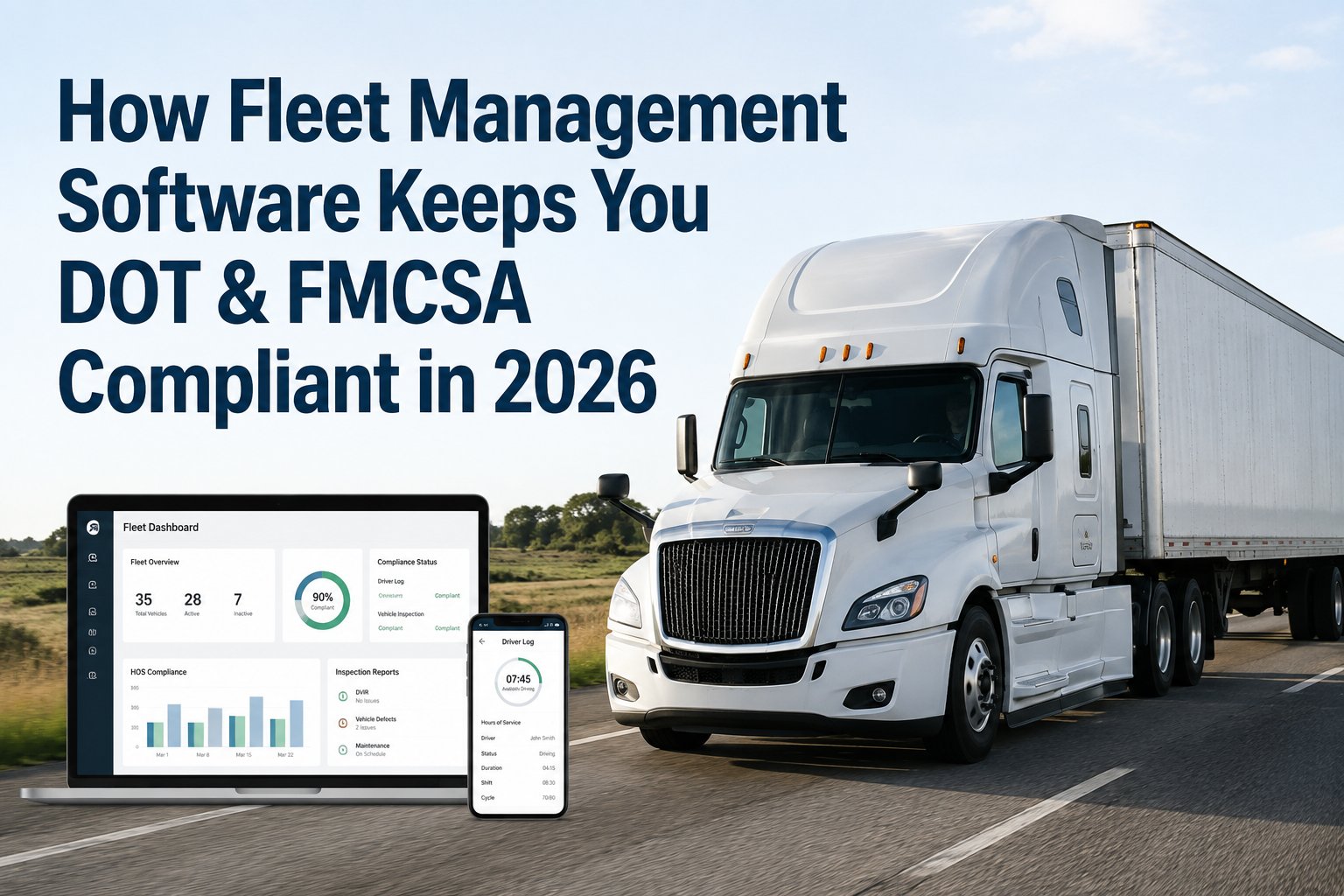
Federal Motor Carrier Safety Administration audits triggered 5,200-plus enforcement actions against carriers in 2024, and the carriers that survived them shared one trait — every DVIR, driver qualification file, hours-of-service log, and maintenance record was instantly producible. Fleet management software built for DOT compliance turns a four-day fire drill into a ten-minute export, and a single failed inspection can otherwise cost a 40-truck operation upward of $48,000 in fines, towing, and downtime. CSA scores below the alert threshold push insurance premiums up 18-35% and shrink the freight pool of brokers who screen BASICs. The platforms below automate the paper, flag violations before they happen, and keep you audit-ready year-round — you can Start Free Trial to see your own compliance gaps mapped in under an hour.
One failed audit can sideline your authority. One platform can make you audit-proof.
Every DVIR, DQ file, ELD log, IFTA return, and maintenance ticket — auto-collected, auto-organized, and exportable to a DOT auditor in under ten minutes. Fleet compliance software replaces the spreadsheets, paper binders, and panic that cost carriers an average of $48,200 per roadside out-of-service violation.
What a single DOT violation actually costs a 40-truck carrier
A roadside inspection that places a truck out of service doesn't end at the fine. The downstream cost — towing, missed delivery penalties, driver reassignment, repair, and the CSA point that lingers for 24 months — is where margins actually bleed.
A 40-power-unit regional carrier in the Midwest ran DVIRs on paper clips and windshield folders. One Level I inspection found a cracked brake drum, an expired annual inspection sticker, and a 14-hour HOS violation on the driver. Direct cost: $14,800 in fines plus $7,200 in towing and layover freight penalties. Indirect: their Unsafe Driving BASIC jumped above threshold, two brokers paused loads for 60 days, and their renewal quote rose 22%. Total 12-month impact: $71,400. A compliance platform covering eDVIR, inspection scheduling, and HOS alerts would have cost $11,400/yr for the same fleet.
Five compliance pillars the software automates end-to-end
FMCSA regulations touch every department — safety, maintenance, HR, and accounting. The right platform doesn't just store documents; it triggers workflows, sends alerts, and blocks violations before they reach the roadside.
Digital DVIR & Defect Tracking
Drivers complete electronic DVIRs on mobile devices; defects auto-create repair work orders, and the platform refuses to clear a truck until the mechanic signs off. Audit trail covers every signature, timestamp, and corrective action.
Driver Qualification File Management
Auto-requests MVRs, employment verification, and medical examiner certificates at hire. Alerts fire 30/15/1 days before any DQ document expires, so a roadside check never finds a lapsed medical card again.
Hours-of-Service & ELD Enforcement
Real-time HOS dashboards flag approaching 11-hour, 14-hour, and 70/8-day limits. Unassigned driving events, form-and-manner edits, and missing logs are surfaced daily — not at audit time.
Annual Inspection & Maintenance Scheduling
Tracks annual DOT inspections, PM intervals, and component warranties. Per-vehicle maintenance histories export in the exact format a DOT auditor expects under Part 396.3 recordkeeping.
CSA Score Monitoring & Intervention Alerts
Live BASICs tracking across Unsafe Driving, HOS Compliance, Vehicle Maintenance, Driver Fitness, Crash Indicator, and Controlled Substances. Alerts fire before your score crosses the 65th-80th percentile intervention threshold.
The digital DVIR workflow that ends paper defects forever
Driver Vehicle Inspection Reports are the single most-cited document in DOT audits — and the most frequently incomplete. Here is the exact four-step loop a compliance platform enforces on every power unit, every shift.
Pre-Trip Inspection
Driver walks a guided 396.11 checklist on a mobile app — brakes, steering, lights, tires, coupling, emergency equipment. Photos attach to defects; GPS and timestamp are locked at submission.
Defect Triage & Work Order
Any defect rated "unsafe" auto-generates a work order in the maintenance module. The vehicle is flagged red on the dispatch board until a certified mechanic signs the corrective action.
Post-Trip Closure
Post-trip DVIR closes the loop. If no defects are reported, the record is sealed. If defects emerged during the run, the cycle restarts before the next dispatch — no truck leaves the yard uncleared.
Audit-Ready Archive
Every DVIR, mechanic signature, and repair receipt is archived for the FMCSA-mandated 12 months and exportable in one click. Auditors get a single ZIP file with the full chain of custody.
The FMCSA audit-day checklist — built into the platform
When a DOT investigator requests records under 49 CFR 384.225, you get 48 hours. This is the document set the platform assembles and time-stamps automatically — no binder-hunting, no missing signatures.
| Required Record | FMCSA Citation | Retention | Platform Status |
|---|---|---|---|
| Driver Qualification File | § 391.51 | Employment duration + 3 yr | Auto-tracked |
| Records of Duty Status (ELD Logs) | § 395.8 / 395.22 | 8 days roadside / 6 mo file | Auto-tracked |
| DVIRs (pre/post-trip) | § 396.11 | 3 months | Auto-tracked |
| Vehicle Maintenance Records | § 396.3 | 1 year + 6 mo after departure | Auto-tracked |
| Annual Inspection Reports | § 396.17 – 396.23 | 14 months | Auto-tracked |
| Drug & Alcohol Testing Records | § 382.401 | 1–5 years by record type | Auto-tracked |
| Hazardous Materials Shipping Papers | § 397.19 / 49 CFR 172 | 1 year / 375 days | Manual upload |
| Accident Register | § 390.15 | 6 months from date of accident | Auto-tracked |
Manual compliance vs. automated compliance — the operational gap
The difference between a paper-based safety program and a software-driven one isn't incremental. It's the difference between reacting to violations and preventing them — measured in dollars, CSA points, and audit hours.
- — 3–4 days to assemble an audit packet
- — 12–18% of DQ files found incomplete at audit
- — Defects discovered at roadside, not in the yard
- — CSA BASICs reviewed manually, weeks after violations post
- — Expired medical cards and inspections caught by accident
- — $48K+ average cost per out-of-service violation
- ✓ 10-minute audit packet export, time-stamped
- ✓ 100% DQ file completeness with 30/15/1-day expiry alerts
- ✓ Defects flagged pre-trip; truck never leaves with an unsafe condition
- ✓ Live CSA dashboards; alerts before scores cross intervention threshold
- ✓ Expiry calendar fires 60 days ahead for every credential and inspection
- ✓ 60–80% reduction in roadside out-of-service events
Run your next DOT audit in 10 minutes — not 4 days.
See your compliance gaps mapped in under an hour. Free for up to 3 assets, no credit card required.
Frequently asked compliance questions
What FMCSA records does fleet management software automatically generate and store?
The platform auto-generates and archives DVIRs (§ 396.11), ELD records of duty status (§ 395.8), annual inspection documentation (§ 396.17), maintenance records under Part 396.3, and the accident register (§ 390.15). Driver qualification files, drug and alcohol testing records, and IFTA quarterly returns are tracked with expiry alerts and document upload — covering roughly 90% of what a DOT investigator will request in a compliance review.
How quickly can I produce records if FMCSA launches an investigation?
Under 49 CFR 384.225 you typically have 48 hours to produce requested records. A compliance platform compiles the full document set — DVIRs, DQ files, HOS logs, maintenance histories, and inspection reports — into a single time-stamped, audit-traceable export in about 10 minutes. Carriers using paper systems routinely take 3 to 4 days and still produce incomplete packets. Start Free Trial and run a mock audit on your own fleet this week.
Does the software protect my CSA / SMS BASICs scores?
Yes. The platform monitors all seven BASICs categories in real time and alerts safety managers before scores cross the 65th–80th percentile intervention threshold. By catching HOS violations, vehicle maintenance defects, and unsafe driving events before they escalate, carriers typically reduce out-of-service violations by 60–80% — which directly prevents CSA points from posting and keeps insurance premiums and broker eligibility intact.
Can fleet management software handle IFTA and IRP reporting too?
Most modern compliance platforms integrate fuel card data, GPS mileage by jurisdiction, and route data to auto-generate IFTA quarterly returns and IRP mileage summaries. This eliminates manual trip-sheet calculations — a common audit failure point — and reduces IFTA prep time from days to roughly an hour per quarter for a 40-truck fleet.
How long does implementation take, and is it worth the cost?
A 40-power-unit carrier is typically live in 7 to 14 days: driver onboarding takes one training session, ELDs pair with the platform in a day, and historical records are imported during setup. At roughly $285 per truck per year, the platform costs about $11,400 annually for that fleet — against an average $48,200 per single out-of-service violation. Preventing one roadside event per year pays for the system nearly five times over. Book a Demo to get a fleet-specific ROI estimate.
Stop racing the auditor. Start running a compliant fleet.
Digital DVIR, DQ file automation, CSA monitoring, and 10-minute audit exports — all in one platform built for DOT and FMCSA compliance.
Free up to 3 assets — No credit card required