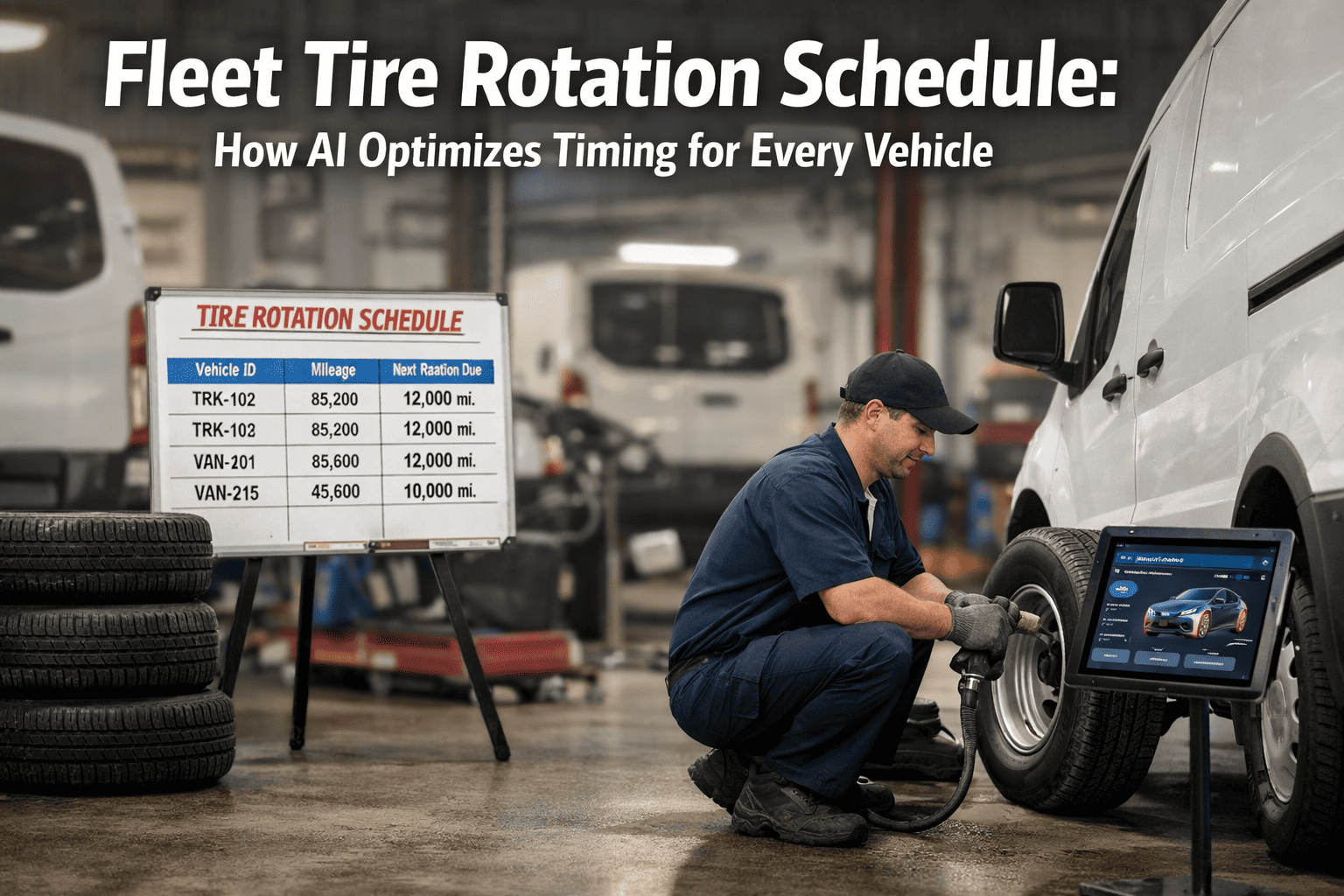
Tire rotation timing shouldn't be a guess. Yet most fleets still rotate based on calendar schedules or round mileage numbers — ignoring the actual wear patterns that determine when rotation actually matters. AI tire rotation scheduling analyzes real wear data from every vehicle in your fleet to generate precise rotation timing that extends tire life by 25-40% and eliminates the premature replacements that drain your tire budget. With fleets spending an average of $3,687 per truck annually on tires, optimizing rotation schedules directly impacts your bottom line. Here's how AI transforms tire rotation from a maintenance task into a cost-saving strategy.
Stop Guessing When to Rotate Tires
AI analyzes wear patterns and generates optimal rotation schedules for every vehicle
Front tires showing 40% faster wear than rear. Rotate at 52,340 miles (in 1,840 miles) to prevent premature replacement and extend set life by 8,000+ miles.
The Problem With Calendar-Based Rotation
Most fleets rotate tires every 5,000-8,000 miles or every 3-6 months — regardless of actual wear. This one-size-fits-all approach ignores the reality that tires on different vehicles, routes, and positions wear at dramatically different rates. A delivery truck making 50 urban stops daily wears front tires far faster than a highway truck covering 500 miles with minimal turning. Calendar schedules either rotate too early (wasting service time) or too late (causing uneven wear that shortens tire life). Missing systematic rotation alone reduces tire lifespan by approximately 25%. Preventive maintenance software solves this by tracking actual vehicle data instead of arbitrary schedules.
Calendar-Based Rotation
- Same interval for all vehicles regardless of use
- Ignores actual tread depth measurements
- No adjustment for route type or load
- Rotates too early or too late
- Leads to 25% shorter tire life
AI-Optimized Rotation
- Custom timing per vehicle based on wear data
- Real-time tread depth monitoring
- Accounts for routes, loads, and driving patterns
- Rotates at the optimal moment
- Extends tire life by 25-40%
How AI Predicts Optimal Rotation Timing
AI tire rotation systems analyze multiple data streams to predict exactly when each vehicle needs rotation — not based on averages, but on that specific vehicle's wear patterns. Machine learning models achieve 94-96% accuracy in predicting tire wear by processing pressure data, temperature fluctuations, tread depth measurements, driving patterns, route characteristics, and load data. The system learns your fleet's unique patterns and continuously improves predictions over time.
Data Collection
TPMS sensors, tread depth gauges, GPS routes, and telematics feed real-time data on every tire's condition and usage patterns.
Wear Pattern Analysis
AI detects wear rate differences between positions, identifying which tires are wearing faster and why (turns, loads, pressure).
Prediction Generation
Machine learning calculates when tread depths will converge optimally, triggering rotation before any tire reaches critical wear.
Automated Alerts
Work orders generate automatically, scheduled during planned PM stops to minimize disruption and maximize technician efficiency.
What AI Tracks for Every Tire
AI tire management goes far beyond simple mileage tracking. Modern systems process over 150 variables per tire to create accurate wear models. Here's what FleetRabbit's AI tire pressure monitoring system tracks in real-time:
The ROI of AI Tire Rotation
Tire costs average $3,687 per truck annually according to ATRI data — the third-highest fleet operating expense. AI-optimized rotation delivers measurable savings across multiple categories. For a 25-vehicle fleet, the math is compelling:
Calculate Your Fleet's Tire Savings
Get a personalized ROI estimate based on your fleet size, current tire costs, and routes. See exactly how much AI rotation scheduling can save.
Common Wear Patterns AI Detects
AI doesn't just measure tread depth — it identifies wear patterns that indicate underlying issues. Catching these patterns early through AI predictive maintenance prevents the root cause from destroying replacement tires too.
Edge Wear
Inner or outer edge wearing faster — indicates alignment or camber issues
Cupping/Scalloping
Wavy wear across tread — suggests suspension or shock absorber problems
Center Wear
Middle of tread wearing faster — indicates chronic overinflation
Both Edges Wear
Inner and outer edges wearing — indicates chronic underinflation
Position-Specific Wear Analysis
Different tire positions wear at different rates based on vehicle type, load distribution, and driving patterns. AI tracks wear rates by position to optimize rotation sequences. Research shows drive tires often wear twice as fast as steer tires due to traction, torque, and braking forces.
AI learns your fleet's specific position wear ratios and adjusts rotation recommendations accordingly. A truck running mostly urban routes will have different optimal timing than one on long-haul highway runs.
Integration With Fleet Operations
AI tire rotation works best when integrated with your broader fleet management software. FleetRabbit connects tire intelligence with maintenance scheduling, work orders, and compliance tracking for seamless operations.
Frequently Asked Questions
Modern AI tire wear prediction achieves 94-96% accuracy for 60-90 day forecasts. Accuracy improves over time as the system learns your fleet's specific patterns and operating conditions. Systems processing TPMS data, tread depth measurements, and telematics achieve 98% accuracy for 30-day predictions.
Basic AI tire scheduling works with manual tread depth measurements entered during inspections. For full predictive capabilities, TPMS sensors ($50-200 per vehicle) provide continuous pressure and temperature data. FleetRabbit integrates with existing telematics and TPMS hardware — no proprietary devices required.
Fleets report 20-40% reduction in tire costs within the first year. For a 25-vehicle fleet spending $92,000 annually on tires, that's $18,000-$37,000 in direct tire savings, plus additional savings from fuel efficiency (even wear reduces rolling resistance) and avoided roadside failures ($1,500-3,000 per incident).
The traditional recommendation is 5,000-8,000 miles, but optimal timing varies dramatically by vehicle, route, and load. AI systems calculate the ideal rotation point for each vehicle based on actual wear rates — which may be 4,000 miles for an urban delivery truck or 10,000 miles for a highway cruiser.
Yes — this is a key advantage. AI detects wear patterns caused by alignment, suspension, or inflation issues. Rotating without fixing these root causes just moves the damage to a different tire. FleetRabbit flags underlying issues for repair before rotation, preventing the same pattern from recurring.
Start Optimizing Your Tire Rotation Schedule
FleetRabbit's AI analyzes your fleet's wear patterns and generates precise rotation timing for every vehicle. Free for up to 3 vehicles, $3/vehicle/month after — no contracts, no hardware required.