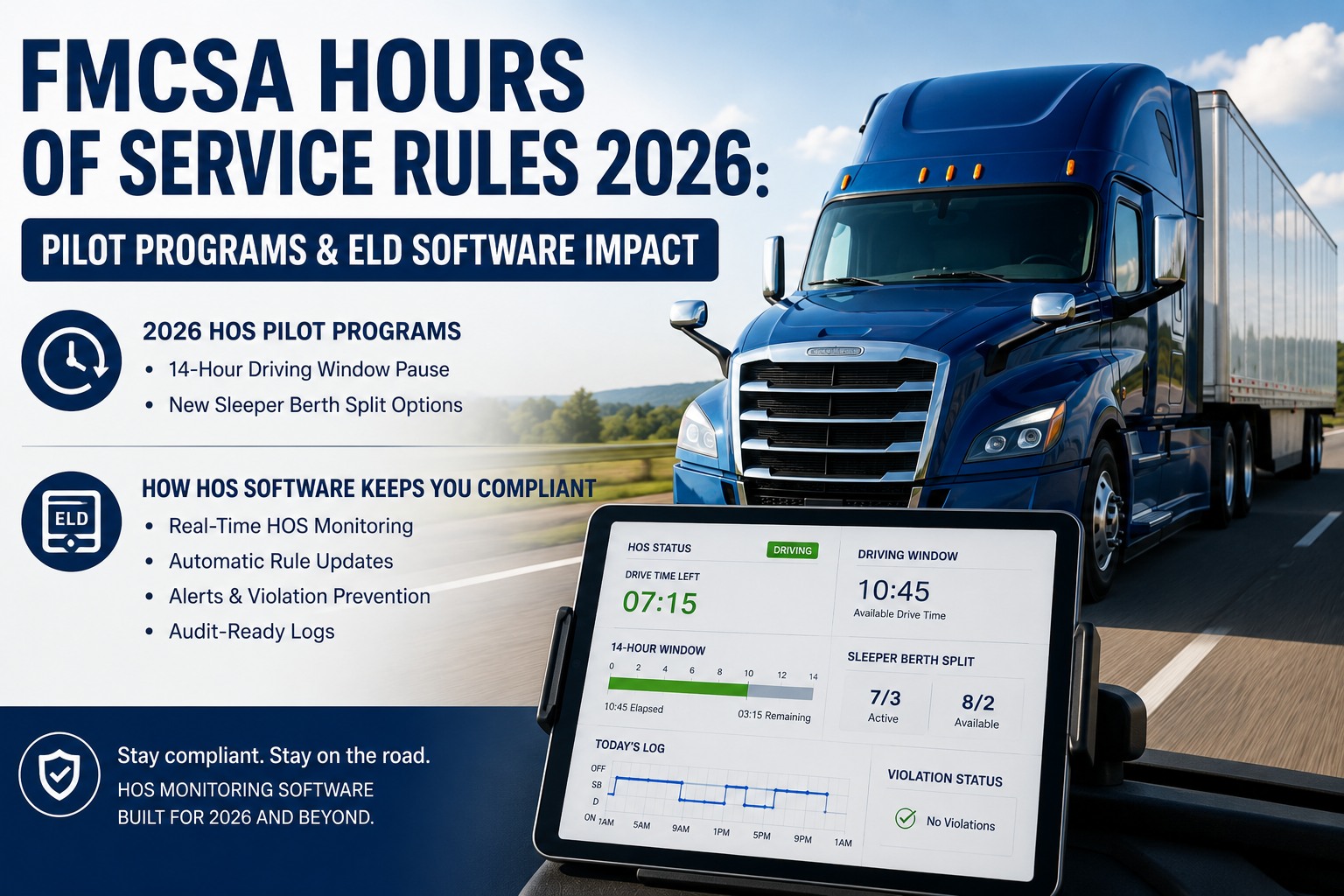
For the first time in over a decade, the FMCSA is testing real flexibility in how truck drivers manage their hours of service — and 2026 is the year those pilot programs went live. Under the Department of Transportation's "Pro-Trucker Package," two pilots are now active: the Flexible Sleeper Berth pilot, which adds 6/4 and 5/5 split options beyond the traditional 8/2 and 7/3, and the Split Duty Period pilot, which lets a driver pause the 14-hour driving window with one break of 30 minutes to 3 hours. For fleet managers, this is both an opportunity and a trap: configured correctly, the new splits unlock real productivity; configured wrong, your ELD logs false violations that tank your CSA score. This guide breaks down the core HOS rules that still apply today, exactly how the 2026 pilots change the math, and how HOS monitoring software keeps your fleet compliant through every configuration. Start free trial or book a demo to see how Fleet Rabbit handles the new HOS rules.
FMCSA PRO-TRUCKER PACKAGE · 2026
The 14-Hour Clock Can Now Be Paused — If You're Enrolled and Configured Right
Two pilot programs launched in spring 2026 give drivers flexibility they've asked for since 2020. But using a new split without enrollment isn't testing a pilot — it's violating current rules. The difference between a productivity gain and a CSA hit is entirely in the setup.
The Standard Duty Day
11-hr driving limit
14-hr on-duty window
10-hr required off-duty
2
Active pilot programs under the 2026 Pro-Trucker Package
30m–3h
Length of the Split Duty Period pause on the 14-hour window
$16,000
Maximum civil penalty per hours-of-service violation
~13%
Of CMV crashes involve driver fatigue, per FMCSA data
One misconfigured ELD split logs a false violation on every driver who runs it.
Fleet Rabbit's HOS monitoring tracks every driving window, break, and split in real time — and flags a problem before it becomes a roadside citation.
The Core HOS Rules That Still Apply in 2026
Before the pilots change anything, it is worth being precise about what has not changed. The 2026 pilots test flexibility on top of the existing framework — they do not replace it. Every rule below is the federal HOS baseline under 49 CFR Part 395 that governs any driver not enrolled in a pilot, which is the overwhelming majority of the industry. Scroll the table horizontally on mobile to see the full detail.
← Swipe to see all columns →
Pilot Program 1: Flexible Sleeper Berth
The current sleeper-berth rule lets drivers split their 10 required off-duty hours into an 8/2 or 7/3 combination. The Flexible Sleeper Berth pilot keeps the 10-hour total but adds two brand-new combinations — 6/4 and 5/5 — that align better with natural sleep patterns. One rule still holds firm: the two blocks must total 10 hours and the shorter sleeper block must be at least 5 hours. Neither block resets your 14-hour driving window; only a full 10-hour off-duty period does that. Book a demo to see how the split math logs correctly in the ELD.
CURRENT
8 / 2
8 hours sleeper berth + 2 hours off-duty. The traditional split most long-haul drivers run today.
CURRENT
7 / 3
7 hours sleeper berth + 3 hours off-duty. The other established split under existing rules.
NEW 2026
6 / 4
6 hours sleeper berth + 4 hours off-duty. A pilot-only option for enrolled drivers seeking more balanced rest.
NEW 2026
5 / 5
5 hours sleeper berth + 5 hours off-duty. The most balanced split — shorter block must still be 5 hrs in the berth.
Pilot Program 2: Split Duty Period
The Split Duty Period pilot is the more radical of the two. For decades, the 14-hour window could not be paused — once the clock started, it ran, whether the driver was moving or sitting at a dock. The SDP pilot changes that. Enrolled drivers can take one break of 30 minutes to 3 hours — off-duty, in the sleeper berth, or on-duty not-driving at a pickup or delivery — and effectively pause the 14-hour window, without losing driving time to detention or traffic.
1
Clock Starts On Duty
The 14-hour window begins the moment the driver comes on duty, same as always.
2
Detention or Traffic Hits
A dock delay or congestion would normally burn window time with the driver stuck and not moving.
3
Pause the Window
The driver takes one 30-min to 3-hour break, correctly logged, and the 14-hour clock pauses.
4
Drive Time Preserved
The window resumes after the break, and the driver keeps the driving hours that detention would have eaten.
The costly detail most fleets miss: the SDP break must be logged in the correct duty status — off-duty, sleeper, or on-duty not-driving at a shipping point. Log it wrong and the break does not pause the clock; it counts against the window and can trigger a violation. A break over 3 hours does not pause the window either — it resets requirements entirely. This is exactly the kind of split-second logging decision that ELD software should handle automatically, not leave to a tired driver at a loading dock.
See how Fleet Rabbit auto-validates the status.
Pilot Eligibility at a Glance
Both pilots launched in spring 2026 as part of the Pro-Trucker Package, in response to Executive Order 14286. They are actively recruiting, but participation is selective and a driver enrolls in one pilot, not both. Here is how the two programs compare side by side. Swipe horizontally on mobile to see every column.
← Swipe to see all columns →
Test New HOS Configurations Without Risking Your CSA Score
Whether your drivers are enrolled in a pilot or running standard splits, Fleet Rabbit's HOS monitoring tracks every window, break, and split in real time — validating the duty status before a mislog becomes a violation. Deploy at $5/vehicle/month, no hardware, live within 72 hours.
Real-time window & break tracking
Split-status auto-validation
Pilot & standard-rule support
Roadside-ready log exports
How HOS Monitoring Software Keeps You Compliant Through Change
Regulatory flexibility is only an advantage if your systems can track it accurately. The pilots introduce new split math, new logging requirements, and new ways to accidentally create a false violation. Here is where Fleet Rabbit's HOS monitoring acts to keep every driver — enrolled or not — on the right side of the rules.
01
Real-Time Window Countdown
Every driver's 11-hour drive, 14-hour window, and 30-minute break status update live, so dispatch and driver both see exactly how much clock is left before a limit is hit.
02
Split-Status Validation
The system checks that a sleeper split or SDP break is logged in the correct duty status — the single most common source of false violations under the new pilots — before it posts to the record.
03
Pilot & Standard-Rule Support
Configure enrolled drivers for 6/4 or 5/5 splits and the SDP pause while everyone else runs standard rules — no separate systems, no manual reconciliation between the two.
04
Violation Early-Warning Alerts
Approaching a limit triggers an alert to the driver and safety desk before the line is crossed — turning a potential OOS order into a routed rest break.
05
Roadside-Ready Log Exports
Complete records of duty status export in the format a DOT officer expects, with the pilot waiver reference attached for enrolled drivers, so a roadside stop stays a formality.
06
HOS-Category CSA Visibility
A dashboard shows how logged violations trend against the 65% HOS Compliance intervention threshold, so a pattern of small mislogs never quietly pushes you toward an investigation.
Why the Logging Detail Matters to Your Bottom Line
Up to $16K
Civil penalty per HOS violation
7 pts
CSA points per major HOS violation
×2
2026 severity weight on OOS violations
65%
HOS Compliance intervention threshold
Driving more than 3 hours past a limit can trigger an immediate out-of-service order at the roadside — the truck stops where it is until the driver has 10 consecutive hours off. Under the 2026 CSA overhaul, that OOS finding now hits your score twice as hard.
Book a demo to protect your HOS percentile.
Frequently Asked Questions
Are the 2026 HOS pilot programs available to every driver?
No. Both the Flexible Sleeper Berth and Split Duty Period pilots are selective, actively recruiting enrolled drivers through the FMCSA pilot portal, with each study collecting data from roughly 256 CDL holders. A driver enrolls in one pilot, not both, and receives a waiver letter listing their name and CDL number. Using a new split without enrollment is not testing a pilot — it is a violation of the rules that still apply to you.
Book a demo.
Do the pilots give drivers more total driving time?
No — and this is the key misconception. The pilots change how you rest and how you handle detention, not how much you can drive. The 11-hour driving limit stays intact. The Flexible Sleeper Berth pilot just lets you split your 10 off-duty hours differently, and the Split Duty Period pilot lets you pause the 14-hour window so detention does not eat into the driving hours you already have.
Book a demo.
What happens if a sleeper split or SDP break is logged wrong?
The break fails to count. For a sleeper split, the shorter block must be at least 5 hours in the sleeper berth; log it off-duty instead and it may not qualify. For the SDP pilot, the pause must be in the correct status — off-duty, sleeper, or on-duty not-driving at a shipping point — or it counts against the 14-hour window instead of pausing it. A break over 3 hours resets requirements entirely rather than pausing. HOS software that validates status at entry prevents these errors.
Book a demo.
Is an ELD still required in 2026?
Yes. Electronic logging devices remain mandatory for most interstate CMV drivers required to keep records of duty status. Several ELD models were delisted in 2025 and 2026 — using a revoked device is treated the same as having no ELD at all, which generates HOS violations. Devices must also sync with the upgraded FMCSA data gateway by January 1, 2027. Keeping your ELD registered and current is itself a compliance requirement.
Book a demo.
What does an HOS violation actually cost?
Civil penalties run up to $16,000 per violation, and major violations — driving beyond the 11-hour, 14-hour, or 60/70-hour limits, or false logs — carry 7 CSA points each. Driving more than 3 hours past a limit can trigger an immediate out-of-service order at the roadside. Under the 2026 CSA overhaul, OOS violations carry double the severity weight, so an HOS-driven OOS finding hits your score twice as hard as it used to.
Book a demo.
Can Fleet Rabbit track both pilot and standard-rule drivers at once?
Yes. You can configure enrolled drivers for 6/4 or 5/5 splits and the Split Duty Period pause while every other driver runs standard HOS rules — all in one system, with no manual reconciliation. Each driver's window, breaks, and splits are tracked and validated against the rule set that applies to them, and logs export roadside-ready with the pilot waiver reference attached where relevant.
Book a demo.
Stay Compliant Through Every HOS Rule Change — Pilot or Standard.
Fleet Rabbit gives commercial fleets real-time window and break tracking, split-status validation, violation early-warning alerts, and roadside-ready log exports — the toolkit that turns HOS flexibility into productivity instead of a CSA risk. Integrated with your existing systems in 5–7 working days, at $5/vehicle/month, with no new hardware required.
Free tier for up to 3 vehicles · No credit card required · No hardware installation
July 18, 2026By Derek Goes
All Blogs