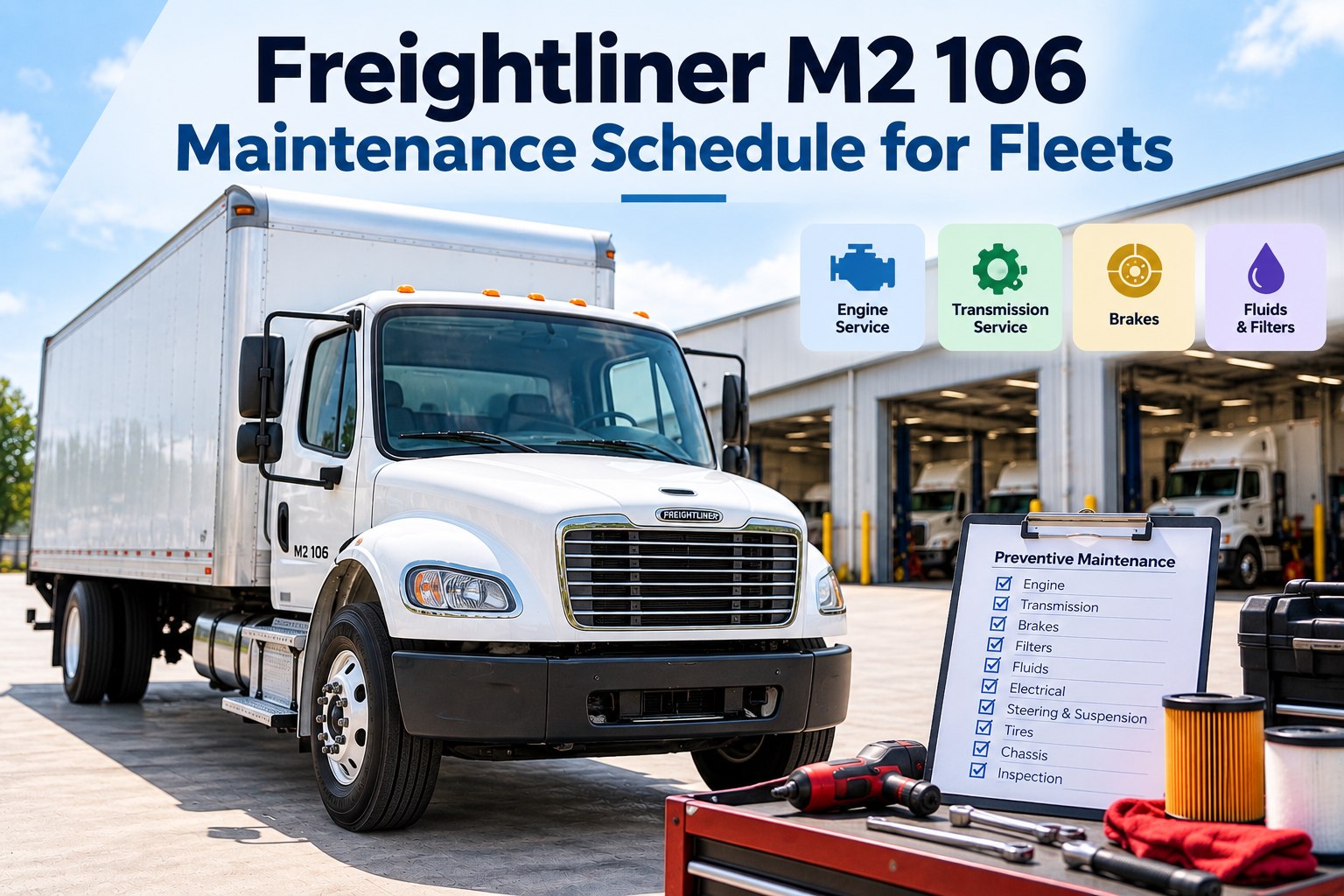
On a Freightliner M2 106 the useful question is not what the interval is but which schedule the truck is on, because that single choice moves every service on the vehicle by up to ten times. Freightliner publishes one ladder of five maintenance levels, M1 through M5, and three schedules to run it on. An M1 service falls due every 1,000 miles on Schedule I and every 10,000 on Schedule III. The counterintuitive part, and the one most fleets get wrong, is that the strictest schedule is reached by low annual mileage, not high — anything under 6,000 miles a year lands there. The levels also nest, so a due M4 carries the M3, M2 and M1 work with it. Book an M2 106 PM review.
Pick the Wrong Schedule and Everything Is Wrong
The three schedules and how you qualify for each, the full M1 to M5 ladder on all of them, why the levels nest, and the hour limits that appear on only one of the three.
Three Schedules, and How You Qualify
Freightliner sets these out by operating condition rather than by what the truck is called, and the wording of the first one matters.
Vehicles that “travel up to 6000 miles (10 000 kilometers) annually or that operate under severe conditions” — dusty roads, extreme climates, frequent short trips, construction sites.
Vehicles that “travel up to 60,000 miles (100 000 kilometers) annually and operate under normal conditions,” with city operation and infrequent freeway travel.
Vehicles that “travel more than 60,000 miles (100 000 kilometers) annually,” running primarily highway mileage.
Read Schedule I's definition again: up to 6,000 miles annually or severe conditions. It is an either-or, so a truck can land there on mileage alone with no severe conditions at all, or on conditions alone while covering serious distance. Schedules II and III both require normal operation, so any severe condition pulls a vehicle out of them regardless of its mileage.
The schedule is a field on the vehicle, not a fleet-wide setting. Annual distance and operating conditions are held per unit, so a mixed M2 fleet runs two or three schedules side by side without anyone reconciling them by hand.
The Ladder, and the Tenfold Spread
Same five services, same truck. Only the clock changes — and it changes a great deal.
Schedule I runs the initial service and M1 at 1,000 miles or 100 hours, then doubles and redoubles up to M5 at 32,000 miles. Schedule III starts at 10,000 and runs M5 out to 160,000. That is a five-fold spread at the top of the ladder and a ten-fold spread at the bottom, on identical hardware. A single PM interval entered once for "M2 106" cannot be right for more than one of the three.
| Level | Schedule I · severe | Schedule II · short haul | Schedule III · long haul |
|---|---|---|---|
| Initial | 1,000 mi / 100 hrs | 8,000 mi | 10,000 mi |
| M1 | 1,000 mi / 100 hrs | 8,000 mi | 10,000 mi |
| M2 | 4,000 mi / 400 hrs | 16,000 mi | 20,000 mi |
| M3 | 8,000 mi / 800 hrs | 32,000 mi | 40,000 mi |
| M4 | 16,000 mi / 1,600 hrs | 64,000 mi | 80,000 mi |
| M5 | 32,000 mi / 3,200 hrs | 128,000 mi | 160,000 mi |
All three ladders are held as schedule templates. Assigning a unit to Schedule I applies the whole ladder with its hour limits, rather than someone copying six intervals across and getting one of them wrong.
Why the Quietest Trucks Need the Most Attention
This is the part worth sitting with, because it inverts the instinct almost everyone brings to a maintenance schedule.
A mileage-driven view of a fleet puts the high-mileage trucks at the top of the worry list and the low-mileage ones at the bottom. Freightliner's schedule does the opposite. A vehicle covering under 6,000 miles a year is on Schedule I, which means an M1 every 1,000 miles — around five or six services a year on a truck that barely leaves the yard, plus M2 at 4,000 and M3 at 8,000 arriving inside two years.
The reasoning is sound once you see it. Short trips, long stands, condensation, fluids that never reach temperature and seals that sit dry are all harder on a vehicle than steady highway running. The utility truck, the municipal unit, the standby and the site vehicle are exactly the ones a mileage report makes invisible, and exactly the ones the OEM wants seen most often.
If you run any M2 106 that covers under 6,000 miles a year, it is worth checking what interval it is currently on. In most systems it will have inherited the fleet default, which means it is being serviced several times less often than Freightliner specifies.
Low-utilisation units are surfaced rather than buried. Because the schedule runs on condition, hours and the calendar as well as miles, a truck that covers almost no distance still comes up when it is due.
Which of your M2s are on the wrong schedule right now
Three schedules, six levels each, nested, with hour limits on one of them. Almost every M2 fleet we see has a single interval applied across the lot, which leaves the severe-service units badly under-maintained and the highway units over-serviced. In thirty minutes we will sort your unit list onto the right ladders.
Hours Appear on Only One of the Three
A detail in the published tables that tells you something about how Freightliner expects these trucks to be used.
Schedule I carries an hour limit against every level — 100 hours at M1, then 400, 800, 1,600 and 3,200. Schedules II and III are stated in miles. That asymmetry is deliberate: a severe-service vehicle may accumulate engine hours far faster than miles, through idling, power take-off work, or simply moving slowly around a site. Mileage stops being a fair proxy for wear, so the OEM supplies a second clock.
The practical consequence is that on Schedule I you are running two clocks at once and servicing on whichever arrives first. A truck at 600 miles and 140 hours is past its M1 on hours while looking barely used on the odometer — and a mileage-only schedule will not notice for another 400 miles, which could be months.
Miles, engine hours and the calendar run together on every unit, and the work is raised by whichever limit arrives first. On Schedule I vehicles that is usually hours, which a mileage-driven schedule never sees.
The Levels Nest, Which Is Where Hand-Kept Schedules Break
The M1 to M5 structure is cumulative rather than a set of separate jobs, and that is easy to lose when intervals are kept as a list.
Clutch bearing, transmission fluid, fifth wheel, suspension, kingpin, tie rods, axle lubricant, driveline, slack adjusters, power steering and door seals — plus transmission breather, brake inspection, tire check and driveline inspection.
Transmission fluid change for petroleum oils, air compressor inspection, radiator cap check, fan drive inspection and exhaust system inspection.
Engine belt inspection, Allison transmission fluid and filter change, suspension fastener checks, wheel nut verification, air brake testing and HVAC filter replacement.
Engine fastener checks, air cleaner element replacement, alternator, battery and starter inspection, radiator flush and coolant change, axle lubricant drain and fill, power steering fluid change and fuel separator element replacement.
Clutch hydraulic fluid change, Mercedes transmission fluid change, air dryer desiccant replacement and power steering filter change.
M1 work recurs at every interval, and each level above it adds to the ones below. So an M4 on Schedule III at 80,000 miles is not one job — it carries the M3, M2 and M1 work with it. Treated as four independent reminders, the usual failure is that the big one gets booked and the lubrication and inspection items underneath it quietly do not happen.
A due M4 is raised as one job carrying everything nested beneath it, with each item listed and signed off individually. Nothing drops out because the headline service was the only thing on the work order.
The Items That Surface Once in a Truck's Life
M4 and M5 are where the long-cycle work sits, and on a second or third owner they are routinely never done at all.
M4 brings the air cleaner element, the radiator flush and coolant change, axle lubricant drain and fill, a power steering fluid change and the fuel separator element, alongside engine fastener checks and inspection of the alternator, battery and starter. M5 brings the clutch hydraulic fluid, the Mercedes transmission fluid where fitted, the air dryer desiccant and the power steering filter.
On Schedule III, M5 falls at 160,000 miles — often beyond a first owner's cycle, which is why a used M2 can arrive with original desiccant and original clutch hydraulic fluid. On Schedule I it falls at 32,000 miles, which on a 6,000-mile-a-year vehicle is more than five years away, so the calendar is doing the work there rather than the odometer. Either way these are the items worth confirming the history of rather than assuming.
For the exact items and intervals on your own units, the Business Class M2 maintenance manual for your model year and the engine maker's own schedule are the authorities, and the engine's oil interval sits in the engine manual rather than this chassis ladder. Everything here is the published chassis framework, not a substitute for those documents.
How FleetRabbit Handles This
Four things, each matched to a specific way this schedule goes wrong when it is kept by hand.
Schedule I, II or III held against each vehicle rather than one setting for the fleet — because on an M2 fleet the same model routinely sits on two or three different schedules.
When an M4 falls due, the M3, M2 and M1 work due with it appears on the same job rather than as four separate reminders somebody has to remember to combine.
Schedule I publishes hour limits as well as mileage. On a truck that idles or runs a PTO, hours arrive first, and the schedule should raise the work when they do.
The vehicles most likely to be on Schedule I are the ones that look idle in a mileage report. Tracking them by condition and hours keeps them from falling off the schedule entirely.
Questions M2 106 Operators Ask
What is the service interval on a Freightliner M2 106?
It depends which of three schedules the truck is on. M1 falls at 1,000 miles or 100 hours on Schedule I, 8,000 miles on Schedule II and 10,000 miles on Schedule III, with M2 to M5 doubling up from there to 32,000, 128,000 and 160,000 respectively. Identify your schedule.
Our trucks barely do any miles — can we extend the intervals?
It goes the other way. Under 6,000 miles a year puts a vehicle on Schedule I, the severe-service schedule, with M1 every 1,000 miles. Short trips and long stands are harder on a truck than highway running, so low mileage earns more frequent service rather than less. Check Your Low-Mileage Units.
What does M1, M2, M3 actually mean?
They are cumulative service levels. M1 is the lubrication and fluid level check plus brake, tire and driveline inspection; each level above adds to it, up to M5 with the clutch hydraulic fluid, air dryer desiccant and power steering filter. A due M4 carries the M3, M2 and M1 work with it. See the ladder.
Why do only some intervals have hours against them?
Schedule I publishes hour limits at every level — 100, 400, 800, 1,600 and 3,200 — because severe-service vehicles accumulate hours faster than miles through idling and PTO work. Schedules II and III are stated in miles alone. On Schedule I you service on whichever arrives first. Set Nested Intervals Up.
Does this cover the engine oil change?
No — this is the chassis ladder. The engine oil interval comes from the engine maker's own schedule for whatever is fitted, and it has its own duty cycle definitions. Both need to be on the vehicle, which is why engine should be a field rather than a note. Hold both schedules.
Can a truck move between schedules?
Yes, and it should when the work changes. A unit moved from highway runs to site work has changed schedule, not just route, and leaving it on the old ladder leaves it several times under-serviced. Worth reviewing whenever a vehicle is reassigned. Reassign and reschedule.
What is most often missed on a used M2?
The M5 items, because on Schedule III they fall at 160,000 miles and frequently sit beyond a first owner's cycle. Air dryer desiccant, clutch hydraulic fluid and the power steering filter are worth confirming rather than assuming on any truck bought in. Audit an incoming unit.
Can we run M2s alongside heavier trucks?
That is the usual case, and the schedules are entirely different shapes — a nested M1 to M5 chassis ladder here against mileage-and-mpg engine tables on a heavy tractor. Both belong on one maintenance record with per-unit intervals. Start M2 Scheduling Free.
Put Every Unit on the Ladder It Belongs On
FleetRabbit holds the schedule per vehicle, raises each level with everything nested beneath it, and runs miles, hours and the calendar together — so the severe-service units stop being invisible and the highway units stop being serviced three times too often.
Free for 3 vehicles · no credit card required