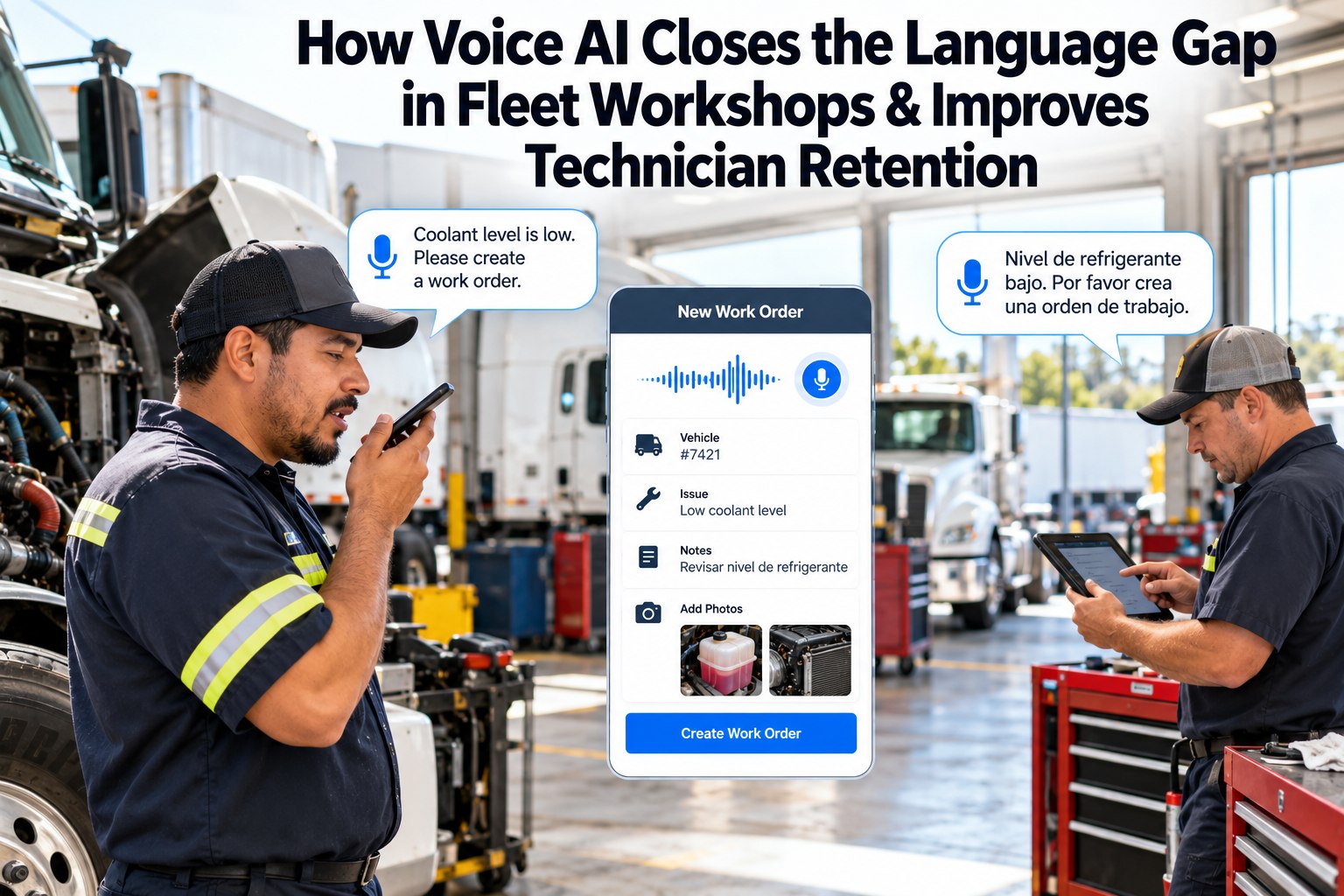
Here is the workflow this page walks, timed to the second: a technician notices a problem, scans or selects the vehicle, speaks what they see, and before a minute has passed a complete, structured work order is saved, routed to the shop, and attached to that truck's permanent record. No keyboard, no end-of-shift catch-up, no re-entry. That speed matters because the alternative is expensive: technicians spend 15 to 25% of their working hours on documentation and work-order creation, manual work orders take 2 to 8 hours just to go from a reported fault to an assigned job, and the admin overhead runs to roughly $64,000 a year for a four-technician shop. Voice AI collapses that entire lag into under sixty seconds, which is why fleets deploying AI automation document 15 to 25% improvements in technician productivity within the first 90 days. This guide walks the timed workflow step by step, shows exactly what happens in each window, and explains what makes the difference between a spoken observation and a finished record. Start a free trial or book a demo to see the under-60-second workflow on your own fleet.
FLEET WORK ORDERS · TIMED WORKFLOW
From Voice to Work Order in Under 60 Seconds
Watch the clock: scan the vehicle, speak the observation, and a structured, routed, ready-to-invoice work order exists before a minute is up. This is the timed walkthrough of how a spoken sentence becomes a finished fleet record — no keyboard, no lag, no end-of-shift pile-up.
2–8 hrs
Typical lag from reported fault to work order in a manual system
15–25%
Of technician hours consumed by documentation and work-order entry
15–25%
Productivity improvement within 90 days of AI automation (Oxmaint)
$64K
Annual admin overhead for a 4-tech shop, eliminated by automation
The Timed Workflow, Second by Second
This is the whole point of the page — the clock. Each window below is a real stage in turning a spoken observation into a structured record, and the entire sequence finishes before sixty seconds elapse.
0:00
Scan or Select the Vehicle
The technician scans a VIN or unit code, or taps the truck from a list. The record is now anchored to the right asset, pulling in its history and open items automatically.
0:10
Speak the Observation
Hands still on the truck, the technician says what they found — the complaint, the cause, the parts, the labor — in plain language, the way they'd tell a coworker.
0:30
AI Transcribes and Structures
Speech recognition transcribes in real time and natural language processing sorts the words into the correct fields — no raw text block to clean up later.
0:45
Glance and Confirm
The structured work order appears for a quick spoken or one-tap confirmation. Any missing required field is flagged so the record is complete before it's filed.
0:55
Saved, Routed, and Flagged
The work order files to the vehicle's permanent record, routes to the shop queue, and any safety defect flags the truck — all before the minute is up.
i
Why "under 60 seconds" is the number that matters: in a manual system, the gap between a technician spotting a problem and a work order actually existing is measured in hours — typically two to eight, sometimes far longer if it waits for an end-of-shift write-up. Every hour in that gap is a truck sitting with an undocumented fault and a shop that can't plan around it. Collapsing fault-to-work-order from hours to seconds is where the real downtime savings come from, not from typing a little faster.
See the timed workflow run on your fleet.
What Gets Captured in Those 60 Seconds
The speed only counts if the record is complete. In that under-a-minute window, voice capture pulls every element a proper work order needs from natural speech. Swipe the table horizontally on mobile.
← Swipe to see all columns →
Sixty seconds of speaking replaces hours of lag and a stack of end-of-shift paperwork.
Fleet Rabbit captures the full work order from voice, files it to the vehicle's permanent record, and routes it to the shop the instant it's confirmed — no re-entry, no delay.
Where the Hours Actually Disappear
To see why the 60-second workflow is such a leap, it helps to name the delays it removes. Manual work-order handling loses time at every handoff — and those hours are pure downtime.
Manual Work Order
2–8 hours, sometimes days
Fault noted, written on paper or remembered
Compiled into a formal work order later
Someone types it into the system
Distributed and assigned to a mechanic
Details lost or vague by the time it's logged
Voice Work Order
Under 60 seconds
Fault spoken the moment it's found
Structured into fields automatically
No typing, no re-entry
Routed to the shop queue instantly
Complete and accurate, captured live
What the Speed Actually Buys You
Under-60-second capture isn't about the novelty of talking to an app. It's about what happens across the operation when documentation stops being a bottleneck.
01
Reclaimed Wrench Time
The 15 to 25% of hours technicians lose to documentation goes back into billable work, recovering capacity you already pay for.
02
Less Vehicle Downtime
Cutting fault-to-work-order from hours to seconds gets trucks into the repair queue faster, shrinking the off-road time that drains availability.
03
More Complete Records
Captured live at the moment of the finding, work orders carry the detail that end-of-shift recall loses — better data for warranty and planning.
04
Lower Admin Overhead
Automating work-order creation removes the roughly $64,000 a year of administrative cost a four-technician shop carries, without adding staff.
05
Instant Retrieval
Records filed to the vehicle's permanent history are retrievable in under a minute for DOT, warranty, or insurance — versus hours of manual assembly.
06
Faster, Cleaner Handoffs
A routed work order reaches the shop the instant it's spoken, closing the coordination gap that manual handoffs leave open for hours.
Turn Every Spoken Observation Into a 60-Second Work Order
Fleet Rabbit runs the full voice-to-work-order workflow in under a minute — scan the vehicle, speak the finding, confirm, and the structured work order is saved, routed, and filed to the truck's permanent record. Reclaim the 15 to 25% of technician time lost to paperwork, at $5/vehicle/month, no hardware, live within 72 hours, free for up to three vehicles.
Under-60-second capture
Structured, routed work orders
No typing, no re-entry
Instant retrieval
60-Second Voice Capture vs. the Alternatives
Where a true voice-to-work-order workflow sits against the tools it replaces, on the things that actually determine speed and quality. Swipe the table horizontally on mobile.
← Swipe to see all columns →
Frequently Asked Questions
Can a work order really be created in under 60 seconds?
Yes, and the timed workflow shows how: scanning or selecting the vehicle takes seconds, speaking the observation takes ten to twenty, the AI transcribes and structures it in real time, a quick confirmation follows, and the work order is saved and routed — all inside a minute. The speed comes from removing the steps that eat time in a manual process, not from rushing, because the technician simply speaks naturally instead of navigating fields. Seeing that full sequence run on a real job is exactly what you can
book a demo to watch.
How does this compare to how long work orders take now?
The contrast is stark. In a manual system, the lag from a reported fault to an actual assigned work order typically runs two to eight hours, and longer if it waits for an end-of-shift write-up, because someone has to collect the request, compile it, type it in, and distribute it. Voice capture collapses that whole chain into under a minute by having the work order structure itself as the technician speaks. Every hour removed is downtime removed, and quantifying that for your fleet is something you can
book a demo to work through.
Is the record actually complete in that time, or just a rough note?
It's a complete, structured work order, not a rough note. In that under-a-minute window the system captures the vehicle, the complaint, the cause, the correction, the parts, the labor, and the priority — each sorted into its correct field rather than dumped as raw text. A quick confirmation step flags any missing required field before the record is filed, so speed doesn't come at the cost of completeness. Comparing that structured output to a hurried manual entry is something you can
book a demo to see directly.
How much technician time does this actually save?
A significant amount, because documentation and work-order creation consume roughly 15 to 25% of a technician's working hours, and fleets deploying AI automation document 15 to 25% improvements in technician productivity within the first 90 days. For a four-technician shop, the administrative overhead that automation removes runs to about $64,000 a year, all without adding staff. That reclaimed time turns straight into billable work, and running those numbers against your own headcount is exactly what you can
book a demo to do.
What happens to the work order after it's created?
It doesn't just get saved and sit there. The moment it's confirmed, the work order files to the vehicle's permanent record, routes to the shop queue for assignment, and if the finding is a safety defect it flags the truck so it isn't dispatched until addressed. Later, that record is retrievable in under a minute by vehicle, date, work-order type, or technician for DOT, warranty, or insurance purposes — versus the hours of manual assembly that used to require. Seeing that full lifecycle is something you can
book a demo to review.
Does it work in a noisy shop or yard?
Yes, because it's built for that environment. Purpose-built fleet voice uses noise-cancelling processing tuned for engine, tool, and shop-floor noise, so the spoken capture holds up where consumer voice apps would struggle. Combined with natural language processing trained on maintenance vocabulary, that keeps the structured fields accurate even in real working conditions rather than a quiet office. Testing that reliability in your own bays is something you can
book a demo to do firsthand.
What does it cost, and is there a free option?
It's designed to be low-risk to try. Fleet Rabbit is free for up to three vehicles with no credit card, and beyond that runs at $5 per vehicle per month with no hardware to buy and deployment live within 72 hours. You can compare pricing and start free without a contract or setup fee, so the workflow proves itself in your bays rather than in a sales pitch. Walking through the pricing for your fleet size is exactly what you can
book a demo to do.
Do technicians need training to hit that speed?
Very little, because speaking naturally is close to how technicians already describe a job to a coworker rather than something new to learn. There are no rigid commands to memorize — the technician talks, and the system does the structuring. That short learning curve is part of why the under-60-second workflow is realistic from early on rather than only after weeks of practice, and gauging how quickly your crew takes to it is something you can
book a demo to try.
Stop Losing Hours to Work-Order Lag
Fleet Rabbit turns a spoken observation into a structured, routed, filed work order in under sixty seconds — reclaiming the 15 to 25% of technician time lost to paperwork and cutting the hours of lag between a fault and a fix. Free for up to three vehicles, then $5/vehicle/month, integrated in 5–7 working days, with no hardware required.
Free tier for up to 3 vehicles · No credit card required · No hardware installation
July 29, 2026By Derek Goes
All Blogs