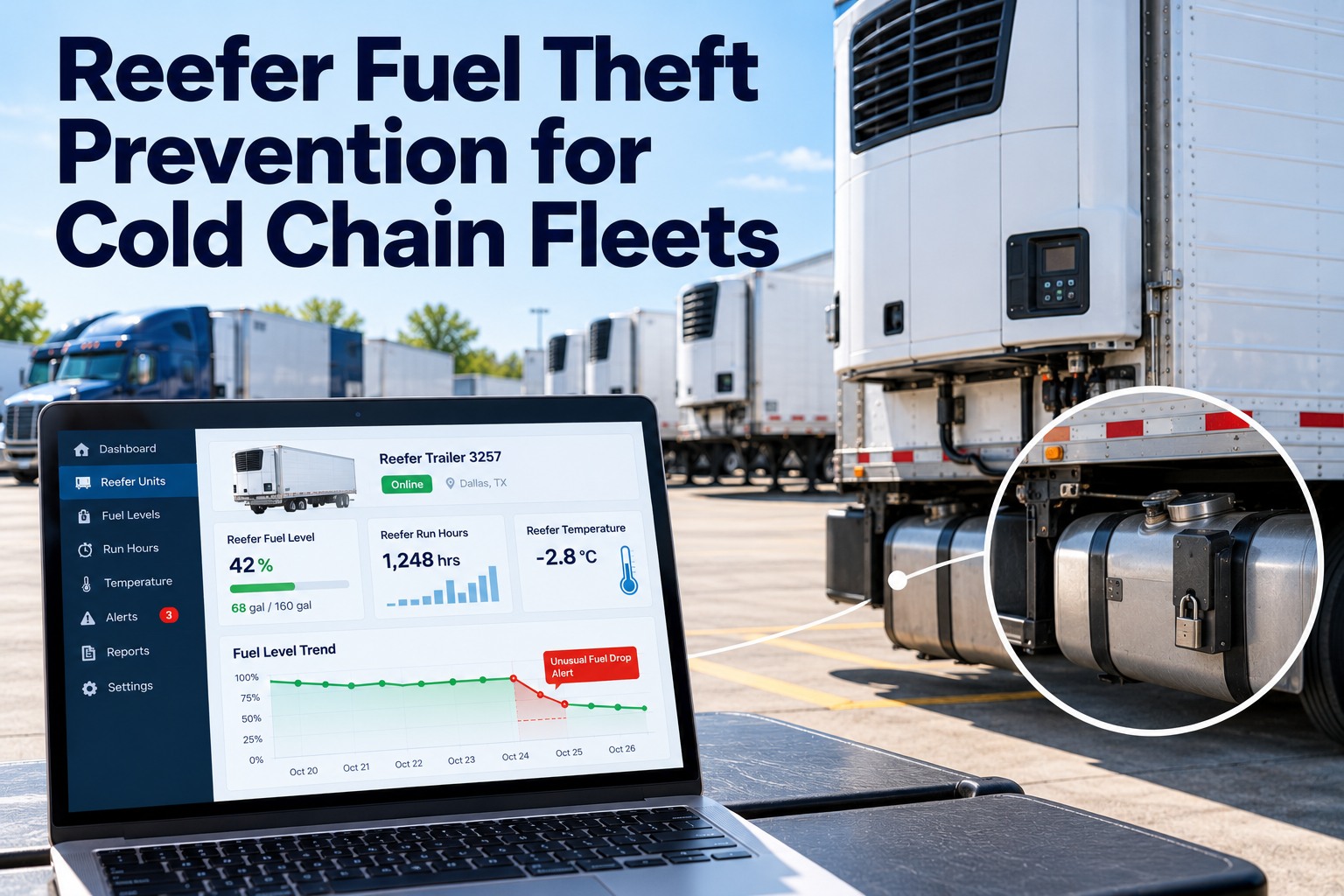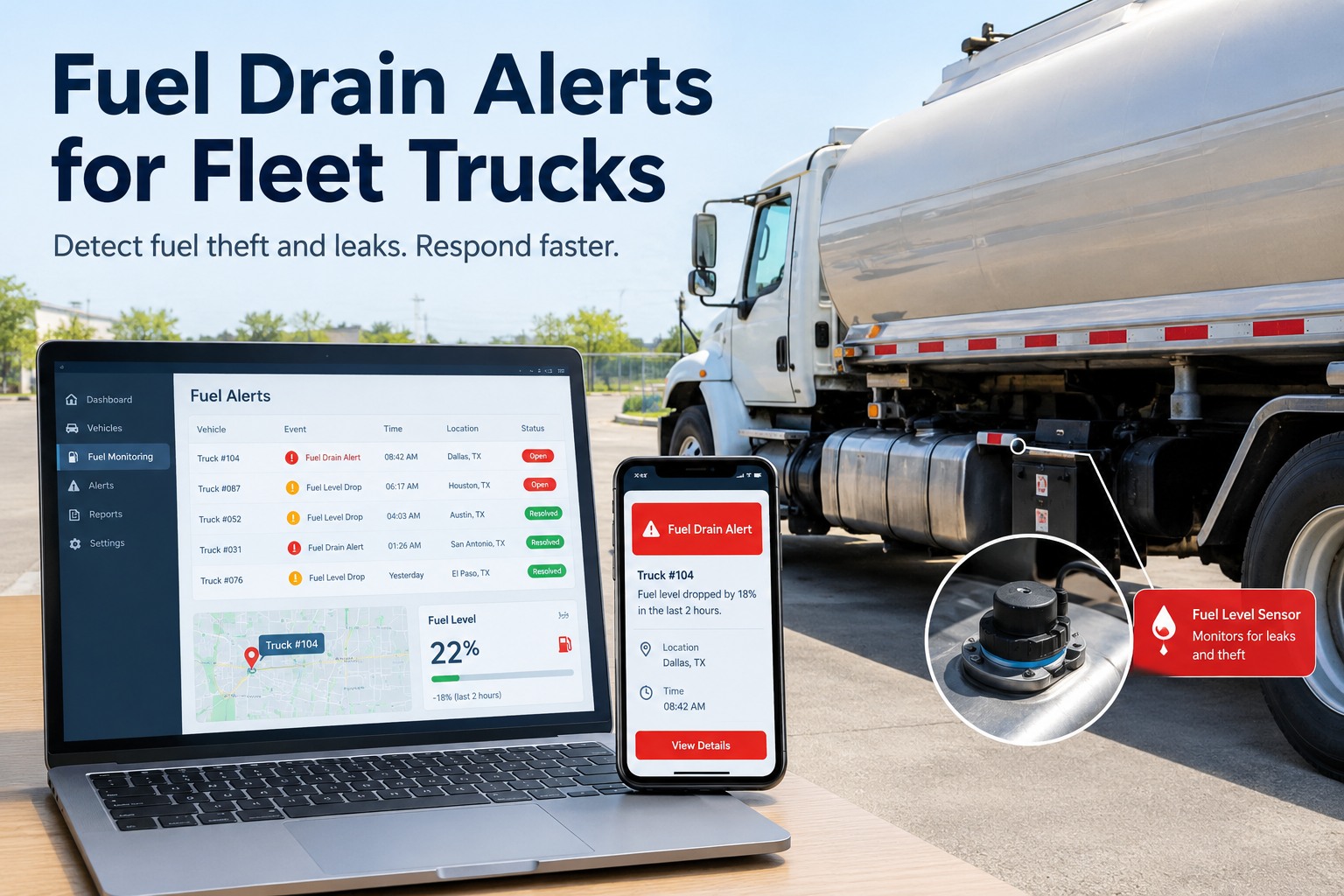
Fuel drain alerts only help if people trust them. Set them too sensitive and slosh, rough ground and tracker power gaps bury the real events. Set them too loose and a slow siphon goes unnoticed. This page shows how to set fuel drain alert thresholds that catch theft and leaks without false alarms, and how to route each alert with location and time proof. Schedule a call to set up fuel drain alerts.
Why Fuel Drain Alerts Fire Falsely: Slosh, Terrain, Power Gaps and Ignition Errors Hide Real Theft
Six non-theft causes explain most alerts that fade away once someone checks the level trend
A level sensor cannot tell moving fuel from consumed fuel. Tracker vendors Mapon and Heavy Vehicle Inspection both describe the same pattern, where a drop appears, then the level returns to about where it was. Mapon does not publish a formal false-drain threshold, so treat its examples as guidance, not a standard.
How to Set Fuel Drain Alert Thresholds That Catch Theft and Leaks Without False Alarms
Five settings decide whether an alert is trustworthy: drop size, time window, recovery check, power state and smoothing
None of the sources we read gives a universal threshold, because tank size, sensor type and routes differ. Start with the logic below, then tune on a few trucks and watch which alerts needed action.
| Setting | What to decide | Why it matters |
|---|---|---|
| Minimum drop size | A level change worth alerting on for each tank size | Too low and slosh fires it; too high and slow theft slips under. The sources give no standard, so tune on your own trucks |
| Time window | How long a drop must hold before it alerts | Mapon treats a drain that lasts only 10 to 20 seconds as likely terrain |
| Recovery check | Did the level return to about its earlier value? | Mapon example: a 7-liter drop from 67 liters that recovers to 65 to 67 liters is false |
| Ignition and power state | Was the engine off, or the tracker unpowered before the drop? | A sharp drop when power returns with no recent trips is a possible drain |
| Smoothing | Filtering level for rough roads or yards | Settings vary by sensor and the source gives no portable values; check the manufacturer |
Telling Fuel Theft, a Leak and a Sensor Fault Apart Before You Act on a Fuel Loss Alert
Check the time of the drop, the ground under the truck and the sensor's own health before blaming anyone
| Cause | What it tends to look like | First check |
|---|---|---|
| Theft | Rapid loss outside operating hours with no equipment use | Location, time and ignition state at the drop; camera footage |
| Leak | Gradual loss, or visible contamination on the ground | Walk the truck and tank; photograph and measure |
| Sensor fault | Inconsistent readings or system error codes | Test sensor, wiring and calibration before accusing anyone |
These clues come from one guide for fleet managers, so use them as a starting order of checks, not a diagnosis. Rapid loss when the equipment is off points toward theft, gradual loss with contamination points toward a leak and inconsistent readings with error codes point toward the sensor.
Response Time After a Fuel Drain Alert: What to Do in the First 5, 30 and 60 Minutes
One published playbook asks for a field team within 15 minutes and site control within 30
Heavy Vehicle Inspection's guide suggests verifying and ranking the alert in the first five minutes, then inspecting the site, collecting evidence and running sensor diagnostics in the next 25 or so. Its windows are below. They are one vendor's guidance, and its performance statistics are unsourced.
Routing Each Fuel Alert to the Right Person With Location and Time Proof Attached
Whoever receives the alert should get the truck, the time, the location and the level trend in one place
| Who | Gets the alert when | Job |
|---|---|---|
| Designated responder | Every confirmed alert | Verify, rank severity, assign the investigation |
| Field staff or shop lead | A drop looks real | Inspect the truck and tank, photograph, measure |
| Law enforcement | Theft is suspected | Take the report with your timeline and evidence |
| Insurance contact | A loss will be claimed | Documented evidence for the claim |
How FleetRabbit Keeps Fuel Level Alerts Next to DVIR, PM and Work Order Records
A slow leak alert can become a work order, and the evidence stays with the vehicle record
FleetRabbit says on its fuel level sensor page that it brings fuel level sensors together with DVIR, PM and compliance in one view and works with the providers fleets already use. It also links slow-leak alerts to work orders for shop leads. The page does not describe threshold settings, alert channels or accuracy, so confirm those on a call. Free for up to 3 vehicles, then $5 per vehicle per month.