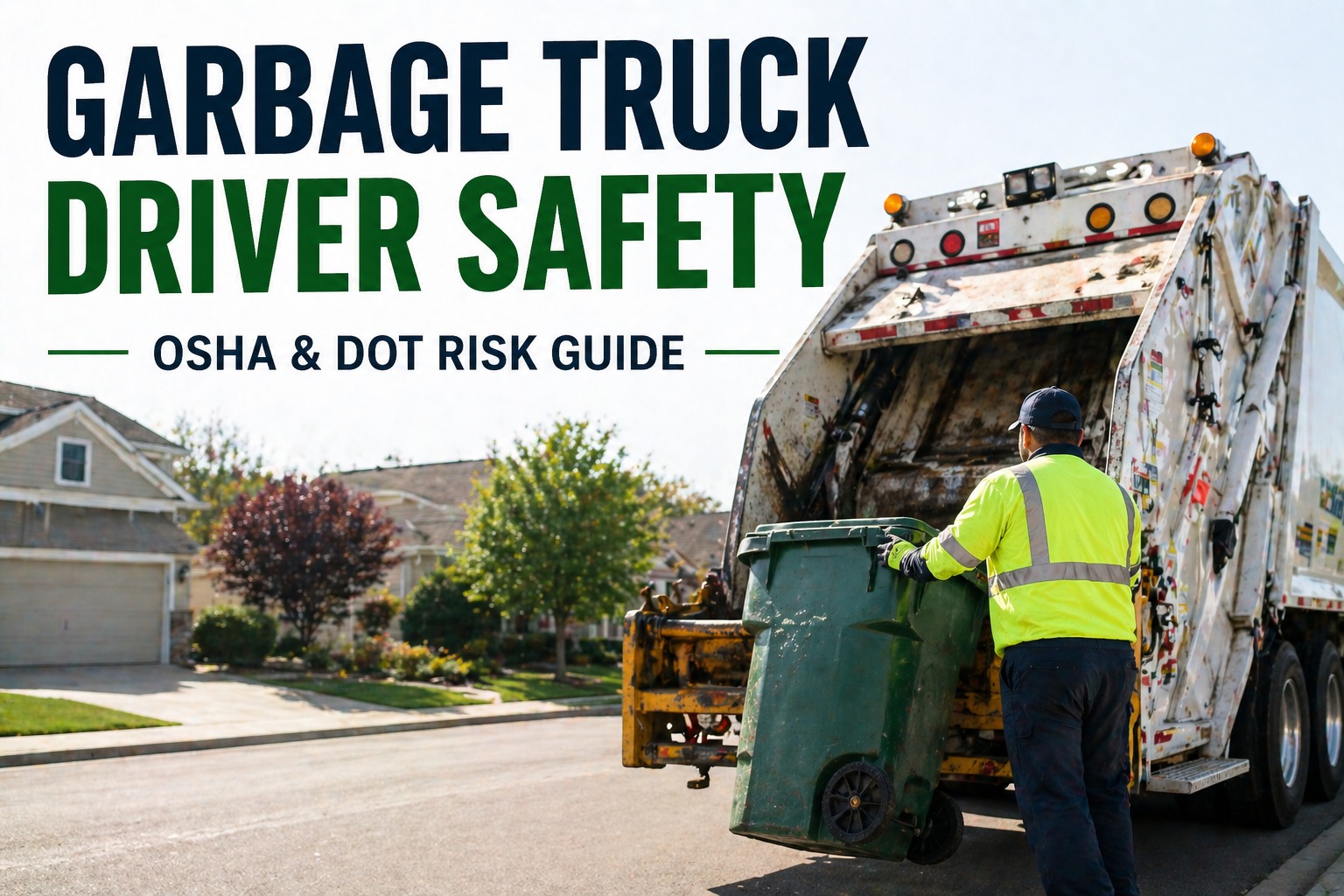
Refuse and recyclable material collectors hold the unfortunate distinction of running the 5th most dangerous job in the United States — with a fatality risk nearly 10 times higher than the average across all industries. The waste management sector's fatality rate is over 5x the all-industries baseline, and roughly 60% of those fatalities are transportation-related: workers struck by their own truck during backing maneuvers, ejected from rear riding steps at speed, or run over after dismounting at a residential stop. SWANA recorded 7 sanitation worker deaths in just the first 10 days of 2018 alone. The pattern has continued every year since. OSHA does not publish refuse-collection-specific regulations, so enforcement leans on the General Duty Clause and ANSI Z245 (Safety Standards for Mobile Refuse Collection and Compaction Equipment) meaning that what protects your drivers and helpers is your internal safety program, not a federal checklist someone hands you. This guide breaks down the Top 10 OSHA & DOT risks that actually injure waste workers, the body-part injury distribution from BLS data, mitigation controls that work, and how Fleet Rabbit digitizes the daily inspection, reversing protocol, and incident logging that turn a paper safety program into a defensible operational system.
5th Most Dangerous Job in America. 60% of Fatalities Are Transportation-Related.
Eliminate the top OSHA + DOT hazards in waste hauling: rear-step accidents, reversing strikes, sharps injuries, hopper crushes. Digitize daily inspections, enforce backing protocols, and produce audit-ready safety records with one click.
The Industry Numbers — Why This Job Earns Its Reputation
Waste collection sits among the most lethal civilian occupations year after year. The data below comes from BLS, NIOSH, OSHA fatality reports, and SWANA industry tracking. Every number represents real workers — and a fully preventable risk that a structured safety program would have caught.
Top 10 OSHA & DOT Risks — Ranked by Severity
This is the hazard countdown every waste fleet safety manager should have memorized. Risks ranked from highest fatality/injury volume to high-frequency-but-lower-severity. Each card includes the OSHA/ANSI reference and the control that actually works.
Worker falls from rear riding step while truck is moving — most common single cause of fatality. ANSI Z245 prohibits riding above 10 mph or beyond 0.2 mile.
Worker run over by their own truck during backing maneuver — frequently while serving as ground spotter. SWANA Backing Best Management Practices is the standard reference.
Single-vehicle rollover during cornering, ramp transitions, or off-camber tipping at landfill faces. Compounded by uneven load distribution and high center of gravity.
Worker caught in compaction blade or hopper mechanism — typically while clearing jammed loads or retrieving items. Lockout/tagout failures are the root cause.
Truck hits pedestrian, cyclist, or motorist — particularly during right-turn blind-spot incidents. Civilian fatality risk is high; civil liability is enormous.
Hidden needles, broken glass, or razor blades in residential waste cause puncture wounds. Bloodborne pathogen exposure (HIV, Hep B, Hep C) requires immediate post-exposure response.
Repetitive lifting of bins, bags, and bulky items causes shoulder, lower-back, and knee injuries. Highest-frequency lost-time injury in residential collection.
Worker slips on wet sidewalks, leaking truck fluids, or icy surfaces during dismount. Common cause of soft-tissue and concussion injury.
Summer heat indices over 90°F and winter wind chill below 0°F both cause measurable injury rates. OSHA enforces under General Duty Clause for outdoor workers.
High-pressure hydraulic line failure during compaction. Pinhole leaks can inject fluid through skin — surgical emergency requiring immediate response.
Every Risk Above Is Caught by a Daily DVIR. The Question Is Whether Yours Is Defensible.
Paper DVIRs disappear. Mobile DVIRs with photo + GPS + signature don't. Fleet Rabbit produces audit-ready safety records that survive both OSHA and DOT inspections.
Body-Part Injury Distribution — Where Workers Get Hurt
BLS data on non-fatal lost-time injuries shows a consistent pattern in waste collection. Knowing where workers actually get hurt drives PPE choice, training emphasis, and intervention prioritization.
Lower-back, shoulder, and knee account for 62% of lost-time injuries. PPE alone doesn't fix the top three — they require ergonomic intervention, lift training, and equipment redesign (cart tippers, weight limits). See How Fleet Rabbit Tracks Lift-Related DVIR Findings →
The 5-Layer Safety Program That Actually Works
One control rarely fixes anything. Effective waste fleet safety programs stack 5 independent layers — so when one layer fails, the next layer catches the hazard before it reaches the worker.
Daily mobile DVIR with photo evidence on every truck before dispatch. Riding-step grip, handhold, hydraulic lines, mirrors, cameras, back-up alarm — all checked and signed off.
ANSI Z245 awareness, SWANA backing protocol, sharps response, lift form, defensive driving. All certifications tracked with expiration alerts. No driver dispatched with expired credentials.
Telematics flags harsh braking, harsh cornering, speeding, and excessive idling per driver. Behavior scoring identifies risky driving before incidents — not after.
Every near-miss documented in the app — photo, GPS, narrative, root cause. Pattern analysis identifies route-specific hazards before they escalate to lost-time injury.
OSHA 300/300A logs, DOT DVIR histories, training records, and incident reports retrievable in 30 seconds. General Duty Clause defense is documented, not improvised.
How Fleet Rabbit Powers Waste Fleet Safety
Native Fleet Rabbit functionality — same login, same dashboard, same audit trail as your DVIRs and PM alerts. Built for the specific hazard profile of refuse collection operations.
Pre-built mobile checklists for rear-loaders, side-loaders, front-loaders, roll-offs. Riding step, hydraulic interlocks, packer blade, hopper guards — all included by default.
Telematics integration logs every reverse maneuver with GPS, duration, speed, and proximity alerts if cameras/sensors are installed. Backing patterns reviewable per driver.
ANSI Z245, SWANA backing, defensive driving, lift form, bloodborne pathogen training — all tracked with expiration alerts at 90/60/30/7 days. No expired credentials at dispatch.
Mobile incident report with photo, GPS, and narrative. Near-miss reports separate from injuries. Pattern analysis surfaces route-specific or driver-specific risk hotspots.
One-click OSHA 300 log + 300A summary export. Annual posting (Feb 1 deadline) and ITA submission (March 2 deadline) covered. No spreadsheet reconstruction at year-end.
OSHA cites refuse operations under General Duty Clause + ANSI Z245. Fleet Rabbit produces the documented program — written policies, training records, inspections — that defense requires.
Fleets activating Fleet Rabbit's safety suite typically see lost-time injury rates drop 40-60% within the first six months — paying for the platform many times over through workers' comp premium reductions alone. Schedule a Safety Walkthrough →
Frequently Asked Questions
No specific regulations — but OSHA enforces refuse-collection hazards under the General Duty Clause and ANSI Z245 (Safety Standards for Mobile Refuse Collection and Compaction Equipment). Citations and fatality investigations both apply. The absence of specific rules does not lessen the obligation; it shifts the burden to the employer to demonstrate a documented safety program.
Backing/reversing strikes — virtually all are preventable through 360° cameras, back-up alarms, written spotter protocols, and event logging that catches procedure deviations before they become injuries. SWANA's Backing Best Management Practices document is the standard playbook. See Reversing Event Logging Live →
Yes, but ANSI Z245 imposes strict limits: workers must not ride during backing maneuvers, while traveling above 10 mph, or beyond 0.2 mile. Riding steps must have self-cleaning slip-resistant surfaces of at least 220 square inches. Riding sills or hoppers is prohibited. Many fleets are eliminating ride-along positions entirely on residential routes due to liability exposure.
Treat as bloodborne pathogen exposure: stop work, clean site, immediate medical evaluation for HIV/Hep B/Hep C testing and prophylaxis. Document time, location, photo of the source if recoverable, witness names. OSHA bloodborne pathogen standard (29 CFR 1910.1030) applies even though refuse-specific rules don't. Fleet Rabbit's incident module captures all required fields automatically.
Carriers typically offer 10-20% premium reductions for fleets with documented telematics-backed safety programs, written training records, and incident-tracking systems. Industry data shows 13% average premium reduction. The documented program is also the primary defense in litigation and OSHA citation contests.
Included in the standard subscription at $3/vehicle/month — no per-driver fee, no separate safety module pricing. Includes DVIR templates, certification tracking, incident logging, OSHA 300/300A generation, and audit packages. Free tier supports up to 3 assets indefinitely. Book a Demo to See Pricing →
The Documented Safety Program That Survives Both OSHA and Litigation.
Refuse-specific DVIR templates. Reversing event logging. Driver certification tracking with expiration alerts. Incident + near-miss reporting with photo evidence. OSHA 300/300A export with one click. Used by waste fleets to drop lost-time injuries 40-60% within six months — and produce the documented program that General Duty Clause defense requires.