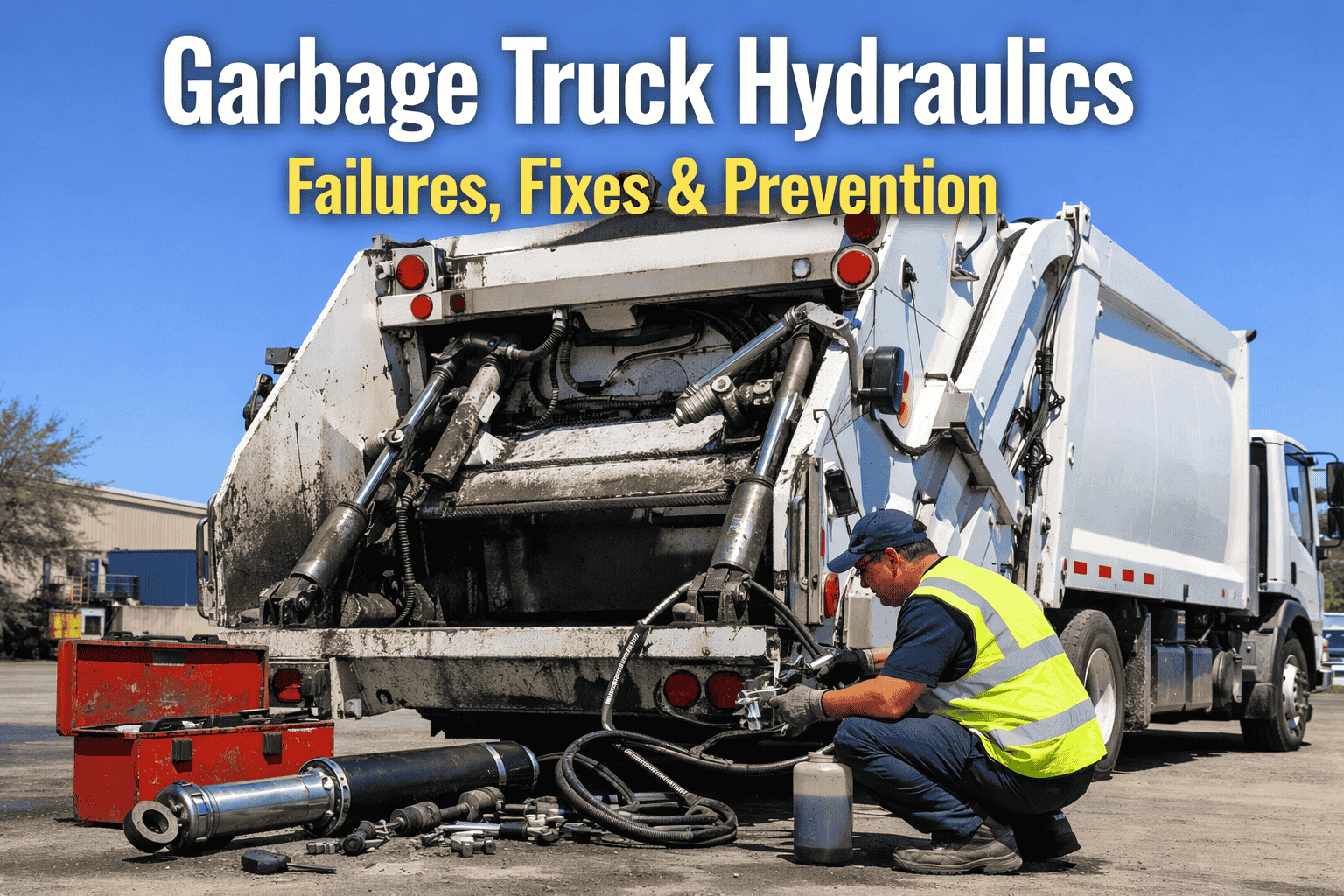
A hydraulic failure on a garbage truck doesn't just stop the truck it stops the entire route. Customers don't get service. Complaints pile up. And if it happens at the transfer station with a full load, you're looking at hours of delay while a backup truck scrambles to take over.
The average refuse truck cycles its hydraulic system 800-1,200 times per route. That's the packer blade compacting, the lift arms grabbing cans, the tailgate opening and closing, the hopper tilting. Every cycle generates heat, creates wear, and stresses seals. Without proper maintenance tracking, failure isn't a question of if it's when.
This guide covers the six most common hydraulic failures in refuse trucks, the warning signs your drivers should recognize, and the preventive maintenance schedule that keeps trucks running. Whether you operate rear loaders, front loaders, or automated side loaders, these principles apply across your entire waste fleet.
Garbage Truck Hydraulic System: Common Failures, Warning Signs & Fixes
The hydraulic system is the workhorse of every refuse truck — running the packer blade, lift arms, tailgate, and hoist through hundreds of cycles every single route. When it fails mid-route, the truck stops. The route stops. And if you're not tracking maintenance digitally, you probably didn't see it coming.
How the Garbage Truck Hydraulic System Works
Before diagnosing failures, it helps to know what you're working with. A refuse truck's hydraulic system typically generates 2,500–3,500 PSI to power 4–6 separate circuits simultaneously. Each failure mode affects a different part of this chain.
6 Most Common Hydraulic Failures — and Exactly What Causes Them
Every one of these failure modes has a recognizable warning sign — if you know what to look for. See how FleetRabbit's preventive maintenance module tracks hydraulic service intervals for your entire refuse fleet →
Cavitation — Air in the Pump
Whining or grinding noise from pump. Erratic system pressure. Slow, jerky compactor movement. Pump housing running abnormally hot.
Low hydraulic fluid level allows pump to draw in air. Air bubbles collapse violently inside the pump, eroding the pump housing and wear plate. Also caused by a clogged suction filter.
Check fluid level before every shift. Replace suction filter every 500 service hours. Never top off with wrong fluid grade — blended fluid foams and causes identical symptoms.
Pressure Spikes — Relief Valve Failure
Frequent hose failures. Damaged cylinders needing repeated repair. Banging sounds during operation. System overshoots intended force.
Differential valves are slow to respond to pressure spikes. Older trucks especially susceptible. Broken valve seals expose the system to fluid leaks and contaminated pressure spikes.
Upgrade to pilot-operated valves for better pressure control. Always check relief valve setting when replacing a failed pump — never raise the setting to compensate for a failing pump.
Fluid Contamination
Milky or cloudy fluid (water intrusion). Dark, metallic-smelling fluid (metal particles). Clogged filters faster than normal. Sluggish operation across all circuits.
Dirt, moisture, and metal particles enter through worn seals, improper fill procedures, or a failed reservoir breather. Contaminated fluid accelerates wear on every internal component simultaneously.
Test fluid every 250 hours with a fluid analysis kit. Flush and replace contaminated fluid immediately. Replace all filters after contamination event. Use sealed fill ports only.
Cylinder Seal Failure & Fluid Leaks
Visible oil on cylinder rod or body. Packer blade drifting down without command. Slow or uneven extension. Oil pooling under the truck at end of shift.
Seals deteriorate from heat, pressure spikes, or contaminated fluid. Cylinder rod surface scoring (from particles in fluid) destroys seal contact surface on every stroke.
Wipe cylinder rods clean daily. Inspect for scoring before each shift. Rebuild cylinders on schedule — don't wait for visible external leaks. Address seal failure before the rod surface is damaged.
Stuck or Jammed Hoist
Hoist rises but won't lower. Erratic or jerky hoist movement. Hoist stuck in dump position. Grinding sounds during dump cycle.
Worn hoist cylinders. Misaligned cylinder disconnecting from the hydraulic circuit. Refuse particles compacted into the hydraulic assembly preventing physical movement.
Clear and inspect hoist assembly after each route. Check cylinder alignment monthly. Replace worn cylinders before failure — a stuck hoist mid-dump at a transfer station is a safety incident, not just a repair.
Hose Failure & Blowout
Weeping fittings or wet hose exteriors. Cracking or fraying outer sleeve. Soft spots or bubbles on hose body. Sudden loss of hydraulic function on specific circuit.
Pressure spikes from valve failures. Physical abrasion against the truck body. UV and heat degradation over time. Incorrect hose routing creating tight bends that crack the inner core.
Inspect all hoses at each PM service. Replace at first sign of outer sleeve damage — don't wait for a blowout. Add protective sleeving on high-friction routing points. Budget for replacement every 2–3 years.
Symptom-to-Cause Quick Reference
Your driver calls in a problem mid-route. Use this table to narrow the likely cause before the truck returns to the shop. Start tracking hydraulic inspection findings digitally with FleetRabbit — free for 3 vehicles →
| Driver Reports | Most Likely Cause | Urgency | Field Action |
|---|---|---|---|
| Whining/grinding pump noise | Cavitation — low fluid or clogged suction filter | Stop Now | Check fluid level. Do not operate until resolved |
| Packer slow or won't complete cycle | Low fluid, valve issue, or pump wear | Return to Depot | Check fluid. Inspect for leaks. Report immediately |
| Oil visible on cylinder rod | Cylinder seal failure | Return to Depot | Note which cylinder. Continue only if safe — do not delay repair |
| Hoist won't lower from dump position | Worn cylinder, misalignment, or debris jam | Stop Now | Do not attempt to force down. Call for assistance |
| Hydraulic system suddenly lost power | Hose blowout, valve failure, or PTO disengagement | Stop Now | Check PTO engagement first. Inspect for visible hose failure |
| Frequent hose replacements needed | Pressure spikes from relief valve failure | Schedule Repair | Inspect relief valve setting. Do not raise pressure setting |
| Milky or dark fluid at check | Water or metal particle contamination | Return to Depot | Do not add fresh fluid on top — full flush required |
Hydraulic System PM Checklist — What to Inspect and When
Preventive maintenance is the only real answer to hydraulic failures. Here's the industry-standard inspection schedule for refuse truck hydraulic systems. See how FleetRabbit automates this schedule and sends reminders before service windows are missed →
Stop Finding Hydraulic Failures at the Transfer Station. Start Catching Them in the Shop.
FleetRabbit's fleet maintenance platform tracks PM schedules, hydraulic inspection findings, fluid change intervals, and defect-to-work-order workflows for your entire refuse fleet. Free for up to 3 vehicles. Live in 48 hours. No hardware. No contracts.