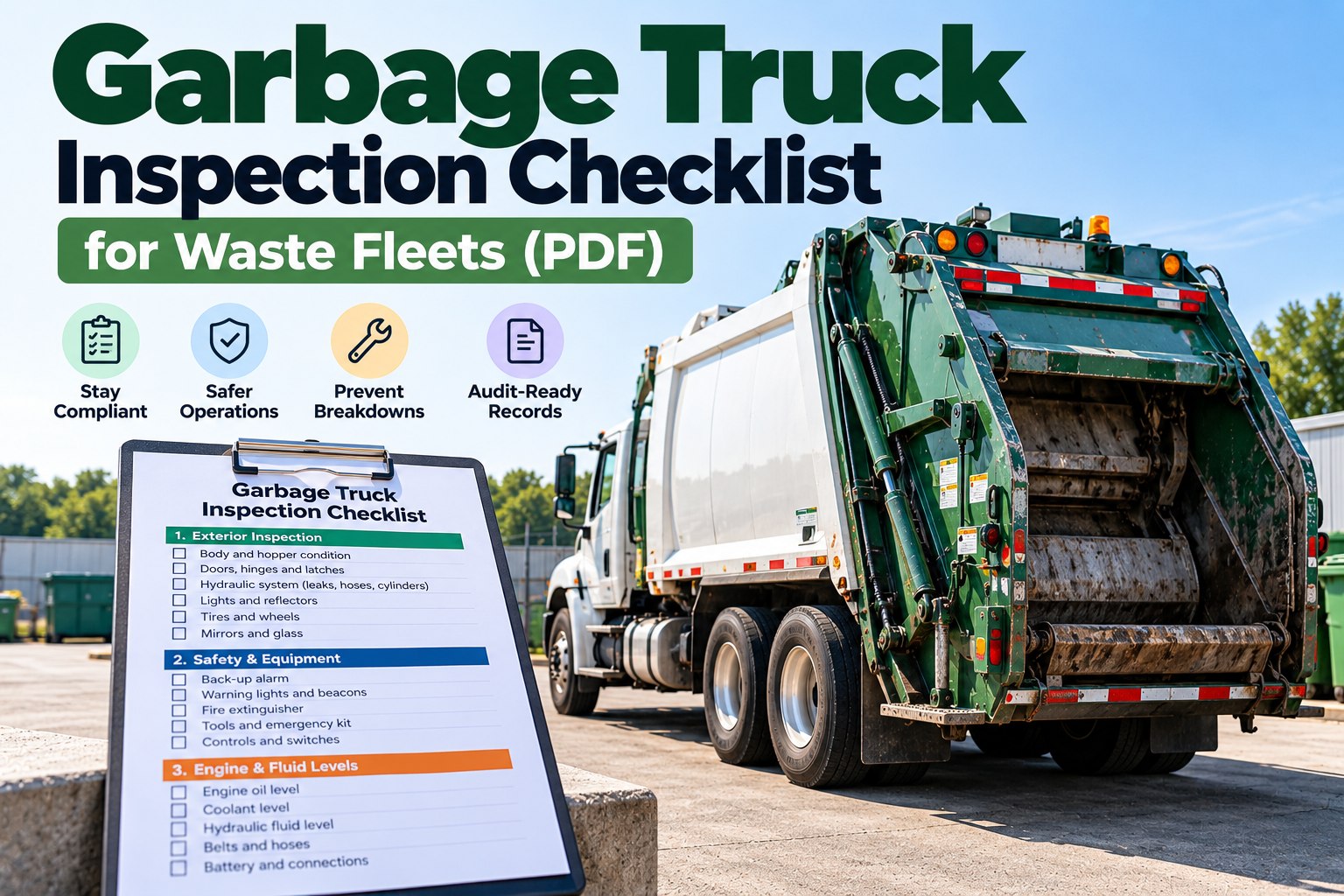
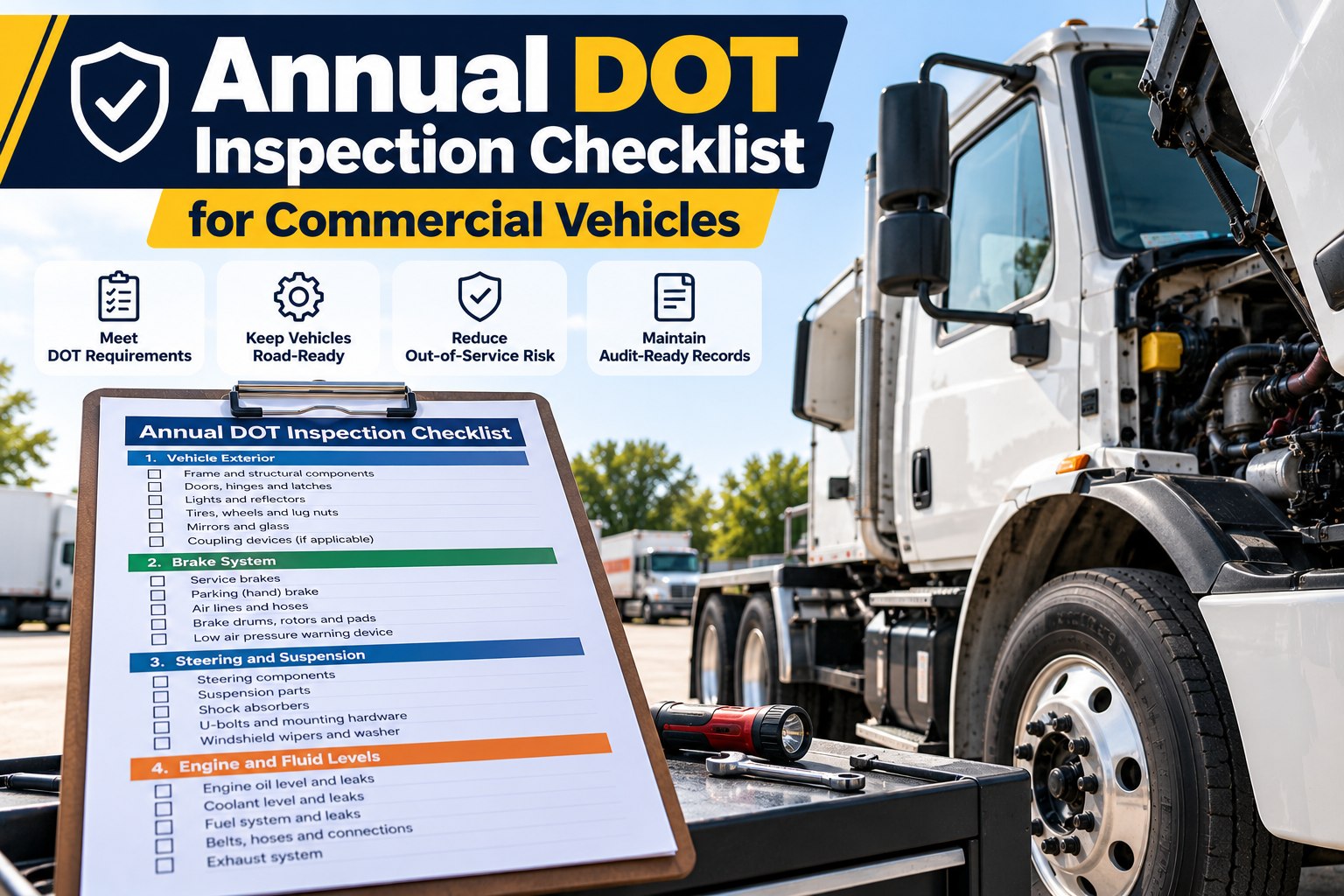
A garbage truck inspection checklist covers two trucks in one: the chassis that has to pass a DOT roadside inspection, and the hydraulic body that does the work. Most generic lists stop at the chassis, so the packer, arm, hopper and cameras go unrecorded, and that is the part an auditor, insurer or municipal contract manager asks about after an incident. This page lists the common checks, the body-specific checks for four truck types, and the records to keep. Schedule a call to build your waste fleet's audit file, or compare it with the standard DOT pre-trip checklist.
WASTE FLEET INSPECTIONS · DRIVERS, SHOPS AND SAFETY MANAGERS
If an Auditor Asked Today, Could You Show the Last 90 Days?
An inspection that was done but not recorded counts for little after an incident. Build the checklist once, and let every shift add to a record you can hand over.
AUDIT FILE · TRUCK 214
DonePre-trip signed, today 5:42 am
DonePacker blade defect closed
DoneAnnual inspection on file
DueHydraulic filter service in 4 days
Who Expects What From a Waste Fleet
Three different parties look at your inspections, and each asks for something slightly different.
DOT / FMCSA
The chassis, in writing
Drivers of commercial motor vehicles must report defects in writing under 49 CFR 396.11, and the carrier keeps the report. Roadside inspectors look at brakes, tires, lights and steering first.
OSHA + ANSI Z245.1
The body, by standard
OSHA has no refuse-specific rule. It relies on the General Duty Clause and consensus standards, such as ANSI Z245.1 for waste collection and compaction equipment. Safety devices on the body fall here.
CONTRACTS AND INSURERS
The proof, on request
Municipal contracts, haulers and insurers often ask for inspection logs and repair history after a claim. If it is not recorded, it is hard to show it happened.
Why the Body Belongs on the Checklist
Federal data shows how exposed this work is. The Bureau of Labor Statistics put the fatal injury rate for refuse and recyclable material collectors at 41.4 per 100,000 workers in 2023, the fourth highest of any occupation. In solid waste collection, 35 workers died in 2023, up from 31 the year before, and most deaths happened on the road.
SOLID WASTE COLLECTION DEATHS BY CAUSE, 2023 (35 TOTAL)
Transportation incidents
24
Harmful substances or environments
4
Source is BLS data for 2023, as reported by Waste Dive. The "other causes" bar is the remainder after the two published categories, and BLS has noted its method changed, so earlier years may not compare directly.
The Common Checks: Every Truck, Every Shift
These ten apply to every garbage truck regardless of body type. Tick each box only after you have looked at the item.
- Tires, wheels and lug nuts
- Service, parking and air brakes
- Steering and suspension
- Headlights, signals, markers and beacons
- Mirrors, windshield and wipers
- Horn, seat belt and gauges
- Backup alarm audible from 30 feet or more
- Rear and side camera screens working
- Emergency stops reachable and working
- Fire extinguisher, triangles and spare fuses
The Body Checks: Pick Your Truck Type
Add the block that matches the truck. Each has six checks focused on the part that moves, lifts or compacts.
REAR LOADER
Packer blade and hopper
- Packer blade and ejector cycle smoothly, no grinding
- Hopper floor and walls free of cracks and thin spots
- Tailgate lock fully engages, seal intact
- Step and riding board grip and handholds sound
- Step-in-use indicator and speed inhibit work
- Leachate drain valve works
FRONT LOADER
Lift arm and container tipper
- Lift arm holds height without drifting
- Arm cylinders and hoses free of leaks and chafing
- Forks or grippers align and grip evenly
- Container tips smoothly with no drift under load
- Packer blade and tailgate lock sound
- Arm controls respond and return to neutral
SIDE LOADER
Grabber arm and camera
- Arm extends, grabs and retracts smoothly
- Grabber pressure even, no slipping
- Joystick and cab camera show the full arm path
- Arm hoses and fittings dry and unrubbed
- Hopper lid and body seals intact
- Arm stows and locks for travel
ROLL-OFF
Hoist, cable and latches
- Hoist cable free of broken wires and kinks
- Hook and cable end connections secure
- Container latches and locks engage
- Rear rollers and slide rails lubricated and sound
- Tarp system deploys and retracts fully
- Hoist tilts smoothly and lowers fully
Running more than one body type?
Tell us your mix of rear, front, side loaders and roll-offs and we will load the right body checks for each truck.
Which Checks Apply to Which Truck
A dot means the check applies. Swipe the table horizontally on mobile.
← Swipe to see all columns →
From Failed Check to Closed Record
An audit-ready fleet can show not only that a defect was found, but that it was fixed and signed off. This is the path every failed item should follow.
1
Inspect
Driver completes the pre-trip on the phone.
→
2
Flag
Any failed item is marked with a photo.
→
3
Route
The defect becomes a work order for the shop.
→
4
Repair
Technician fixes it and records parts.
→
5
Sign off
Mechanic clears it and the driver acknowledges.
→
6
Archive
Every step is stored with a timestamp.
Records to Keep Ready
These are the federal minimums for the chassis. Hold the body records for as long as your contract and insurer need them.
Driver vehicle inspection reports
3 months
Kept after the report is made.
Annual inspection report
14 months
Kept by the motor carrier.
Maintenance and repair records
1 year, plus 6 months
Kept where the vehicle is housed, and for 6 months after it leaves your control.
Hydraulic and body service history
Per your policy
Not set by the federal rules, so match your contract or insurer.
Make Every Route Start With a Record You Can Hand Over
FleetRabbit puts the common and body checks on the driver's phone, requires a photo on any failure, sends defects to the shop as work orders, and keeps a timestamped trail with service reminders.
Read the federal report rule.
Body-specific checks
Photo on every defect
Work orders with sign-off
Service reminders
Frequently Asked Questions
What should a garbage truck inspection checklist include?
The standard chassis checks, such as tires, brakes, steering, lights and safety equipment, plus the body: packer blade, hopper, tailgate lock, lift arm or grabber, hydraulics, cameras, backup alarm and emergency stops, depending on the truck type.
Do garbage trucks need a DVIR?
Commercial motor vehicles of 10,001 pounds or more in interstate commerce need written defect reports under federal rules, and refuse trucks are usually well above that weight. Local-only fleets may fall under state rules, but the same report is good practice.
Read 49 CFR 396.11.
What is ANSI Z245.1?
It is the American National Standard for mobile waste and recyclable collection, transport and compaction equipment. OSHA has no refuse-specific rule, so the standard is widely used as the benchmark for body safety devices.
How long are inspection records kept?
Federal rules keep driver inspection reports for three months, annual inspection reports for 14 months, and maintenance records for a year plus six months after the vehicle leaves your control. Many fleets keep them longer for claims.
Who inspects the hydraulic body?
The driver checks what is visible before each shift, such as leaks, hoses, cycling and safety devices. Technicians do deeper hydraulic work at scheduled service, and both should be recorded.
Is a garbage truck inspection PDF enough for an audit?
A PDF is a good template, but paper is easy to lose and cannot show a defect was closed. A digital record keeps the report, the repair and the sign-off together.
Schedule a call to see an audit file.
What does FleetRabbit cost for waste fleets?
Inspect Once. Prove It Every Time.
The crew that checks the body as carefully as the chassis is the crew with fewer mid-route failures and a clean file when someone asks. Start the record today.
Free tier for up to 3 vehicles · No credit card required · Every step stored with a timestamp
October 9, 2026By Emily Parker
All Blogs