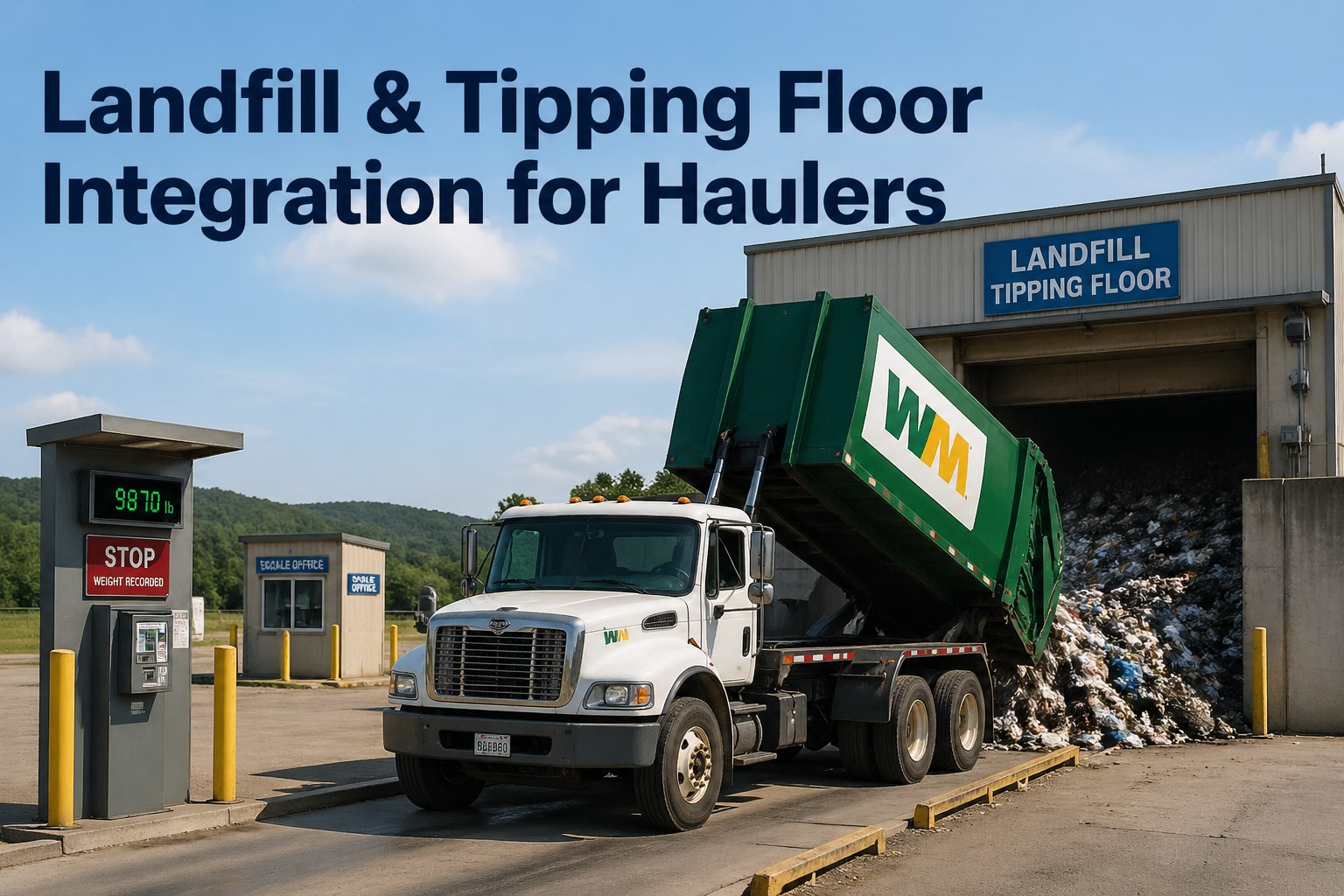
Every refuse hauler knows the same scene by heart. The truck rolls onto the scale at the landfill or transfer station. The driver leans out the window, hands the scalehouse a paper ticket. The scalehouse types a number into a different system. The driver gets a printed slip. The slip ends up in a clipboard, then a folder, then maybe a binder back at dispatch — where the AP clerk eventually keys the disposal weight and tipping fee into the billing system, three weeks later. By that time the route is already invoiced, the customer is already paid, and the disposal cost-per-ton is a guess. The 2026 problem isn't that haulers don't have data — it's that the truck and the yard are two different operational worlds that don't talk. Fleet Rabbit's landfill and tipping floor integration closes that gap. Scale tickets capture in real time, weights flow automatically into work orders and billing, tipping fees reconcile against disposal contracts, and every load gets attributed to the right route, customer, and material category — by the time the truck rolls off the scale, the data is already in the system. This guide breaks down how the integration works, what the scalehouse-to-truck loop looks like end-to-end, and what changes when paper tickets disappear.
Connect the Scale to the Truck. Stop Reconciling Tipping Tickets at Month-End.
Every weigh-in, every tipping fee, every disposal certificate — captured at the scale, attributed to the route, posted to the work order before the truck leaves the yard. Paper tickets become a 2025 problem.
The Cost of Disconnected Yards and Trucks
For most refuse and waste haulers, the disposal half of the operation runs on a parallel set of paper tickets, scale-house spreadsheets, and end-of-month reconciliation. The bills arrive late, the disposal cost-per-ton is always an estimate, and tipping fee disputes with landfills routinely cost mid-sized haulers tens of thousands of dollars per year in overpaid or contested charges.
The 5-Stage Scale-to-Billing Loop
Here's what happens between the moment a refuse truck rolls onto the scale and the moment that load posts to the customer invoice. Real workflow, with timing — and the exact stages where paper systems lose data.
Driver pulls onto the scale. RFID tag, license plate read, or PIN entry identifies the truck. Driver, route, and customer auto-populate from the cloud — no clipboard, no radio call to dispatch.
Scale indicator pushes weights directly into Fleet Rabbit. Gross at the inbound weigh-in, tare from the empty-truck reading, net calculated automatically. NTEP-certified scale data, tamper-evident timestamps.
MSW, recyclables, C&D debris, hazardous, organics — material category logged at the scale. Tipping fee auto-calculated using the disposal contract rate for that material at that landfill. Surcharges, fuel adjusters, and minimum-load fees applied.
The disposal load attributes to the right route, customer, and work order in real time. Multi-customer routes split tonnage by drop sequence. Roll-off jobs link tonnage to the specific job ticket.
Customer invoice gets the disposal weight and pass-through tipping fee. Vendor side, the landfill's monthly invoice auto-reconciles against the captured weights — disputed loads flag immediately, not 30 days later.
What Gets Captured at Every Weigh-In
The scale ticket is the source of truth for billing, regulatory reporting, and disposal cost analytics. Here's the full data set Fleet Rabbit captures the moment a truck crosses the platform.
The Scale and the Truck Should Be the Same System.
Disposal cost is one of the three biggest line items in waste hauling. Treating it like a paper-ticket afterthought is what makes margins disappear. Fleet Rabbit closes the loop in real time.
What This Unlocks for Waste Haulers
The reconciliation hours saved are the obvious win. The bigger wins are in the operational and financial visibility that arrives when scale data flows into the same system as routes, work orders, and customer invoices.
Real-time visibility into what each landfill, each material type, and each route actually costs to dispose. Negotiate disposal contracts from data, not estimates.
Every weigh-in is timestamped with truck ID, scale cert, and material category. When the landfill bill shows a charge that doesn't match, you have receipts — not a clipboard from three weeks ago.
Disposal weight posts to the work order in real time. Roll-off and on-call jobs invoice the same day with accurate tonnage — no waiting for paper tickets to come back to dispatch.
Revenue per route minus actual disposal cost minus driver labor minus fuel. Finally a real number on which routes are profitable and which are bleeding margin to disposal fees.
Special waste manifests, recycling diversion percentages, hazardous waste tracking — all auto-logged with the right paperwork. Audit-ready exports for state and municipal regulators.
Commercial customers see their disposal weights, pass-through fees, and recycling diversion live. Fewer support calls, faster payments, defensible billing.
Manual Tickets vs Integrated Scale Data — Side by Side
The before/after on a 30-truck waste hauler running 60+ scale tickets per day shows the magnitude of the change. Reconciliation work that used to consume two full-time AP clerks collapses to 2-3 hours per week of exception review.
| Activity | Manual Tickets | Integrated Scale Data |
|---|---|---|
| Ticket capture | Paper, given to driver | Real-time digital, auto-attributed |
| Weight to billing lag | 3-5 days minimum | < 30 seconds |
| Tipping fee calc | Manual lookup or estimated | Auto from contract rates |
| Customer pass-through | Estimated, billed late | Exact, billed same-day |
| Landfill invoice reconciliation | Manual, monthly, painful | Auto, daily, exception-only review |
| Disputed charges resolved | 30-60 days later | Same-day with timestamped data |
| Disposal cost-per-ton visibility | Monthly average, lagging | Live, by route + customer + material |
| Weekly reconciliation hours | 15-25 hrs / 30 trucks | 2-3 hrs / 30 trucks |
For most haulers, the math pays for the integration in the first month from disputed-charge defense alone — before counting recovered AP hours or the strategic value of seeing real disposal cost-per-ton. See the Reconciliation Math for Your Operation →
How Fleet Rabbit Connects to the Scale House
Integration with landfill and transfer station scales is built around the same principle as the rest of Fleet Rabbit: works with what you have, no rip-and-replace required. Most haulers are running their disposal operations against scales that already exist — we plug into them.
Direct serial / Ethernet / API integration with truck scales certified by the National Conference on Weights and Measures. Gross, tare, and net weights flow into the system without manual entry, with full chain-of-custody.
Trucks identified at the scale via RFID tag or LPR camera. Driver, route, and customer auto-populate. Speed-pass weigh-ins for high-throughput yards. Manual PIN-entry fallback when ID hardware isn't available.
Contract rates per material type per landfill stored once and applied automatically. Surcharges, fuel adjusters, minimum-load fees, and contract escalators all calculated at the scale, not three weeks later.
One platform across multiple landfills, transfer stations, and yards. Speed of throughput maintained at each site, but data consolidates centrally for fleet-wide reporting.
Vendor invoices from landfills auto-match against captured scale weights line-by-line. Mismatches flagged before payment with full timestamp and load context for dispute resolution.
Tonnage by customer, recycling diversion percentages, special waste manifests, hazardous waste documentation. Real-time customer portal access plus audit-ready exports for state and municipal regulators.
Most haulers complete scale integration setup in 2-4 weeks per yard, with full ROI inside 60-90 days from recovered AP hours and disputed-charge defense alone. Schedule a 30-Minute Walkthrough →
Frequently Asked Questions
Most NTEP-certified truck scale systems with serial output, Ethernet output, or vendor API. Common platforms include Mettler Toledo, Cardinal, Avery Weigh-Tronix, Rice Lake, and Fairbanks. If your scale exposes weight data through any standard interface, we can read it. See Scale Compatibility for Your Yard →
The integration works for both inbound disposal (your trucks at someone else's landfill) and outbound (your landfill / transfer station receiving outside trucks). For third-party landfills where you don't control the scale, scale-ticket photos and EDI feeds from the landfill operator both work as data sources.
Tonnage is split across the customers on a route based on configurable allocation rules — equal distribution, container-size weighted, or pre-defined route-share percentages. Roll-off and on-call jobs link tonnage 1:1 to the specific job. Allocation logic is per-customer-contract configurable.
Yes. Hazardous waste, medical waste, special-handling materials all support manifest tracking with chain-of-custody documentation. Material category drives both fee calculation and regulatory reporting in a single workflow.
Fleet Rabbit exports cost data and customer billing line items in formats compatible with QuickBooks, Sage, NetSuite, and most waste-industry billing platforms. AP teams pull daily exports for posting to GL while operations sees real-time dashboards.
Scale integration is part of the Fleet Rabbit fleet management subscription with no per-ticket fees. Setup costs depend on number of scales and ID hardware needed. Free tier supports up to 3 assets — enough to test the workflow before committing. Book a Demo to See Pricing →
The Scale, the Truck, and the Invoice — Finally One System.
Real-time scale capture. Auto disposal cost calculation. Same-day customer invoicing. Auto-reconciled landfill bills. True disposal cost-per-ton by route and customer. Used by waste haulers to recover 15-25 reconciliation hours per week, defend $0.42-per-ton overcharges, and finally see profitability route-by-route.