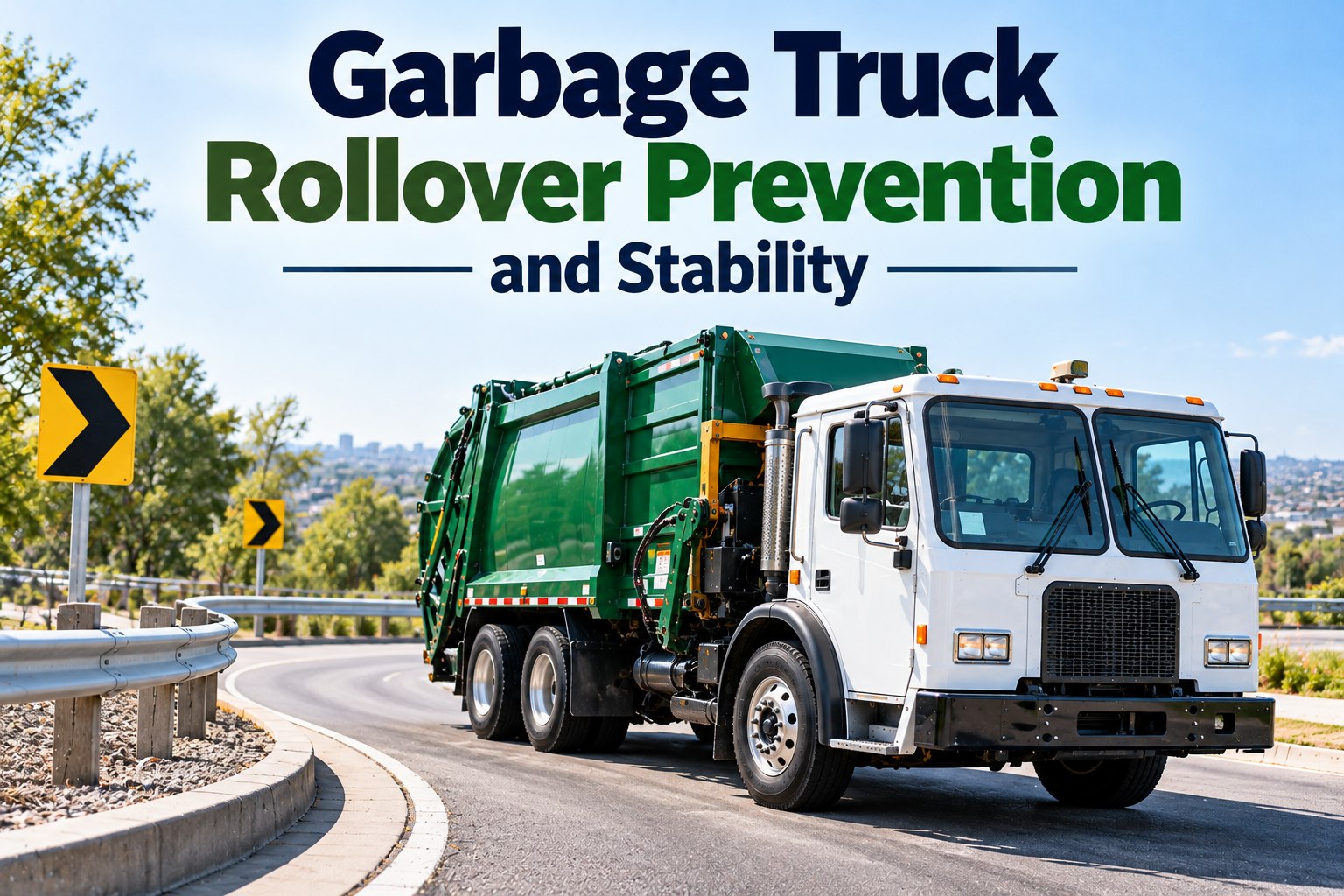
Garbage truck rollover prevention is usually discussed as driver behaviour, and that framing hides the two facts that matter most. The first is physical: a loaded heavy truck rolls at a lateral acceleration well below half of what a passenger car tolerates, and a refuse packer carries its mass higher than almost anything else on the road. The second is regulatory: the federal electronic stability control standard names truck tractors and certain large buses, and a packer is neither. Taken together, that means the stability of your refuse fleet is decided by specification, maintenance and route discipline rather than by a mandate someone else enforced. Here is what the published numbers actually say, and which maintenance items move them. Book a product demo.
The Federal Stability Mandate Names Tractors and Buses. Not Your Packer.
What a rollover threshold is, why a refuse truck’s changes through the shift, why the geometry calculation flatters you, and the maintenance items that genuinely move the number.
Loaded Heavy Trucks Roll Below 0.5 g. Cars Roll Above 1.0 g.
The static rollover threshold is simply the lateral acceleration at which a vehicle rolls over, measured in g. Starting with the published figures makes the scale of the problem obvious before any theory.
Passenger cars are virtually always above 1 g. Light trucks, vans and SUVs sit between 0.8 and 1.2 g. For loaded heavy trucks the threshold often lies well below 0.5 g — a five-axle tractor-semitrailer is around 0.5 g with a dense, low-centre-of-gravity load and as low as 0.25 g with a worst-case one. Petroleum semitankers come in around 0.35 g, cryogenic tankers as low as 0.26 g, and measured logging trucks between 0.23 and 0.31 g.
No published figure for refuse packers appears in that set, and this page will not invent one. What the set does show is the pattern: the vehicles at the bottom are the ones carrying mass high up. That is the category a loaded refuse body belongs to, and it is the reason the rest of this page is about centre-of-gravity height.
Your Truck Has a Different Threshold at 7am and at 2pm
The rigid-vehicle stability factor is half the track width divided by the centre-of-gravity height. Because the threshold scales with one over that height, every tonne that goes into the body lowers the number — and raising the body to tip lowers it furthest of all.
Both curves are drawn from the published formula at a nominal 0.95 metre half-track, so they illustrate the relationship rather than describing any particular truck. The upper dashed line is what geometry alone predicts. The solid line beneath it is the same vehicle after real-world compliance, and the gap between them is the subject of the next section.
The Calculation Overstates Your Stability by up to 40 Per Cent
This is the part that surprises people who have done the arithmetic and reassured themselves with it.
The rigid-body figure assumes the vehicle behaves as one solid object. Real vehicles do not. Tyres deflect, springs compress, suspension linkages take up lash, and frames twist. Each of those lets the sprung mass roll further than the geometry allows for, and each one therefore subtracts from the real threshold. A published case study puts numbers on it: a vehicle with a rigid-body stability of 0.45 g drops to roughly 0.36 g from tyre and spring compliance alone. Taken together, compliances can reduce stability to as little as 60 per cent of the rigid value.
The practical reading is that compliance is not a fixed penalty — it is a maintenance-dependent one. New dampers, correct pressures and tight linkages keep you near the top of that range. Worn ones move you toward the bottom, which is the same thing as saying worn suspension lowers your rollover threshold. That connection is why the maintenance section below is not filler.
The Federal ESC Rule Covers Truck Tractors and Certain Buses
Electronic stability control has been mandated on heavy vehicles in the United States since the final rule was issued in 2015, and it is worth being precise about who it covers.
What the rule actually says
The standard requires electronic stability control systems on truck tractors and certain large buses with a gross vehicle weight rating greater than 11,793 kilograms, which is 26,000 pounds. Typical three-axle truck tractors were phased in from August 2017, with longer timelines for other tractors and for buses in the lower weight band.
Where that leaves a refuse packer
A refuse truck is a single-unit vehicle, not a truck tractor and not a bus, so the applicability statement does not name it. The rulemaking does discuss single-unit trucks in its own section, and this page is not going to characterise the agency’s reasoning from a document it could only read in part — but the scope language is unambiguous about what is required. If your packers have stability control, it is because somebody specified it, not because a rule obliged it. That is worth checking against your actual spec sheets rather than assuming either way.
Five Moments Where Refuse Rollovers Happen
Low threshold only matters where lateral acceleration arrives. These are the places it does. Swipe sideways on mobile.
| Moment | Why the margin is thin | What reduces the risk |
|---|---|---|
| Entering a roundabout or ramp loaded | Lateral acceleration is sustained rather than momentary, so there is no recovery margin. | Posted ramp speeds are set for cars. A loaded packer needs a slower number and drivers need to be told what it is. |
| The last third of the route | The body is full, the centre of gravity is at its highest, and the driver is at their most familiar with the road. | Route the heaviest legs early where that is possible, and treat late-shift corners as a separate briefing. |
| Raised body at the tip face | The centre of gravity is far above normal and the ground is rarely level. | A level pad and a refusal to raise on a cross-slope. This is the scenario with the least margin of any on the route. |
| Avoidance manoeuvres | A sudden swerve produces exactly the lateral acceleration the vehicle has least of. | Following distance is a stability control, not just a collision one. |
| Soft shoulders and kerbs | A dropped wheel adds a roll input the geometry never accounted for. | Mirror discipline and a rule about not correcting hard if a wheel drops. |
The connection most fleets miss
Worn shocks are a stability defect, not a ride-quality one
If compliance can cost you up to forty per cent of your calculated threshold, then the components that govern compliance belong on a schedule with a date on it — not on a list of things to look at when there is time.
Six Maintenance Items That Move the Threshold
Each of these affects how far the body rolls for a given input, which is the same thing as affecting where you sit between the two curves above.
Worn dampers let the body roll further and faster for the same input. This is the maintenance item most directly tied to the compliance losses that drag the real threshold below the calculated one.
Unequal pressure changes the effective track and loads one tyre of a pair early. It is a five-minute check that moves a stability number.
Lash and compliance in the suspension linkage is part of why a vehicle rolls off its geometry. Slack here is slack in the stability budget.
A body that can move relative to the frame adds its own roll angle, and on a refuse truck that body is the majority of the high mass.
A truck that brakes unevenly in a corner introduces yaw at the worst moment. Brake balance is a stability item, not only a stopping one.
If the truck has protection for the raised-body case, it is worth confirming it still works rather than assuming it does.
None of them is exotic, and that is the point. Rollover prevention on a refuse fleet is mostly ordinary suspension and body maintenance done on time, plus route and tip-face discipline. The reason it gets neglected is that no individual item announces itself as a safety-critical component, so each one loses to whatever is visibly broken that week. Putting them on a preventive maintenance schedule is how they stop losing that argument.
Turn Stability Checks Into Scheduled PM in FleetRabbit
The maintenance above only helps if it happens on an interval rather than on recall. That is the specific job the software does — here is what it covers.
What FleetRabbit tracks on a refuse fleet
Shocks, bushings, torque rods and body mounts come round on an interval you set, per vehicle, instead of when somebody remembers.
A driver who felt the body move in a corner has somewhere to put that, attached to the truck, before it becomes a claim.
The same suspension component replaced twice on one unit gets flagged rather than quietly repeating.
A failed stability check opens a job automatically, so nothing depends on a note being transcribed.
When a unit is involved in an incident, the maintenance record is already assembled and in order.
Suspension and body spend per unit, which is how the three problem vehicles make themselves obvious.
Product walkthrough · 20 minutes · no obligation
See Stability Items Turned Into a Live PM Schedule
- We build the stability PM togetherShocks, bushings, tyre pressures, body mounts — on the intervals you want, assigned across your fleet list.
- We add the driver-side checksThe items a driver can notice but usually has nowhere to report, put into the daily inspection.
- We show the repeat-fault viewUsing a handful of your past repairs, so you can see which units would already have been flagged.
- You decide whether it earns its placeTwenty minutes, no obligation. If your current schedule already covers it, we will say so.
Or set it up yourself — the first three vehicles are free, and the daily inspection items can be live today.
Garbage Truck Rollover Prevention Questions Fleet Managers Ask
What is a rollover threshold, in plain terms?
The sideways acceleration a vehicle can take before it rolls, measured in g. Cars are above 1.0 g. Loaded heavy trucks are often well below 0.5 g, and the ones at the bottom of the published range are all carrying mass high up.
Are garbage trucks required to have stability control?
The federal standard names truck tractors and certain large buses above 26,000 pounds. A packer is a single-unit truck and is not named in that applicability statement, so whether yours has it depends on how it was specified. Check the spec sheet rather than assuming.
Why is the truck less stable at the end of the route?
Because the body is full and the centre of gravity is at its highest. Threshold falls as that height rises, so the same corner taken at the same speed has less margin at 2pm than at 7am. Schedule Stability Checks.
When is the truck at its least stable?
With the body raised at the tip face. The centre of gravity is far above its normal position and the ground is rarely perfectly level, which is why a level pad and a refusal to raise on a cross-slope matter more than any other single habit.
Can we just calculate our threshold from track width and CG height?
You can calculate the rigid-body figure that way, but treat it as optimistic. Tyre and spring compliance alone took one published case from 0.45 g to about 0.36 g, and combined compliances can leave as little as 60 per cent of the rigid value.
Does suspension wear really affect rollover risk?
Yes, and that is the most actionable finding here. Compliance is what separates the calculated threshold from the real one, and worn dampers, slack linkages and uneven tyre pressures all increase it. Turn Checks Into Scheduled PM.
What should drivers be told specifically?
That posted ramp and roundabout speeds are set for cars, that a loaded body changes the vehicle they are driving, and that following distance is a stability control because a sudden swerve produces exactly the lateral acceleration they have least of.
What does a rollover actually cost?
The vehicle is usually the smallest part. Recovery, spilled-load cleanup, route disruption, injury exposure and insurance consequences all follow, which is why the maintenance that prevents it is cheap by comparison. Price One Rollover.
Put it on a schedule
Stability Lives in the Suspension Schedule, Not in a Safety Poster
Shocks, bushings, torque rods, tyre pressures and body mounts on a recurring interval per vehicle, driver reports attached to the truck, and failures that open a work order instead of a note. First three vehicles free.