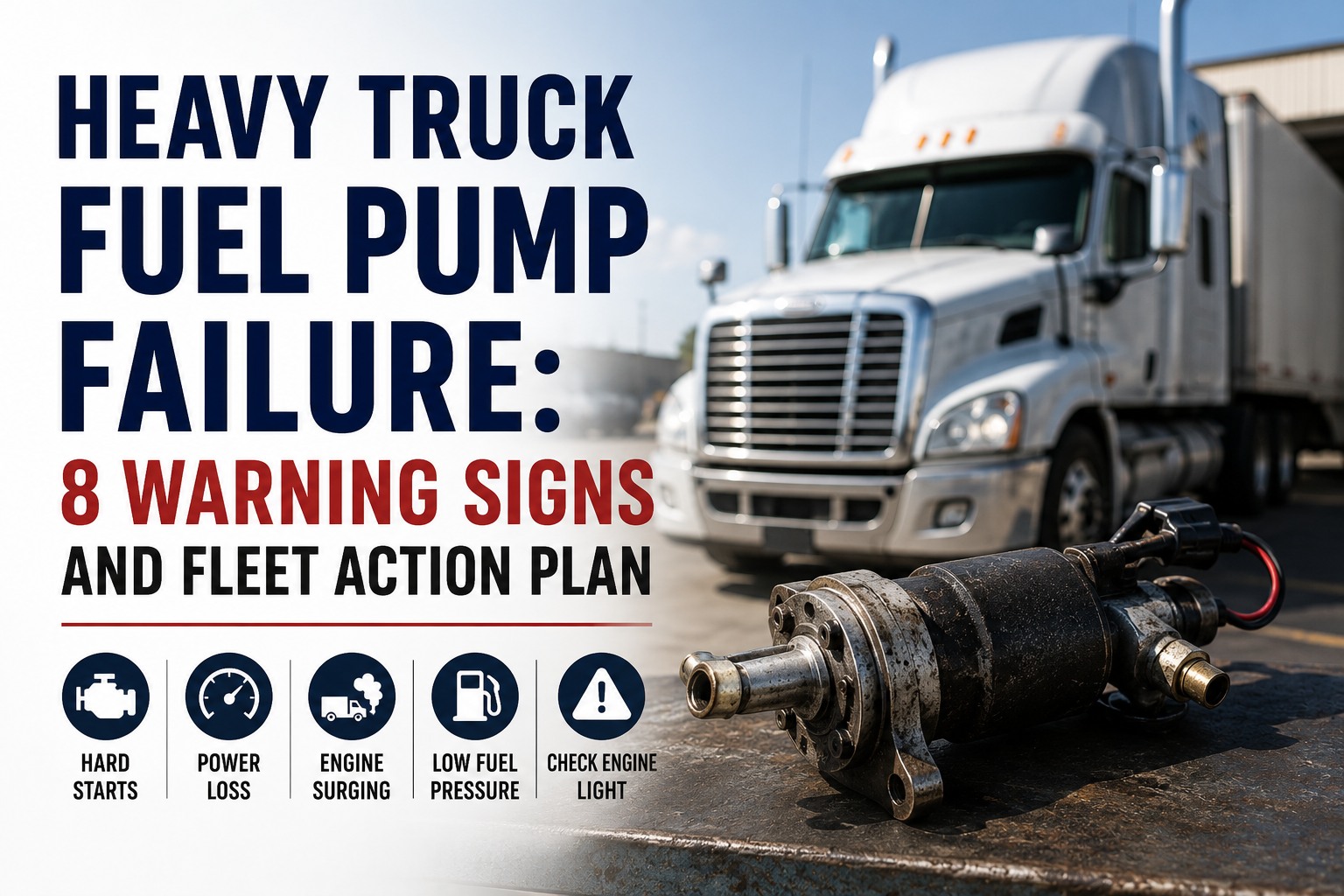
A heavy truck's fuel pump doesn't usually die all at once — it warns you. Long before a driver is stranded at a truck stop with a crank-no-start, the pump has been dropping hints: a little longer to fire in the morning, a flat spot pulling a grade, a surge at cruise that the driver learned to ignore. For a fleet manager, those eight warning signs are worth catching early, because the difference between acting on them and ignoring them is the difference between a planned pump replacement and a catastrophic failure that sends metal shavings through every injector, rail, and line in the system — a contamination that a flush can't fix and that can run past $10,000 to repair out of warranty. This guide walks through the eight warning signs of fuel pump failure, what to inspect for each, when to act, and how preventive-maintenance software stops a weakening pump from becoming a fleet-stranding disaster. Start free trial or book a demo to put fuel-pump health on a schedule instead of a prayer.
DIAGNOSTICS & REPAIR · FUEL DELIVERY
A Fuel Pump Warns You 8 Times Before It Strands the Truck
Heavy-truck fuel pumps rarely fail without warning. The signs show up early and cheap to address — then compound into a catastrophic failure that contaminates the entire fuel system. The whole game is catching the warning before the wreckage.
$10K+
Out-of-warranty cost of a catastrophic CP4 failure
Metal shavings contaminate injectors, rails, lines
A flush won't clear it — every component gets replaced
Caught early, it's a scheduled pump swap instead
Heavy diesels run two fuel pumps — and knowing which one is failing changes everything:
Low-Pressure Lift / Supply Pump
Feeds fuel from the tank to the high-pressure pump at 45–65 PSI. Usually fails first, and its weakness makes a healthy high-pressure pump look bad — which is why it's always checked first.
High-Pressure Pump (CP3 / CP4 / HPFP)
Builds the extreme rail pressure the injectors need. When a CP4 fails it can self-destruct and contaminate the whole system — the expensive, catastrophic scenario worth preventing at all costs.
The 8 Warning Signs, Ranked by When They Appear
Fuel pump symptoms tend to arrive in a rough order — subtle starting and performance issues first, dramatic failures last. Each sign below includes what it means and what to inspect. The rule of thumb: any one alone is worth a look; two or more together means schedule the truck now, before the pattern becomes a breakdown.
Hard Starting & Long Cranking
Extended cranking before the engine fires, especially on cold mornings or after sitting. The pump can't build pressure fast enough at startup. Inspect: supply pressure at the filter housing, then cranking rail pressure on a scan tool.
Power Loss Under Load
The truck feels "gutless" — a lack of acceleration and trouble holding highway speed, especially uphill or loaded. The ECM cuts power to protect components when it detects low pressure. Inspect: commanded vs. actual rail pressure under load; watch for limp mode.
Surging, Stuttering & Hesitation
Inconsistent fuel pressure makes the engine surge or hesitate during acceleration — revs changing under a constant throttle and load. Inspect: fuel pressure stability on a live graph; check the FCA and pressure sensor before the pump.
Poor Fuel Economy
A struggling pump disrupts the fuel-air mixture, causing inefficient combustion and rising fuel-per-mile. It's a quiet, gradual sign that fleet fuel tracking catches long before a driver notices. Inspect: fuel-per-mile trend on the specific truck vs. its own baseline.
Fuel Rail Pressure Codes
The most common electronic indicator: codes like P0087 (pressure too low), P0088 (too high), or P1291/P128F as the pump struggles to meet the ECM's pressure commands. The engine may enter limp mode. Inspect: pull codes; a P0087+P0088 pair on a CP4 is a stop-driving signal.
Whining, Rattling or Grinding Noise
Unusual sounds from the pump area point to internal wear or damage. A loud whine often signals a struggling pump; rattling or grinding can mean internal components are breaking down. Inspect: listen at the pump; a metallic grind on a CP4 is a red flag for imminent self-destruction.
Visible Fuel Leaks
Fuel weeping or pooling around the pump or fuel lines means the pump can no longer contain the pressure it's building — a performance problem and a fire risk at once. Inspect: pump seals, high-pressure line fittings, and mounting area for wet fuel.
Stalling & No-Start Condition
As pump efficiency drops, it can no longer supply the pressure to fire the injectors — intermittent stalling that gets progressively worse until it becomes a crank-no-start that strands the truck. Inspect: this is the end stage — the pump has failed and the truck needs recovery, not a roadside fix.
Sign #1 shows up months before sign #8. Which one do you want to catch?
Fleet Rabbit lets drivers log hard starts and power complaints instantly, flags rising fuel-per-mile automatically, and turns every early sign into a scheduled inspection before the pump strands the truck.
The Fleet Action Plan: Inspect, Then Act
Warning signs are only useful if they trigger the right action fast enough. This triage plan maps each stage of pump failure to what you should do — and the single most important rule is to work the cheap, common causes before condemning an expensive pump. Swipe the table horizontally on mobile.
← Swipe to see all columns →
Always Diagnose in This Order
Supply / lift pump pressure
→
Fuel filter condition
→
Air intrusion
→
Injector return flow
→
FCA & sensor
→
High-pressure pump
A restricted filter or weak lift pump makes a healthy high-pressure pump look bad. Condemn the pump last, not first — replacing a $4,000 pump when a $30 filter was the problem is the most expensive mistake in diesel fuel diagnosis.
Why CP4 Failure Is the One You Must Prevent
Inside a CP4 pump, the roller lifters aren't locked in place — if one rotates ninety degrees, it cuts into the main shaft and the pump begins grinding itself apart. Those metal particles don't stay put: they travel through the fuel rails, injectors, high-pressure lines, and overflow valve, contaminating every component they touch. A flush won't clear the residual particles — the only way to be sure the system is clean is to replace all affected components, which can run past $10,000 out of warranty. This is why fuel-pump prevention isn't about saving a pump; it's about saving the entire fuel system.
Put Every Truck's Fuel Pump on a Schedule, Not a Prayer
Fleet Rabbit turns fuel-pump warning signs into tracked defects and scheduled inspections, flags the fuel-trend and code patterns that precede failure, and keeps filter and water-separator service on a usage-based schedule — so a weakening pump gets caught at the inspection stage, not the stranded-on-the-highway stage. Deploy at $5/vehicle/month, no hardware, live within 72 hours.
Driver symptom logging
Fuel-trend anomaly flags
Usage-based PM scheduling
Fault-code pattern alerts
What Actually Kills Fuel Pumps — and How to Prevent It
Most pump failures trace back to a handful of preventable causes. The good news for a fleet is that every one of them is addressable with maintenance discipline that software can enforce. Swipe the table horizontally on mobile.
← Swipe to see all columns →
How PM Software Prevents Catastrophic Failure
Every point on the failure curve where a fleet loses money is a point where preventive-maintenance software would have intervened. Here is exactly how Fleet Rabbit moves fuel-pump health from reactive to managed.
01
Driver Symptom Logging
Hard starts, power complaints, surging, and pump noises get logged from the driver's phone the moment they appear — capturing sign #1 months before sign #8.
02
Fuel-Trend Anomaly Flags
Rising fuel-per-mile on one truck is one of the earliest and quietest pump-failure signs. Trend alerts surface it against the truck's own baseline before a driver ever notices.
03
Usage-Based PM Scheduling
Fuel filter and water-separator services scheduled by mileage and engine hours attack contamination — the number-one pump killer — before it ever reaches the pump.
04
Fault-Code Pattern Alerts
P0087, P0088, and P1291 codes are logged against the truck, and a P0087+P0088 pair on a CP4-tagged unit raises the stop-driving flag before the pump self-destructs.
05
Defect-to-Work-Order Routing
Every logged sign becomes a tracked defect and a scheduled work order automatically, so a driver's "it felt gutless today" never dies in a text message.
06
Per-Truck Failure History
A complete symptom and repair history per vehicle turns a scattered set of complaints into a clear pattern pointing at a pump on its way out — before it takes the fuel system with it.
Frequently Asked Questions
What is the first sign of a failing fuel pump on a diesel truck?
Hard starting and extended cranking are usually the earliest signs, especially on cold mornings or after the truck has sat. The pump can't build pressure fast enough at startup, so the engine takes longer to fire. It's subtle and easy to dismiss, which is exactly why it should be logged the day it appears — it's the cheapest point in the entire failure curve to act. Power loss under load, where the truck feels "gutless" pulling a grade, tends to follow closely behind.
Book a demo.
Should I check the lift pump or the high-pressure pump first?
Always the lift pump and supply side first. A weak low-pressure lift pump or a restricted fuel filter makes a perfectly healthy high-pressure pump look like it's failing — same symptoms, tiny fraction of the cost. The correct diagnostic order is supply pressure, then filter condition, then air intrusion, injector return flow, and the FCA and sensor, and only then the high-pressure pump. Condemning a $4,000 pump when a $30 filter was the culprit is the most expensive mistake in diesel fuel diagnosis.
Book a demo.
Why is CP4 pump failure so catastrophic?
The CP4 pump's roller lifters aren't locked in place, so one can rotate ninety degrees and cut into the main shaft, at which point the pump grinds itself apart. The metal particles it generates travel through the fuel rails, injectors, high-pressure lines, and overflow valve, contaminating every component. A flush can't remove the residual particles, so the only way to guarantee a clean system is to replace all affected components — which can exceed $10,000 out of warranty. That's why the priority with a CP4 is prevention, not repair.
Book a demo.
Can I keep driving with fuel pump warning signs?
It depends on the stage. Early signs like an occasional hard start give you days to schedule a proper diagnosis. But grinding noise, a visible fuel leak, or a P0087 and P0088 pair together on a CP4-equipped engine are stop-driving situations — continuing risks turning a pump replacement into a full fuel-system contamination event. When symptoms reach the noise-or-leak stage, take the truck out of service and diagnose rather than finishing the route.
Book a demo.
What causes fuel pumps to fail early?
The biggest killers are fuel contamination (dirt, water, and debris scoring the internals), low-lubricity fuel that accelerates wear, running tanks near empty which strips the pump of its fuel-based cooling and lubrication, and extended filter intervals that let debris through. Nearly all of these are preventable with maintenance discipline: on-schedule filter and water-separator service, quality fuel sourcing, and not ignoring the early warning signs. That's precisely the discipline PM software is built to enforce.
Book a demo.
How does PM software prevent fuel pump failures across a fleet?
It closes the gap between the first warning sign and the eventual failure. Drivers log symptoms the moment they appear, fuel-per-mile anomaly flags catch the quiet early decline, and fault codes like P0087 and P0088 are tracked against each truck with a stop-driving flag on CP4 units. Underneath it all, usage-based filter and water-separator scheduling attacks the contamination that kills most pumps before it ever reaches them. Fleets that manage fuel-system health this way catch weakening pumps at the scheduled-inspection stage instead of the stranded-on-the-highway stage.
Book a demo.
Catch the Warning Sign Before the Pump Takes the Whole System Down.
Fleet Rabbit turns fuel-pump warning signs into scheduled inspections, flags the fuel-trend and fault-code patterns that precede failure, and keeps filter and water-separator service on a usage-based schedule — so a weakening pump is a planned repair, never a catastrophic one. Integrated with your existing systems in 5–7 working days, at $5/vehicle/month, with no new hardware required.
Free tier for up to 3 vehicles · No credit card required · No hardware installation
July 21, 2026By Derek Goes
All Blogs