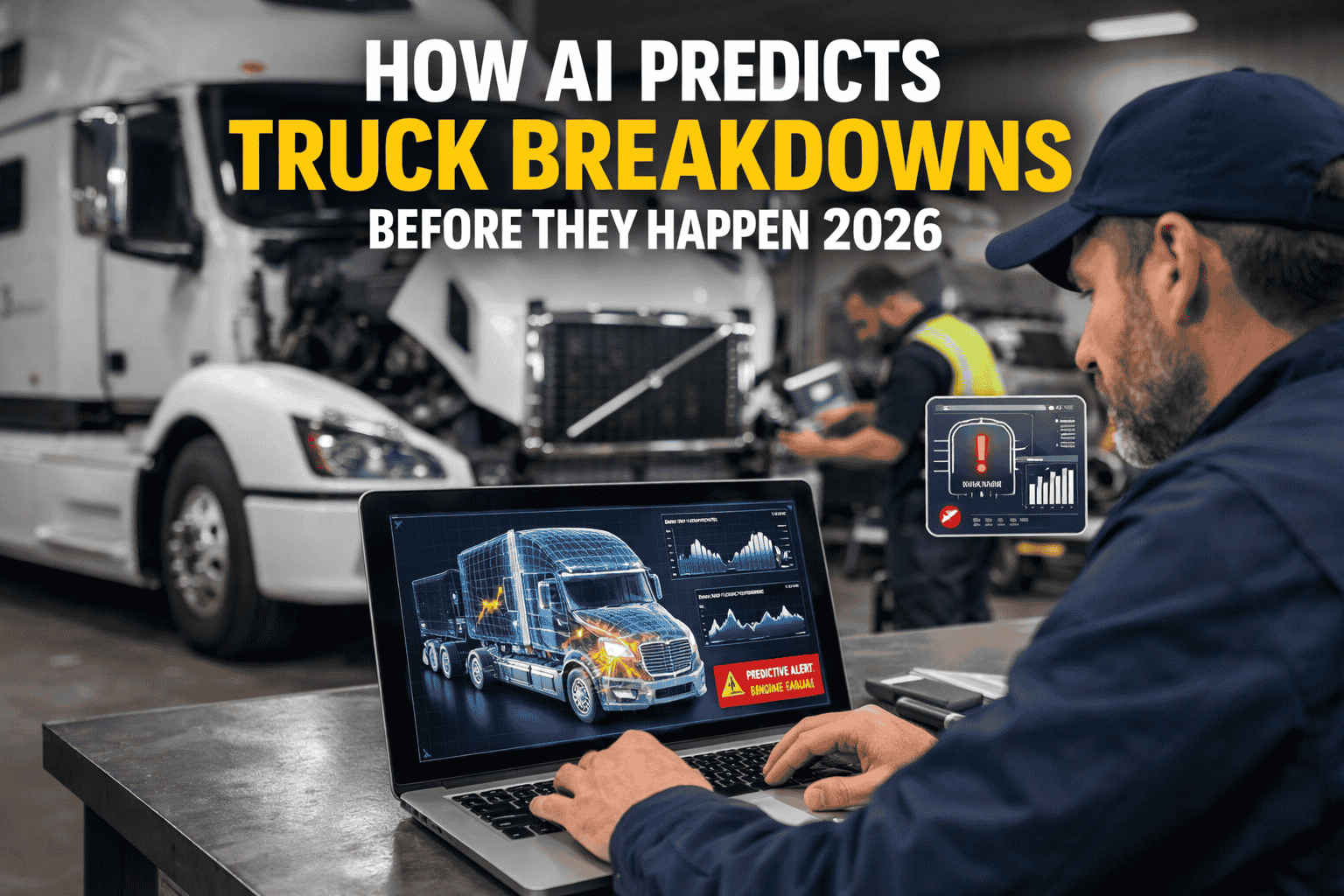
A truck breakdown on I-40 at 2 AM costs more than the repair itself. Towing runs $500-$1,200. The load misses its window — penalty fees add another $2,000. Your driver sits idle for 8 hours while the shop diagnoses what went wrong. Total damage: $4,500+ from a single event. Now here's what's changing in 2026: AI systems analyze your engine data continuously and flag the exact component trending toward failure 2 to 3 weeks before it breaks. The alternator that would have died on the highway? Replaced during scheduled downtime for $180 in parts and 45 minutes of labor. That's how AI predicts truck breakdowns before they happen. This guide shows you exactly how it works, what sensor data matters, and how to start predicting failures in your own fleet.
The True Cost of an Unplanned Breakdown
Most fleet managers underestimate breakdown costs by 60-70% because they only count the repair bill. The real damage goes far deeper. When a truck dies on the highway, you're not just paying for parts — you're paying for a cascade of failures that compounds by the hour.
Anatomy of a $4,500+ Breakdown
What actually happens when your alternator fails at mile marker 247
Now compare that to catching the same alternator issue with AI: the system flags declining voltage patterns 18 days before failure. You schedule a 45-minute repair during planned downtime. Parts cost: $180. Labor: $150. Total: $330. Zero operational impact. Zero stress. Zero customer calls. This is why 65% of maintenance teams are adopting AI by end of 2026 — the math is undeniable. Start preventing breakdowns with a free trial.
How AI "Sees" a Breakdown Coming
Your truck's engine generates thousands of data points every minute. Oil pressure, coolant temperature, battery voltage, exhaust readings, vibration patterns — all streaming through sensors that feed into the engine control module. Humans can't process this flood of information in real-time. AI can. And more importantly, AI learns what "normal" looks like for each specific truck, then spots the tiny deviations that predict failure weeks ahead. Book a demo to see this pattern detection on your fleet data.
Sensors Collect Data
50+ readings per second from engine, transmission, brakes, tires
AI Learns Baseline
Establishes "normal" patterns unique to this truck's history
Deviation Detected
Flags patterns that match known failure signatures
Alert + Work Order
Notifies you 2-3 weeks early, auto-schedules repair
The 6 Sensor Signals AI Monitors for Early Warnings
Not all sensor data matters equally. AI predictive systems focus on six critical signals that provide the clearest early warning of component failure. Understanding these helps you evaluate whether your current telematics captures what AI needs to work.
Engine Temperature
Oil Pressure
Battery Voltage
Vibration Patterns
Transmission Temp
Fuel System Pressure
Want to see which of these signals your current telematics captures?
Get Free Data AssessmentReal Example: How AI Caught an Alternator Failure 18 Days Early
Here's actual prediction data from a Class 8 truck running regional routes. The AI flagged a battery voltage anomaly that would have become a roadside breakdown.
The driver never noticed anything wrong. The dashboard light hadn't come on yet. But the AI saw the pattern: cold-start voltage dropping faster than normal, combined with charging voltage declining under load. Classic alternator diode failure signature. Repair completed during a scheduled overnight stop — zero operational impact.
Why 85% of Breakdowns Are Actually Predictable
Here's something most fleet managers don't realize: the vast majority of truck breakdowns aren't sudden catastrophic failures. They're the end result of gradual degradation that was visible in sensor data for weeks. Understanding why breakdowns happen — and how they develop — explains why AI prediction works so well.
Predictable Failures
Gradual degradation over days/weeks- Alternator/charging system decline
- Battery capacity degradation
- Brake pad/rotor wear
- Cooling system issues
- Belt and hose deterioration
- Fuel system component wear
- Transmission fluid degradation
- Turbocharger bearing wear
Sudden Failures
External causes, no warning pattern- Road debris tire damage
- Collision damage
- Manufacturing defects
- Vandalism/theft
- Extreme weather events
- Fuel contamination
The 85% that AI can predict share a common pattern: they generate subtle but measurable changes in sensor data before they fail. An alternator doesn't just die — its voltage output drops 0.1V per day for two weeks before it quits. A turbo doesn't explode — its vibration signature shifts gradually as bearings wear. AI systems detect these micro-trends that humans would never notice in raw data streams. Book a demo to see how FleetRabbit identifies these patterns in your fleet.
What You Need to Start Predicting Breakdowns
Good news: you probably already have most of the infrastructure. AI prediction doesn't require replacing your trucks or installing expensive new hardware. Here's what's actually needed:
Telematics Device
Any major provider works — Geotab, Samsara, Verizon Connect, KeepTruckin. If you have ELD compliance, you likely already have this.
OBD-II or J1939 Port Access
Standard on all commercial trucks since 2007. This is where engine data streams from.
6+ Months of Historical Data
The AI needs baseline data to learn your fleet's patterns. More data = better predictions.
Digital Maintenance Records
Optional but valuable. Past repair data teaches AI what failure patterns look like.
Ready to Stop Breakdowns Before They Start?
FleetRabbit connects to your existing telematics and delivers your first failure prediction within 72 hours. Free tier covers 3 vehicles — no credit card required.
Getting Started: 4-Week Implementation Path
You don't need to overhaul your entire operation to start using AI predictions. Most fleets are producing value within 30 days using existing telematics infrastructure. Here's the typical path from signup to first prevented breakdown.
Connect Your Data
FleetRabbit integrates with your existing telematics provider via API. No hardware changes needed. Your historical data starts flowing into the AI system within hours of setup.
AI Learns Your Fleet
The system establishes baseline patterns for each vehicle — what "normal" looks like for engine temp, oil pressure, voltage, and dozens of other parameters unique to your trucks and routes.
First Predictions Arrive
You'll start receiving alerts for any vehicles showing early degradation patterns. Initial predictions run in "monitor mode" so you can validate accuracy before taking action.
Automated Workflows
Connect predictions to your maintenance system. AI alerts automatically generate work orders, schedule repairs during planned downtime, and notify the right technicians.
Ready to see your first prediction? Connect your telematics in under 10 minutes.
Start Free TrialFrequently Asked Questions
Leading platforms achieve 85-92% accuracy after 3-6 months of learning your fleet's patterns. Early stage (month 1-3) accuracy runs 75-80%. The more data the system processes, the sharper predictions become. Some specific failure types — like alternator and battery issues — reach 95%+ accuracy because they follow very consistent degradation patterns.
Most predictions come 2-4 weeks before failure would occur — enough time to schedule repair during planned downtime. Some slower-degrading components (like transmission issues) can be flagged 6-8 weeks out. Sudden failures (like tire blowouts from road debris) can't be predicted, but represent less than 10% of breakdowns.
Any truck with OBD-II or J1939 diagnostic ports (standard since 2007) works. For older trucks without embedded telematics, simple aftermarket devices ($100-300) can provide the sensor data AI needs. The key requirement is getting engine data into a connected system — the truck's age matters less than data availability.
One prevented breakdown typically pays for 6-12 months of service. Industry data shows fleets using AI predictive maintenance see 45% fewer breakdowns, 25% lower maintenance costs, and 73% reduction in specific failure types like hydraulic issues. Most fleets achieve positive ROI within 90 days. FleetRabbit's free tier lets you validate ROI on 3 vehicles before scaling.
Stop Paying for Breakdowns You Could Have Prevented
65% of maintenance teams will use AI by end of 2026. Early adopters are already saving $50,000+ annually. Start your free trial today.