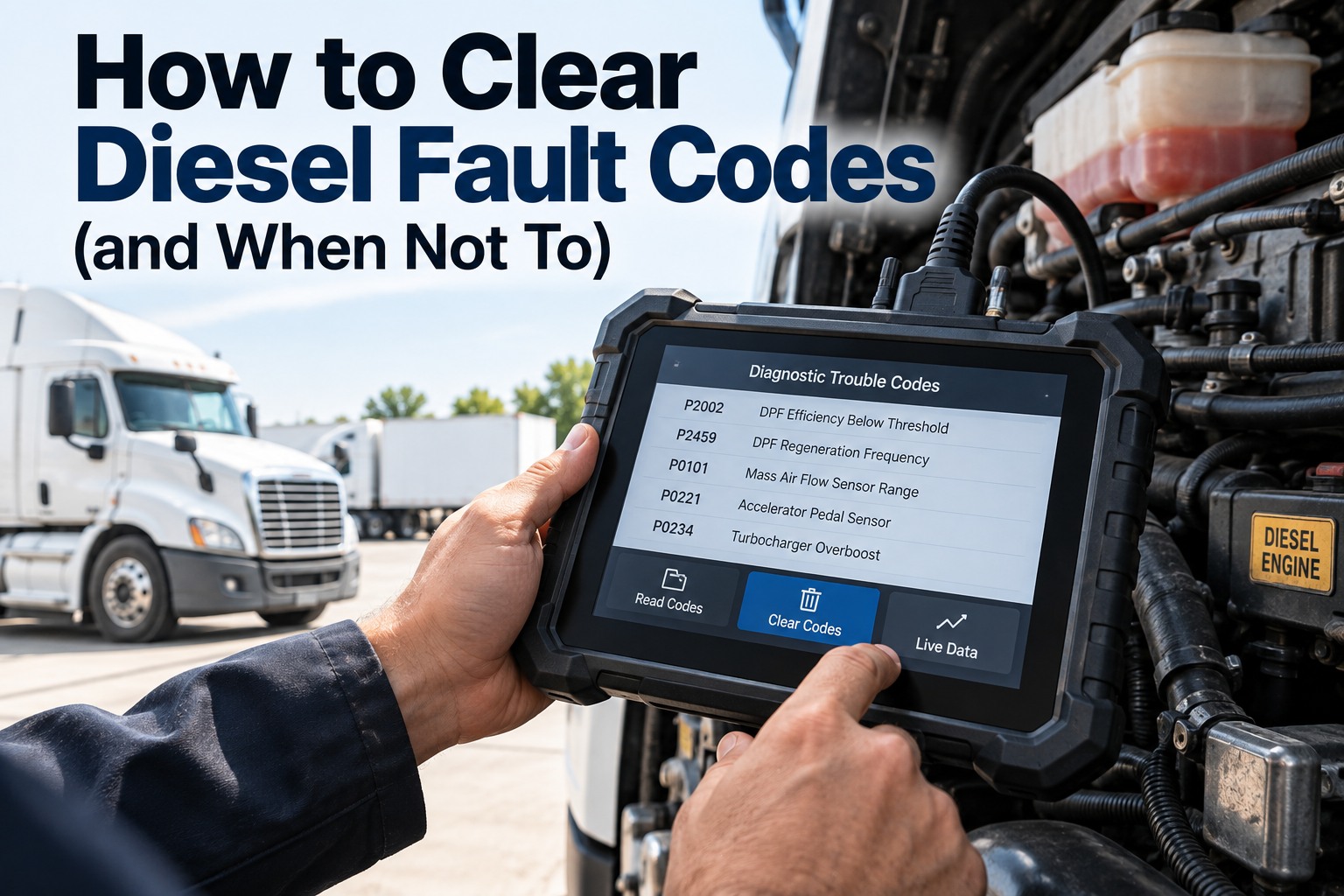
To clear diesel fault codes on a heavy-duty truck, connect a J1939-capable scan tool or the engine maker's software, record every active and inactive code with its freeze-frame data, repair the cause, then clear the codes and drive the truck to confirm they stay gone. Clearing is the last step of a repair, not the repair itself: it turns the lamp off and erases the evidence, but it does not fix the fault, and some emissions codes and derates will not clear until the problem is really fixed. This guide explains what clearing actually erases, the right order to do it in, which tools can clear what, when you should never clear a code, how to tell whether the repair worked, and what drives the repair bill. Book a demo to see every code kept on record before it's cleared, or start free with 3 vehicles.
Diesel fault codes · Clear them the right way
Clearing a Code Turns the Light Off. Only the Repair Keeps It Off.
For technicians, shop leads and fleet managers: the safe way to clear heavy-duty diesel codes, the situations where clearing does harm, and how to keep a record that proves the fix worked.
- The code and freeze-frame data are recorded
- The cause has been found and repaired
- You will drive the truck to verify the fix
- A red stop or engine protection lamp is on
- Nobody has written the code down yet
- The goal is to hide it before an inspection
What Clearing a Diesel Fault Code Actually Erases, and What It Leaves Behind
A clear command resets the engine computer's fault memory, but it only removes information; it never changes the condition that set the code. Emissions diagnostics on modern heavy-duty engines are built so that some records survive a clear: under California's on-board diagnostic rules, a permanent fault code is erased only after the system's own monitor runs and confirms the fault is gone, and freeze-frame data is erased along with the confirmed code. You can save every code and its conditions to the truck's record on a free account before anything is cleared.
Returns as soon as the system detects the fault again if it isn't fixed.
Evidence of intermittent faults is lost — record them first.
Speed, load and temperatures at the moment of the fault disappear.
Cleared only when the monitor runs and finds no fault.
Emissions derates may need the repair confirmed, and some need the engine maker's tool.
Nothing mechanical or electrical changes when a code is cleared.
The Right Order for Clearing Diesel Fault Codes: Record, Repair, Clear, Verify
Clearing belongs at step three of four, after the evidence is saved and the cause is fixed, and before a test drive that proves it. Skip a step and you either lose the data a technician needs or send out a truck that will light up again on the next trip. We can build these four steps into your work orders in a demo.
Record every code and its conditions
Active and inactive codes, occurrence counts, freeze-frame data and the lamps that were lit.
Find and repair the root cause
Diagnose from the code's failure type; check wiring before replacing parts.
Clear the codes with the right tool
Only now. Use a tool that can also reset derates if one was active.
Verify with a drive or a forced test
Let the monitor run; confirm the code doesn't return before closing the job.
Which Tools Can Read, Clear and Reset Codes on a Heavy-Duty Diesel Truck
Heavy-duty trucks use the J1939 data network, so a basic car code reader won't do. Tools differ in what they can clear: most can erase ordinary codes, but resetting an emissions derate or running a forced regeneration usually needs the engine maker's software or a professional scan tool with that function. Log which tool was used with every repair for free. Swipe the table on mobile.
| Tool | Read codes | Clear codes | Reset derate, run tests | Best for |
|---|---|---|---|---|
| Dash display or cluster menu | Often | Rarely | No | Driver checking what's active |
| Generic handheld J1939 reader | Yes | Basic codes | Usually not | Quick reads in the yard |
| Professional heavy-duty scan tool | Yes | Yes | Many functions | Independent shops, mixed fleets |
| Engine maker's diagnostic software | Yes | Yes | Yes | Emissions repairs, derate resets, calibrations |
| Telematics fault feed | Yes, remotely | Generally no | No | Seeing codes before the truck arrives |
General capabilities by tool category; confirm features for your engine make and model year.
Six Situations Where You Should Not Clear a Diesel Fault Code
In each of these cases, clearing makes the problem harder to fix, more dangerous or more expensive. Treat them as hard stops in your shop's procedure. We'll help you turn these into shop rules in a demo.
A red stop or engine protection lamp is lit
Clearing and restarting can run an engine with low oil pressure or overheating into serious damage.
Nobody has recorded the codes yet
Intermittent faults may never show again long enough to diagnose.
An emissions derate is counting down
The fault returns and the derate sequence continues; fix the cause instead.
A warranty or dealer diagnosis is pending
Erased history can make a warranty claim harder to support.
The truck was just in a crash
Fault and event data can matter for the investigation; preserve it.
The aim is to hide a fault
Before an inspection, a sale or a hand-off, clearing without repair misleads the next person who relies on that truck.
Turn these six stops into a rule your shop can't skip
In 30 minutes we'll show how FleetRabbit requires the code and freeze-frame data on the work order before a job can be closed, so no fault is cleared without a record.
Why Disabling Emissions Systems to Stop Codes Costs Far More Than the Repair
Repeated emissions codes tempt some operators toward delete kits or reprogramming that stop the codes permanently — which is tampering under the Clean Air Act. The U.S. Justice Department said in 2025 it would stop criminal prosecutions for these defeat devices, but EPA civil enforcement still applies, and owners can be required to restore the truck to its original specification. Keep a clean repair record for every emissions fault free.
Maximum EPA civil penalties under the Clean Air Act
Figures as published by EPA and reported in 2020–2025 coverage; penalty amounts are adjusted for inflation over time.
The legal fix is the cheaper one
A sensor, doser or DPF repair has a known price. A tampering case can include per-vehicle penalties and the cost of restoring every modified truck.
After You Clear the Codes: How to Tell Whether the Repair Really Worked
A code that stays gone for one short drive hasn't proven anything, because many emissions monitors only run under specific conditions such as a minimum run time or highway speed. Keep the job open until the monitor has run. See verification tracking on work orders in a demo.
What Drives the Repair Bill After a Diesel Fault Code Is Found
The cost of a fault code depends far more on where the fault is and how long the truck sits than on the code itself. Repairs climb from connectors and sensors to major aftertreatment work, and downtime adds a daily cost on top: industry benchmarking by FleetNet America and ATA's Technology & Maintenance Council puts it at roughly $448 to $760 per truck per day before towing and repair. Track repair cost per code and per truck free.
Relative cost by repair type, illustrative. Downtime benchmark: FleetNet America and TMC, via industry reporting. ATRI puts 2025 average repair and maintenance cost at $0.215 per mile.
Keep Every Cleared Code on the Truck's Record So Repeat Faults Get Caught
Once a code is cleared from the engine computer, the only lasting record is the one your shop keeps. Save the code, conditions, repair and verification on a work order, feed codes in automatically through OEM telematics, and read pending codes at every PM. See a complete fault record in a demo.
What every cleared-code record should hold
- The code, occurrence count and freeze-frame values
- Which lamps were lit and any derate message
- The repair made and parts used
- Who cleared it, when and with which tool
- How the fix was verified
- Whether the same code has appeared before on that truck
Diesel Fault Code Clearing Questions Technicians and Fleet Managers Ask
How do you clear diesel fault codes on a heavy-duty truck?
Connect a J1939-capable scan tool or the engine maker's software to the diagnostic port, record all codes and freeze-frame data, repair the cause, then use the tool's clear function and drive the truck to confirm the codes don't return. See the process on your trucks.
Will disconnecting the batteries clear diesel fault codes?
It may reset some stored information on some trucks, but it's unreliable, it doesn't clear permanent emissions codes, and it erases useful diagnostic data. Use a proper scan tool after the repair. Record codes before any reset free.
Why did the fault code come back after I cleared it?
Because the cause is still there. The engine's monitor re-checked the system and found the same fault. Diagnose and repair the root cause, then clear and verify again. Track repeat codes with us.
Can clearing a code remove an emissions derate?
Not reliably. Emissions derates are tied to the underlying fault, and many require the repair to be confirmed — sometimes with the engine maker's software — before full power returns. Log derate repairs free.
Is it illegal to clear diesel fault codes?
No. Clearing codes after a repair is normal practice. What is illegal is removing or disabling emissions equipment, or installing devices or software that stop the system from working, which is tampering under the Clean Air Act. Keep compliant repair records with us.
How much does it cost to fix the fault behind a diesel code?
It ranges from a low-cost connector or sensor repair to major aftertreatment or engine work, and downtime often adds the most — roughly $448 to $760 per truck per day by industry benchmarks, before towing and repair. Track costs per truck free.
Record Every Fault Before You Clear It, and Prove the Repair Worked
FleetRabbit keeps each code, its conditions, the repair and the verification on the truck's history, so a cleared code never disappears and a repeat is spotted the first time it returns.