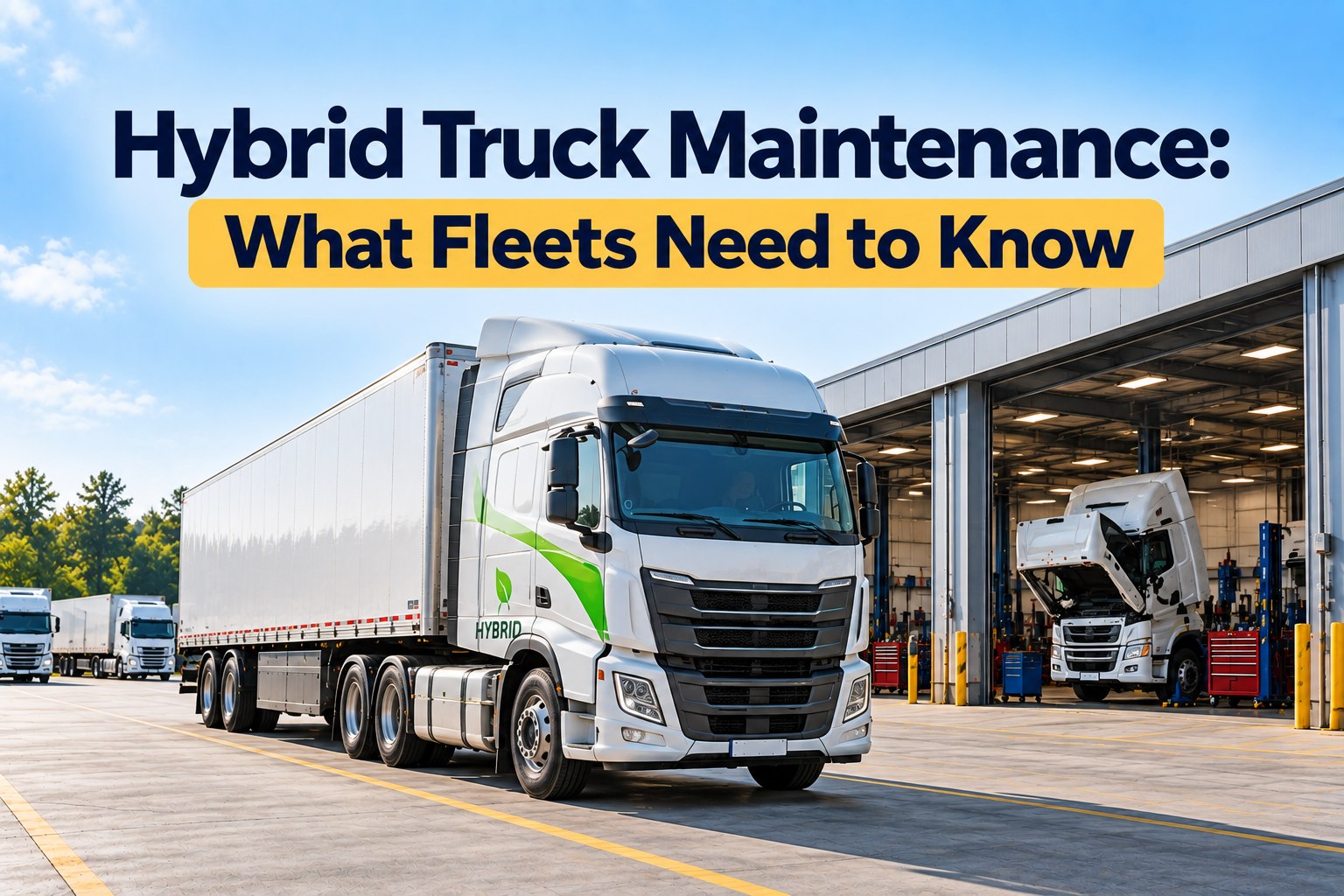
The assumption behind most hybrid purchases is that they sit roughly halfway between diesel and electric on maintenance as well as on fuel. Argonne National Laboratory's cost scaling says otherwise. Measured against a conventional medium or heavy truck at 100%, Argonne puts hybrids at 87%, plug-in hybrids at 83% and battery electric at 60% — so a hybrid delivers roughly a seventh of the available maintenance reduction rather than half of it. The reason is structural rather than surprising, and the Department of Energy's own component list makes it plain in one glance: a hybrid keeps the entire combustion system and adds an electric drivetrain on top. See both systems tracked on one record.
You Did Not Replace Half the Diesel. You Added an Electric Truck to It.
What a hybrid actually changes on a maintenance schedule, what it adds that was never there before, where it genuinely earns its place in a fleet, and why the maintenance saving is smaller than almost everyone expects.
Count the Components
The Department of Energy names thirteen key parts in a hybrid electric vehicle. Sorting them by which world they came from is the fastest way to understand the maintenance consequence.
DOE's list covers the internal combustion engine, exhaust system, fuel filler and fuel tank alongside the traction battery pack, electric traction motor, electric generator, DC/DC converter and power electronics controller, with the auxiliary battery, thermal cooling system, transmission and motor generators serving both. Note also what hybrids do not have: they cannot be plugged in, and DOE states the battery "is charged through regenerative braking and by the internal combustion engine." No charging infrastructure, no depot electrical works, no demand charges — which is a genuine and frequently decisive advantage.
What Changes, Item by Item
Ten lines from a real PM schedule, with the honest verdict on each. Swipe the table sideways on mobile.
| Maintenance item | Conventional diesel | Hybrid | Net effect |
|---|---|---|---|
| Engine oil and filters | Full schedule | Full schedule, and the engine may run cooler and shorter cycles which changes nothing about the interval | Unchanged |
| Aftertreatment: DPF, DEF, SCR | Full burden | Still present. Shorter engine run time can mean less heat for passive regeneration, which is not a saving | Unchanged or worse |
| Fuel system | Full schedule | Full schedule. Injectors, filters, water separators all remain | Unchanged |
| Friction brakes | Primary braking | Regen does a share of the decelerating, so pads and linings last longer on stop-start duty | Genuinely reduced |
| Traction battery and thermal loop | None | New. Its own cooling circuit, its own state-of-health question, its own service interval | Added |
| High-voltage cabling and connectors | None | New. Inspection by a qualified technician, insulated tooling, documented de-energising | Added |
| Insulation resistance testing | None | New. A measured value with a pass threshold, and the most important electrical safety check on the vehicle | Added |
| Power electronics and inverter cooling | None | New. Shares or parallels the thermal management, and is routinely forgotten because it has no dipstick | Added |
| Technician qualification | Diesel skills | Diesel skills plus high-voltage qualification, insulated tools and PPE for anyone touching the propulsion system | Added |
| Charging infrastructure | None | None. A hybrid does not plug in — the battery charges from regenerative braking and the engine | Still none |
One row reduces. Four are added. Five are unchanged. That distribution is the whole argument, and it maps closely onto Argonne's 87% figure — a real but modest reduction, arriving alongside a genuine increase in the range of skills and procedures the workshop has to carry.
Is your hybrid running one maintenance schedule or two?
Most fleets add hybrids to the existing diesel schedule and bolt the high-voltage items on wherever they fit. We will set up one unit properly — engine intervals and HV intervals running in parallel, insulation resistance stored as a value, and technician qualification recorded against the people allowed to do the work.
Where Hybrids Actually Make Sense
The case for them is real. It is just not a maintenance case, and buying on the wrong reason is how a sound decision gets judged a failure two years later.
- Routes too long or too cold for a battery electric vehicle to finish reliably
- Sites where depot charging is not yet installed or the electrical service will not support it
- Stop-start urban duty where regen does real work and idle reduction matters
- Operations wanting lower fuel burn without taking on charging infrastructure or demand charges
- Cold-climate work, where engine waste heat warms the cab instead of draining a traction pack
- Buying primarily for maintenance savings — Argonne puts hybrids at 87% of conventional repair cost, against 60% for battery electric
- Highway-dominant duty, where regenerative braking has little to recover
- Workshops with no route to high-voltage qualification, since the complexity arrives either way
- Fleets that could charge at a depot and run battery electric on the same routes
- Anywhere the real driver is an emissions target that a hybrid will not actually reach
The cold-weather point on the left is worth drawing out, because it is the strongest technical argument available and it rarely gets made. Department of Energy testing found battery electric range falling 41% at 20°F against 10% for a comparable combustion vehicle, with the dominant cause being cabin heating drawn from the traction pack. A hybrid has an engine producing waste heat, so the cab is warmed by something that was going to be wasted anyway. In genuinely cold operations that single difference can decide whether a route is completable.
Whether the One Saving Is Real for You
Brakes are the single line that genuinely improves, so it is worth knowing in advance whether your duty cycle will deliver it. Regenerative braking only recovers energy when the vehicle actually brakes.
NREL's vocational drive-cycle work gives the contrast in a single pair of numbers. A refuse truck averages 2.68 stops per mile at an average driving speed of 21.26 mph. A drayage truck averages 0.24 stops per mile at 43.76 mph. That is roughly eleven times the braking events per mile, and NREL notes that refuse and transit vocations "stand out in their usage as compared to the rest of the sample."
Apply that to a hybrid and the conclusion is direct. On refuse, municipal, delivery and transit work, regen is doing something substantial every few hundred yards, and the brake saving should be meaningful. On highway-dominant running it has very little to recover, the friction brakes do nearly all the work they always did, and the hybrid has added complexity for a saving that will not materialise on that line.
This is the question worth answering before the purchase rather than after. If your routes look like drayage, the maintenance case for a hybrid is close to zero and the decision has to rest entirely on fuel burn and emissions. If they look like refuse, the one genuine saving on the table is the one you will actually collect — and it is worth measuring on your own vehicles rather than accepting a manufacturer figure.
The Workshop Question Nobody Budgets
The component count has a consequence that shows up in people rather than parts, and it arrives on the day the first hybrid does.
Everything on the combustion side is work your technicians already do. Everything on the electric side requires high-voltage qualification, insulated tooling, personal protective equipment and a documented de-energising procedure — and that requirement does not scale with how many hybrids you own. One hybrid in the fleet creates the same qualification requirement as forty, because the first time somebody needs to work on the propulsion system, they either hold the qualification or the vehicle goes out to a dealer.
That fixed cost is why hybrids often look worse per unit at small volumes than the headline figures suggest, and why the decision benefits from being made at fleet level rather than vehicle by vehicle. If high-voltage capability is coming anyway because battery electric units are planned, the hybrid inherits an investment already justified. If it is not, the first hybrid carries the whole of it.
Worth asking your dealer or body builder directly: what work on this vehicle requires a qualified high-voltage technician, and what can a conventionally trained diesel technician do safely? The answer varies by manufacturer and it determines how much of the maintenance you can actually keep in house.
How FleetRabbit Handles This
Four things, and the first is what stops the high-voltage half becoming a separate spreadsheet.
The engine intervals and the high-voltage intervals run in parallel against the same unit, because they are the same truck and a split record is how one of them gets forgotten.
Who is certified to work on the propulsion system, and until when. On a mixed fleet that is a scheduling constraint as much as a compliance one.
A reading, trended per unit, rather than a tick. The second measurement is what makes the first one worth taking.
Regen should extend pad life on stop-start duty. Recording stroke and lining depth is how you find out by how much on your own routes, and whether the interval can safely move.
Questions Fleets Ask
Do hybrid trucks need less maintenance than diesel?
A little. Argonne's scaling for medium and heavy duty puts hybrids at 87% of a conventional truck's repair cost, against 83% for plug-in hybrids and 60% for battery electric. The reduction is real but modest, and it arrives alongside new high-voltage items that were not on the schedule before. Track your own split free.
Do hybrid trucks need charging?
No. DOE is explicit that hybrids cannot be plugged in — the battery charges through regenerative braking and the internal combustion engine. That removes depot charging works, charger maintenance and demand charges entirely, which for many operations is the single biggest practical advantage over battery electric. Compare the three powertrains.
Will the brakes really last longer?
On stop-start duty, yes, because regenerative braking does a share of the decelerating. How much longer depends entirely on your routes, so measure it rather than assuming a figure — and keep recording stroke and lining depth on the normal interval, since less wear is not less inspection and a lightly used brake can still be out of adjustment. Measure your own brake life.
Can our diesel technicians work on them?
On everything combustion, yes. On the high-voltage propulsion system, not without qualification, insulated tooling and a documented de-energising procedure. Find out from the manufacturer exactly where that line falls on your specific vehicle, because it decides how much work stays in house. Check your HV coverage.
Does the traction battery need replacing?
It degrades like any battery, though a hybrid pack is small, rarely deeply discharged, and actively managed — a gentler life than a battery electric pack doing full cycles. Treat state of health as a recorded measurement rather than a warranty question, and check the terms in your own agreement rather than assuming a standard. Start trending pack health.
Are hybrids a stepping stone to electric?
They can be, usefully, if the high-voltage capability you build is the same capability battery electric will need later — qualification, tooling, procedures. They are a poor stepping stone if bought purely to defer a decision, since you take on the complexity of both powertrains without the infrastructure that makes the electric one pay. Plan the sequence with us.
Can we run hybrids alongside diesel and electric?
Yes, and most fleets heading this way end up with all three. The body, brakes, tires, suspension and every inspection obligation are identical across them; only the powertrain schedule differs. Keeping all of it on one maintenance record is what stops a mixed fleet becoming three parallel systems. See both systems on one record.
Run Both Halves of the Truck From One Record
FleetRabbit holds the engine intervals and the high-voltage intervals in parallel against the same vehicle, stores insulation resistance as a trendable value, records which technicians are qualified and until when, and keeps hybrids beside diesel and electric on one schedule.
Free for 3 vehicles · no credit card required