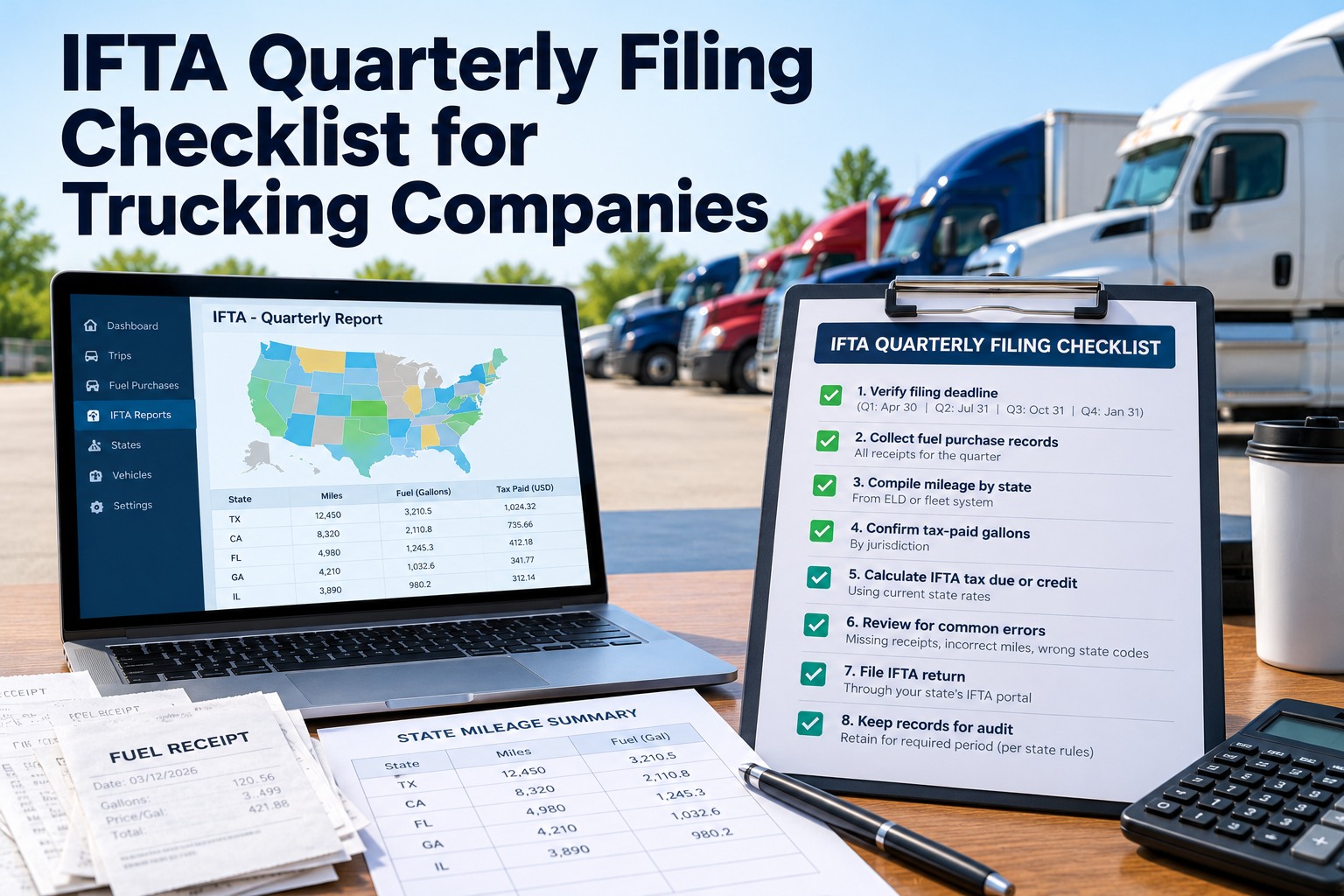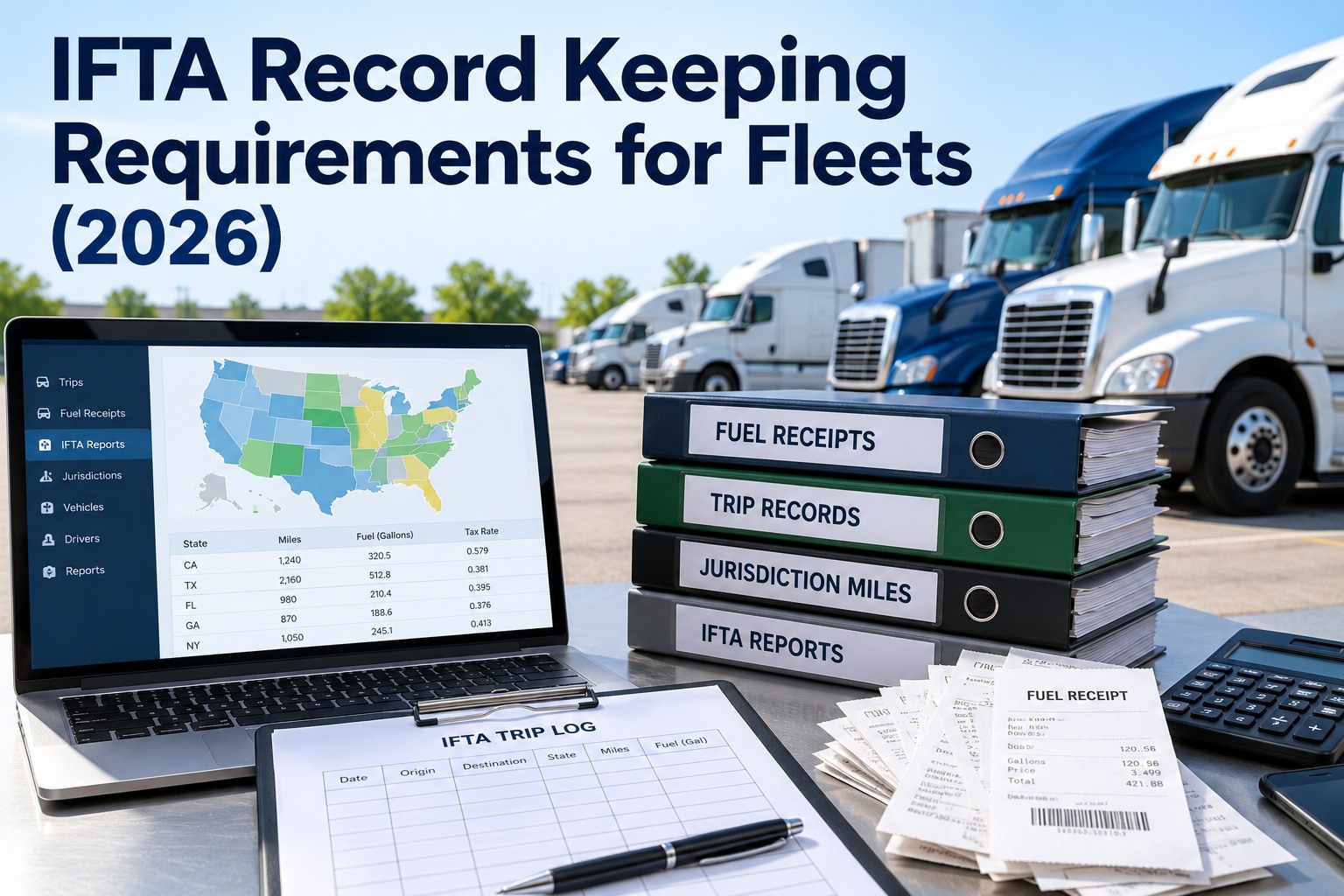
IFTA record keeping comes down to two sets of proof for every power unit: where it drove, by jurisdiction, and what fuel it bought. States set the detail, and an auditor who cannot find either one can replace your numbers with theirs. This page lists the IFTA records you must keep, how long to keep them and in what format, and how to stay audit ready all year. Schedule a call to organize your IFTA records.
The Four Kinds of IFTA Records Every Fleet Must Keep for Each Power Unit
Distance, fuel purchases, bulk fuel and monthly summaries together prove the miles and gallons on your return
The requirements below come from state IFTA audit pages in Iowa, Florida, Washington and Minnesota. They follow the same agreement, but each base jurisdiction administers its own audits, so check your own state's page before you rely on a detail.
What an IFTA Fuel Receipt Must Show, and Which Receipts Auditors Refuse
A card statement without itemized detail is not enough, and altered receipts will not be accepted
| Fuel receipt field | Why auditors look for it |
|---|---|
| Purchase date | Places the fuel in the right quarter |
| Seller name and address | Shows where tax was paid |
| Gallons or liters, and fuel type | Feeds the miles-per-gallon calculation, with a separate total for each fuel type |
| Price per unit or total sale | Supports the tax-paid credit |
| Unit number of the vehicle fueled | Ties fuel to one power unit |
| Purchaser or driver name | Shows who bought it, lessor or lessee name accepted if legally connected |
| Taxes paid | Supports the credit claimed |
Florida and Iowa both say prepaid fuel receipts do not qualify for the tax-paid credit, and Iowa says a credit card statement without itemized detail is inadequate. Florida says receipts with alterations or erasures will not be accepted. If you take fuel from your own tank, you also need delivery receipts, a quarterly reconciliation for each tank, its capacity and a record of every withdrawal, including for non-IFTA equipment.
IFTA Mileage Records by Jurisdiction: Trip Reports Compared With Electronic Tracking Data
A trip report and an electronic record prove the same miles, but they are built and accepted differently
| Distance record type | What it must show |
|---|---|
| Trip report (manual) | Start and end dates, origin and destination, routes, beginning and ending odometer, total miles, miles in each jurisdiction, unit or VIN |
| Individual vehicle mileage record | Accepted by Florida as a distance record |
| Electronic tracking | A record at least every 10 minutes while the engine runs, with date and time, latitude and longitude to 4 decimals, ECM odometer and VIN or unit number |
| Paper trip report | Electronic tracking record | |
|---|---|---|
| Created by | Driver, every day for every unit | Device or ELD, every 10 minutes while the engine runs |
| Key fields | Dates, route, odometer, miles by jurisdiction | Time, latitude and longitude, ECM odometer, VIN |
| Accepted format | Original driver-prepared record | Spreadsheet or delimited: XLS, XLSX, CSV, text |
| Not accepted | Altered or erased receipts | Static PDF, JPEG, PNG or Word for tracking data |
| Main risk | Missing miles or jurisdictions | A device that does not meet IFTA and IRP requirements |
Minnesota says its electronic tracking rules took effect January 1, 2024, and its IRP tracking records use a 15-minute interval instead. Iowa notes there is no IFTA or IRP certification for ELDs, so confirm that your device records the required fields rather than relying on a label.
How Long to Keep IFTA Records: Four Years From the Later of the Due Date or the Filing Date
Retention runs per return, so each quarter has its own four-year clock
Washington adds that driver logs and ELD records should be kept four years when they are the only source documentation, and that other agencies may require different periods. Iowa says exceptions exist in section P510 of the IFTA procedures manual.
What Happens When Your IFTA Records Do Not Hold Up: Adjusted MPG, Lost Credits and Assessments
Inadequate records let the auditor substitute estimates for your actual miles and gallons
| If records fail audit | What can happen |
|---|---|
| Mileage adjusted | Reported fleet MPG may be set to 4.00 or cut by 20 percent (Iowa) |
| Credit disallowed | Tax-paid credit for poorly documented fuel can be refused |
| Best-information audit | The base jurisdiction may audit using whatever information it has |
| Assessment | Minnesota says assessments for inadequate records may exceed $10,000 per vehicle |
| License action | License can be suspended, revoked or canceled |
A Monthly IFTA Routine That Keeps You Audit Ready Instead of Scrambling Every Quarter
Close each month's gaps while drivers still remember the trip
Minnesota lists missing distance or fuel data and tracking devices that do not meet requirements among common audit deficiencies, and recommends watching MPG for out-of-range values. A monthly review catches both while the trip is still fresh.
How FleetRabbit Keeps Vehicle Compliance Records Together for IFTA Audit Preparation
Vehicle records, inspections and work orders sit in one place, and you confirm the IFTA fields on a call
FleetRabbit stores DVIRs, inspections, work orders and compliance records per vehicle. We have not verified which IFTA fields, such as jurisdiction miles or fuel receipts, it captures or exports, so confirm that on a call before you rely on it for a return. Free for up to 3 vehicles, then $5 per vehicle per month.