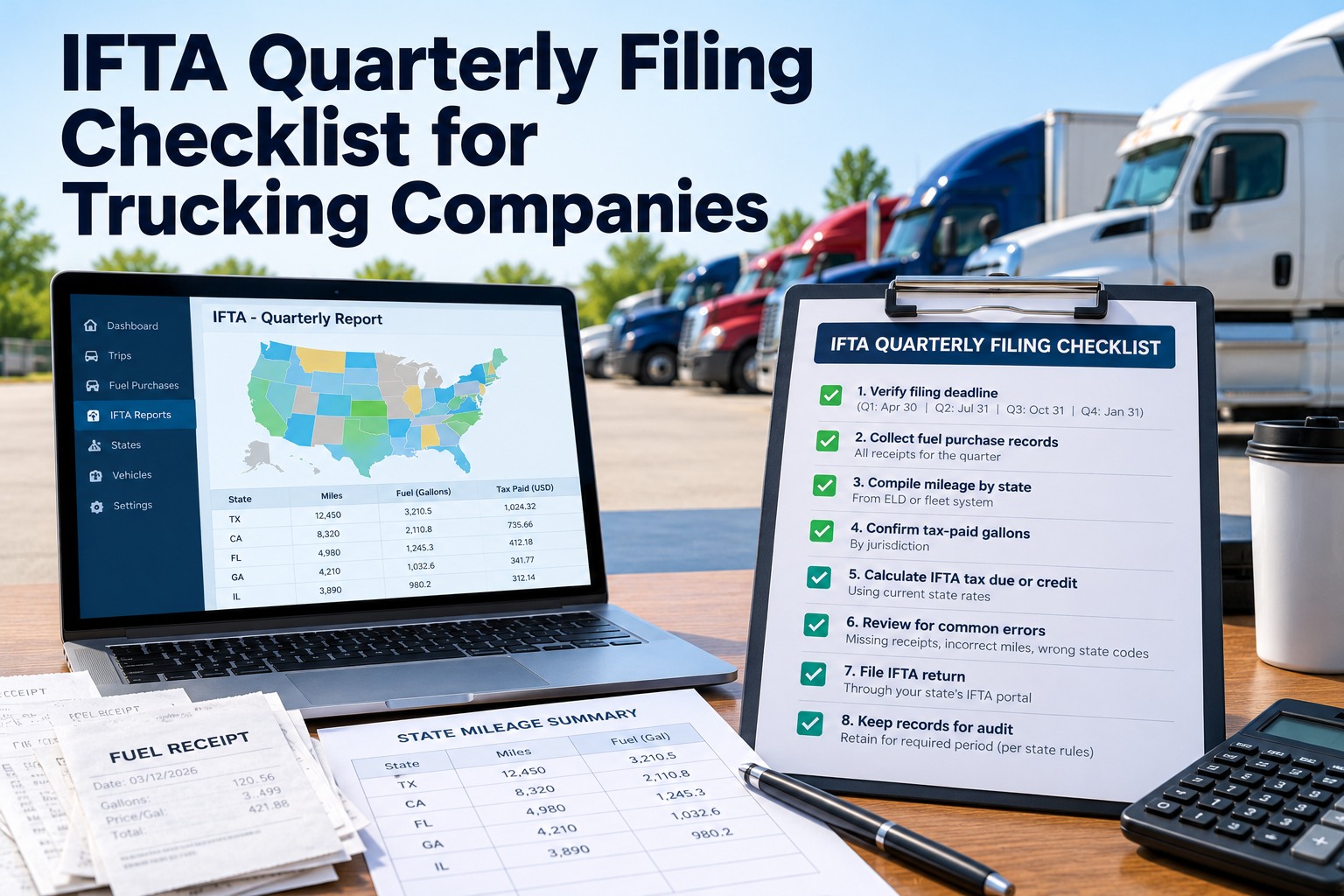
An IFTA quarterly return is simple arithmetic built on records that are easy to get wrong: miles by state, gallons by state and one fleet miles-per-gallon figure. This checklist walks through the filing steps in order, shows the calculation with an example, lists the deadlines and covers the errors that attract attention. Schedule a call to build your IFTA quarterly filing routine.
IFTA Quarterly Filing Deadlines and the Five-Step Order That Keeps Every Return On Time
Returns are due after each calendar quarter, and a weekend or holiday due date moves to the next business day
Missouri, New Jersey, Florida and South Carolina all publish the same four deadlines shown above. Florida and New Jersey say a due date that falls on a weekend or holiday moves to the next business day, and Florida judges timeliness by postmark. Your base jurisdiction runs your filing, so use its portal and form.
How to Calculate Your IFTA Return: Fleet MPG, Taxable Gallons, Tax-Paid Gallons and Net Tax
The return reduces to five calculations, and a negative result for a jurisdiction is a credit
| Step | What to do | Example (illustrative) |
|---|---|---|
| 1. Fleet MPG | Total miles divided by total gallons put in qualified vehicles, carried to 3 decimals then rounded to 2 | 12,000 miles / 2,000 gallons = 6.00 MPG |
| 2. Taxable gallons | Taxable miles in each jurisdiction divided by fleet MPG, rounded to a whole number | State A: 3,000 / 6.00 = 500. State B: 9,000 / 6.00 = 1,500 |
| 3. Tax-paid gallons | Gallons bought and taxed in each jurisdiction, from receipts dated in the quarter. They total the gallons on step 1 | State A: 450. State B: 1,550 |
| 4. Net taxable gallons | Taxable gallons minus tax-paid gallons. A negative number is a credit | State A: +50 (tax due). State B: -50 (credit) |
| 5. Tax | Net gallons times that jurisdiction's tax rate, plus any surcharge on taxable gallons | Rate comes from the IFTA rate chart for the quarter |
The steps and rounding rules come from Florida's IFTA return booklet. The numbers in the example are ours and are illustrative, not a benchmark. Fuel in bulk storage is not counted until it is pumped into a vehicle, and surcharges are never credits.
The IFTA Quarterly Filing Checklist: What to Have in Hand Before You Open the Return
Tick each item so the numbers on the return match the records behind them
IFTA Late Filing Penalties and Interest: What a Missed Quarterly Deadline Costs
The penalty is the greater of $50 or 10 percent of net tax, so small returns pay the minimum and larger ones pay more
| Item | Rule as stated by Florida and South Carolina |
|---|---|
| Penalty | Greater of $50 or 10 percent of net tax due; applies to non-filing, late filing, amended returns or underpayment (South Carolina) |
| Interest | Annual rate 2 percentage points above the IRS underpayment rate, charged monthly at one-twelfth (South Carolina) |
| Timeliness | Judged by postmark, not receipt date (Florida) |
| Weekend due date | Next business day (Florida, South Carolina, New Jersey) |
| Failure to file | State may estimate tax on best available information; license and decals can be suspended or revoked (South Carolina) |
The chart applies the stated formula to four example tax amounts and is our arithmetic, not a state schedule. Interest, rate and exact rules differ by jurisdiction, so check your base state.
Common IFTA Filing Mistakes That Draw Audit Attention, and How to Avoid Each One
Most come from estimates, gaps in trip logs and last-minute rushing, not from the arithmetic
| Common error | Why it draws attention |
|---|---|
| Filing late, or not filing | Penalty, interest and possible audit or license action |
| No return for a quarter with no activity | A return is still required, marked as no operations |
| Estimated miles or gallons | Estimates cannot replace exact records |
| Suspicious MPG | One 2017 source says 5 to 10 MPG is typical, so explain anything outside it |
| Missing personal and unloaded miles | Gaps in trip logs draw scrutiny |
| Records left for the last week | Rushing raises the chance of mistakes |
| Software that does not follow approved calculation methods | Verify, do not assume |
The list is adapted from Fleetio's 2017 article on reporting mistakes, so treat the typical-MPG range as a loose sanity check, not a rule. Minnesota's audit page separately names missing distance or fuel data and non-compliant tracking devices among common deficiencies.
How FleetRabbit Gathers the Quarter's Miles, Fuel and Odometer Records for IFTA Filing
The data collection is handled per vehicle, and you still file and pay with your base jurisdiction
FleetRabbit's IFTA page lists GPS-based miles by jurisdiction, fuel card transactions with gallons, location and price, fuel card imports, odometer readings from digital DVIRs and reports generated from the quarter's data. It says filing and paying the return, each quarter's tax rates and answering an audit stay with you. Confirm in a demo with your own trucks and fuel cards. Free for up to 3 vehicles, then $5 per vehicle per month.