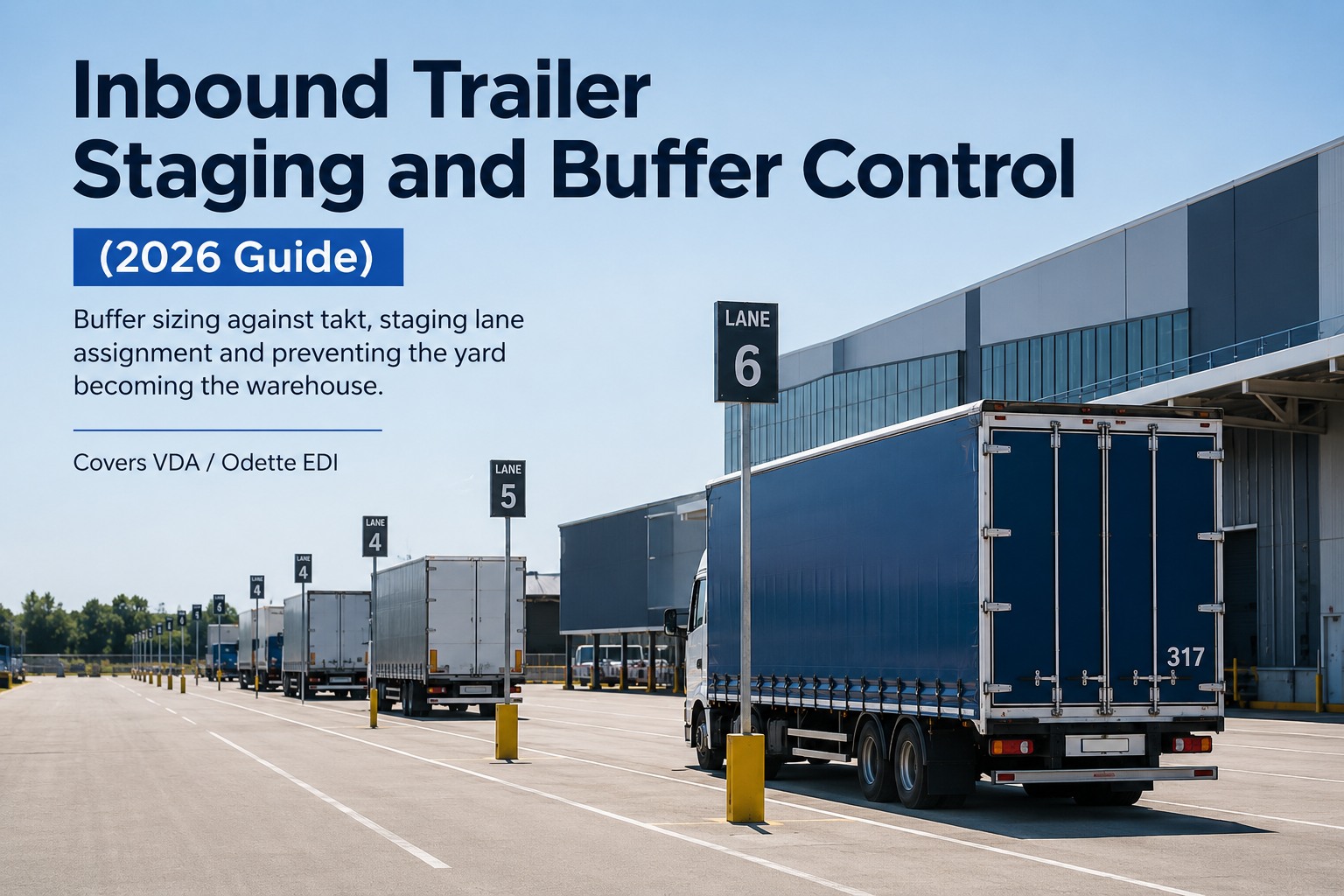
There is a specific moment when a plant yard stops being a buffer and becomes a warehouse, and almost nobody notices it happening. It is not a decision. It is a series of individually reasonable choices — one trailer held back because receiving is behind, a second because the supplier shipped early and it seemed rude to turn them away, a third because there is genuinely nowhere else for it to go. Six months later the yard holds four days of inventory nobody has counted, the shunt drivers spend most of a shift searching rather than moving, and the detention invoices have become a monthly line item that finance has stopped questioning. The distinction that prevents this is unglamorous but absolute: a buffer is sized against consumption and has a defined exit condition, while storage is sized against whatever happens to arrive and has none. This guide covers sizing staging capacity from takt, assigning lanes by purpose rather than by space, and detecting the drift before it becomes structural. Book an architecture review to size the buffer against your own consumption rate.
2026 GUIDE · FOR PLANT TEAMS
Inbound Trailer Staging and Buffer Control
Sizing staging capacity against takt rather than against available tarmac, assigning lanes by purpose, and the diagnostic that catches a yard turning into a warehouse while it is still reversible.
Buffer or Storage: The Test
Run this against your own yard before reading further. Every trailer currently on site should pass all four. The ones that fail are not buffer — they are inventory you are holding on wheels, at a cost you are probably paying to somebody else.
01
Does it have a known exit condition?A door, a window, a demand signal — something that will cause it to move. "When we get to it" is not an exit condition.
02
Is its content known without opening it?Bound to a validated despatch advice. If somebody has to break the seal to answer the question, it is not staged, it is stored.
03
Is its dwell inside the planned band?Staging dwell is measured in hours against a target. Anything sitting for days has crossed into storage regardless of intent.
04
Is it in a lane assigned to its purpose?Parked where its function dictates, not where there was room. A trailer in the wrong lane is a trailer that will be found late.
The one-line distinction
Without a management layer, yard storage is just a parking lot. With one, the same tarmac becomes a managed buffer that keeps freight moving on schedule. The physical space does not change — what changes is whether every trailer on it has a state, a content record and a reason to be there.
Sizing the Buffer Against Takt
Staging capacity is almost always sized against available space, which is the wrong input entirely. The right input is consumption. Work forward from takt, and the number of positions you actually need falls out of the arithmetic rather than out of the site plan.
1TaktSeconds per unit, from the build plan
2Consumption rateContainers per hour for this part family
3Coverage targetHours of protection required for this lane
4Trailer equivalentContainers per trailer for this commodity
=PositionsStaging slots genuinely required
Coverage differs by lane typeSequence-critical lanes are sized to the frozen window, typically one to two hours. General supply can carry substantially more without harm.
Add recovery, not comfortSize for one supplier miss, not for every possible miss. Buffering against the worst conceivable day is how yards become warehouses.
Positions are not parking spacesA position needs shunt access without moving another trailer. Spaces that require a two-move extraction are storage, whatever the plan calls them.
Recalculate on the build planA high-variant shift consumes differently from a steady one. A staging plan set once and inherited is wrong within a quarter.
The 80% rule holds here too
Above roughly 80% sustained utilisation, every shunt move takes longer because there is no slack to shuffle into, and extraction errors climb. So the honest capacity figure is not the number of positions you have — it is 80% of the number of positions you have. Sizing to physical capacity guarantees you operate above the threshold on your busiest days, which are precisely the days you needed the slack.
Lane Assignment by Purpose
A single undifferentiated yard is the root cause of most staging failure, because it forces every decision to be made ad hoc at the moment of arrival. Assign lanes by function and the decision becomes a lookup rather than a judgement call.
Sequence
Sequence-critical stagingClosest to the relevant doors, single-move extraction mandatory, sized to the frozen window. Never used as overflow, no matter how full the rest of the yard is. This is the lane that protects the line and it must be defended from every reasonable-sounding exception.
General
General inbound stagingStandard staging against a booked door slot. Multi-move extraction acceptable. Dwell target measured in hours. This is where the majority of volume sits and where dwell discipline is easiest to lose.
Hold
Early-arrival holdTrailers admitted ahead of their window because off-site holding was unavailable or the yard had genuine slack. Explicitly time-boxed. If this lane is consistently full, the problem is arrival shaping, not staging capacity.
Empty
Empty and returnables poolUnloaded trailers awaiting collection, plus returnable container reconciliation. Chronically under-planned, and the single most common source of yard congestion that has nothing to do with inbound volume at all.
Exception
Exception and quarantineMissing or unvalidated despatch advice, damage discovered at gate, quality hold. Segregated deliberately so exceptions never queue behind normal flow, and so their dwell is visible rather than absorbed into the general average.
Surge
Surge reserveHeld empty by policy. Roughly twenty per cent above average daily requirement is a reasonable starting point. The lane everyone raids first under pressure, and the one whose absence turns a bad Tuesday into trucks queuing on the public road.
If your yard has one lane type, every arrival decision is a judgement call.
An architecture review maps your consumption rates, lane geometry and extraction constraints, and produces a sized staging plan by purpose — not a parking layout.
How Yards Become Warehouses
The drift is gradual and each stage looks defensible from inside it. Find the stage you recognise — the earlier you catch it, the cheaper the reversal, and the reversal costs nothing at all at stages one and two.
Stage 1
The reasonable exceptionOne trailer held overnight because receiving ran behind. Entirely sensible. No policy changed, nothing recorded as unusual.Reversal: none needed. This is normal operation.
Stage 2
The exception becomes routineSeveral trailers held most nights. Still tracked informally. Shunt drivers begin keeping a mental list of what is where.Reversal: reinstate dwell targets and measure. Free.
Stage 3
The yard is planned aroundPlanners start assuming yard stock exists. Suppliers ship early because it is tolerated. Detention appears as a recurring monthly figure nobody challenges.Reversal: arrival shaping plus enforced hold limits. Weeks.
Stage 4
The yard is the warehouseDays of inventory on wheels, uncounted and unvalued. Shunt drivers spend more time locating than moving. Extraction routinely needs three moves.Reversal: full state model plus off-site holding. A quarter.
Stage 5
Structural dependencyThe plant cannot run without the yard stock, because build plans, supplier behaviour and receiving capacity have all adapted around it. Removing it now causes shortages.Reversal: a supply chain project, not a yard project.
The tell that separates stage 3 from stage 4 is a question, not a metric: ask a planner whether they count yard stock when checking coverage. If the answer is yes, the yard is already part of your inventory strategy whether or not anyone decided that. Everything after that point is about how much it costs to unwind.
Staging Controls Worth Enforcing
Each control below prevents a specific failure mode. Implement them as rules with owners rather than as guidance, because every one of them will be argued against at the moment it matters most. Our analytics and reporting layer is where the thresholds get monitored.
← Swipe to see all columns →
What VDA and Odette Contribute to Staging
Staging discipline depends entirely on knowing trailer contents without opening trailers, and in European automotive that knowledge arrives on a defined message set. This is why message compliance is a staging issue rather than purely an IT one — an unvalidated arrival cannot be staged correctly, only parked.
VDA 4987 despatch adviceBinds contents to the trailer before arrival, so a staging lane can be chosen on what is inside rather than on what is free. Replaced legacy VDA 4913 and derives from EDIFACT DESADV.
VDA 4937 APERAKAcknowledgement confirming the despatch advice validated. Without it, "content known" is an assumption rather than a fact, and the staging test above cannot be passed.
VDA 4915 JIT call-offTies an arriving load to a specific sequence window rather than to a delivery day — which is what allows sequence-lane assignment to be automatic instead of manual.
VDA 4902 transport labelOdette label scanned at the barrier, giving the staging assignment a verified content record in seconds rather than a keyed one in minutes.
VDA 4905 delivery scheduleForecast volume, which is the input that staging capacity should be sized against alongside takt. Sizing against last quarter's actuals lags the plan.
VDA 4945 transport statusIn-transit events allowing a staging position to be assigned before arrival, or released when a load slips. Reserved-but-empty positions are lost capacity.
Metrics That Expose Staging Problems
Six numbers. The first three are usually already available; the last three almost never are, and they are the ones that actually tell you whether staging is under control.
Staging dwell, 90th percentileAverages hide the trailers that sat for days, which are exactly the ones generating detention and blocking positions. Always read this at percentile, never at mean.
Yard utilisation against the 80% lineNot against physical capacity. Time spent above the threshold is the number that predicts shunt productivity collapse.
Empty pool as a share of positionsFrequently a quarter or more of a congested yard. Cheapest capacity you will ever recover, and it needs a carrier conversation, not a construction project.
Moves per extractionHow many trailers must be shifted to retrieve the target. Anything above one in a sequence lane is a design failure, not a bad day.
Trailers staged without validated contentThe direct measure of how much of your yard is parked rather than staged. Should trend toward zero and rarely does.
Surge lane occupancyShould be zero most of the time. Any sustained non-zero reading means reserve capacity has quietly become working capacity.
Size the Buffer Against Your Own Takt
An architecture review takes your consumption rates by part family, your yard geometry and extraction constraints, your current dwell distribution and your empty pool, and produces a sized staging plan by lane purpose. It also tells you honestly which drift stage your yard is currently at, and what reversing it costs.
Takt-based buffer sizing
Lane assignment by purpose
Drift stage assessment
VDA / Odette content binding
Frequently Asked Questions
How much staging capacity does a plant actually need?
Work it from consumption rather than from available space. Takt gives you units per hour, which converts to containers per hour by part family, which converts to trailer equivalents once you know containers per trailer. Multiply by the coverage target for that lane — one to two hours for sequence-critical, more for general supply — and you have your position count. Then treat 80% of your physical positions as the working ceiling, because above that every shunt move slows and extraction errors climb.
Is using the yard for storage always wrong?
No, but it has to be a decision rather than a drift. Yard storage used deliberately is a genuine operational buffer — capacity can be brought online during a surge without a construction project or a lease negotiation, and overflow can be routed there for controlled intake once inside capacity opens up. What makes it dangerous is doing it accidentally, because then the inventory is uncounted, the detention is unbudgeted and the sequence lanes get raided when space runs short. Decide, document, and give it its own lane.
Our yard is congested but inbound volume has not risen. Why?
Check the empty pool first. Unloaded trailers awaiting collection and unreconciled returnable containers routinely occupy a substantial share of positions in a congested yard, and they are invisible in any inbound volume figure because they are not inbound. The fix is a collection threshold and a carrier escalation, which costs nothing. Second most likely cause is arrival clustering — the same daily volume compressed into a narrower band produces the same congestion as a volume increase would.
What is single-move extraction and why does it matter so much?
It means the target trailer can be pulled without first relocating another one. In a sequence lane it is non-negotiable, because a trailer requiring two or three moves is effectively unavailable during the minutes when the sequence window needs it — and the shunt driver discovers this at the worst possible moment. Measure moves per extraction as a standing metric. Anything above one in a sequence lane is a layout or assignment design failure rather than an operational bad day.
How do we stop suppliers shipping early into our yard?
Score it and give earliness somewhere else to go. Tolerated early arrival teaches suppliers to ship when ready rather than when scheduled, and the yard absorbs the consequence invisibly. Publish tolerance bands, count early arrivals separately on the scorecard, and provide off-site holding with call-forward so early trucks wait somewhere that costs nothing rather than somewhere that consumes staging positions. The combination works; either measure alone tends not to.
Do we need trailer tracking hardware to do this?
Not to start. Lane assignment, dwell clocks, content binding at gate and extraction discipline all run on handsets and existing despatch advice data. Where existing trailer telematics or yard tractor GPS is already available, it removes manual position updates and is worth connecting. Fixed infrastructure becomes worth costing once the process is proven and you know which specific handover justifies it — instrumenting first and buying hardware second is consistently the cheaper order. Our
integrations overview covers the data surface.
Which drift stage is still cheap to reverse?
Stages one and two cost essentially nothing — reinstate dwell targets, measure, and the behaviour corrects. Stage three needs arrival shaping and enforced hold limits, so a few weeks. Stage four requires a full trailer state model and somewhere off site for earliness to go, which is a quarter of work. Stage five is no longer a yard project at all, because build plans and supplier behaviour have adapted around the yard stock and removing it causes shortages. The asymmetry is the argument for measuring dwell early rather than well.
Keep the Yard a Buffer
Staging capacity sized against takt, lanes assigned by purpose with single-move extraction where it counts, content bound at the gate, and dwell controls that catch the drift toward storage while reversing it is still free.
No yard hardware required to start · Works alongside existing EDI · Site-level configuration
August 12, 2026By Marcus Halloway
All Blogs