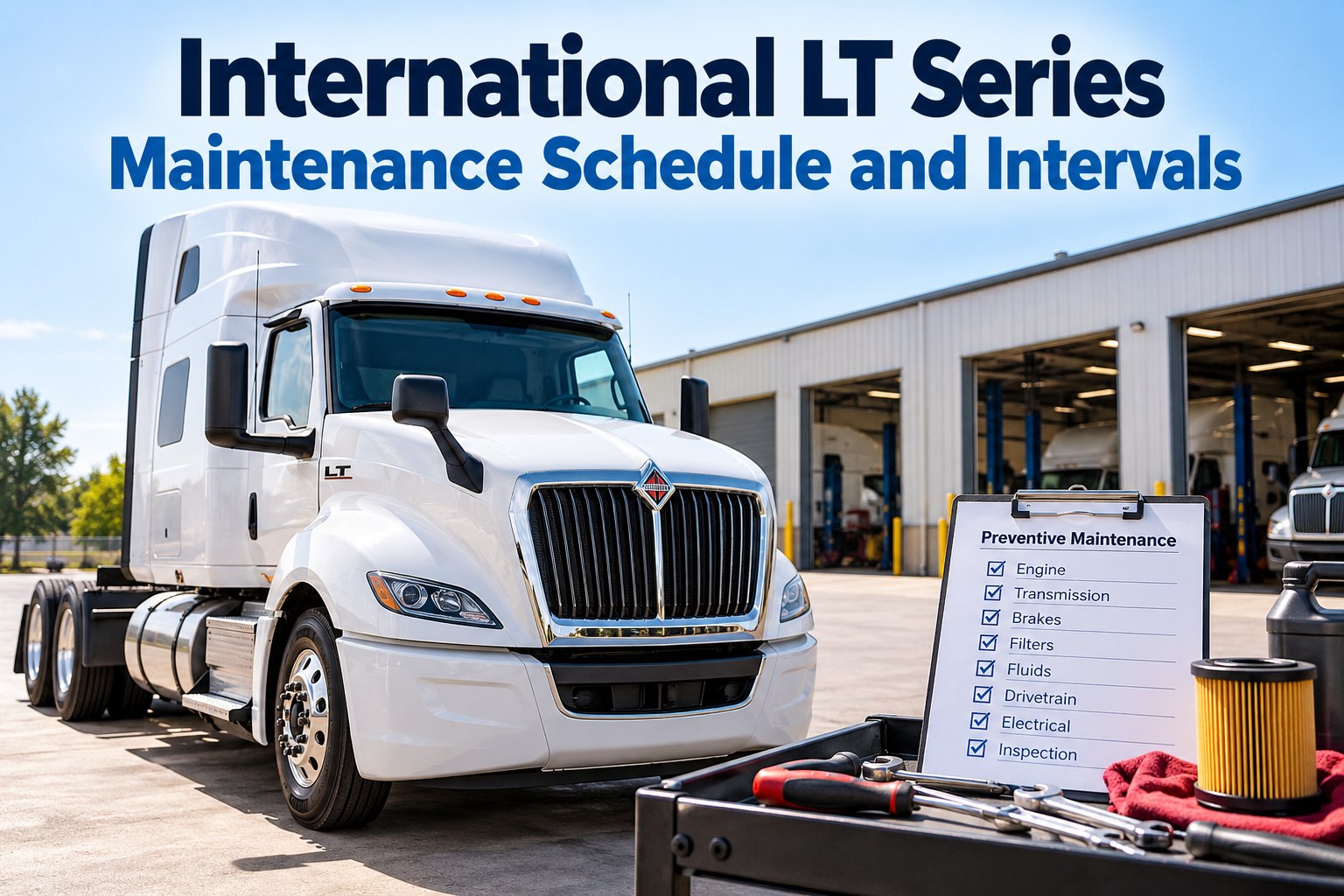
There is no single maintenance schedule for an International LT, and the reason is structural rather than awkward. The LT ships with either International's own A26 or a Cummins X15, and the two have entirely different service ladders. Cummins then defines its intervals by measured fuel economy — 25,000 miles at 3 to 4.9 mpg rising to 75,000 at 7-plus — with a footnote that drops you a tier if idle and PTO time exceeds 40%. International's headline 70,000-mile drain is quoted "with a sampling program," and its 600,000-mile DPF figure applies to fleets above 6.5 mpg. Every published number is conditional, the conditions are the actual maintenance work, and the interval your truck displays is a setting somebody configured rather than a verdict on your duty cycle. Book an LT schedule review.
Your Interval Is an Output of Your Own Data
The published LT intervals are real, and they are all conditional. Here is the actual ladder for both engine options, the footnotes that move you down it, and the handful of things you have to be measuring before you can look up anything at all.
First Question: Which Engine Is Actually in It
Everything downstream depends on this, and on a mixed-spec fleet it is the field most often wrong in the maintenance system.
International's own big-bore. Oil drain quoted “up to 70,000 miles with a sampling program.” DPF service “not required until 600,000 miles or 11,000 hours for fleets achieving more than 6.5 mpg.” Factory fill 10W-30 CK-4, with an optional FA-4 fill International credits with 0.7% better fuel economy. Warranty 24 months, unlimited mileage, unlimited hours.
A published four-tier ladder keyed to measured mpg, from 25,000 miles at the severe end to 75,000 at the light end, with 20,000 miles for vocational applications. Oil capacity 36.3 to 43.8 litres. DPF 250,000 to 800,000 miles depending on duty cycle. DEF filter 300,000 miles. Overhead adjustment and engine brake at 500,000 miles.
These are not small differences. One engine's schedule is a four-tier table keyed to fuel economy; the other's headline figure is gated on running an oil analysis programme. A single "LT maintenance schedule" entered once and applied to every unit will be wrong for one of the two groups, and probably for both.
The Cummins Ladder Is Written in Miles Per Gallon
This is the part that surprises people. The duty cycle categories are not vocations — they are fuel economy bands, and you need your own number to find your row.
Four tiers, each with a 12-month limit alongside the mileage, plus a separately stated 20,000 miles for vocational applications. The practical consequence is that two identical LTs on the same spec sheet can sit two tiers apart because one runs a flatter route. Fuel filters follow the same pattern, from 25,000 miles up to 75,000 matching the duty cycle, with an extended-life filter rated up to 100,000.
| Duty cycle | Fuel economy band | Oil drain | Time limit | What tends to sit here |
|---|---|---|---|---|
| Severe | 3 – 4.9 mpg | 25,000 mi | 12 months | Heavy-haul, steep terrain, stop-start, high-load work |
| Short haul | 5 – 5.9 mpg | 50,000 mi | 12 months | Regional running with frequent stops |
| Normal | 6 – 6.9 mpg | 60,000 mi | 12 months | The band most on-highway LTs actually land in |
| Light | 7+ mpg | 75,000 mi | 12 months | Steady long-haul at good economy |
| Vocational | Stated separately | 20,000 mi | 12 months / 500 hrs | Applies regardless of the mpg bands above |
The Footnote That Quietly Demotes You
Worth pulling out of the small print, because it is the single most commonly missed condition on the whole schedule.
Alongside the mpg table, Cummins states that idle and PTO time above 40% requires moving to the next lower interval tier. So a truck returning 6.2 mpg is not on the 60,000-mile interval if it spends more than two fifths of its engine time stationary or running a power take-off. It is on 50,000.
That condition is invisible unless someone is measuring idle share. Most fleets can produce a fuel economy figure if asked; far fewer can produce an idle percentage per unit, which means the demotion goes unnoticed and the oil stays in roughly 10,000 miles longer than the engine maker intends. The failure mode is not dramatic and that is exactly why it persists.
There is a mirror image of this worth knowing too: Cummins notes extended intervals are possible with its maintenance monitor. The direction of travel in both cases is the same — the interval responds to measured conditions rather than sitting fixed, and the fleet that measures gets the benefit in whichever direction the data points.
Most LT fleets are running one interval for two engines
If the PM interval in your system was typed in once at setup, it is almost certainly wrong for part of the fleet — wrong engine, wrong mpg band, or missing the idle condition entirely. In thirty minutes we will map your units by engine and measured duty cycle and show where the schedule and the OEM disagree.
What the A26 Headline Numbers Actually Require
The A26's figures get quoted widely and the conditions attached to them get dropped almost as often. Both halves matter.
On oil, International's product development manager put the figure as drain intervals of "up to 70,000 miles with a sampling program." That final clause is the whole thing. The extended interval is not a property of the engine you can simply adopt — it is what the engine is capable of when you are running oil analysis and acting on the results. A fleet that takes the 70,000 and skips the sampling has not adopted an OEM interval; it has adopted the number without the mechanism that justifies it.
On the diesel particulate filter, the quoted figure is that service will not be required "until 600,000 miles or 11,000 hours for fleets achieving more than 6.5 mpg" — and the same source observed this means most first owners will never touch their DPF. The 6.5 mpg qualifier is doing real work there. A fleet below it should not be planning around 600,000 miles.
There is a third item worth knowing about. Navistar's own A26 service documentation covers the change-oil service interval as a set of programmable parameters — the reminder is configured, and the document points you to the engine and vehicle maintenance manuals for the intervals themselves. So the figure the truck shows a driver is reporting a setting. If nobody has revisited that setting since the vehicle was built, it reflects an assumption about duty cycle made before the truck ever ran your routes.
For the specific intervals on your own units, the operator's manual for your engine and model year is the authority, and a dealer can confirm what the oil change reminder is currently programmed to. Everything on this page is the published framework, not a substitute for the manual that shipped with your truck.
The Two Floors Nothing Lets You Through
Whatever tier you land in, two limits apply underneath all of it.
The first is time. Every tier in the Cummins table carries a 12-month limit alongside the mileage, and it is whichever comes first. A spare unit or a seasonal truck that covers 18,000 miles in a year is still on an annual oil change. Mileage-only scheduling misses this entirely, and it tends to miss it on exactly the vehicles nobody is watching.
The second is federal. 49 CFR 396.3(a) requires every motor carrier to systematically inspect, repair and maintain all vehicles under its control. It sets no intervals of its own — what it requires is that you have a system and that you can show it ran. That is why the records matter as much as the intervals: an OEM schedule you followed but cannot evidence is, for audit purposes, uncomfortably close to one you did not follow.
What You Have to Measure Before You Can Look Anything Up
Six inputs. Without them the schedule is a number someone chose rather than the interval your engine maker specifies. Swipe the table sideways on mobile.
| Input | Why the schedule cannot be set without it |
|---|---|
| Fuel economy, per unit, over a period | It is the axis the entire Cummins interval table is built on. Without it you cannot identify your tier, so any interval you use is a guess dressed as an OEM figure. |
| Idle and PTO share of engine time | The footnote that moves you down a tier triggers at 40%. A truck can sit in the right mpg band and still not qualify for that band's interval. |
| Oil analysis results and trend | The A26's extended drain is explicitly conditional on a sampling program. The results are what the interval rests on, so they are part of the maintenance record, not a lab report in a drawer. |
| Which engine is in which unit | Two engines with different ladders, different capacities and different aftertreatment intervals. On a mixed-spec LT fleet this is the first field that has to be right. |
| The programmed oil change reminder value | Navistar's service documentation treats the A26 oil change reminder as a programmable parameter. The dash is reporting a setting, and the setting may predate your duty cycle. |
| Engine hours alongside miles | Vocational intervals and several of the long-cycle items are stated in hours as well as miles, and on low-speed work hours arrive first. |
How FleetRabbit Handles This
Four things, aimed at making the interval follow the truck rather than the other way round.
FleetRabbit holds measured fuel economy and idle share per unit, so the PM interval follows the tier the truck is actually in rather than a number someone entered at setup and nobody revisited.
A26 and X15 units carry different ladders. Recording the engine against the unit means the schedule is right per truck instead of right on average.
Sample results, dates and trend held against the vehicle, so an extended drain is backed by the programme it depends on and an adverse result pulls the interval in automatically.
Miles, engine hours and the 12-month limit tracked together, with whichever arrives first raising the work — which is how every one of these intervals is actually written.
Questions LT Operators Ask
What is the oil change interval on an International LT?
It depends which engine and what your fuel economy is. A Cummins X15 runs 25,000 miles at 3 to 4.9 mpg, 50,000 at 5 to 5.9, 60,000 at 6 to 6.9 and 75,000 at 7-plus, each capped at 12 months, with 20,000 miles for vocational applications. The A26 is quoted up to 70,000 miles with a sampling programme. Work out your tier.
Can we really get 70,000 miles between oil changes?
That figure comes with the condition "with a sampling program" attached, and the condition is the point. Extended drains are earned by running oil analysis and acting on it, not adopted by writing a bigger number into the PM schedule. Without the sampling you have no evidence the oil is still fit at 70,000. Set Up Oil Analysis Tracking.
Why would two identical LTs have different intervals?
Because the Cummins ladder is keyed to measured fuel economy, so route terrain and loading move a truck between tiers. Add the condition that idle and PTO time over 40% drops you one tier, and two trucks off the same order can legitimately sit two tiers apart. Compare your units.
When does the DPF need servicing?
On the A26 the quoted figure is 600,000 miles or 11,000 hours, for fleets achieving more than 6.5 mpg — below that economy, sooner. On the X15, Cummins publishes a range of 250,000 to 800,000 miles depending on duty cycle. Both are wide enough that your own fuel economy is what locates you in them. Track it per unit.
Does the 12-month limit really apply if we have not hit the miles?
Yes. Every tier in the published table carries 12 months alongside the mileage, on a whichever-comes-first basis. Spare units, seasonal trucks and anything that had a quiet year are the ones this catches, and they are the ones least likely to be on anyone's radar. Put both clocks on.
Is the interval shown on the dash the right one?
Treat it as a setting rather than a verdict. Navistar's A26 service documentation handles the change-oil interval as a programmable parameter, so the displayed figure reflects however it was configured — possibly at build, before the truck saw your routes. Worth confirming with your dealer what it is currently set to. Record the programmed value.
Do we still need a PM programme if we follow OEM intervals?
The intervals are the schedule; 49 CFR 396.3(a) requires a system of systematic inspection, repair and maintenance and the ability to show it ran. Following the intervals without records leaves you compliant in practice and hard to defend on paper, which is the wrong half to get right. Schedule Your LT Fleet Free.
Can we run A26 and X15 units in one system?
That is the normal case on an LT fleet and it is what makes engine a scheduling field rather than a note. Both ladders held against their own units, on one maintenance record, so the right interval raises the right work without anyone remembering which truck is which. Map your fleet.
Let the Interval Follow the Truck
FleetRabbit holds engine spec, measured fuel economy, idle share, engine hours and oil analysis against each unit, and raises the PM at whichever limit arrives first — so the schedule matches what the engine maker actually specifies for that truck, and the record is there when someone asks.
Free for 3 vehicles · no credit card required