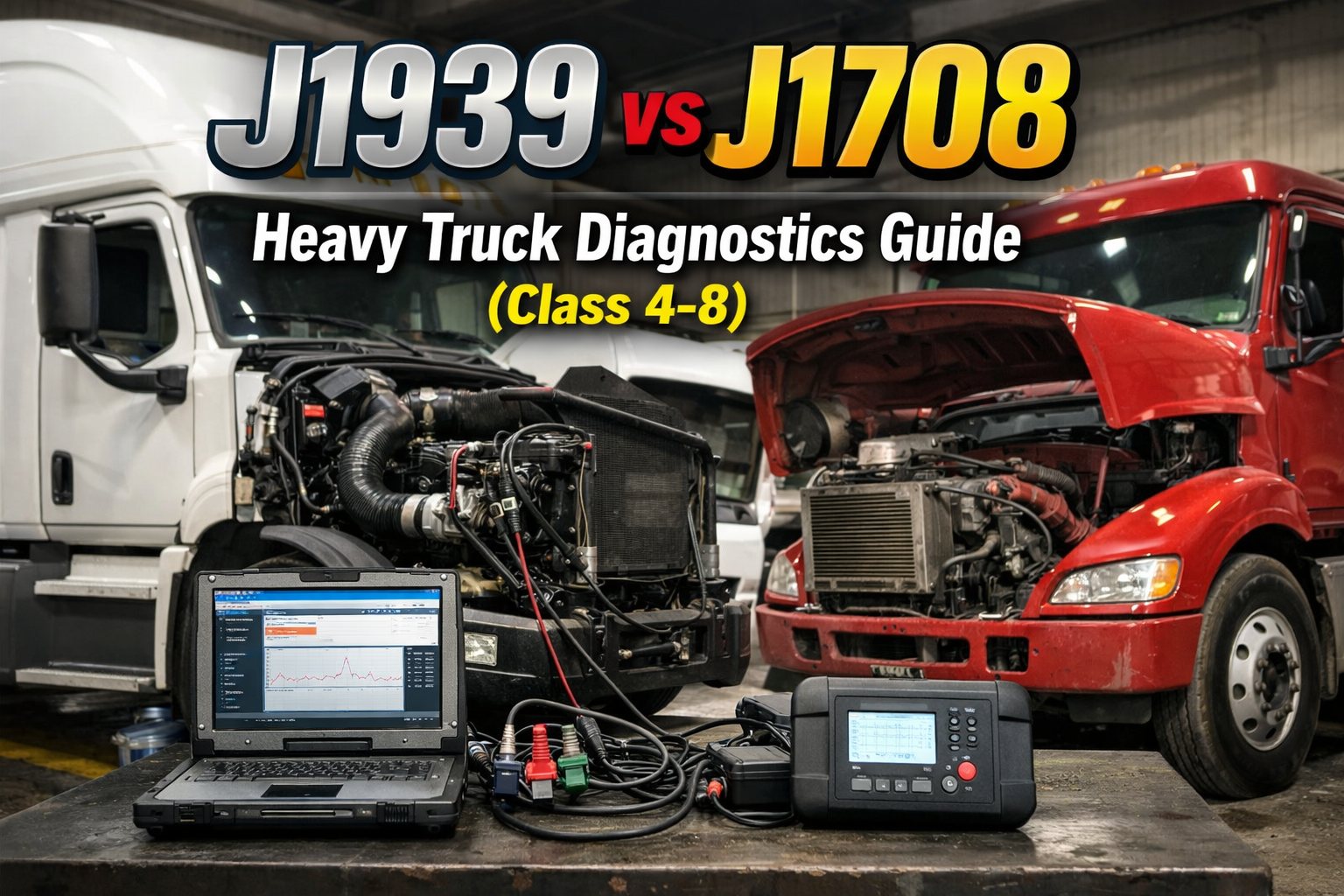
A Class 8 Freightliner running a cross-country haul generates over 2,000 data points per second from its engine, transmission, brakes, and aftertreatment systems. Somewhere in that data stream, an NOx sensor starts drifting out of specificationtriggering SPN 5246 with FMI 4. Without J1939 fleet diagnostics, that fault code sits unnoticed in the ECU until the DEF system forces a derate, stranding the driver 400 miles from home with $800/day in lost revenue accumulating. This scenario plays out across commercial fleets daily because most operations lack the infrastructure to monitor heavy-duty diagnostic protocols at scale.
Modern heavy-duty trucks communicate through specialized protocols—SAE J1939, J1708, and J1587—that differ fundamentally from the OBD-II systems in passenger vehicles. Understanding these protocols is essential for fleet managers, diesel technicians, and maintenance teams responsible for Class 4-8 vehicle uptime. This guide explains how heavy duty truck diagnostics protocols work, compares J1939 vs J1708 architectures, and demonstrates how fleet telematics platforms convert raw ECU data into actionable maintenance intelligence.
The Fleet Visibility Problem
Most fleets operating 50-300 heavy-duty trucks still rely on outdated diagnostic methods: driver reports, manual scan tool checks during weekly maintenance, and reactive repairs after breakdowns occur. This means critical J1939 fault codes often go unnoticed for days—sometimes weeks—until a derate strands a driver or a roadside failure halts operations.
| Current Practice | Fleet Impact |
|---|---|
| Missed SPN alerts | Delayed repairs → escalating damage |
| Late fault detection | Roadside breakdowns → $800+/day lost |
| Manual diagnostic scans | High technician workload → missed issues |
| No centralized data | Reactive maintenance → higher costs |
| Driver-reported issues only | 25-40% of faults never reported |
Fleet telematics platforms solve this by capturing J1939 data automatically from every truck in real time—converting raw ECU fault codes into prioritized maintenance workflows before minor issues become major failures. See how automated diagnostics work.
Why Heavy-Duty Trucks Use Different Diagnostic Protocols
Passenger vehicles manufactured since 1996 use OBD-II—a standardized protocol focused primarily on emissions compliance. Heavy-duty commercial vehicles require something more robust. Class 4-8 trucks operate multiple interconnected electronic control units (ECUs) managing engines, transmissions, brakes, aftertreatment systems, and body controllers simultaneously.
The Society of Automotive Engineers (SAE) developed specialized protocols to address these requirements. The result is a family of standards—J1939, J1708, and J1587—that provide the foundation for modern commercial vehicle ECU diagnostics and fleet telematics integration. Start monitoring your fleet free.
The Three Heavy-Duty Diagnostic Protocols Explained
Understanding the relationship between J1939, J1708, and J1587 is essential for anyone working with heavy duty truck ECU diagnostics. These protocols evolved over three decades, with J1939 now dominant but older systems still present in legacy equipment.
SAE J1708
Physical Layer
Defines the hardware wiring, electrical specifications, and basic data transmission rules. Built on RS-485 serial communication at 9.6 kbps. Introduced in the late 1980s and widely adopted through the 1990s.
SAE J1587
Application Layer
Defines the message format, parameter identification (PIDs/SIDs), and fault codes transmitted over J1708. Works in tandem with J1708—J1708 provides the "road" while J1587 defines the "language."
SAE J1939
Complete Protocol Stack
Modern CAN-based protocol covering physical layer through application layer. Replaced J1708/J1587 starting in the mid-2000s. Now the industry standard for all new heavy-duty vehicles worldwide.
J1939 vs J1708: Technical Comparison
The transition from J1708 truck protocol to J1939 represented a generational leap in heavy-duty vehicle networking. Understanding the technical differences helps fleet managers assess compatibility requirements and telematics integration options. Schedule a demo to see how FleetRabbit supports both protocols.
| Specification | SAE J1708/J1587 | SAE J1939 |
|---|---|---|
| Physical Layer | RS-485 serial | CAN 2.0B (ISO 11898) |
| Data Rate | 9.6 kbps | 250 kbps (500 kbps newer) |
| Message Size | 21 bytes maximum | 8 bytes (1785+ via Transport Protocol) |
| Fault Code Format | MID + PID/SID + FMI | SA + SPN + FMI |
| Connector | 6-pin Deutsch | 9-pin Deutsch (Type 1/2) |
| Adoption Period | 1990s–early 2000s | Mid-2000s–present |
The 26x speed improvement (9.6 kbps → 250 kbps) enabled modern trucks to support sophisticated systems like selective catalytic reduction (SCR), diesel particulate filters (DPF), and advanced driver assistance systems (ADAS).
Monitor J1939 Data Across Your Fleet
See how FleetRabbit captures heavy-duty diagnostic data and converts fault codes into automated maintenance workflows.
Understanding J1939 Fault Codes: SPN, FMI, and SA
J1939 diagnostic trouble codes (DTCs) use a three-part structure that provides significantly more detail than OBD-II's generic P-codes. Understanding this structure is essential for interpreting diesel truck diagnostic protocol data. Try fleet-wide CAN bus monitoring free.
Interpretation:
- SA 0: Fault originates from Engine Control Module (ECM)
- SPN 5246: Aftertreatment 1 Inlet NOx Sensor
- FMI 4: Voltage below normal (short to ground)
Diagnosis: The NOx sensor at the SCR inlet is reporting low voltage. Check wiring harness for damage, inspect connector for corrosion, verify sensor power supply.
Fleet Impact: If unaddressed, this fault will trigger DEF derate within 4-8 hours of operation. See how real-time alerts prevent derates.
How Fleet Telematics Platforms Use J1939 Data
Raw J1939 data is valuable only when captured, transmitted, and analyzed systematically. Modern fleet telematics diagnostics platforms connect directly to the vehicle's J1939 network, capturing thousands of parameters per second and converting them into actionable fleet intelligence. Start capturing J1939 data free.
ECU Detects Fault
Engine ECM detects NOx sensor voltage below threshold. Generates DTC.
J1939 Broadcast
ECU broadcasts DM1 message to J1939 network.
Telematics Captures
Device reads fault code with GPS location and timestamp.
Cloud Transmission
Data transmits via cellular to fleet platform.
Work Order Created
Platform generates maintenance work order automatically.
Repair Complete
Technician resolves issue, system verifies fix.
FleetRabbit: Heavy-Duty Telematics Integration
FleetRabbit integrates with leading J1939-compatible telematics devices to provide comprehensive fleet maintenance management for heavy-duty operations. The platform captures fault codes, parameter data, and vehicle health metrics from Class 4-8 trucks, converting raw J1939 data into automated maintenance workflows.
FleetRabbit Heavy-Duty Capabilities
- J1939 & J1708 support: Compatible with both modern and legacy diagnostic protocols
- Real-time fault monitoring: DTC alerts transmitted within seconds of occurrence
- SPN/FMI translation: Human-readable fault descriptions with repair guidance
- Automated work orders: Critical faults generate maintenance requests automatically
- Fleet health dashboards: Vehicle-by-vehicle diagnostic status at a glance
- Integration flexibility: Works with Geotab, Samsara, Teltonika, and 20+ providers
ROI Calculator: What Could J1939 Diagnostics Save Your Fleet?
Here's what a typical 25-vehicle fleet can expect from automated diagnostic monitoring.
Annual Savings Estimate: 25-Vehicle Fleet
Manual Diagnostics vs Fleet Telematics
Understanding the difference between traditional scan tools and modern telematics-based diagnostics helps fleet managers evaluate the right approach for their operation.
| Capability | Manual Scan Tools | Fleet Telematics |
|---|---|---|
| Fault detection | Driver reports + scheduled scans | Automatic, real-time |
| Vehicle coverage | One truck at a time | Entire fleet simultaneously |
| Diagnostics visibility | Limited to shop visits | 24/7 remote monitoring |
| Maintenance workflow | Manual work order creation | Automated work orders |
| Downtime prevention | Reactive repairs | Predictive maintenance |
Fleet-wide visibility requires telematics integration that captures J1939 data continuously across all vehicles. Start free with 3 assets to experience the difference.
Frequently Asked Questions
What's the difference between J1939 and J1708?
J1708 is a legacy serial protocol (RS-485) running at 9.6 kbps with 21-byte message limits, used in heavy trucks from the 1990s to early 2000s. J1939 is the modern CAN-based protocol running at 250-500 kbps with sophisticated network management, now standard in all new Class 4-8 vehicles. J1939 is approximately 26x faster and supports far more data parameters.
Can I use an OBD-II scanner on a heavy-duty truck?
No. Heavy-duty trucks use different connectors (9-pin Deutsch instead of 16-pin OBD-II) and different protocols (J1939/J1708 instead of OBD-II). You need a scanner specifically designed for heavy-duty diagnostics. Entry-level options start around $150-300; professional tools range from $1,500-$5,000+.
What do SPN and FMI mean in truck fault codes?
SPN (Suspect Parameter Number) identifies WHAT component has a problem—there are over 10,000 standardized SPNs covering everything from turbo speed to DEF tank level. FMI (Failure Mode Identifier) describes HOW the component failed—32 standard failure modes like "voltage above normal" or "mechanical failure." Together, SPN+FMI provide precise diagnostic information.
Can one system monitor both J1708 and J1939 trucks?
Yes. Quality telematics devices and fleet management platforms support both J1708 and J1939 protocols. FleetRabbit integrates with telematics providers offering dual-protocol support, allowing you to monitor your entire mixed fleet from a single dashboard regardless of vehicle age.
How quickly do J1939 fault codes transmit to fleet software?
With cellular-connected telematics, fault codes typically appear in your fleet dashboard within seconds of triggering. This near-real-time visibility enables maintenance teams to respond before minor faults escalate—especially critical for aftertreatment issues that can trigger derates within hours.
See How FleetRabbit Integrates Heavy-Duty Truck Diagnostics
Transform J1939 fleet diagnostics into automated maintenance workflows. Monitor fault codes in real time, generate work orders automatically, and reduce downtime across your heavy-duty fleet.