A frozen window is not a planning convenience. It is a promise made simultaneously to a dozen suppliers whose lead times differ by hours, and its length is not yours to choose freely — it has to be aligned with the JIS supplier having the longest delivery time, because that supplier starts buying and producing first. Everyone else with shorter lead times begins later to avoid holding stock, which means your single published sequence is actually running as several sub-sequences of different lengths, side by side, each accumulating its own drift between the planned and the real. That structure is where sequence breaks come from. They are rarely a supplier failing outright; far more often they are a distortion inside one sub-sequence that nobody could see because the only signal anyone monitors is the arrival itself. This covers how to size the window honestly, where breaks actually originate, what predicts them, and what each recovery option costs before you are forced to choose one under pressure. Book an architecture review to map the signals against your own supplier set.
ENTERPRISE GUIDE · JIS RELIABILITY
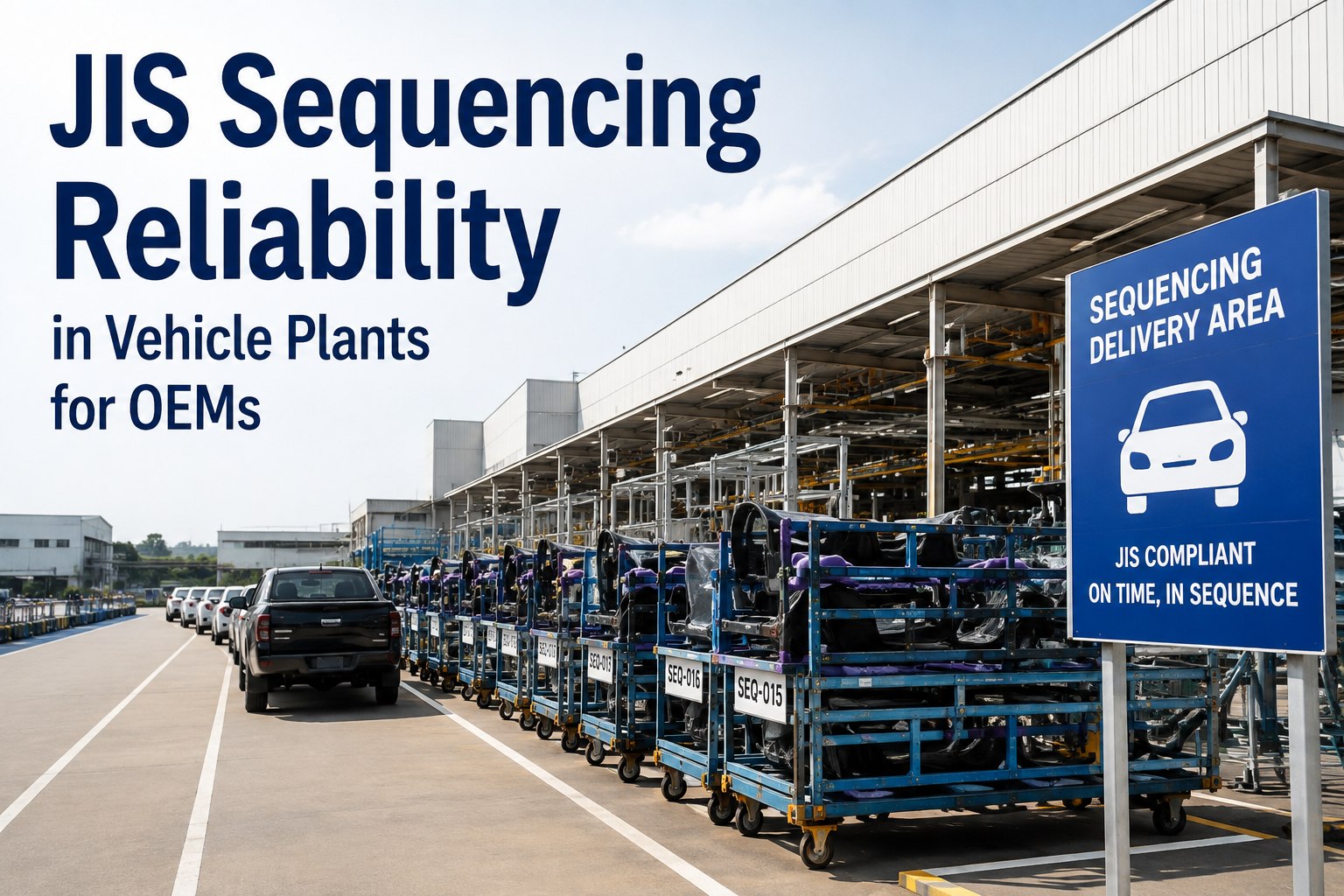
Sequencing Reliability in Vehicle Plants
Sizing the frozen window against your longest-lead supplier, finding where breaks actually originate, reading the signals that predict one, and knowing what each recovery costs before the station is starving.
Station consumption order
01matched
02matched
03matched
04break
05blocked
06blocked
One break at position four does not cost one position. Everything behind it is blocked, because the station consumes the next arriving unit and cannot choose.
The Sequence Contract
Three properties have to hold simultaneously. Lose any one and the other two stop being worth anything — a perfectly ordered delivery of unlabelled parts is as useless as a labelled delivery in the wrong order.
i
Sequence identityEvery item uniquely labelled and traceable to a specific build position. Without identity, verification is impossible and any break becomes a manual reconciliation.
ii
Sequence integrityItems arrive in order — which in practice means loaded last-in-first-out, so unloading naturally reproduces the consumption order rather than requiring a sort at the dock.
iii
Sequence confirmationThe station verifies the expected identity before install. This is the property most often skipped, and skipping it converts every mis-sequence into a quiet one discovered later.
Why JIS is unforgiving by design
JIS removes choice at the point of fit. That is the entire benefit — no searching, no picking error, no line-side inventory of variants — and it is also why a break cascades into stops, overtime and rework rather than into a minor delay. A JIT miss means a part is late. A JIS miss means the station cannot proceed even though parts are physically present.
Sizing the Frozen Window
The window cannot be shorter than your slowest sequenced supplier needs, and lengthening it to suit them freezes the plan for everyone. This is the trade-off, drawn honestly.
Sequenced supplier lead times against one published window
Seats — on-site sequencing cellShortest
Bumpers — local Tier 1Short
Cockpit — regional Tier 1Medium
Wiring harness — distant supplierLong
Exhaust — longest-lead sequenced partGoverns
The frozen period has to align with the longest of these, because that supplier is first to commit. Everyone shorter starts later to avoid holding stock — which means several sub-sequences of different lengths run synchronously against one published order, and each can drift internally without the others showing anything. Monitor the sub-sequences, not just the aggregate.
Most sequence programmes monitor arrivals. The drift happens well before arrival.
An architecture review maps your sequenced supplier set by lead time, identifies where each sub-sequence is currently invisible, and shows which signals are available before the trailer is anywhere near your gate.
Where Breaks Originate
Six origins, each with a different mechanism and — importantly — a different earliest point at which it could have been seen. The last column is where reliability work actually lives.
Upstream in-line sequencing
Body or paint reshuffle changes the build order after the sequence was published. Internal, and frequently not communicated outward with the urgency it deserves.
Earliest signalDivergence between published order and current in-line order
Late plan change
A last-minute production order change disrupts the system's logic and forces resequencing. The most self-inflicted category on this list.
Earliest signalAny amendment landing inside the frozen window at all
Supplier build drift
The supplier produces in a different order for their own efficiency and intends to restore sequence before shipping. Restoration is where it fails.
Earliest signalSupplier despatch order compared against called-off order
Loading and pick error
Correct parts, wrong load order — usually a non-LIFO load, or a pick that pulled the right part number from the wrong tote.
Earliest signalScan sequence at pack, before the trailer doors close
Transport disruption
Congestion or a missed window. The buffer that would have absorbed it sits with the supplier, not at your line, so a transport problem becomes a station problem directly.
Earliest signalIn-transit ETA variance against the sub-sequence it feeds
Data and variant errors
Sloppy colour codes, label variants or component alternates. Sequencing goes wrong not because anyone mis-picked but because two things that should be distinct were not.
Earliest signalVariant master reconciliation, ideally before the model year starts
The Signals That Predict a Break
Ordered by how much recovery time each one buys. A watchlist wired to these turns most breaks into expedites, and most expedites into non-events.
← Swipe to see all columns →
Note where the cheap detection sits: the pack-station scan and the kit verification are both scan-enforced checks, and both prevent quiet mis-sequences rather than discovering them. Directed picking that will not let an operator pull the wrong tote belongs in the same family — it removes the error rather than detecting it, which is always cheaper.
What Recovery Costs, in Order
When a break happens, these are the options. They are listed cheapest first, and the practical value of a prediction is simply that it keeps you higher up this staircase.
1
Absorb in the bufferCoverage holds, the late unit lands inside its window. No cost beyond the alert.
2
Re-point the kitPull the required variant from another staged load or an on-site source. Minutes of planning, no line effect.
3
Manual sort at the cellRestore order by hand before the container reaches the station. Labour cost, and it must be recorded as a miss rather than counted as adherence.
4
Hold the positionLet the unit pass and reinsert later. Cheap on the line, expensive downstream — every held unit carries rework, retest or a follow-up operation.
Resequence the planReorder client production orders around the missing components. Effective, but it invalidates every other supplier's sub-sequence simultaneously and propagates work upstream.
5
Stop the lineThe station starves and everything behind it in weld, paint and final backs up. The option every other line on this staircase exists to avoid.
6
Resequencing is not free recovery
It is tempting to treat plan resequencing as the clean answer, because it avoids a visible stop. But an altered sequence can perform worse at the assembly line in terms of utility work, and it forces every sequenced supplier to reconcile against a changed order — so a fix applied to one missing component distributes cost across the whole supply base. Use it deliberately, cost it honestly, and count it as a break.
Preconditions Worth Auditing
Sequencing reliability programmes usually fail on one of these rather than on technology. Audit them before investing in detection — a reliable break-prediction system on an unstable plan just tells you faster.
1JIT competency first. JIS processes are typically implemented only after a high degree of competency on JIT — a plant that cannot deliver on time reliably will not deliver in order reliably.
2A stable, levelled build plan. JIS requires a fixed assembly sequence over a defined period; last-minute order changes disrupt the logic and force resequencing.
3Clean variant master data. Colour codes, label variants and component alternates all distinct, because ambiguity here produces breaks nobody mis-picked.
4LIFO loading discipline, so unloading reproduces the consumption order without a sort at your dock.
5Scan-enforced verification at pack and at the station. Both ends, not one — a check at only one end finds half the breaks and creates confidence in the wrong half.
6Real-time transmission of the sequence to suppliers and internal cells through connected systems rather than a file someone remembers to send.
7Acknowledgement that buffers moved rather than disappeared — they sit with the supplier now, so supplier disruption reaches your station directly.
8A defined sequencing point per part family, so everyone agrees where variants enter the order final assembly requires.
The Message Layer
Sequence reliability is carried on messages before it is carried on trucks. These are the exchanges that have to work, and the failure mode when each one does not. Our integrations overview covers the wider data surface.
Sequenced call-offThe ordered list by VIN or serial, published to each sequenced supplier. Transmitted through connected systems in real time — if this arrives as a periodic file, your frozen window is effectively shorter than you think.
Call-off acknowledgementConfirmation that the supplier received and is building to that order. Without it you do not know whether a supplier is working from the current sequence or the previous one.
Despatch advice with sequence detailWhat is on the trailer and in what order. Comparing this against the call-off is the last chance to detect a break before transit.
Sequenced transport labelScannable identity per unit tying it to a build position. This is what makes station-side confirmation possible at all.
Transport statusIn-transit events mapped to the sub-sequence a load feeds, so a delay is expressed as sequence exposure rather than as a late truck.
Consumption confirmationStation-side scan closing the loop. Also the only honest source for a sequence adherence figure, since everything upstream reports intent.
Map the Sub-Sequences You Cannot Currently See
An architecture review takes your sequenced supplier set, their lead times, your frozen window and your existing message flows, and identifies which sub-sequences are running unmonitored, which predictive signals are already available in data you hold, and where scan-enforced verification would remove breaks rather than detect them.
Window sizing by lead time
Sub-sequence monitoring
Predictive signal watchlist
Scan verification design
Frequently Asked Questions
How long should the frozen window be?
Long enough for your longest-lead sequenced supplier, because that supplier is first to start buying and producing against the published order. Suppliers with shorter lead times begin later specifically to avoid holding stock, which is why one window produces several sub-sequences of differing length running in parallel. Shortening the window below the longest lead time does not make the plant more agile — it makes one supplier work from a forecast while everyone believes they are working from a commitment.
What is the difference between JIS and in-line sequencing?
JIS is the supplier delivering parts in sequence to the OEM — a supply chain process, external. In-line sequencing is the OEM's internal process of maintaining the vehicle build order through body shop, paint shop and final assembly — a production control process. Both are sequence disciplines and they interact constantly, which is exactly why the divergence between your current in-line order and the order you published to suppliers is one of the highest-value signals available. Sites that treat them as separate domains find breaks late.
Does JIS eliminate buffers?
No, and assuming it does is a common misinterpretation. Buffers are displaced upward in the material flow to the component suppliers rather than removed — the cost of buffer inventory is reallocated, and the line-side buffer shrinks because similar components are consolidated into distributed, sequenced buffers partly sitting on the transport path. The practical consequence is that supplier disruption or transport congestion now reaches your station directly, with nothing local to absorb it. That is the trade you accepted.
Where should verification scans sit?
Both at pack and at the station. The pack scan catches load-order errors while the fix still costs nothing — before the trailer doors close — and the station scan confirms the expected identity before install, which is what stops a mis-sequence being discovered by an operator holding the wrong part. Directed picking that prevents an operator pulling the wrong tote belongs alongside them, because prevention beats detection every time. A check at only one end finds half the breaks and builds confidence in the wrong half.
Should we resequence the plan when a component is missing?
Sometimes, but cost it before you reach for it. Reordering client production orders around missing or defective JIS components is a legitimate technique and avoids a visible stop, but an altered sequence can perform worse at the assembly line in utility-work terms, and it forces every other sequenced supplier to reconcile against a changed order. So a fix aimed at one component distributes cost across the supply base. Treat it as rung five of six, not as a free option, and always record it as a break.
Why do breaks happen when every supplier reports on-time delivery?
Because on-time is a JIT measure and sequence is a different property. A supplier can deliver the correct quantity within the window and still have produced in a different order for their own efficiency, intending to restore the OEM sequence before shipping — restoration is a real technique and it is also where it fails quietly. Comparing despatch order against called-off order, rather than just arrival time against window, is what exposes this. Most scorecards do not, which is why the two numbers disagree.
What should we fix first?
Amendment volume inside the frozen window, if you have any. It is the cheapest thing on the list because it costs nothing but discipline, it is entirely within your control, and it removes a whole class of breaks rather than detecting them. After that, scan verification at pack and station, then sub-sequence monitoring for your longest-lead suppliers. Detection technology applied to an unstable plan simply produces earlier notice of self-inflicted problems. Our
analytics and reporting layer is where the watchlist lives.
Predict the Break, Not the Stop
A frozen window sized against the supplier who commits first, sub-sequences monitored individually rather than in aggregate, scan-enforced verification at both ends, and a recovery staircase you climb deliberately instead of falling down.
Works alongside existing EDI and MES · No line changes required · Site-level configuration