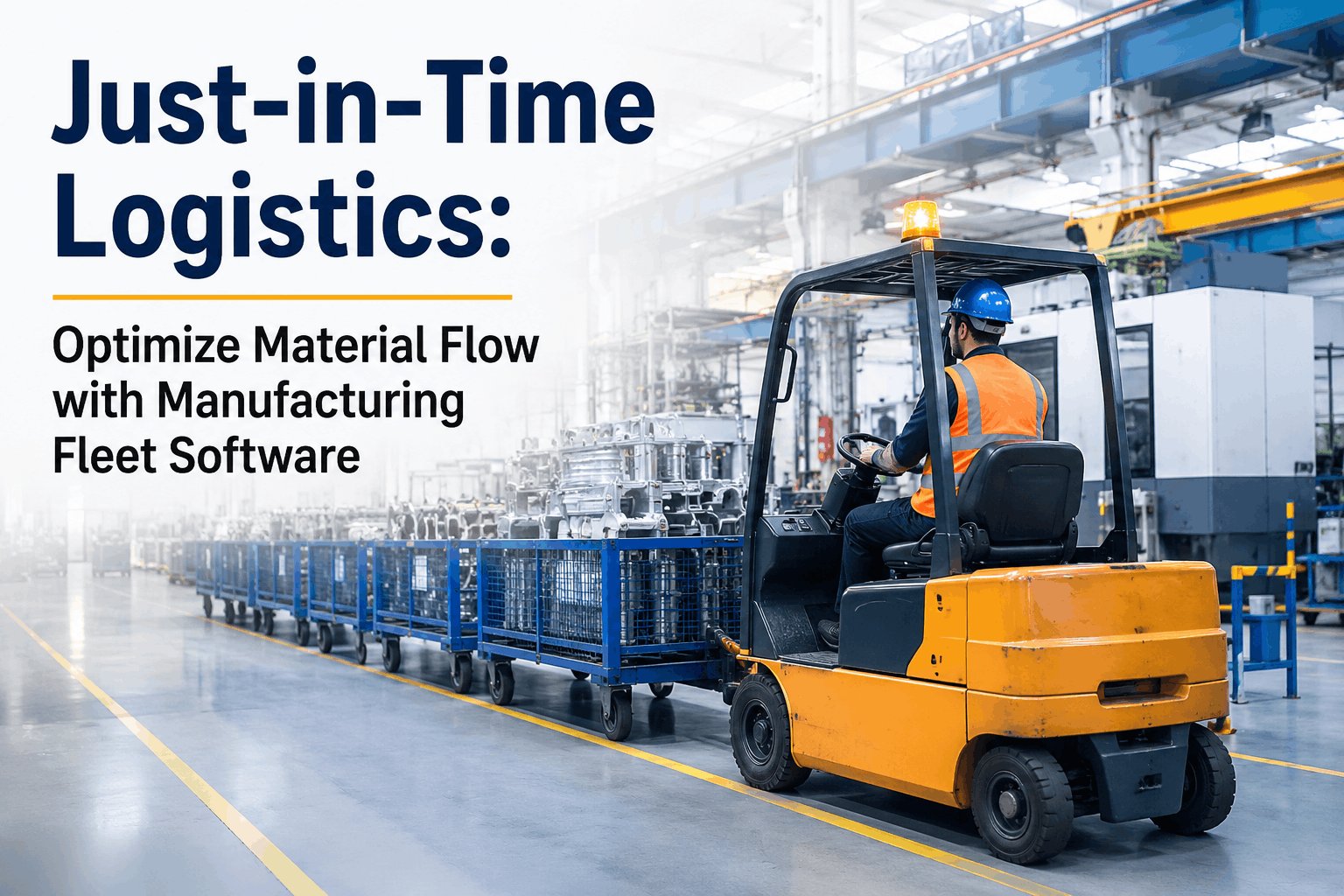
Just-in-time manufacturing is one of the most demanding logistics environments that exists. Every component, subassembly, and raw material must arrive at the exact production cell at the exact moment it is needed — not hours early consuming floor space and creating inventory exposure, and not minutes late triggering a line stoppage that costs $10,000 to $50,000 per hour in lost output. The gap between a JIT system that works and one that fails is almost always a fleet management problem: the delivery vehicles, forklifts, and inter-facility shuttles that carry materials to the production line are operating on dispatch logic that has not kept pace with the precision that modern JIT manufacturing demands. Dynamic dispatch, real-time tracking, and route optimization are not productivity improvements in a JIT context — they are the operational infrastructure that makes the entire production model viable.
Just-in-Time Logistics: Optimize Material Flow with Manufacturing Fleet Software
Why JIT Logistics Fails Without Real-Time Fleet Visibility
Traditional manufacturing fleet dispatch operates on static assignments: a driver or forklift operator receives a route or task list at the start of the shift and executes it in sequence. This model works adequately when production demand is predictable, traffic conditions are stable, and no disruptions occur between shift start and shift end. In a JIT environment, all three of those assumptions break down routinely. Production demand changes intra-shift based on customer order fluctuations, quality holds, or equipment status changes. A dock blockage creates a cascade of delivery delays. An inter-facility shuttle runs behind schedule, and the components waiting at the receiving area back up the entire supermarket replenishment system feeding three production lines simultaneously.
The dispatch manager working from a whiteboard and radio cannot simultaneously track which vehicles are idle, which docks are available, which runs are overdue, and which production cells are approaching a shortage condition. The result is a system that depends on individual knowledge and supervisor experience rather than real-time data — and when that supervisor goes on break, or leaves the shift, the awareness they carried goes with them. Real-time fleet visibility closes this dependency gap entirely: every vehicle's position, status, and task queue is visible on a live dashboard, and the dispatch logic that assigns new tasks runs continuously rather than reactively. Sign up with FleetRabbit to replace manual JIT dispatch coordination with a real-time fleet intelligence platform built for manufacturing logistics.
When a production line's material requirement changes mid-shift — a quality hold, an unplanned changeover, a rate increase — a static dispatch list cannot adapt. Materials go to where they were planned to go, not where they are now needed.
A single blocked dock or overdue inter-facility run creates a queue that backs up three or four subsequent deliveries. Without real-time dock status visible to dispatch, drivers queue at the door while other docks stand empty.
Vehicles traveling between tasks without optimized routing accumulate empty miles that deliver zero production value. In plants without route optimization, operators take the same paths regardless of congestion or shorter alternatives — wasting 15 to 28% of available travel capacity per shift.
When a production planner cannot see the real-time ETA of an inbound material delivery, they cannot intervene before a shortage condition develops. By the time the line actually stops, the intervention window has already closed.
Dynamic Dispatch: Replacing Institutional Knowledge With Real-Time Intelligence
Dynamic dispatch systems automatically assign tasks to the nearest qualified available asset in real time — without requiring a dispatcher to manually match vehicle to task based on incomplete information. When a task is created — whether from a production line trigger, a WMS work order, or a supervisor request — the system identifies the nearest qualified available asset and pushes the task directly to the operator's mobile device. Assignment logic considers asset type, operator certification, current task queue depth, and zone proximity — not just raw distance. Operators receive task details with navigation on their device, eliminating radio dependency and the coordination overhead that accumulates to hours of delay per day.
The financial case for dynamic dispatch is well-documented. Enterprises deploying automated dispatch systems have achieved up to 20% logistics cost reduction, 90% fleet utilization improvement, and 66% faster planning cycles. Across 1.5 billion deliveries optimized with Locus's platform globally, the documented outcomes include 99.5% on-time SLA performance. For JIT manufacturing operations, where a 15-minute delivery delay can translate to a line stoppage costing tens of thousands of dollars, those performance levels are not a benchmark to aspire to — they are the minimum threshold the production model requires. Book a FleetRabbit demo to see dynamic dispatch applied to your specific plant layout and production delivery requirements.
Production trigger, WMS work order, or supervisor request generates a task in the platform
Algorithm identifies nearest qualified available vehicle considering type, certification, zone, and queue depth
Optimized route pushed to operator's mobile device with real-time dock availability and aisle status
Zone boundary crossing auto-executes downstream actions: dock prep, delivery confirmation, next-task assignment
Live view of every asset, every task, every ETA — exceptions flagged automatically before they become delays
FleetRabbit's dynamic dispatch engine assigns tasks in real time, optimizes routes continuously, and pushes geofence-triggered actions to operators — eliminating the coordination overhead that stalls JIT material flow.
Route Optimization in a Manufacturing Context
Route optimization in manufacturing logistics is fundamentally different from route optimization in commercial delivery. In commercial last-mile delivery, the routing challenge is sequencing external stops across a road network with variable traffic. In a manufacturing plant, the challenge is optimizing paths within a defined facility footprint where dock occupancy, aisle blockages, task queue density, and floor congestion patterns change continuously throughout the shift. The routing engine must recalculate continuously based on live facility status — not a static sequence generated at the start of the shift.
FleetRabbit's routing engine continuously recalculates optimal paths within the plant and between facilities based on live data: dock occupancy status, aisle blockage flags from operator reports, task queue clustering that enables multi-stop efficiency on a single forklift trip, and historical travel time data by zone and shift. Routes are pushed to operator devices in real time — when a dock becomes blocked, the system reroutes automatically without dispatcher intervention. This continuous recalculation reduces empty travel time by up to 28% per shift compared to operations running static route sequences. For inter-facility shuttle routes, the system manages departure windows, receiving dock pre-notification, load verification at handoff, and return-trip consolidation — identifying opportunities to combine runs that are currently made as separate trips. Sign up with FleetRabbit and reduce your plant's empty travel time starting from your first optimized shift.
Geofencing: The Automation Engine for JIT Handoffs
Geofencing — defining digital zone boundaries around production cells, staging areas, docks, and inter-facility corridors — converts physical vehicle position into automated workflow triggers. Without geofencing, every inter-facility handoff requires manual coordination: the driver calls ahead, the receiving dock is manually cleared, the next task is manually assigned after arrival is confirmed, and each of these steps introduces a delay that accumulates across every run, every shift, every day. With geofencing, every boundary crossing automatically executes the downstream action sequence: dock preparation, delivery confirmation, next-task assignment, and production notification — all without dispatcher intervention.
In a JIT context, geofence automation provides a capability that manual coordination simply cannot replicate: real-time ETA visibility that enables production planners to intervene before a shortage condition develops, not after it has already stopped the line. When a planner's dashboard shows that an inbound material delivery is 12 minutes from the production cell's supermarket location, and the production cell's current inventory covers 15 minutes of run time, the intervention window is still open. When a planner learns the delivery is late because a line supervisor called them to report a shortage, the window is already closed. Book a FleetRabbit demo to see geofence-triggered JIT workflow automation configured for a plant layout similar to yours.
FleetRabbit connects dynamic dispatch, real-time route optimization, and geofence-triggered automation into one platform — giving your JIT operation the material flow precision that production targets require.