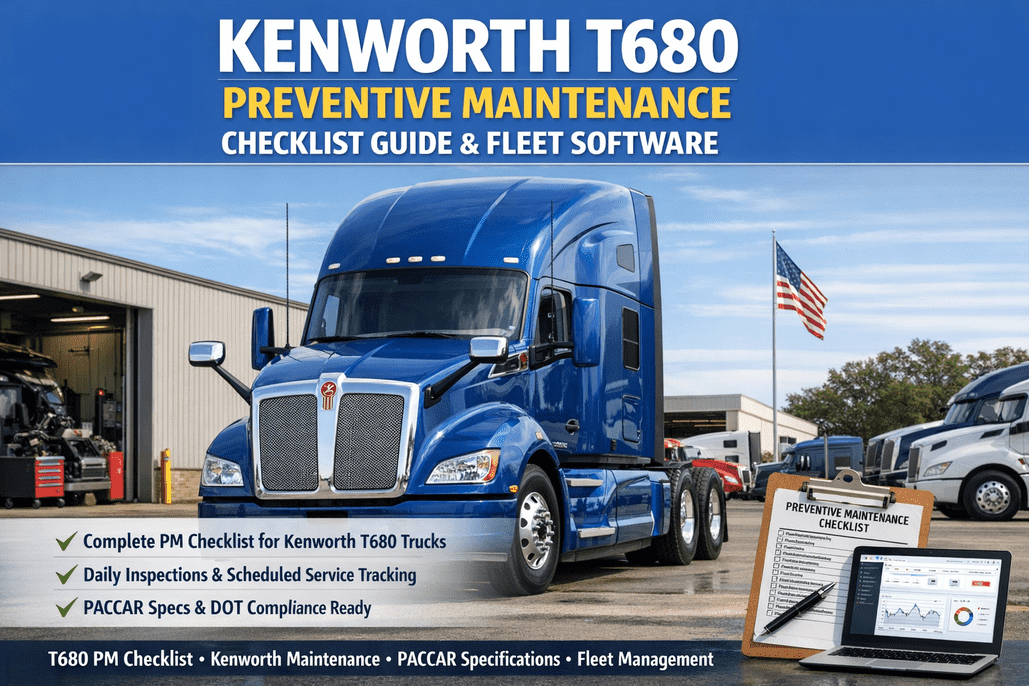
A Kenworth T680 that misses a single PM cycle costs an average of $15,000-$20,000 in unplanned repairs per year — and every missed daily inspection is a DOT violation waiting to happen. Whether you're running five T680s or five hundred, a structured preventive maintenance checklist program is the difference between predictable uptime and emergency roadside calls. This guide provides the complete PM checklist framework for the Kenworth T680 — from daily DVIR walk-arounds to annual DOT inspections — built around PACCAR MX-13 specifications and FMCSA compliance requirements. Digitize your T680 PM checklists with FleetRabbit.
DailyDVIR Walk-Around
PM-A10-15K Miles
PM-B25-30K Miles
PM-CAnnual / DOT
PM-DMajor Overhaul
Daily DVIR Walk-Around Checklist
Every CDL driver must complete a Driver Vehicle Inspection Report before operating their Kenworth T680 — it's federal law under 49 CFR 396.11. A thorough DVIR takes 30-45 minutes and follows a systematic clockwise pattern around the truck. Defects affecting safe operation must be repaired before dispatch. Here's the complete T680 walk-around broken into inspection stations.
01
Approach and Cab Entry
Review previous DVIR for noted defects and repair certification
Check under truck for fresh oil, coolant, or fuel leaks
Check cab entry steps and grab handles for damage or looseness
Verify fire extinguisher is charged and accessible
Confirm emergency triangles are present and in good condition
02
In-Cab Systems Check
Start engine, build air pressure to 120-140 PSI (governor cut-out)
Check 15-inch digital display for fault codes and warning lights
Test all gauges: oil pressure, coolant temp, voltage, air pressure
Verify horn, wipers, washers, and defroster operation
Check mirrors for adjustment, cracks, and mounting security
Test seat belt operation and all seat adjustments
03
Air Brake System Test
With engine off, release parking brake, apply foot brake
Hold 1 minute: pressure drop must not exceed 3 PSI (single) / 4 PSI (combination)
Fan brakes down: low air warning must activate before 60 PSI
Continue fanning: spring brakes must pop between 20-40 PSI
Rebuild pressure, verify governor cut-in at approximately 100 PSI
04
Front of Truck
Headlights (high and low beam), turn signals, clearance lights
Windshield for cracks, chips, or visibility obstructions
Front bumper and hood latch security
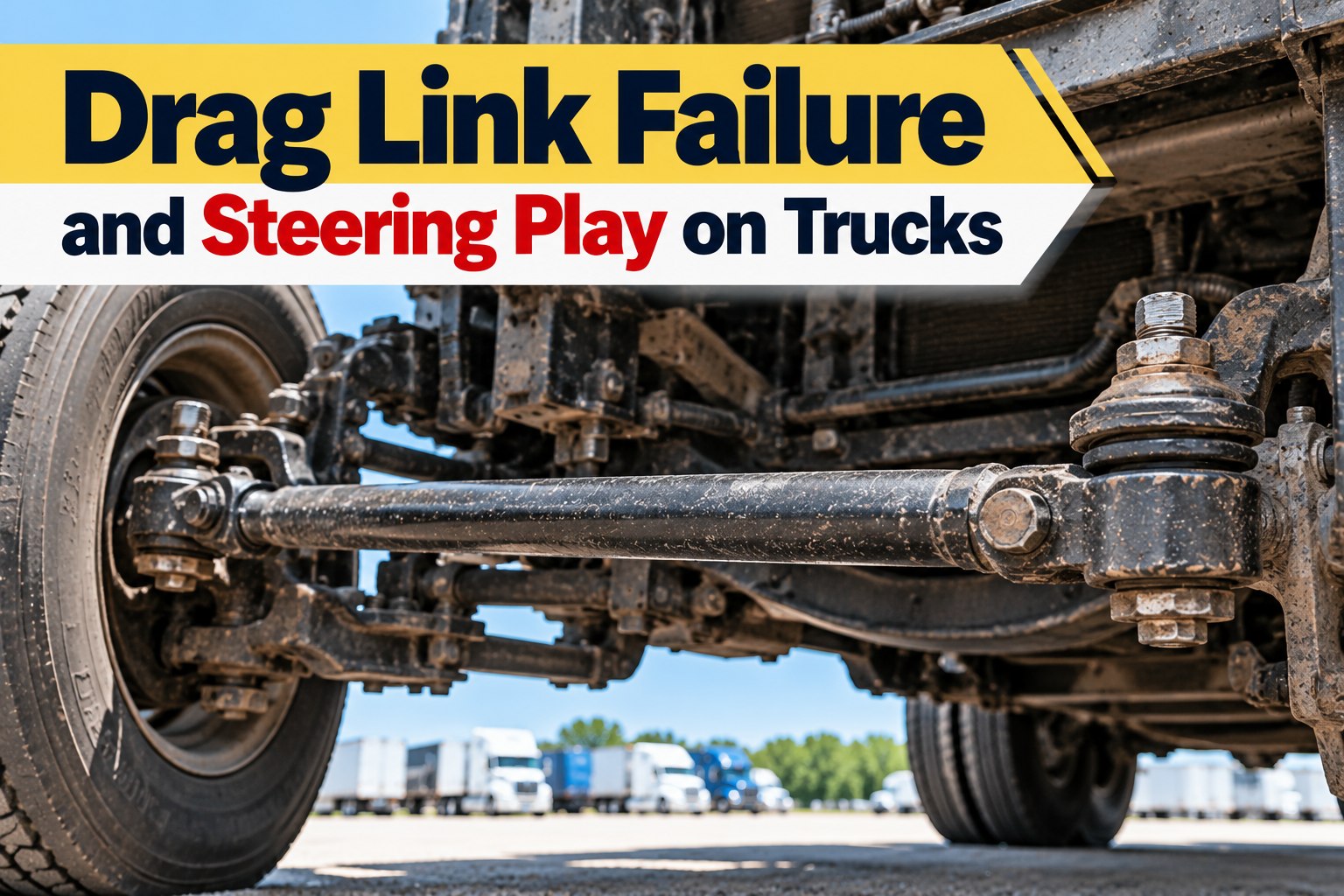
Steering linkage visible components for wear or damage
05
Under-Hood Inspection
Engine oil level (PACCAR MX-13: SAE 10W-30 CK-4)
Coolant level and condition (no discoloration or contamination)
Power steering fluid level
Belt condition: check for cracks, fraying, proper tension
Hoses: squeeze-test for soft spots, check clamp tightness
Battery terminals: clean, tight, no corrosion
Air compressor connections and air lines
06
Driver-Side Walk
Front tire: tread depth (min 4/32"), inflation, sidewall condition
Lug nuts: all present, no signs of looseness or rust trails
Brake components visible: shoes/pads, drums/rotors, air lines
Fuel tank: cap secure, mounting straps tight, no leaks
DEF tank level check and cap secure
Exhaust system: no leaks, hangers secure, DPF/SCR intact
Fifth wheel: securely mounted, jaws locked, no visible cracks
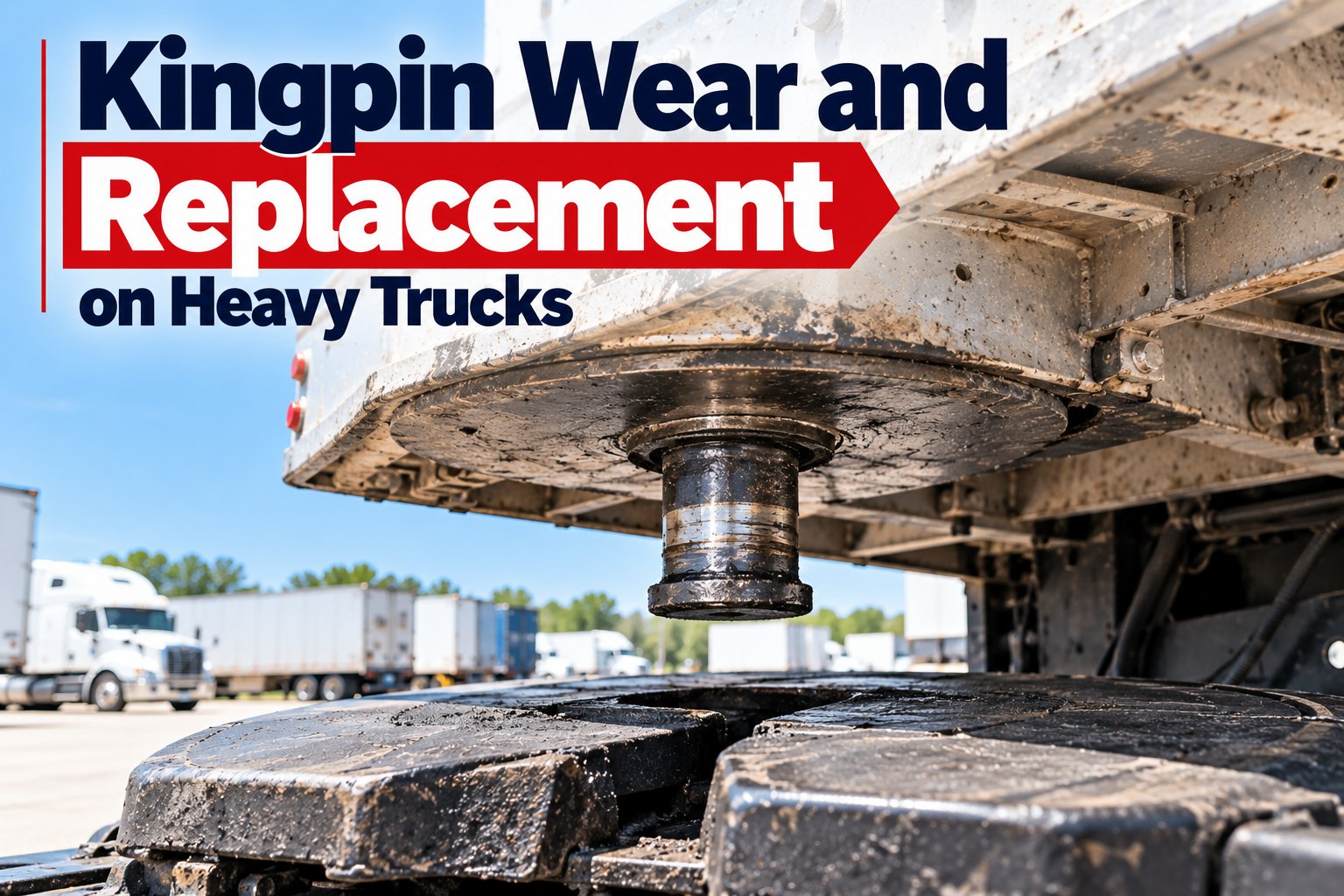
Kingpin engagement: tug test, release arm in locked position
Mud flaps present and properly positioned
FMCSA Requirement: Per 49 CFR 396.11, drivers must submit a signed DVIR at the end of each work day. DVIRs must be retained for 90 days. The next driver must review the previous DVIR and confirm defect repairs before operating.
Go Digital with Your T680 DVIRs
FleetRabbit replaces paper inspection forms with a mobile app that guides drivers through every station, captures photos of defects, timestamps submissions, and automatically alerts maintenance when issues are found.
A robust Kenworth T680 preventive maintenance program operates on four service tiers, each building on the previous level. This structure ensures your trucks receive the right depth of service at the right interval — not too much (wasting money) and not too little (inviting breakdowns). Here's how each PM level applies specifically to the T680 with PACCAR MX-13 engine.
A
PM-A: Safety Inspection and Lube
Every 10,000-15,000 miles or 45 days
Safety Systems
All lighting: headlights, markers, clearance, reflectors
PM-C must be performed by a qualified DOT inspector. Inspection report must be retained 14 months and the inspection sticker must remain on the vehicle.
D
PM-D: Major Component and Special Service
As needed based on mileage milestones and condition
Major Component Service
Valve lash adjustment (initial at 150K, then every 300K miles)
Summerization: A/C charge, cooling system capacity test
Engine overhaul (if needed, typically 750K-1M miles)
Transmission rebuild (if condition warrants)
Coolant system complete flush (600K mi or 5 years)
DOT Inspection Readiness Scorecard
Over 70% of DOT Level I inspection violations are related to just six categories. A proactive PM program that consistently addresses these areas keeps your T680s inspection-ready at all times and protects your CSA (Compliance, Safety, Accountability) scores. Here's the breakdown of what inspectors focus on most — and how your PM checklist maps to each.
#1Brake Systems
43%of all OOS violations
PM-A: Adjustment checkPM-B: Component inspectionPM-C: Full DOT measurement
FleetRabbit tracks PM-A through PM-D schedules for every T680 in your fleet, sends automated alerts when services are due, and generates DOT-compliant inspection reports with a single tap.
Inspect wiper blades and washer fluid (winter formula)
Air dryer coalescent filter condition (moisture critical in cold)
Summer Prep (Apr-May)
A/C system charge and performance test
Cooling system pressure test and cap check
Condenser and radiator: clean debris and bugs
Cabin air filter replacement
Tire pressure adjustment for ambient temp increase
Check coolant fan clutch engagement temperature
Verify idle shutdown timer settings (EIST: 25-75 F range)
Paper Checklists vs. Digital PM Software
Many fleets still rely on paper PM checklists and spreadsheet-based scheduling. While this technically satisfies the FMCSA requirement to have a PM program (49 CFR 396.3), it creates gaps that digital PM software eliminates entirely.
Capability
Paper / Spreadsheet
FleetRabbit Digital PM
PM schedule tracking
Manual calendar entries
Auto-calculated by mileage, hours, or time
Missed PM alerts
None unless manually noticed
Automated push and email alerts
DVIR documentation
Paper forms filed in cabinets
Digital with photos, timestamps, e-signatures
Defect-to-work-order flow
Phone call or manual entry
Instant auto-generated work orders
DOT audit readiness
Dig through filing cabinets
One-click compliance reports
PACCAR Connect integration
Not possible
Real-time mileage, hours, fault codes
Cost per truck/year
$1,200+ (labor, lost records, missed PMs)
Fraction of the cost with 3x ROI
Frequently Asked Questions
What should be on a Kenworth T680 preventive maintenance checklist?
+
A complete T680 PM checklist should cover safety systems (brakes, tires, lights), engine service (oil, filters, belts, hoses), drivetrain components (transmission, axles, U-joints, king pins), aftertreatment system (DPF, DEF, SCR), chassis (frame, suspension, fifth wheel), and cab systems (HVAC, electrical, wipers). Items should be organized by PM service level — PM-A (safety and lube every 10-15K miles), PM-B (engine service every 25-30K miles), PM-C (annual DOT inspection), and PM-D (major component service as needed).
How often does a Kenworth T680 need preventive maintenance?
+
At minimum, T680s need a PM-A safety inspection every 10,000-15,000 miles, a PM-B engine service including oil change every 25,000-30,000 miles (or at PACCAR's recommended intervals based on idle percentage), and a PM-C annual DOT inspection every 12 months. Daily DVIR walk-around inspections are required by FMCSA before every driving shift. The exact intervals depend on your operating conditions — high-idle or vocational applications require more frequent service. Schedule a demo to see how FleetRabbit adjusts intervals to your operating profile.
Is a daily DVIR inspection required by law for the T680?
+
Yes. Under 49 CFR 396.11 and 396.13, all CDL drivers operating commercial motor vehicles must ensure the vehicle is safe to operate before driving. While the regulation technically requires a signed DVIR at the end of each workday, most carriers require both pre-trip and post-trip inspections. Property-carrying drivers must submit a DVIR if any defect is found (many carriers require daily submission regardless). DVIRs must be retained for 90 days and include the driver's signature.
What are the most common DOT violations for Kenworth T680 trucks?
+
The most common out-of-service violations mirror the industry-wide pattern: brake system defects (approximately 43% of all OOS violations), tire and wheel issues (18%), lighting violations (12%), steering and suspension problems (9%), and exhaust system defects (8%). For the T680 specifically, aftertreatment-related issues like DPF warning codes and DEF system faults can also trigger inspection flags. A structured PM program that addresses all of these at appropriate intervals virtually eliminates OOS violations.
Can FleetRabbit create custom PM checklists for different T680 configurations?
+
Yes. FleetRabbit allows you to create fully customizable PM templates for each vehicle configuration in your fleet. A T680 with a sleeper cab running linehaul gets a different checklist than a T680 day cab in regional service. You can customize inspection items, PM intervals, and service tasks based on PACCAR MX-13 vs MX-11 engine specifications, transmission type (TX-12 vs TX-12 Pro), and application (linehaul, regional, vocational). Templates can be duplicated and modified across your fleet. Sign up to start building your custom T680 checklists.
How long should a thorough T680 pre-trip inspection take?
+
A thorough Kenworth T680 pre-trip inspection should take 30-45 minutes when following a systematic walk-around pattern. This includes approach inspection, in-cab systems check, air brake test, under-hood inspection, full walk-around of all sides checking tires, lights, and components, and fifth wheel/coupling verification. Rushing through in under 15 minutes is a red flag — it means items are being skipped. FleetRabbit's guided mobile inspection walks drivers through each station and typically helps new drivers complete thorough inspections within the 30-minute target.
Your Complete T680 PM Program in One Platform
From daily DVIRs to annual DOT inspections, FleetRabbit manages every preventive maintenance checklist for your Kenworth T680 fleet. Custom templates, automated scheduling, PACCAR Connect integration, and instant compliance reports.